.
Likkutei Sichos Vol. 14 – Ha'azinu 1 / Shabbos Shuvah
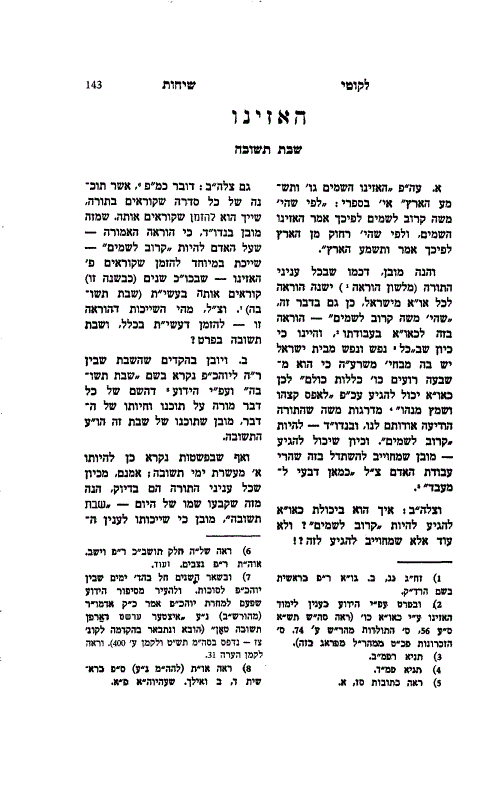
1. On the verse "Give ear, O heavens, and I will speak; and let the earth hear" it is stated in the Sifrei: "Since Moses was close to the heavens, he said 'Give ear, O heavens,' and since he was distant from the earth, he said 'let the earth hear.'
It is understood that just as in all matters of Torah (which means instruction), there is a lesson for every Jew, so too in this matter. The fact that Moses was "close to the heavens" serves as a lesson for each individual in their service. This is because, as it is known, "in every soul of the house of Israel there is a spark of Moses our teacher, for he is one of the seven shepherds who encompass all" and therefore, each person can at least reach "a small portion" of the levels of Moses that the Torah testifies about. In our case, this means being "close to the heavens." Since one can reach this, it is understood that one is obligated to strive for it, as a person's service must be "as one who desires to fulfill."
It needs to be understood: How is it possible for each individual to reach the level of being "close to the heavens"? Moreover, how is it that one is obligated to reach this level?
2. Additionally, it needs to be understood: It is mentioned several times that the theme of each Torah portion read is connected to the time it is read. This is understood in our case, as the instruction—that a person should be "close to the heavens"—is particularly relevant to the time when Parshas Haazinu is read, which in many years (like this year) is read during the Ten Days of Repentance (Shabbos Shuvah). We must understand, what is the connection of this instruction to the time of the Ten Days of Repentance in general, and Shabbos Shuvah in particular?
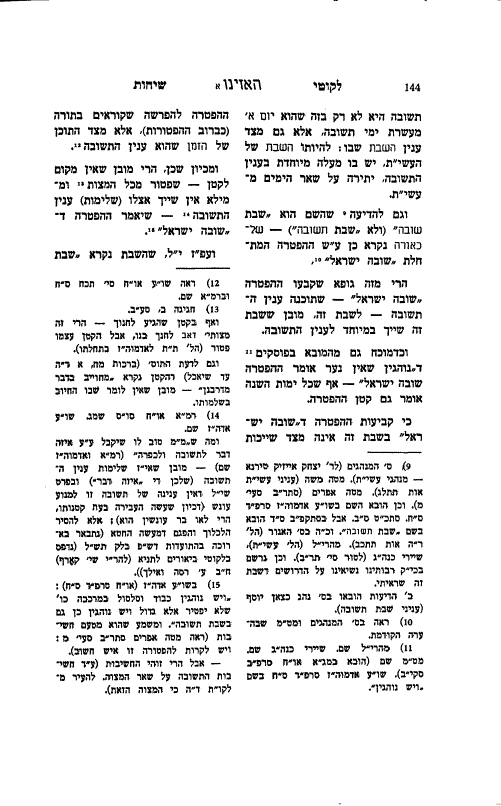
3. This will be understood by first explaining that the Shabbos between Rosh Hashanah and Yom Kippur is called "Shabbos Shuvah." According to what is known, the name of everything indicates its content and vitality, it is understood that the content of this Shabbos is the concept of teshuvah (repentance).
Although it is simply called this because it is one of the Ten Days of Repentance, since all matters of Torah are precise, from the fact that the name of the day was established as "Shabbos Shuvah," it is understood that its connection to the concept of teshuvah is not only because it is one of the Ten Days of Repentance, but also due to the aspect of Shabbos within it. Being the Shabbos of the Ten Days of Repentance, it has a special quality in the matter of teshuvah, surpassing the other days of the Ten Days of Repentance.
Even according to the opinion that the name is "Shabbos Shuvah" (and not "Shabbos Teshuvah")—which seemingly is named after the haftarah that begins with "Return, O Israel"—
From the very fact that the haftarah "Return, O Israel," whose content is the concept of teshuvah, was established for this Shabbos, it is understood that this Shabbos is particularly connected to the concept of teshuvah.
This is also evident from what is brought in the poskim that "it is customary that a minor does not say the haftarah 'Return, O Israel'"—even though throughout the year a minor does say the haftarah.
2. The haftarah is not chosen based on the Torah portion being read (as is the case with most haftaros), but rather due to the content of the time, which is the concept of teshuvah (repentance).
Since this is the case, it is understood that there is no place for a minor—who is exempt from all mitzvos and therefore does not have the concept of (complete) teshuvah—to recite the haftarah of "Return, O Israel."
Accordingly, it can be said that the Shabbos is called "Shabbos Shuvah" not only because of the beginning of the haftarah, but also (and primarily) because of the content of the Shabbos itself, which is the concept of teshuvah (which is why this haftarah is read).
Thus, even according to this opinion, the name "Shabbos Shuvah" indicates the special connection of this Shabbos to the concept of teshuvah.
It must be explained: What is the special connection between this Shabbos (in terms of the aspect of Shabbos within it) and the concept of teshuvah?
3. The explanation of all this:
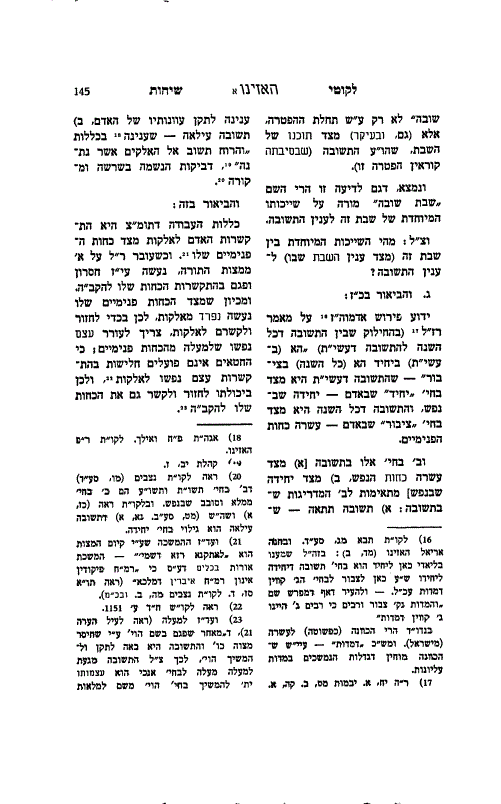
It is known the explanation of the Rebbe on the statement of our Sages (regarding the difference between the teshuvah of the entire year and the teshuvah of the Ten Days of Repentance) "this (in the Ten Days of Repentance) is for the individual, and this (the rest of the year) is for the community"—that the teshuvah of the Ten Days of Repentance is from the aspect of "individual" within a person—the yechidah of the soul, while the teshuvah of the entire year is from the aspect of "community" within a person—the ten internal faculties.
These two aspects of teshuvah [1) from the ten faculties of the soul, 2) from the yechidah of the soul] correspond to the two levels of teshuvah:
4. The essence of teshuvah is to rectify a person's sins. There is a higher level of teshuvah, which is generally described as "and the spirit returns to G‑d who gave it," referring to the soul's attachment to its source and root.
The explanation of this is as follows:
The general service of Torah and mitzvos is the connection of a person to G‑dliness through his internal faculties. When one, G‑d forbid, transgresses one of the mitzvos of the Torah, it creates a deficiency and blemish in the connection of his faculties to G‑d. Since, through his internal faculties, he becomes separated from G‑dliness, in order to reconnect them to G‑dliness, he must awaken the essence of his soul, which is above the internal faculties. For sins do not weaken the connection of the essence of his soul to G‑dliness, and therefore it has the ability to reconnect even his faculties to G‑d.
However, since the purpose of this teshuvah is to fill the deficiency and blemish of the internal faculties, it is necessary to say that it comes from a level in the soul that has a connection to the faculties, and the deficiency in them—caused by sins—"matters to it." That is, this teshuvah, although it also comes from the essence of the soul, which is above the internal faculties, is from a level in the soul that has already extended to be a source and root for the faculties, and not the essence of the soul itself.
But the level of yechidah—the essence of the soul that is above being a source and root for the faculties—is entirely above the concept of sins. The teshuvah from this level is not about sins and transgressions; rather, it is about ascending from strength to strength in the soul's attachment to its source and root.
This is the advantage of the teshuvah of the Ten Days of Repentance over the teshuvah of the entire year—the service of higher teshuvah, from the level of yechidah in the soul.
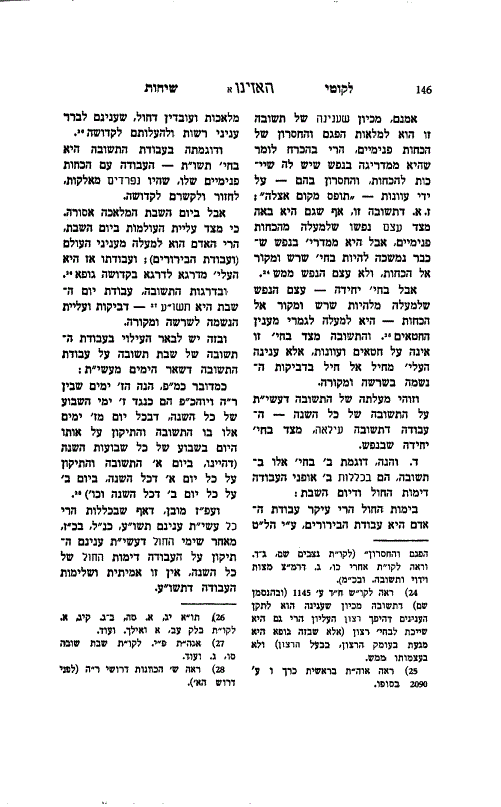
5. Similarly, these two levels of teshuvah correspond to the two general modes of service during the weekdays and on Shabbos: During the weekdays, the primary service of a person is the service of refining, through the thirty-nine [types of work].
6. The weekday labors and activities, which involve refining mundane matters and elevating them to holiness, are analogous to the service of teshuvah known as תשובת התחתונה (lower teshuvah). This involves working with one's internal faculties, which were separated from G‑dliness, to reconnect and bind them to holiness. However, on Shabbos, work is forbidden because, due to the elevation of the worlds on Shabbos, a person transcends worldly matters (and the service of refinement). The service then is to ascend from level to level within holiness itself. In the levels of teshuvah, the service of Shabbos is תשובת העילאה (higher teshuvah) — the soul's attachment and ascent to its source and root.
Based on this, we can explain the superiority of the teshuvah service on Shabbos Shuvah over the teshuvah service of the other days of the Ten Days of Repentance. As discussed many times, the seven days between Rosh Hashanah and Yom Kippur correspond to the seven days of the week throughout the year. Each day of these seven days is for teshuvah and rectification of that specific day of the week for all weeks of the year (i.e., on Sunday, teshuvah and rectification for all Sundays of the year, on Monday for all Mondays, etc.).
Accordingly, although in general the entire Ten Days of Repentance are about תשובת העילאה, nevertheless, since the weekdays of the Ten Days of Repentance are about rectifying the service of the weekdays of the entire year, this is not the true and complete service of תשובת העילאה.
In contrast, on the Shabbos of these seven days, which is for teshuvah and rectification of the service of Shabbos throughout the year, the service of this day is the completion of the service of תשובת העילאה.
5. Based on the above, we can explain the connection of the Sifri's teaching — that Moshe was "close to the heavens" — to Shabbos Shuvah:
The two aspects — "earth" and "heavens" in a person's soul are generally the internal faculties and the essence of the soul: the internal faculties, which manifest in the body's organs, are the "earth" aspect in a person; and the essence of the soul, the level of yechidah, which surrounds the body, is the "heavens" aspect in a person.
Therefore, the two aspects of teshuvah [1) תשובת התחתונה — from the internal faculties, 2) תשובת העילאה — from the level of yechidah] correspond to the two aspects "earth" (תשובת התחתונה) and "heavens" (תשובת העילאה).
According to what was explained earlier, that the teshuvah of the Ten Days of Repentance in general, and Shabbos Shuvah in particular, is the service of תשובת העילאה, it is understood that during these days a person must be "close to the heavens" — the service of תשובת העילאה.
This explains how every person can reach this level of "close to the heavens."
The explanation: The fact that the service of the Ten Days of Repentance is תשובת העילאה does not come from the person who serves, but from the power given from above, as the Sages expound on the verse "Seek the L‑rd while He may be found, call upon Him while He is near" — "These are the ten days between Rosh Hashanah and Yom Kippur," during which the Holy One, blessed be He, is "close" — "the closeness of the luminary to the spark," which influences the "spark" to be drawn to its source — the luminary.
Therefore, although throughout the year the service must be in order and progression — first תשובת התחתונה, and only then to reach תשובת העילאה, during the Ten Days of Repentance, there is a power given from above to each individual to be able to reach "close to the heavens" — תשובת העילאה.
A special advantage is in the fact that Shabbos Shuvah comes immediately after Rosh Hashanah, and the week of days between Rosh Hashanah and Yom Kippur begins with Shabbos — since Shabbos "from it all days are blessed," there is a special empowerment that even the service of all the other days of the Ten Days of Repentance will be on the level of תשובת העילאה of Shabbos.
(From the talks of Shabbos Shuvah 5722, 5727)
5. It is understood that the level of repentance during these days is even higher, as we are taught to ascend in holiness. At first glance, it seems surprising to suggest that this repentance surpasses that of the Ten Days of Repentance and Yom Kippur, as expressed in the phrase: "Now is the time to truly repent." This requires further investigation.
The reason this unique quality of these four days is not explicitly mentioned in the Talmud and the legal codifiers may be similar to what is explained regarding the Hakafos, which are not mentioned in the Written Torah or the Talmud. This is discussed in Likkutei Torah, Sukkos, and in the Siddur of the Alter Rebbe.