

Likkutei Sichos Vol. 14 – Ha'azinu 2
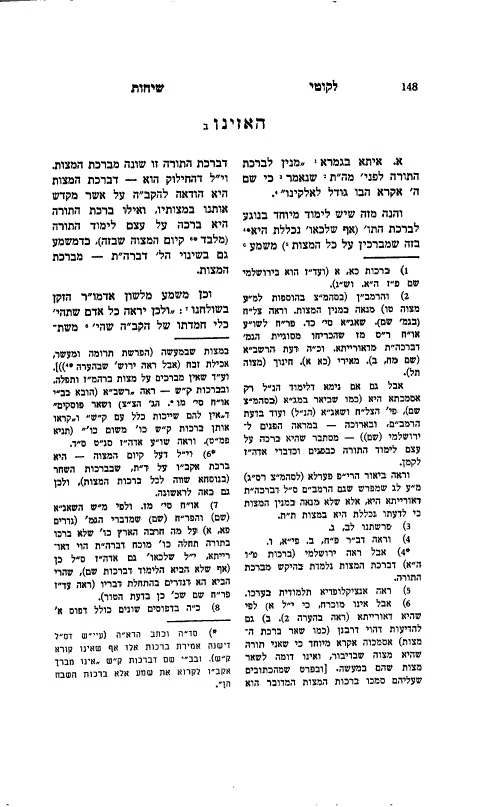
1. It is stated in the Gemara: "From where do we derive the obligation to recite the blessing over the Torah before studying it from the Torah itself?" As it is said, "For I will proclaim the name of the L‑rd; ascribe greatness to our G‑d."
Now, from the fact that there is a specific teaching regarding the blessing over the Torah (even though it would seem to be included in the general blessing over all mitzvos), it implies that the blessing over the Torah is distinct from the blessing over mitzvos. One could say that the difference is that the blessing over mitzvos is a thanksgiving to the Holy One, blessed be He, for sanctifying us with His commandments, whereas the blessing over the Torah is a blessing on the very act of studying Torah (aside from the fulfillment of the mitzvah involved). This is also implied by the difference in the wording of the blessing over the Torah compared to the blessing over mitzvos.
Similarly, this is implied by the words of the Alter Rebbe in his Shulchan Aruch: "Therefore, every person should see to it that the Torah, which is the cherished vessel of the Holy One, blessed be He, with which He engages every day, is considered by him as more precious to bless over with joy than all the pleasures of the world." This suggests that the blessing is on the very act of studying Torah.
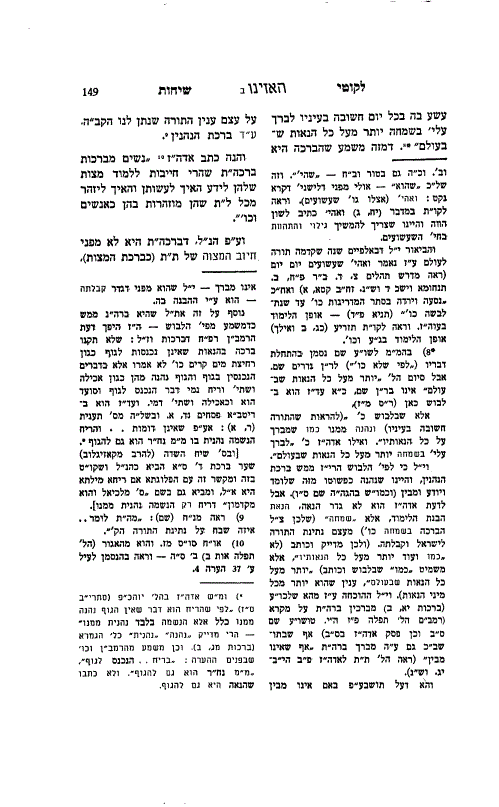
2. The explanation can be given that during the two thousand years that the Torah preceded the world, it is said, "I was His delight every day". Subsequently, the Torah "descended and was concealed in the hidden realms until it was clothed" — this refers to the manner of study in this world. In Likkutei Torah, Parshas Tazria, it discusses the manner of study in Gan Eden, etc.
It is noted that the Alter Rebbe writes that women recite the blessing over the Torah because they are obligated to learn the mitzvos that pertain to them, to know how to perform them and how to avoid the prohibitions they are warned against, just like men.
According to the above, the blessing over the Torah is not due to the obligation of the mitzvah of Torah study (as is the case with the blessing over mitzvos), but rather it is on the very essence of the Torah that G‑d gave us. This is similar to the blessing over enjoyment.
Furthermore, if one were to say that it is indeed a blessing of enjoyment, as implied by the Levush, it would contradict the opinion of the Ramban at the beginning of chapter eight of Berachos, who states that blessings were not instituted for enjoyments that do not enter the body, such as washing with cold water, but only for things that enter the body and from which the body derives benefit, such as eating and drinking. The Ritva in Pesachim and the Shlah in Maseches Taanis also discuss this, noting that although the soul derives pleasure from fragrance, it is still considered a benefit for the body.
The Alter Rebbe writes in the laws of Yom Kippur that fragrance is something from which the body does not derive any benefit at all, only the soul enjoys it. This is precise in the use of "enjoys" and "benefits," as noted in the Gemara, and it is also implied by the Ramban, who writes about fragrance entering the body, yet it is still considered a benefit for the body.
11. However, regarding the essence of Torah study, which obligates one to bless before it, it would seem that even if women were not obligated to "learn the mitzvos that pertain to them," they should still recite the blessing over the Torah beforehand. This is because they too should be included in what is stated in the Gemara.
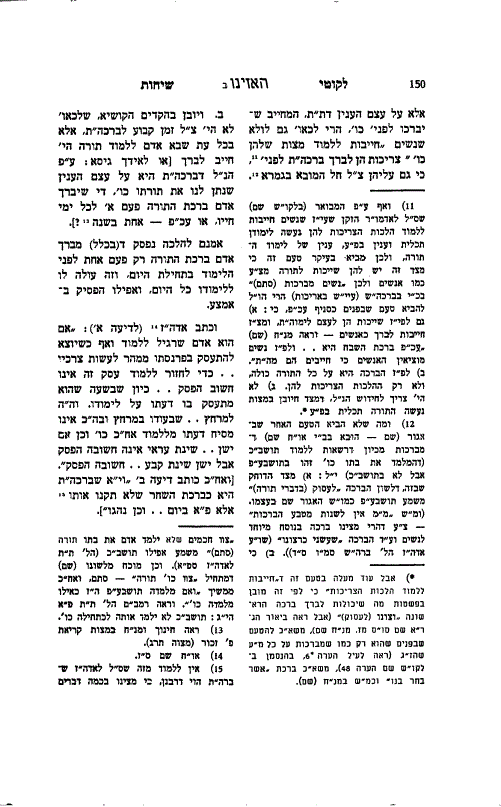
And even though it is explained that the Alter Rebbe holds that since women are obligated to learn the laws necessary for them, their study becomes an end and a matter in itself, a matter of Torah study, and therefore he primarily brings this reason because from this perspective, they have a connection to the Torah itself like men. Therefore, "women bless (simply)" in the blessing of the Torah. Nevertheless, he should have brought this reason at least as a support, because: a) Even according to this, they are connected to the essence of Torah study, and from this, they are obligated to bless like men — see Minchas Chinuch (there) "at least it is a blessing of praise... and according to this, women can fulfill the obligation for men because they are obligated by Torah law." b) According to this, the blessing is over the entire Torah, not just the laws necessary for them. c) There would be no need for the aforementioned innovation, that due to their obligation in mitzvos, the Torah becomes an end in itself.
12. And the reason he did not bring the other reason mentioned in the Agur (there — brought in Beis Yosef Orach Chaim there) that they bless because they are permitted to learn the Written Torah (the prohibition of teaching one's daughter etc. applies to the Oral Torah but not to the Written Torah) can be explained: a) Due to the difficulty in this, as the wording of the blessing "to engage (in words of Torah)" implies the Oral Torah, as the Agur himself writes there.). b) Because
* However, there is an additional advantage in this reason that "they are obligated to learn the necessary laws" because according to this, it is simply understood why they can recite the initial blessing "and commanded us (to engage)", whereas according to the reason in the text, it is only like they bless over all positive time-bound commandments, unlike the blessing "Who has chosen us" as mentioned in Minchas Chinuch (there).
2. This can be understood by first addressing the question: It would seem that there should not be a fixed time for the blessing over the Torah, but rather whenever a person comes to study Torah, they should be obligated to bless [or conversely: according to the above, since the blessing over the Torah is on the very essence of the matter that He gave us His Torah, it would suffice for a person to bless the blessing over the Torah once in their lifetime, or at least — once a year].
However, the halacha is that (in general) a person blesses the blessing over the Torah only once before studying at the beginning of the day, and this covers their study for the entire day, even if they interrupt in the middle.
The Alter Rebbe writes (for the first opinion): "If he is a person accustomed to study, and even when he goes out to engage in his livelihood, he hastens to complete his needs... in order to return to study, this is not considered an interruption... because while he is engaged in it, his mind is on his study. The same applies to the bathhouse... while he is in the bathhouse and the restroom, he does not divert his mind from studying afterward, etc. Similarly, if he sleeps... a temporary sleep is not considered an interruption, but if he sleeps a fixed sleep... it is considered an interruption." [He later writes a second opinion: "And some say that the blessing over the Torah is like the morning blessings that were only instituted once a day... and so is the custom"].
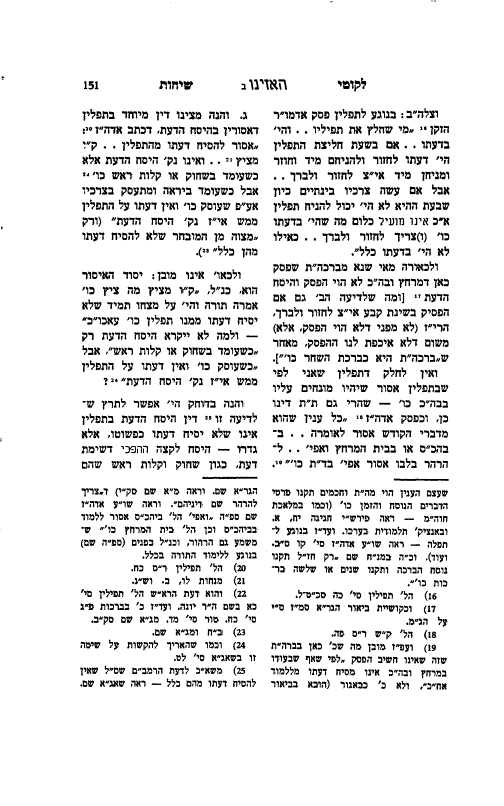
4. We need to understand: Regarding tefillin, the Alter Rebbe rules: "If one removes his tefillin... and intends... if at the time of removal he intended to put them back on immediately and does so, he does not need to recite the blessing again... But if he engaged in other activities in the meantime, since at that time he could not wear tefillin, his intention does not help... and he must recite the blessing again... as if he had no intention at all." At first glance, how is this different from the blessing over the Torah, where it is ruled here that the bathhouse and restroom do not constitute an interruption or distraction? [And according to the second opinion, even if one interrupts with a fixed sleep, he does not need to recite the blessing again, not because it is not an interruption, but because we are not concerned with the interruption, since "the blessing over the Torah is like the morning blessings, etc."].
One might argue that tefillin is different because it is forbidden to wear them in a restroom, etc. — but the same applies to Torah study, as the Alter Rebbe rules: "Any matter of holiness is forbidden to be spoken... in a restroom or bathhouse, and even... to think about it in one's heart is forbidden, even in Torah matters, etc."
5. We find a special law regarding tefillin that distraction is forbidden, as the Alter Rebbe writes: "It is forbidden to divert one's mind from the tefillin... all the more so than from the tzitz. And it is not called a distraction unless one is engaged in frivolity or lightheadedness, etc. But if one stands in awe and is occupied with his needs, even though he is engaged, etc., and his mind is not on the tefillin, it is not called a distraction" (and it is only "a preferred mitzvah not to divert one's mind from them at all").
At first glance, this is not understood: The basis of the prohibition is, as mentioned, "all the more so than from the tzitz, as the Torah says, 'and it shall be on his forehead always,' so that he does not divert his mind from it, tefillin, all the more so" — so why is it not called a distraction except "when one is engaged in frivolity or lightheadedness," but "when one is occupied, etc., and his mind is not on the tefillin, it is not called a distraction"?
With difficulty, one could answer that according to this opinion, the law of distraction regarding tefillin is not that one should not divert his mind in the literal sense, but its definition is a distraction to the opposite extreme of focus, such as frivolity and lightheadedness, which are a disgrace to the tefillin on him, and it is an intention and focus opposite to the matter of tefillin, not just a distraction.
4. However, it is not possible to interpret the opinion of the Alter Rebbe in this manner. For (in addition to the difficulty with the comparison to the tzitz), he writes, "It is forbidden to divert one's mind from the tefillin as long as they are upon him, even for a moment", from which it is understood that the concept of distraction here is literal, that one's mind should truly be on the tefillin and not divert from them, and not merely to negate an intention and focus that is opposite.
5. The explanation of all this: In the mitzvah of tefillin, there are two aspects: a) the placing of the tefillin, b) the intention of the mitzvah to subjugate, etc., the soul that is in the brain, etc., to the heart, which is also a part of fulfilling the mitzvah.
Now, even if one's mind is not on the tefillin, this is not considered a distraction or interruption in the placing of the tefillin, for in the very fact that they are placed upon him, he fulfills the mitzvah continuously. And even regarding the blessing, his connection to the blessing he recited at the time of placing them is not interrupted.
However, when one removes the tefillin, his connection to the tefillin is interrupted, and therefore he must recite the blessing again when he puts them back on, unless he had in mind to return and put them on again.
Additionally, even if he intended to put them on again but attended to his needs in the meantime, since at that time he could not put on tefillin, his intention to return and put them on does not help, etc. — because since it must be in continuation to the blessing, meaning to the previous placing, there must be an intention to return and put them on in a manner that can lead to an actual placing, so that it is not called an interruption (whereas if there is a moment when he cannot put them on, etc., his intention does not help since it is not fit for placing).
6. Since one of the components of the mitzvah is the intention "to subjugate the heart and mind, etc.," it is understood that this intention must be present throughout the entire duration of the mitzvah. However, since at the time of placing the tefillin, he had this intention of subjugating the heart and mind, and due to this intention, he stands in awe, etc., even in a subsequent "neutral" state, where he is engaged in other matters and his mind is not directly on the tefillin, the intention he had at the time of placing them extends throughout the entire time that follows, and it is not considered a distraction from it. This is similar to the concept of "for its own sake," where the primary preparation for this intention is required at the beginning of the study, etc., and as in the case of a get (divorce document) and a Torah scroll, which must be written for their specific purpose, it suffices to declare at the beginning of the writing, "I am writing for the sake of the sanctity of a Torah scroll or for his and her sake, etc."
All the more so, and certainly with tefillin, where the distraction of thought is connected to the general subjugation of the mind and heart.
The most severe of all is the tzitz (the headplate of the High Priest) — even though it is similar to tefillin in that the distraction of thought is related to the letters upon them, its purpose and function are to atone and appease for the blood and fat that were offered, etc., a specific offering at a specific time.
However, "when one stands in laughter or frivolity, it is called a distraction of thought" regarding tefillin, because it is the opposite and negation of the aforementioned intention and nullifies the effect of subjugating the heart, etc., that he had at the time of placing them, and then his connection to the mitzvah of tefillin is interrupted, and it is considered a distraction of thought.
5. Now, the Alter Rebbe brings two opinions regarding the interruption between the blessing over the Torah and the beginning of study: "Some say that one does not need to study immediately after it, but even if he interrupts between the blessing and his study, it is considered as if he interrupted in the middle of his study, etc., and it is not similar to the blessing over mitzvos, etc. However, a Torah scholar who is obligated to engage in it constantly, when he interrupts between the blessing and study, it is not considered an interruption since at that time he is obligated to study. There are those who disagree with this, and it is proper to be concerned for their opinion, etc."
It can be said (not to increase disputes) that the second opinion does not disagree with the fundamental reasoning that because a Torah scholar "is obligated to engage in it constantly," a person has a connection to the Torah even when he is not actively engaged in it (and they only disagree on whether this reasoning applies to the interruption between the blessing and the beginning of study).
Therefore, according to all opinions, there is no need for actual intention throughout the day to avoid it being called an interruption and distraction of thought, because the very obligation to constantly engage in Torah study connects a person to the mitzvah. Therefore, even when he enters a bathhouse or restroom, where it is forbidden to engage in Torah study, nevertheless, since he is obligated in Torah study and it is only an external factor preventing him, the intention to study afterward suffices so that it is not called an interruption.
However, a fixed sleep (or someone who does not usually study), which is a complete distraction of thought, is considered an interruption, and he must return and recite the blessing (according to the first opinion).
6. Based on this, we can understand what the Alter Rebbe writes: that women recite the blessing over the Torah because they are obligated to learn the mitzvos that pertain to them and to be cautious of all prohibitions, etc. Without this explanation, even though one might say that women recite the blessing over the Torah as a preface to their study (based on the teaching "When I call out the name of the L‑rd, etc." or similar to the blessings over food, as explained earlier in section 1), it would still be necessary for them to recite the blessing each time they begin to study. This would be a novelty, and no Tanna has ever stated this anywhere.
Therefore, the Alter Rebbe explains that since women are obligated to learn, etc., his intention is: just as men recite the blessing once a day, because the constant obligation of Torah study suffices for one blessing a day (if there is no complete distraction of thought), so too with women. Since they are obligated to learn the mitzvos that pertain to them and to be cautious of all prohibitions, which is a constant obligation throughout the day, they also have a constant obligation to study throughout the day. Therefore, one blessing a day suffices for women, just as it does for men.
7. However, seemingly, according to the opinion (which is the custom) that the blessing over the Torah is recited once a day because "the blessing over the Torah is like the morning blessings, which were instituted to be recited only once a day" — the question returns to its place: why did the Alter Rebbe need to add the reason for the blessing over the Torah for women because "they are obligated to learn, etc." (and women also recite it once a day because "the blessing over the Torah is like the morning blessings, etc.")?
But this is not so, for regarding the institution of the morning blessings, the Alter Rebbe writes: "The Sages instituted the morning blessings in accordance with the order of the world and its conduct, that people should bless the Holy One, blessed be He, for this the first time they derive this benefit each day."
This clarifies that the morning blessings were instituted for the daily and constant benefits that people enjoy, so they bless for their benefit immediately at the beginning of the day [such as the blessing "Who straightens the bent," which is a constant matter throughout the day, and they bless for it the first time at the beginning of the day]. However, for benefits and matters that are not constant, even if they occur sporadically once or more during the day — and similarly with the Torah study of women (unless they are "obligated to learn the mitzvos, etc."),
it is not appropriate to institute a morning blessing for them.
Therefore, the Alter Rebbe needs to explain that women are "obligated to learn the mitzvos, etc." and that because of this, they have a constant obligation of Torah study, and they are indeed connected to the blessing over the Torah as one of the morning blessings for women.