Why was the מבול for 40 days.
Why is the מבול referred to as מי נח?
What are the מים רבים in a person’s life?
Why is a מקוה 40 סאה?
What is the idea of immersing in a מקוה?
What Is the explanation why Hashem gives a person challenges?
How can a person change a situation for the better quickly?
What is the lesson from the תהום רבה?
What is the lesson from ארובות השמים?
Should one’s occupation with community matters interfere with observance of Mitzvos?
How do we know that one’s reasons for not studying Torah and doing Mitzvos are not legitimate?
How does one save themselves from the מי המבול?
How does the בעל שם טוב interpret the meaning of תבה?
What is the significance of starting the day with מודה אני and ברכות etc.?
Why do we make the morning blessings for things we already have?
What is the meaning of איזה חכם הרואה את הנולד?
The Davening changes the person attitude towards things. How?
How do we explain the prayer of רב ייסא סבא who would pray for food while his food was in front of him?
Likkutei Sichos Vol. 1 – Noach
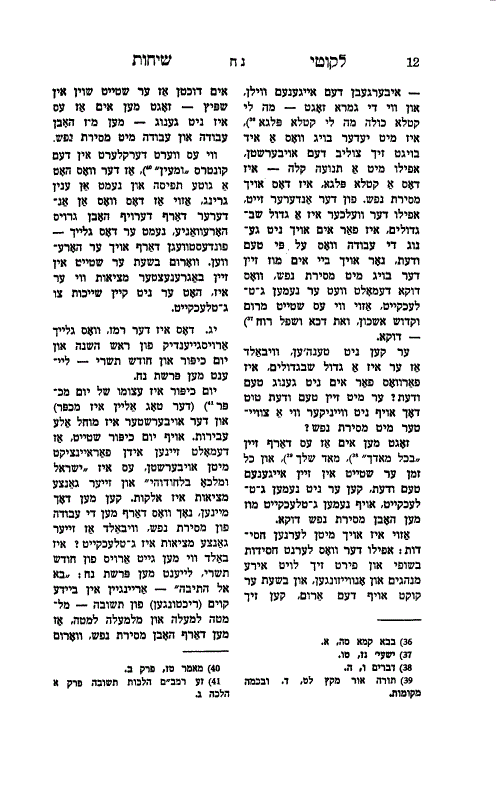
1. In Torah Ohr, Parshas Noach, it is explained that the Flood was not merely a punishment, but also a matter of purification. The Flood purified the world, which before the Flood was impure. Therefore, the Flood lasted for 40 days, corresponding to the 40 se'ah of a mikveh. This is why the Flood is referred to as "the waters of Noach" — a soothing of the spirit.
The same concept is elaborated in Torah Ohr regarding concerns and preoccupations with livelihood, which are called "many waters." These waters wash away from a person those matters that should not be, thereby also achieving a "soothing of the spirit."
2. The explanation of the connection between concerns of livelihood, the Flood, and the mikveh is as follows:
The inner aspect of a mikveh is "bitul" (self-nullification), as the Rambam writes, "he should immerse in the pure waters of knowledge." Therefore, a mikveh must contain forty se'ah, which is the measure in which "the entire body can be immersed," meaning that they encompass the entire human body. The word "tevillah" (immersion) shares the same letters as "habitul" (the nullification), indicating that the nullification, where one transcends their ego, elevates them to become a vessel for holiness.
This is also the true intention behind giving a person concerns about livelihood. Although it temporarily disturbs and confuses him, it breaks him internally and allows him to transcend his own ego, thereby becoming a vessel for holiness.
3. Since the true intention is not to punish him, G‑d forbid, but rather to remove and cleanse him from undesirable matters, it follows that this can be accomplished in a single moment. If, in one instant, he grasps the inner intention and achieves within himself what the matter is meant to accomplish, he has already fulfilled it. He can then experience "soothing" both materially and spiritually.
4. The "mayim zedonim" (malicious waters) of the Flood are divided into two parts: a) "tehom rabah" (the great abyss), and b) "arubot hashamayim" (the windows of the heavens). Similarly, human concerns and disturbances are divided into these same two categories:
"Tehom rabah" (a great abyss) refers to the concerns of material, lowly matters, such as the worries of livelihood, etc. "Arubot hashamayim" refers to concerns that stem from spiritual, lofty matters, such as communal involvement and the like, which nevertheless disturb a person from learning and fulfilling mitzvos.
Indeed, one must engage in communal activities, but this should not interfere with learning Torah and fulfilling mitzvos. For the essence of mitzvos is that through them, "And you who cleave to the L‑rd your G‑d are alive every one of you this day" — they connect the person who fulfills the mitzvah with the Almighty, and through this, divine vitality is drawn to him. However, if this is lacking, then what is the purpose of his involvement in all these matters when he is not doing what is stated in the Shulchan Aruch?
The claim that he is occupied with "arubot hashamayim" — with spiritual matters — is a mistake. This claim does not come from the G‑dly soul but from the animal soul. The best proof of this is that since it is a disturbance to the study of Torah and the fulfillment of mitzvos according to the law of the Shulchan Aruch, it is certainly something that is contrary to holiness.
And since it is contrary to holiness, even though he is currently occupied with "arubot hashamayim," ultimately, he descends lower and lower, until from "arubot hashamayim" it becomes "tehom rabah."
5. The solution to the waters of the Flood — both from "tehom rabah" and from "arubot hashamayim" — is "bo el hateivah" (come into the ark). The Baal Shem Tov interprets "teivah" to mean the words of Torah and prayer. Entering the "teivah" means that one must immerse oneself in the letters of Torah and prayer — to be surrounded by them, ensuring that nothing will overwhelm him, and the "Noach, a righteous man," along with his household, will remain intact.
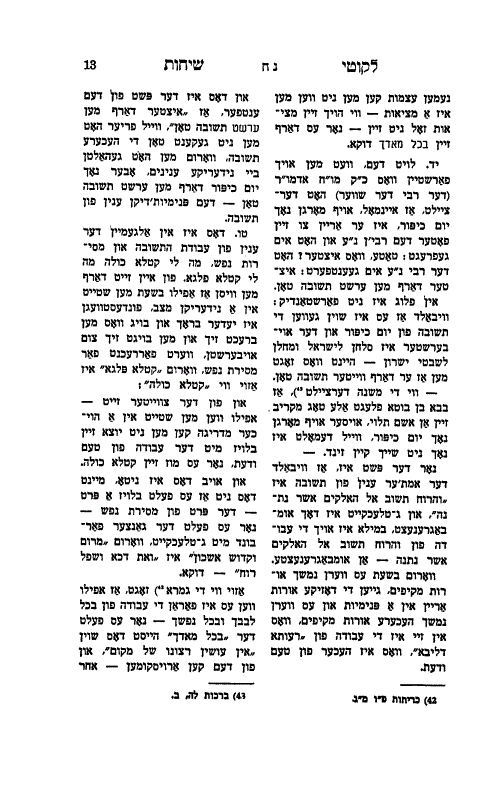
Therefore, the daily order is that as soon as one rises from sleep, before entering the world — into the "malicious waters" — one first says "Modeh Ani Lefanecha" (I give thanks before You) for returning my soul. He acknowledges that the life of his soul is solely from the Almighty. Then he recites the morning blessings and thanks the Almighty for each specific detail: "Who clothes the naked," etc. Even though he has clothes to wear, what is the meaning of the blessing "Who clothes the naked" — and similarly with the other blessings?
It is because "He is the wise one who sees the outcome," who is a wise person? One who sees how everything is created anew every moment from nothing to something — he knows that every moment the "something" is brought into being from G‑dliness.
3. As it is stated in the Zohar, Rabbi Yissa Saba would pray that the Almighty provide him with his sustenance. This means that even when the food was prepared for him, he would not eat until he prayed this prayer. One might ask: How is it relevant to pray for the Almighty to send him food when the meal is already prepared for him?
The explanation is that every creation, by itself, remains in a state of nothingness as it was before its creation. The fact that it exists is solely because the Almighty, in His goodness, renews it constantly, as it is stated: "Who renews in His goodness every day, continuously, the work of creation." Therefore, it is relevant to pray even when the food is already on the table, and similarly with other necessities. Because the sustenance that existed a minute earlier has, by itself, become nothing, one must therefore pray to the Almighty to renew it so that he will have what he needs.
When he has the preface of prayer, he knows that by itself, the physical has no existence, and only the Almighty must constantly renew it. And that the entire existence of the world is solely to fulfill the Almighty's intention of "I created it for My glory," etc. Then he can enter the matters of this world and has no fear of the "malicious waters."
Before he prays, he is absorbed in the notion that the world is primary, that it is, G‑d forbid, an independent existence. Then it is entirely simple to him that what is permitted, he may certainly do, and what he is not sure is forbidden, he may also do, because one must establish everything on its presumption, and the presumption is — the world.
However, when the emphasis is that in truth there is no existence, there is only the Almighty, and He renews the world from absolute nothingness for the purpose of the Divine desire that the Holy One, blessed be He, desired to have a dwelling place in the lower realms...
5. A dwelling place in the lower realms (the Almighty created the world because He desired to have a dwelling, as it were, here below) — then the "existence" is only that which brings about this intention. Therefore, this leads to a reversed conclusion: that which is forbidden — and consequently in contradiction to this intention — is not allowed, and not only forbidden matters, but even permissible things (unnecessary matters) are also not allowed. When the evil inclination comes with an argument and says that something is needed, one responds: bring proof! For the presumption is that there is only G‑dliness, and therefore, "the burden of proof is on the claimant" (the one who wants to extract something from another must bring proof that he is right).
And according to the chassidic saying: "What is forbidden — is forbidden, and what is permitted — is not necessary."
And this is the concept of "enter the ark" — to enter the "words" of Torah and prayer — to be constantly surrounded by them. When it is established for him that the primary existence is Torah and prayer and all other matters are only for this purpose, then even when he is engaged in physicality, etc., because one must have a healthy body, this itself becomes a service or a matter for the sake of service.
The only advice on how to be rid of the floodwaters, whether from the great deep or from the windows of heaven, is — enter the ark. Then he has no connection to anything that is not a matter of holiness, and all his matters and needs are arranged in a manner of "in all your ways know Him."
6. However, this does not mean that he should only enclose himself in the ark — the words of Torah and prayer — and what happens with another should not concern him at all, claiming "I have saved my own soul."
On this, the Torah tells us: Enter the ark, you and your sons and your wife and your sons' wives. Not only you alone, but also your household, and also "your sons — these are the students," and ultimately this means — all Jews, which falls under the category of your wife or your sons, because a wife represents the concept of receiving, and every Jew is in the aspect of receiving, as one Jew receives from another, for all Jews are a...
6. You must bring them all into the ark, meaning you must influence and inspire all Jews to enter the ark of Torah and prayer. Even before the giving of the Torah, when one might mistakenly think, "What do I care about another — I have saved my own soul," even then, G‑d told Noah, "Enter the ark, you and your wife," etc. And especially after the giving of the Torah, after the mutual responsibility established in the covenant of Arvos Moav, where all Jews are responsible for one another, one certainly cannot fulfill their duty by focusing only on themselves. The situation of another Jew must genuinely and internally affect you.
As mentioned earlier, all Jews are like one complete body, and just as in the human body the health of one limb is connected to the health of another, so too in the complete structure of the Jewish people. The spiritual health of one Jew affects another Jew. Therefore, when one does not engage with another, it naturally also affects oneself.
7. The idea that one must also influence other Jews, especially one's household, should not be done merely to fulfill an obligation, but one must truly be invested in it. As the well-known saying of the Rebbe Rashab goes: Just as putting on tefillin every day is a Torah obligation for every Jew, regardless of whether they are a great Torah scholar or a simple person, so too is it an absolute obligation for every Jew to think every day, at least for half an hour, about the education of children and to do everything within their power, and even beyond their power, to ensure that the children follow the path in which they are being educated.
One might ask, why did the Rebbe specifically mention the mitzvah of tefillin? After all, there are other mitzvos as well. One of the hints in this is because the mitzvah of tefillin is not just a practical mitzvah, but its inner aspect is the subjugation of the heart and mind, as stated in the Shulchan Aruch and in Tanya. This should also be the approach in influencing one's household: it should not be done merely as a formality, but one should invest their heart and mind into it. And when one does not focus solely on themselves, but actively engages — and not just superficially, but with dedication and commitment...
8. To save another Jew from the turbulent waters of the flood and bring him into the ark — then he can also be assured of his own safety, that he will remain intact.
The explanation for this is: For everything, one needs assistance from Above. Therefore, after Noach had already entered the ark, it was necessary to have "And G‑d closed it for him" — a divine assistance from Above.
If one were to enter the ark — the words of Torah and prayer — relying solely on their own strength, it might not be as it should be. As the Sages say: "They did not bless the Torah first," which means that in the blessing over the Torah, we say, "Who has given us His Torah," and we conclude with "Giver of the Torah" — "Giver" is in the present tense — meaning, he knows that the Torah is received from the Almighty. However, "they did not bless the Torah first" implies that while learning Torah, they forgot, G‑d forbid, about the Giver of the Torah.
The same applies to prayer: one might pray, but the prayer might not be felt by him, and it might not influence his daily affairs to be as they should be. This is the main intention of "Come into the ark" — not to remain in the ark, but to go out into the world and make the world a dwelling place for the Almighty. However, for the prayer to influence the entire day, the prayer must be in such a manner that during the prayer, he is entirely unaware of the existence of the world; he is then completely removed from the world, knowing only G‑dliness. Later, after the prayer, when he comes into the world, it is — as it was for Noach — a new world he sees, he perceives a new world.
As it is told about the Baal Shem Tov, that before praying, he would contemplate whether after the prayer he would remain alive in his body. He was uncertain about this, due to the "expiration of the soul" he would experience during prayer.
And in order for Torah and prayer to be as they should be, one needs "And G‑d closed it for him," the help and assistance from Above.
And to receive this help from Above, it is through dedicating oneself to another Jew. Then, as the Sages say regarding the verse "The L‑rd enlightens the eyes of both," it becomes illuminated for him as well — and then the "Come into the ark" is as it should be.
9. Furthermore, we find that the Almighty told Noach to bring into the ark all worldly matters that could be lost — "of all living things, etc."
The lesson from this for every Jew is:
9. Everything that exists in the world, which he knows that without his effort it will be destroyed and lost, he has an obligation to bring it into his "ark" in order to save it and elevate it to G‑dliness. If he thinks that this has no connection to him, this is against the principle of Divine Providence: since the Almighty has arranged that he knows of the existence of such a thing, and that without his effort it will be destroyed and lost, it is certainly for the purpose that he should bring it closer and elevate it.
And then he receives the help and assistance from Above for the "Come into the ark" until it becomes for him "and to a cubit you shall finish it from above." The word "cubit" (אמה) is an acronym for "Our G‑d, King of the world" (אלקינו מלך העולם). Through "Our G‑d" (the G‑d of the Jews), He becomes "King of the world"; "you shall finish it from above" — even the vessels (for sustenance) are given to him from Above, similar to "and He will sustain you" — until "I have set My bow in the cloud" — the bow (rainbow) is, so to speak, compared to the Almighty — that He makes the entire world into a dwelling place for His Essence, may He be blessed.
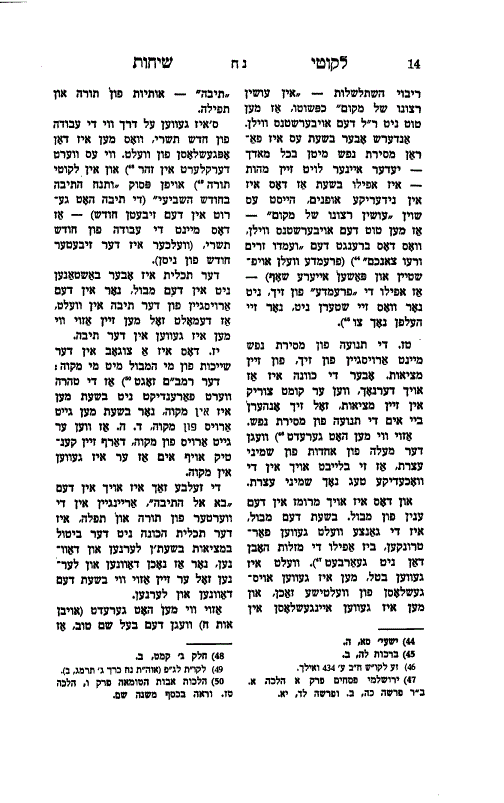
10. There is a note (a Torah record) from the Rebbe, the Tzemach Tzedek, which begins: "Rabbi Akiva said: Fortunate are you, Israel, before whom do you purify yourselves and who purifies you." The time of this note is from the months of Elul and Tishrei. The connection of "Rabbi Akiva said, etc." to this time is understandable, for it speaks about the service of repentance. Therefore, the Mishnah "Rabbi Akiva said" was placed at the end of Tractate Yoma, where the service of Yom Kippur is discussed.
There is also a Chassidic discourse with the same beginning ("Rabbi Akiva said") from Shabbat Parshat Noach of the year 5667 (1907), fifty years ago. Since it was said in Parshat Noach, it is a sign that it has a connection to the parsha. It can be simply said, as explained in Torah Ohr, that the Flood was similar to the waters of a mikvah which purify.
11. In repentance, there are two aspects: A. Simply — to repent for sins. B. The inner aspect of repentance — "and the spirit shall return."
12. The concept of "the spirit shall return to G‑d who gave it" refers to the service of G‑d at the level of "the desire of the heart" (a deep yearning of the heart), which is beyond reason and understanding. This is also indicated by the double expression: "Before whom do you purify yourselves" and "Who purifies you." The first — "Before whom do you purify yourselves" — refers to repentance from below to above, repentance for sins. The second — "Who purifies you" — refers to repentance from above to below — "and the spirit shall return to G‑d who gave it." It can be said that these two aspects of repentance are also alluded to in Parshat Noach, as is known from the Baal Shem Tov's interpretation of the verse "Come into the ark" — one should enter into the letters of Torah and prayer. These two aspects — Torah and prayer — are from above to below (Torah) and from below to above (prayer). The letters of Torah are like stones made by Heaven, while the letters of prayer are compared to bricks, which are stones made by man.
The concept of "the desire of the heart" and mesiras nefesh, which is beyond reason and understanding, exists in various forms — higher and lower. Mesiras nefesh means the surrender of one's will, and as the Gemara states — "What difference does it make if it is a complete death or a partial death?" With every bow that a Jew makes for the sake of the Almighty, even with a slight movement, it is a partial death, and this too is mesiras nefesh. On the other hand, even the greatest of the great cannot suffice with service according to reason and understanding alone; they too must have the bowing with mesiras nefesh, for only then will they receive G‑dliness, as it is written, "I dwell in the high and holy place, and with the contrite and humble spirit" — specifically.
One cannot argue that since he is the greatest of the great, why is reason and understanding not enough for him? He, with his reason and understanding, accomplishes no less than another with mesiras nefesh. He is told that it must be "with all your might," your "might," and as long as he remains within his own reason and understanding, he cannot receive G‑dliness. To receive G‑dliness, one must have mesiras nefesh specifically.
This is also true with learning Chassidus: even one who learns Chassidus abundantly and conducts himself according to its customs and instructions, and when he looks around, he might think he is already at the pinnacle — he is told that it is not enough — one must have service and service with mesiras nefesh. As explained in the booklet "U'Maayan," even someone who has a good grasp and easily accepts a concept, so that what another needs great effort for, he takes in immediately — nevertheless, he too must toil. For as long as he stands in his limited existence as he is, he has no connection to G‑dliness.
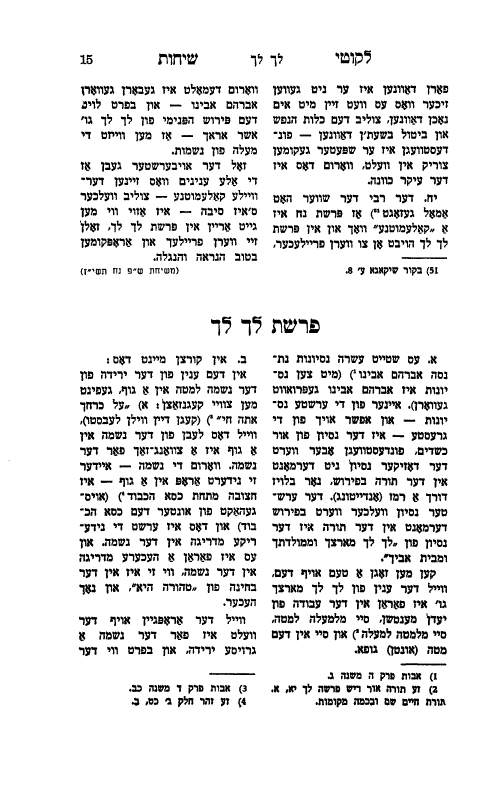
13. This is the hint: immediately after emerging from Rosh Hashanah, Yom Kippur, and the month of Tishrei, we read Parshas Noach. Yom Kippur is a day where the essence of the day itself atones, and G‑d forgives all transgressions. On Yom Kippur, it is said that the Jewish people are united with G‑d, it is "Israel and the King alone," and their entire existence is G‑dliness. One might think, therefore, why is there a need for the service of mesiras nefesh, since their entire existence is G‑dliness? Thus, immediately after the month of Tishrei, we read Parshas Noach: "Enter the ark" — to enter both directions of teshuvah, from below to above and from above to below, indicating that one must have mesiras nefesh. For one cannot grasp the essence when one is a separate existence — no matter how elevated that existence may be — it must be specifically "with all your might."
14. According to this, we can also understand why the Previous Rebbe (the Rebbe's father-in-law) recounted that once, on the morning after Yom Kippur, he went to his father, the Rebbe, and asked him: "Father, what now?" The Rebbe replied: "Now we must begin to do teshuvah." At first glance, this is not understood: since the teshuvah of Yom Kippur has already occurred and G‑d has forgiven Israel and pardoned the tribes of Jeshurun — why is it said that one must continue to do teshuvah? As the Mishnah recounts, Baba ben Buta would offer a guilt offering every day, except on the morning after Yom Kippur, because at that time, sin was not applicable. However, the explanation is that the true essence of teshuvah is "and the spirit returns to G‑d who gave it," and since G‑dliness is infinite, the service of "and the spirit returns to G‑d who gave it" is also infinite. For when encompassing lights are drawn down, these lights enter into an inner dimension, and higher encompassing lights are drawn down, in which the service of "the desire of the heart" is beyond reason and understanding.
And this is the meaning of the response, "Now we must begin to do teshuvah," because previously one could not perform the higher teshuvah, as they were engaged in lower matters. But after Yom Kippur, one must begin to do teshuvah — the inner aspect of teshuvah.
15. This is, in general, the concept of the service of teshuvah and mesiras nefesh, "what difference does it make if it is complete death or partial death." On one hand, one must know that even when standing in a lowly state, nevertheless, every breaking and bending of oneself towards G‑d is considered mesiras nefesh, because "partial death" is like "complete death."
And on the other hand — even when one stands on a higher level, one cannot fulfill their obligation merely with the service of reason and understanding; it must be complete death.
16. And if this is absent, it does not mean that only a detail is missing — the detail of mesiras nefesh — but rather the entire bond with G‑dliness is lacking. For "I dwell in the high and holy place" is specifically "with the contrite and humble spirit."
As the Gemara states, even when there is the service of "with all your heart and with all your soul," but if "with all your might" is missing, it is already considered "not fulfilling the will of the Omnipresent." From this can result — other consequences.
However, when there is mesiras nefesh with "with all your might" — each person according to their own essence — even when this is in a lower manner, it is already considered "fulfilling the will of the Omnipresent," meaning that one is doing the will of G‑d. This brings about "And strangers shall stand and feed your flocks" — that even the "strangers" within oneself not only do not hinder but even assist.
17. The movement of mesiras nefesh means going beyond oneself, beyond one's own existence. However, the intention is that even afterward, when one returns to their existence, the movement of mesiras nefesh should still be felt within them. As discussed regarding the advantage of the unity of Shemini Atzeres, that it remains even in the weekdays following Shemini Atzeres.
This is also hinted at in the concept of the Flood. During the Flood, the entire world was submerged, to the extent that even the constellations did not function. The world was nullified; one was excluded from worldly matters and enclosed within the "ark" — the letters of Torah and prayer.
This was similar to the service of the month of Tishrei, where one is then secluded from the world. As explained in the Zohar and in Likutei Torah regarding the verse "And the ark rested in the seventh month" — that this refers to the service of the month of Tishrei, which is the seventh month from Nissan. However, the ultimate purpose was not in the Flood, but in the emergence from the ark into the world, so that one should be as they were in the ark.
18. This adds to the connection between the waters of the Flood and the waters of a mikveh: The Rambam states that purification is completed not while one is in the mikveh, but when one exits the mikveh, meaning that when one leaves the mikveh, it should be evident that they have been in the mikveh.
The same applies to "enter the ark," entering the words of Torah and prayer. The ultimate intention is not the nullification of existence during learning and praying, but that after praying and learning, one should be as they were during the praying and learning. As discussed earlier (above, section 8) regarding the Baal Shem Tov, that…
19. Before praying, he was uncertain about what would happen to him after praying, due to the intense yearning and self-nullification during prayer. Nevertheless, he later returned to the world, because this is the primary intention.
20. The Previous Rebbe once said that the week of Parshas Noach is a "melancholy" week, and in Parshas Lech Lecha, it begins to become more joyous, because that is when Avraham Avinu emerged. Especially according to the inner explanation of "Lech Lecha... to the land that I will show you" — that it reveals the greatness of the souls. May the Almighty grant that all matters which are currently melancholy — for whatever reason — as we enter Parshas Lech Lecha, should become joyous and descend in a manner of visible and revealed good.