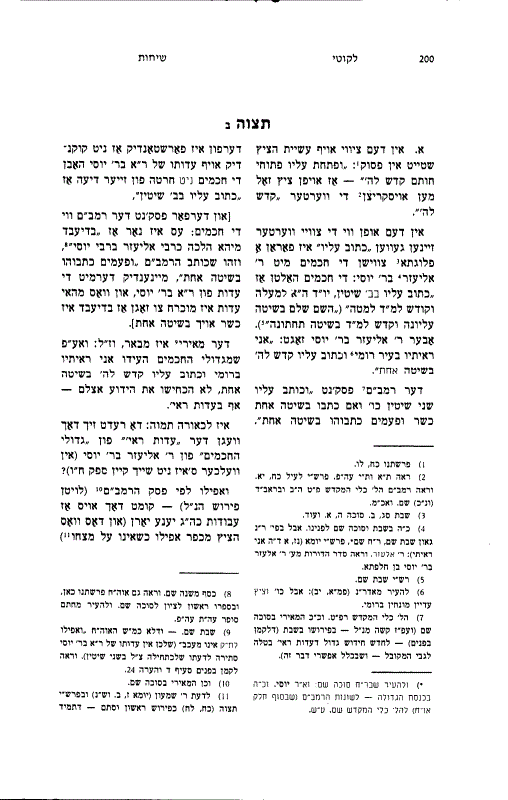
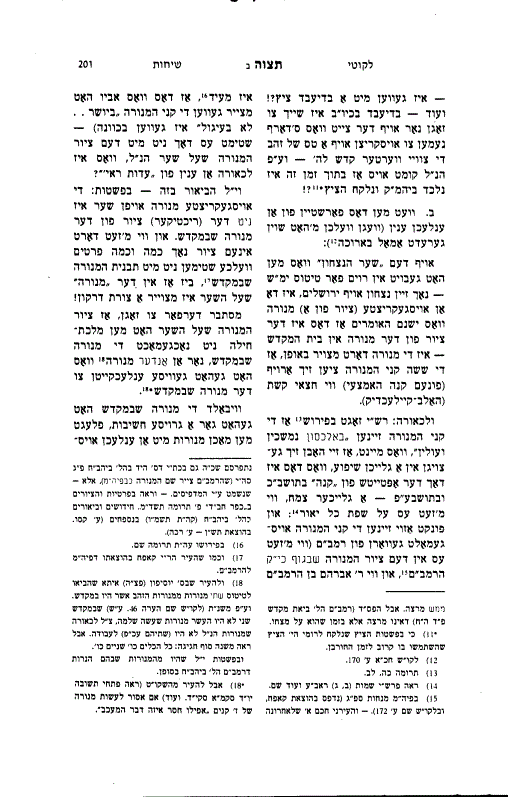
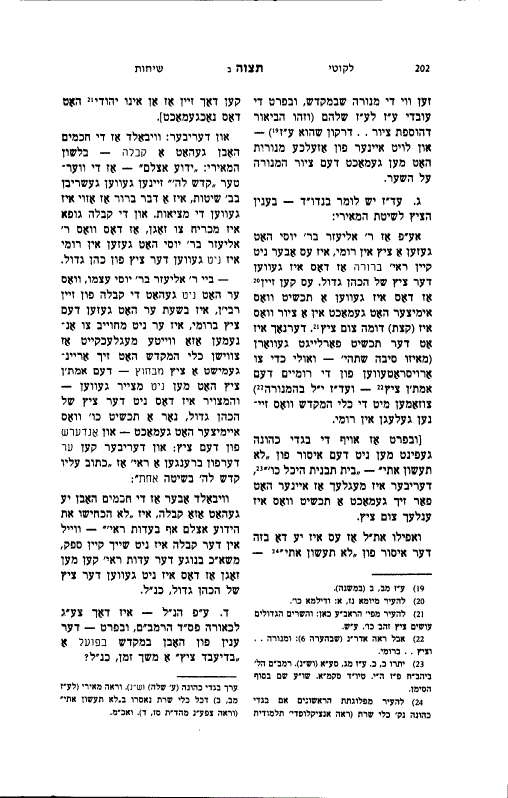
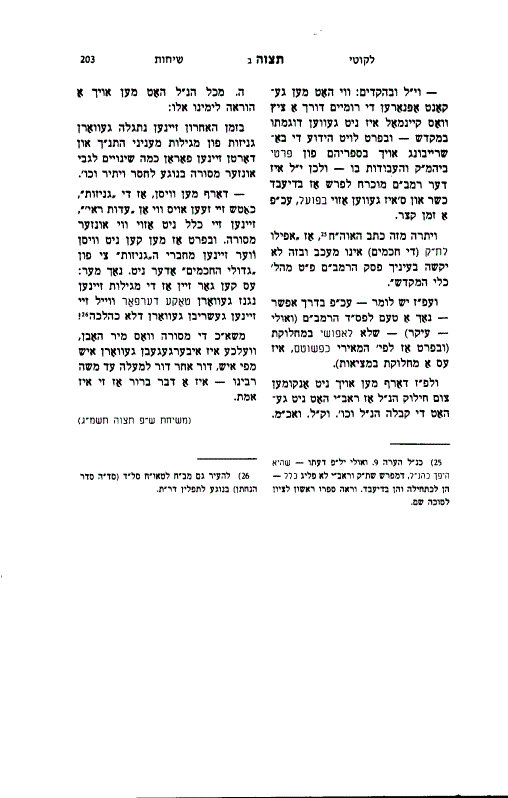
I. The Disputed Engraving: One Line or Two?
The Rebbe begins with the biblical requirement for the Tzitz (Headplate) worn by the Kohen Gadol, engraved with the words "Kodesh LaHashem" (Holy to G‑d).
-
The Chachamim (Sages): Maintain it must be written in two lines. The Name of Hashem occupies the top line; "Kodesh Lamed" occupies the bottom.
-
Rabbi Elazar ben Rabbi Yose: Challenges this with an eyewitness account: "I saw it in the city of Rome, and it was written in one line."
II. The Halachic Dilemma (The "Give and Take")
If a Tanna (Sage) provides eyewitness testimony of the actual artifact from the Beis HaMikdash, how can the Sages maintain their position?
-
The Rambam’s Compromise: The Rambam rules like the Sages Lechatchila (ideally two lines), but rules that Bedieved (after the fact) one line is kosher. He justifies this by saying, "Sometimes they wrote it in one line," clearly accounting for Rabbi Elazar's testimony.
-
The Difficulty with Rambam: If one line is only Bedieved, why would the Temple service have used an "inferior" headplate? Did the Romans happen to capture the one "not-ideal" Tzitz?
-
The Meiri’s Radical Stance: The Meiri goes further, suggesting the Sages did not change their mind at all despite the testimony. This is "surprising"—how can you ignore a direct observation by a great Sage?
III. The Arch of Titus and the Menorah
To resolve the conflict, the Rebbe introduces a parallel from the Arch of Titus in Rome:
-
The Observation: The Arch depicts the Menorah with semi-circular (curved) branches.
-
The Tradition: Rashi and the Rambam (in his own hand-drawn sketches) state the branches were straight (diagonal).
-
The Resolution: The Rebbe argues the Arch is not evidence. The Romans likely depicted an imitation or a different decorative Menorah (notably, the Arch includes foreign "dragon" imagery on the base). Just because it was in Rome doesn't mean it was the original.
IV. Reconciling the Testimony (The "Pshat")
The Rebbe applies this logic back to the Tzitz:
-
To the Sages: Their tradition was so absolute that when Rabbi Elazar said "I saw it," they assumed he saw a copy, an ornament, or an imitation used to trick the Romans during the exile.
-
To Rabbi Elazar: Since he didn't have a specific tradition to the contrary, he naturally assumed the artifact he saw was the original.
-
The Result: The Sages aren't "denying" what he saw; they are denying that what he saw was the authentic Halachic artifact.
V. The Bottom Line: The Authority of the Mesorah
The Rebbe concludes with a powerful contemporary application regarding manuscripts and the Dead Sea Scrolls:
-
The Conflict: Modern discoveries (like the Cairo Genizah or scrolls) often show spelling variations (Chaser v'Yaser) that differ from our Torah scrolls.
-
The Rebbe's Rule: We do not change a letter based on archaeology.
-
The Reason: If a scroll was hidden or put in a Genizah, it was often because it was incorrect or unfit for use. Our tradition—passed from teacher to student back to Moses—is more "factual" than a physical object found in the dirt.
-
The Rambam’s "Bedieved" Ruling: A Closer Look at the Give-and-Take
In this sicha, the Rebbe meticulously deconstructs the Rambam's decision to rule that a Tzitz written in one line is Bedieved (post-facto) kosher. This section of the shakla v'tarya (dialectic) addresses the logical difficulties in the Rambam's position and offers a revolutionary resolution.
I. The Logical Hurdle
The Rebbe asks: If the Rambam accepts Rabbi Elazar’s testimony that he saw a one-line Tzitz in Rome, why doesn't he rule that one line is Lechatchila (ideally preferred)?
-
The Conflict: If the artifact Rabbi Elazar saw was the "real" Tzitz from the Temple, it should define the law.
-
The "Bedieved" Problem: If the Rambam maintains it is only Bedieved, he is essentially saying that the High Priests in the Second Temple were using an "inferior" or "non-ideal" headplate. This is historically and halachically difficult to accept.
II. The "Temporary Use" Theory
The Rebbe explores a potential answer:
-
The Suggestion: Perhaps the Temple only used a one-line Tzitz during an emergency or a transition period (e.g., if the original was lost and they had to make a quick replacement).
-
The Rebuttal: The Rebbe rejects this. The time it takes to engrave a Tzitz is minimal. It is highly improbable that the only time the Romans captured the Tzitz was during the few hours or days they were using a "temporary" one-line version.
III. The Rebbe’s Resolution: Two Perspectives on the Artifact
The Rebbe resolves the tension by distinguishing between Halachic Reality and Physical Appearance:
-
The Sages' Tradition (The Absolute Truth): The Sages possessed a Mesorah (tradition) that the Tzitz must be two lines. This tradition is so powerful that it overrides any physical object found later. To the Sages, if an object in Rome has one line, it simply cannot be the authentic Tzitz of the Kohen Gadol.
-
The Eyewitness's Logic: Rabbi Elazar, not possessing that specific tradition, saw an object in the Roman treasury and concluded, "This is the Tzitz."
-
The Rambam's Synthesis: The Rambam rules that the Mesorah (two lines) defines the law Lechatchila. However, because a Great Sage (Rabbi Elazar) testified to seeing a one-line version, we must concede that a one-line version existed and was functionally valid. Therefore, he rules it is Bedieved kosher.
IV. Why did a one-line version exist?
The Rebbe suggests that the artifact in Rome was likely an imitation.
-
Strategic Deception: The Jews may have surrendered a "close-enough" copy to the Romans to save the real, two-line Tzitz from being taken into exile.
-
Halachic Basis: There is no strict prohibition against making a decorative "imitation" of the priestly garments (unlike certain Temple vessels). Therefore, a one-line "replica" could easily have been what Rabbi Elazar saw.
The Ultimate Takeaway
The "give-and-take" concludes that Visual Evidence is Secondary to Tradition. Even when your eyes tell you one thing (a one-line Tzitz or a curved Menorah), the Mesorah of the Sages remains the defining reality.
-
-
The Rambam’s Synthesis: Reconciling Sight with Law
In the shakla v’tarya (analytical exchange) of this Sicha, the Rebbe addresses a glaring difficulty: If the Chachamim (Sages) and Rabbi Elazar ben Rabbi Yose disagree on a physical fact, why does the Rambam rule in a way that seems to partially validate both?
I. The Conflict: Eyewitness vs. Tradition
-
The Sages' Position: Based on their Mesorah (tradition), the Tzitz (Headplate) must be written in two lines.
-
Rabbi Elazar's Testimony: He explicitly states, "I saw it in Rome, and it was written in one line."
-
The Halachic Problem: Usually, in a dispute between an individual and the majority, we follow the majority. However, Rabbi Elazar isn't offering an opinion; he is testifying to a fact. You cannot simply "vote" against someone’s eyes.
II. The Rambam’s "Third Way"
The Rambam rules: Ideally (Lechatchila) it should be two lines, but after the fact (Bedieved), one line is kosher.
-
The Rebbe's Question: This ruling is perplexing. If one line is only "post-facto" kosher, it implies the Tzitz Rabbi Elazar saw in Rome was an "inferior" or "not-ideal" version. Why would the most holy objects of the Temple be made in a non-ideal way?
-
The "Emergency" Rejection: One might suggest it was a temporary Tzitz made in haste. The Rebbe dismisses this—engraving a few words on a gold plate doesn't take long enough to justify using a non-ideal version for an extended period.
III. The Resolution: Defining the "Fact"
The Rebbe explains that the "give and take" isn't about whether Rabbi Elazar saw something, but what he saw:
-
The Sages' Logic: Their tradition was so absolute that it defined reality. If they knew the Tzitz was two lines, then anything with one line—even if found in the Roman treasury—was by definition not the authentic Tzitz. It was an imitation, a decorative piece, or a "decoy" surrendered to the Romans to hide the real one.
-
Rabbi Elazar’s Logic: Since he lacked a specific tradition regarding the lines, he saw a gold plate in Rome labeled "Kodesh LaHashem" and logically concluded, "This is the Tzitz."
-
The Rambam's Insight: The Rambam accepts the Sages' tradition as the Law (Lechatchila). But he accepts Rabbi Elazar’s testimony as proof that a one-line version could and did function as a Tzitz. Therefore, he validates it as Bedieved kosher.
IV. The Modern Parallel: Manuscripts & Scrolls
The Rebbe uses this shakla v’tarya to establish a vital principle for today:
-
The Challenge: People find ancient scrolls (like the Dead Sea Scrolls or Genizah fragments) that differ from our Torah's spelling.
-
The Rebbe's Stance: We do not correct our Torah based on archaeology.
-
The Logic: Just as the "Roman Tzitz" was likely an imitation or a discarded copy, ancient scrolls found in a Genizah (a place for burying "unusable" items) were likely put there precisely because they were incorrect. Our Mesorah (living tradition) is more legally "factual" than a physical artifact.
-