
What is repeated in this weeks סדרה?
When a whole subject is repeated it must have?
What are the 2 reasons for the name of באר שבע?
What do both names have in common?
What does the name חרן point to?
What is the questions we may have why does השם?
Where do we find the answer to this question?
How does יעקב represents the Jewish people in their pure state?
Before יעקב needed to put up the Jewish people he lived in באר שבע this means he needed to live in a place where?
When יעקב needs to build the Jewish people he has to go where? And that represents what?
What is the lesson for every Jew?
What did יעקב do and what did he not do when he started out on his journey?
What is the lesson for us?
The opposite is true?
Why did יעקב take מאבני המקום וישם מראשותיו?
Why did he only protect his head?
What does יגיע כפיך כי תאכל mean?
The emphasis is on כפיך what are the other possibilities?
What is best for the person both physically and spiritually?
How does the above explain why וישם מראשותיו?
What did יעקב use to protect his head? What is the lesson for us?
What is the idea of a נדר?
What is the reward?
Every part of the house and even when one sleeps his home is a בית אלוקים how do we see this?
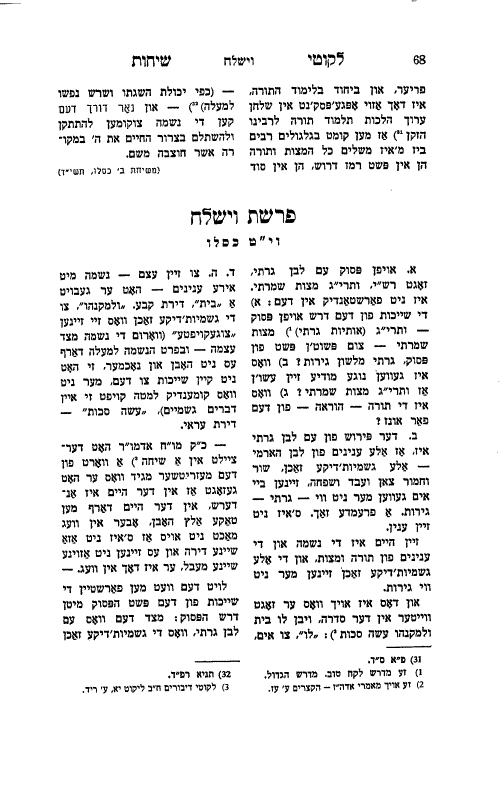


Parshas Vayeitzei
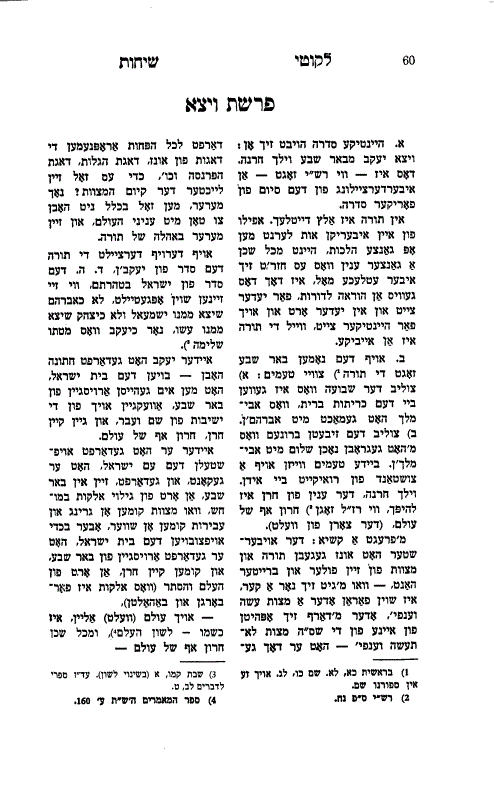
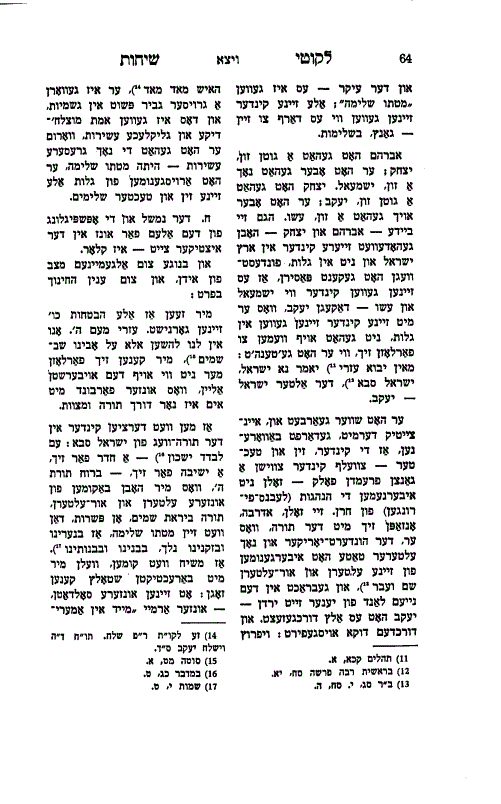
1. Today's Sidrah begins: "ויצא יעקב מבאר שבע וילך חרנה" ("And Yaakov went out from Be'er Sheva and went toward Charan"). This is — as Rashi says — a retelling of the conclusion of the previous Sidrah.
In the Torah everything is precise. Even from a single extra letter entire halachos are learned. All the more so an entire matter which is repeated several times — it is certainly a lesson for all generations, for every time and every place, and also for our present time, because the Torah is eternal.
2. For the name Be'er Sheva the Torah gives1 two reasons: a) because of the oath (shevuah) that took place at the making of the covenant which Avimelech made with Avraham; b) because of the seventh (shevi'i) well that was dug after the peace with Avimelech. Both reasons point to a state of tranquility among Jews.
"וילך חרנה" ("And he went toward Charan") — the matter of Charan is the opposite, as our Sages say2: "חרון אף של עולם" ("the burning wrath of the world").
A question is asked: The Al-mighty gave us Torah and mitzvos from His full and open hand — wherever one turns, there is already either a positive commandment and its offshoots, or one must guard oneself against one of the 365 prohibitions and their offshoots. So He should at least have taken our worries off us — the worry of exile, the worry of livelihood, etc. — so that the fulfillment of the mitzvos would be easier? Even more: that we should not have to deal with worldly matters at all, and could be more in the tent of Torah?
To this the Torah relates the order of Yaakov, that is, the order of the Jewish people in their purity, as they are already set apart — "not like Avraham, from whom Yishmael came forth, and not like Yitzchak, from whom Esav came forth," but like Yaakov, whose "bed was complete"3.
Before Yaakov was to marry — to build the house of Israel — he was told to go out from Be'er Sheva, to leave even the yeshivos of Shem and Ever, and to go to Charan, "the burning wrath of the world."
Before he had to establish the Jewish people, he could, and had to, be in Be'er Sheva, a place of tangibly revealed G‑dliness, where mitzvos come easily and sins come with difficulty. But in order to build the house of Israel, he had to go out from Be'er Sheva and come to Charan, a place of concealment and hiddenness (where G‑dliness is concealed and hidden).
— The world (olam) itself is also as its name — from the word he'elem (concealment)4; all the more so "the burning wrath of the world" — where sins come very easily and mitzvos very hard. And through withstanding the tests, he built the house of Israel — "his bed was complete."
This is also a lesson for every Jew: precisely through having tests, overcoming them and withstanding them, he builds a Jewish home — a bright home and a warm home.
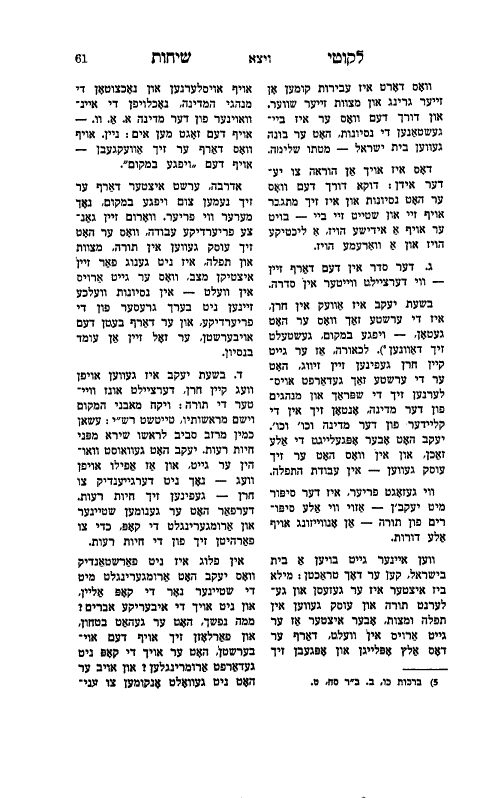
3. The order in this must be as related further on in the Sidrah.
When Yaakov set out for Charan, the first thing he did was "ויפגע במקום" ("And he encountered the place") — he stood up to pray5. Seemingly, since he was going to Charan to find his match, the first thing he should have done was learn the language and customs of the country, dress in the clothing of the country, etc., etc. Yaakov, however, set all these things aside, and with what did he occupy himself? With the service of prayer.
As said earlier, the story of Yaakov — like all the stories of the Torah — is an instruction for all generations.
When a person goes to build a home in Israel, he may think: Until now he sat and learned Torah and occupied himself with prayer and mitzvos; but now that he is going out into the world, he must set all that aside and devote himself to learning and imitating the customs of the country, running after the inhabitants of the country, and so on. To this he is told: No. To what must he devote himself? To "And he encountered the place."
On the contrary, only now must he take up "And he encountered the place," even more than before. For all his earlier service, when he occupied himself with Torah, mitzvos and prayer, is not enough for his present situation, now that he goes out into the world — into tests that are incomparably greater than the earlier ones — and he must ask the Al-mighty that he be able to stand firm in the test.
4. While Yaakov was on the way to Charan, the Torah further tells us: "ויקח מאבני המקום וישם מראשותיו" ("He took from the stones of the place and put them around his head"). Rashi explains: "עשאן כמין מרזב סביב לראשו שירא מפני חיות רעות" ("He arranged them like a gutter around his head, for he was afraid of wild beasts"). Yaakov knew where he was going, and that even on the way — before reaching Charan — there are wild beasts. Therefore he took stones and surrounded his head, in order to protect himself from the wild beasts.
At first glance it is not understood: why did Yaakov surround only his head with the stones, and not the rest of his limbs as well? Either way: if he had trust and relied on the Al-mighty, he should not have needed to surround even his head; and if he did not want to resort to matters above nature, he should also have protected the body and the feet?
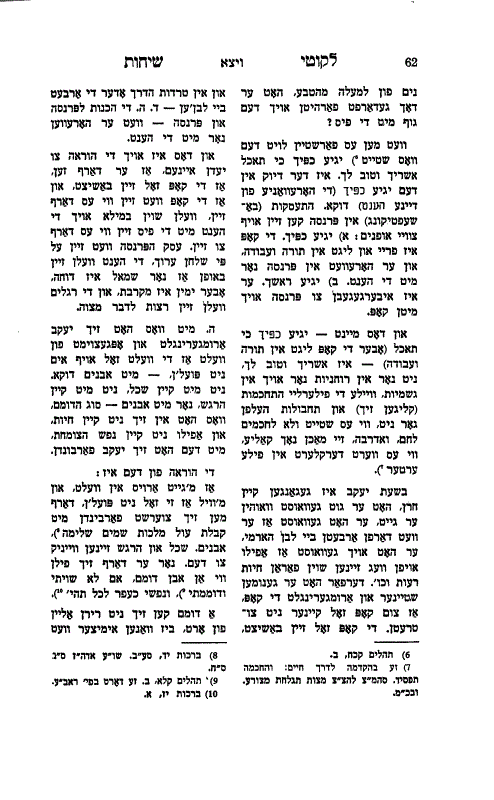
This will be understood according to what is written6: "יגיע כפיך כי תאכל אשריך וטוב לך" ("When you eat the toil of your hands, you are fortunate and it is good for you"). The precision is in "the toil of your hands" specifically. Involvement (occupation) in earning a livelihood can be in two ways: a) "the toil of your hands" — the head is free and immersed in Torah and the service of G‑d, and he labors for his livelihood only with his hands; b) "the toil of your head" — he is given over to his livelihood with his head as well.
And this is the meaning: "When you eat the toil of your hands" (but the head is immersed in Torah and the service of G‑d) — then "you are fortunate and it is good for you," not only spiritually but materially as well, because all the various clever schemes (outsmarting) and stratagems do not help at all, as it is written, "ולא לחכמים לחם" ("nor is bread to the wise"); on the contrary, they even spoil things, as is explained in many places7.
When Yaakov went to Charan, he knew well where he was going. He knew that he would have to work for Lavan the Aramean; he also knew that even on the way there were already wild beasts, etc. Therefore he took stones and surrounded his head, so that no one should get at the head. The head should be protected, and in the troubles of the road or the work for Lavan — that is, the preparations for a livelihood and the livelihood itself — he would labor only with his hands.
And this is also the lesson for every individual: he must see to it that the head is protected; and when the head will be as it should be, then automatically the hands and the feet will also be as they should be. His business will be conducted according to the Shulchan Aruch; the hands will be in the manner that only "the left pushes away, while the right draws near"; and the feet will be "running to a matter of mitzvah."
5. With what did Yaakov surround himself and fence himself off from the world, so that the world should not affect him? With stones specifically — not with intellect, not with feeling, but with stones: the category of the inanimate, which has no vitality in it, not even a vegetative soul. With this Yaakov bound himself.
The lesson from this is:
When one goes out into the world and wants it not to affect him, he must first bind himself with complete acceptance of the yoke of the Kingdom of Heaven8 — stones. Intellect and feeling are insufficient for this. Rather, he must feel like an inanimate stone — "אם לא שויתי ודוממתי" ("Surely I have composed and stilled my soul")9, "ונפשי כעפר לכל תהיה" ("and let my soul be as dust to all")10.
An inanimate object cannot move from its place by itself until someone takes it and carries it from one place to another. So too he must feel like an inanimate object — a simple servant — whom the Al-mighty carries from one place to another, and he must let himself be carried, in order to carry out the intent and the mission which the Al-mighty has placed upon him.
6. The reward for this is as stated at the end of the parsha: "והאבן הזאת אשר שמתי מצבה יהיה בית אלקים" ("And this stone which I have set up as a pillar shall be a house of G‑d"). Not silver and not gold, but simple stones; even more — not stones from a town, from an inhabited house, but stones which Yaakov found in the middle of the road — became a house of G‑d. Through what? Through his surrounding himself with stones, and through his binding himself to the Al-mighty with a vow — the concept of a vow being that although, from the standpoint of his own will, understanding and feeling, he would not have done it, the vow compels him. Through this he reached the ultimate elevation: that even the most ordinary things he had became a house of G‑d.
And this too is a lesson and a moral for everyone, and especially for those who are going to build a home in Israel, a chassan and kallah: not only the siddur and the Chumash in the home are holy, but also — to make a distinction — the forks and the spoons of the home must be holy. Through what? Through the beginning being "And he encountered the place" (prayer), until not only during weekday activity and during prayer, but even in sleep it is: "וזה" ("this") — there where he is — "שער השמים" ("is the gate of heaven"). Then the home and everything found in it becomes a house of G‑d.
(From the sichos of Shabbos Parshas Vayeitzei, 5701)
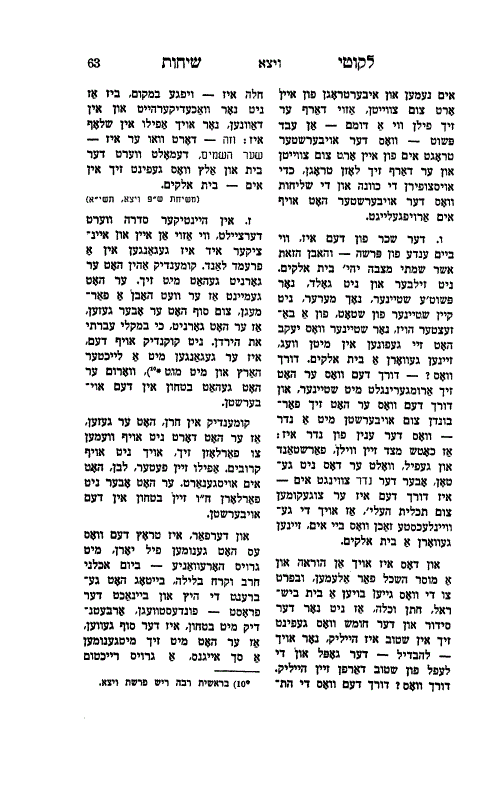
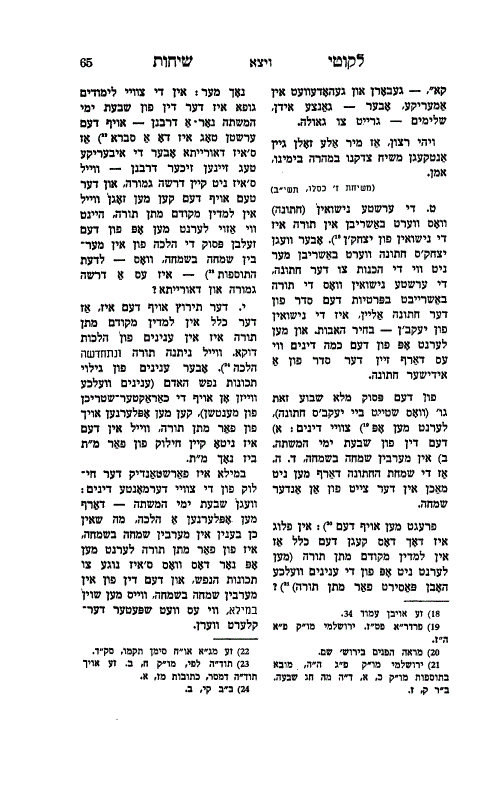
7. In today's Sidrah it is related how a single, solitary Jew went to a foreign land. When he arrived there, he had nothing with him. He had thought that he would have wealth, but in the end he saw that he had nothing: "כי במקלי עברתי את הירדן" ("for with my staff I crossed the Jordan"). Despite this, he went with a light heart and with courage*10, because he had trust in the Al-mighty.
Arriving in Charan, he saw that he had no one there to rely on, not even relatives. Even his uncle, Lavan, deceived him. But he did not, G‑d forbid, lose his trust in the Al-mighty.
And therefore, even though it took many years, with great toil — "ביום אכלני חרב וקרח בלילה" ("by day the heat consumed me, and the frost by night"): by day the heat burned, and by night the frost — nevertheless, working with trust, the end was that he took with him many possessions, great wealth, and the main thing — it was "his bed was complete": all his children were as they should be — whole, in completeness.
Avraham had a good son, Yitzchak; but he also had another son, Yishmael. Yitzchak had a good son, Yaakov; but he also had a son, Esav. Although both of them — Avraham and Yitzchak — raised their children in Eretz Yisrael and not in exile, nevertheless it could happen that there were children like Yishmael and Esav. In contrast, Yaakov — who with his children was in exile, having no one to rely upon, as he pleaded: "מאין יבוא עזרי" ("From where will my help come?")11; "יאמר נא ישראל" ("Let Israel now say") — "Yisrael Saba"12, the elder Israel, i.e., Yaakov —
he worked hard and, at the same time, had to ensure that the children, sons and daughters — twelve children in the midst of an entirely foreign people — should not adopt the conduct (ways of life) of Charan; rather, they should imbue themselves with the Torah which he, the father of a hundred years and even older, had received from his parents and forebears, Shem and Ever13, and brought into the new land from the other side of the Jordan. Yaakov accomplished all this, and precisely through this achieved: "ויפרוץ האיש מאד מאד" ("And the man became exceedingly prosperous")14. He became a great wealthy man, plainly in material terms, and this was truly successful and fortunate wealth, because he had the even greater wealth — his bed was complete: he brought out of exile all his sons and daughters whole.
8. The application and reflection of all this for us in the present time is clear — both regarding the general situation of the Jewish people, and regarding the matter of education in particular:
We see that all the assurances, etc., amount to nothing. "עזרי מעם ה'" ("My help is from G‑d"); "אנו אין לנו להשען אלא על אבינו שבשמים" ("We have no one to rely upon but our Father in Heaven")15. We can rely on no one but the Al-mighty Himself, and our bond with Him is only through Torah and mitzvos.
If we raise children in the Torah way of Yisrael Saba — "עם לבדד ישכון" ("a people that dwells alone")16: a cheder of its own, a yeshivah of its own — in the spirit of G‑d's Torah, which we received from our parents and forebears, Torah with fear of Heaven, without compromises, then there will be "his bed was complete," fulfilling "בנערינו ובזקנינו נלך בבנינו ובבנותינו" ("With our young and with our old we will go, with our sons and with our daughters")17. When Moshiach comes, we will be able to say with justified pride: Here are our soldiers — our army, "made in America" — born and raised in America, yet whole Jews, complete, ready for the Redemption.
May it be G‑d's will that we all go forth to greet Moshiach Tzidkeinu, speedily in our days, Amen.
(From the sichos of 7 Kislev, 5712)
9. The first marriage (wedding) described in the Torah is the marriage of Yitzchak18. But regarding Yitzchak's wedding, no more than the preparations for the wedding are described. The first marriage for which the Torah describes in detail the order of the wedding itself is the marriage of Yaakov — the chosen of the Patriarchs — and from it a number of laws are learned about how the order of a Jewish wedding must be.
From the verse "מלא שבוע זאת" ("Complete the week of this one") (stated in connection with Yaakov's wedding), two laws are learned19: a) the law of the seven days of feasting; b) "אין מערבין שמחה בשמחה" ("one does not mix one celebration with another"), that is, the wedding celebration should not be held at the time of another celebration.
On this it is asked20: Seemingly, this contradicts the rule that "אין למדין מקודם מתן תורה" ("we do not derive laws from before the Giving of the Torah") (we do not learn from matters that took place before the Giving of the Torah)21?
Even more: within the two derivations themselves, the law of the seven days of feasting is only Rabbinic — regarding the first day there is a view22 that it is Biblical, but the remaining days are certainly Rabbinic — because it is not a full derivation, and the reason for this can be said to be that "we do not derive laws from before the Giving of the Torah." If so, how is the law "one does not mix one celebration with another" derived from the very same verse — which, according to Tosafos23, is a full derivation and Biblical?
10. The answer to this is that the rule "we do not derive laws from before the Giving of the Torah" applies to matters of halachah specifically, because "ניתנה תורה ונתחדשה הלכה" ("the Torah was given and the law was renewed")24. But matters that reveal the characteristics of the human soul (matters which indicate people's traits of character) can be learned even from before the Giving of the Torah, because in this there is no difference between before the Giving of the Torah and after the Giving of the Torah.
Accordingly, the difference between the two laws mentioned is understood: regarding the seven days of feasting, one must derive a halachah; whereas regarding "one does not mix one celebration with another," from before the Giving of the Torah one learns only what pertains to the traits of the soul, and the law "one does not mix one celebration with another" is then known automatically, as will be explained later.
11. Regarding the traits of the soul there can be two views: a) When a person is in a certain emotional state, such as the emotion of joy, then although the joy comes from a particular matter, it nevertheless also helps the joy of another matter, since it is the same emotion. b) When a person is in a state of joy, for whatever cause, not only does the joy not help another joy, but on the contrary, it even interferes; for although both effects (results) are of the same emotion, since the causes are different and therefore one confuses the other, this must also come out in the effects — in the joy.
And this is learned from the verse "Complete the week of this one," in accordance with the second view; and consequently one knows the law "one does not mix one celebration with another."
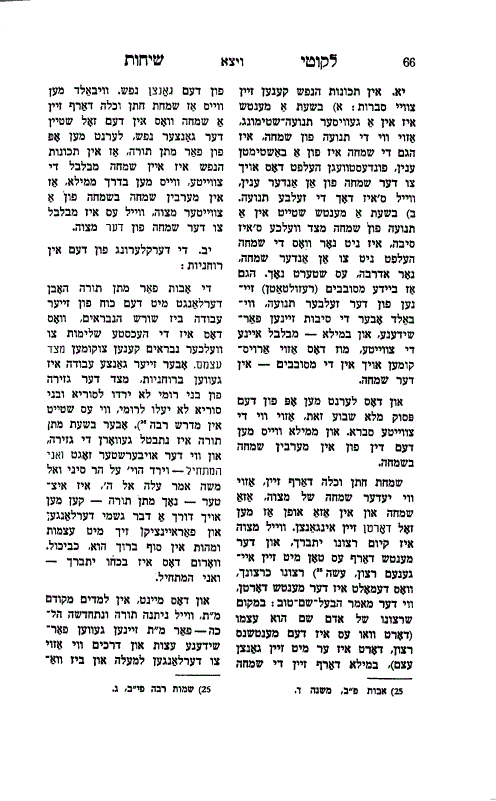
The joy of chassan and kallah must be, like every joy of a mitzvah, a joy of such a kind and in such a manner that one is there entirely. For a mitzvah is the fulfillment of His Will, blessed be He, and a person must do it with his own will — "עשה רצונו כרצונך" ("Make His will as your will")25 — for then the person is there, as in the saying of the Baal Shem Tov: "במקום שרצונו של אדם שם הוא עצמו" ("Where a person's will is, there he himself is") (wherever a person's will is, there he is with his entire essence). Accordingly, the joy must be of the entire soul. Since one knows that the joy of chassan and kallah must be a joy in which the entire soul is present, and one learns from before the Giving of the Torah that in the traits of the soul one joy confuses another, one knows as a matter of course that one does not mix in the joy of another mitzvah, because it confuses the joy of this mitzvah.
12. The explanation of this in spiritual terms:
The Patriarchs before the Giving of the Torah reached, through the power of their service, up to the root of the created beings, which is the highest perfection that created beings can attain on their own. But all their service was in spirituality, because of the decree "בני רומי לא ירדו לסוריא ובני סוריא לא יעלו לרומי" ("The inhabitants of Rome shall not descend to Syria, and the inhabitants of Syria shall not ascend to Rome"), as stated in Midrash Rabbah26. But at the Giving of the Torah the decree was annulled, and as the Al-mighty says, "ואני המתחיל" ("And I will be the one to begin") — "וירד ה' על הר סיני" ("And G‑d descended upon Mount Sinai"), "ואל משה אמר עלה אל ה'" ("And to Moshe He said, 'Go up to G‑d'") — now, after the Giving of the Torah, one can reach even through a physical thing, and become united with the Essence and Being of Ein Sof, blessed be He, as it were; for this is through His power, blessed be He — "And I will be the one to begin."
And this is the meaning of "we do not derive laws from before the Giving of the Torah," because "the Torah was given and the halachah was renewed": before the Giving of the Torah there were various counsels and paths for how to reach Above, and to what extent one can reach. But after the Giving of the Torah — "the Torah was given and the halachah was renewed" — new ways and paths came into being for how to transform oneself "בשעתא חדא" (in a single moment), and even through a physical thing — "מעומק תחת אל עומק רום" (from the very depth below to the very height above).
Nevertheless, whatever pertains to the traits of the soul is indeed learned from before the Giving of the Torah, because through the fulfillment of Torah and mitzvos one must refine and rectify the matters that existed before the Giving of the Torah — the rectification of the shattering of the vessels, of the sin of the Tree of Knowledge and of the other sins; for after the sin of the Golden Calf, the impurity of the primordial serpent returned27. Thus the traits of the soul from before the Giving of the Torah are relevant: since one must refine them, one must know what one is dealing with. But all this concerns that which is being refined; with regard to the one who refines and the methods of refinement, "we do not derive laws from before the Giving of the Torah," because "the Torah was given and the halachah was renewed."
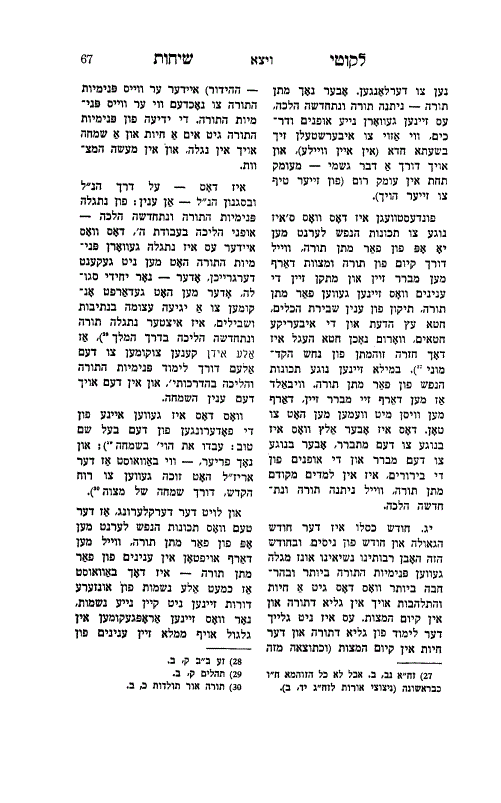
13. The month of Kislev is the month of redemption and the month of miracles. And in this month our Rebbeim, our leaders, revealed to us pnimiyus haTorah (the inner dimension of the Torah) to the greatest degree and most expansively, which gives vitality and enthusiasm also in the revealed part of the Torah and in the fulfillment of the mitzvos. The study of the revealed part of the Torah and the vitality in fulfilling the mitzvos (and, as a result, their beautification) are not the same before a person knows pnimiyus haTorah as after he knows pnimiyus haTorah. Knowledge of pnimiyus haTorah gives him vitality and joy also in nigleh and in the actual performance of the mitzvos.
This is — along the lines of the above, and in the above style — a matter of "pnimiyus haTorah was revealed and the halachah was renewed": ways of going (halichah) in the service of G‑d. That which, before pnimiyus haTorah was revealed, could not be attained — or only by select individuals, or one had to resort to tremendous toil along paths and byways — now "the Torah has been revealed and a new way of going has been renewed, on the King's highway"28, so that all Jews can attain all of this through the study of pnimiyus haTorah and walking in its guidance; and in this, also the matter of joy.
This was one of the demands of the Baal Shem Tov: "עבדו את ה' בשמחה" ("Serve G‑d with joy")29; and even earlier — as is known, the Arizal merited Divine inspiration through the joy of a mitzvah30.
And according to the explanation that the reason the traits of the soul are learned from before the Giving of the Torah is that one must accomplish things in matters from before the Giving of the Torah — it is known that almost all the souls of our generations are not new souls, but souls that have come down in reincarnation to complete matters from before, and especially in the study of Torah. As is ruled in the Shulchan Aruch, Laws of Torah Study, of the Alter Rebbe31, that one comes in many reincarnations until one completes all the mitzvos and the Torah, whether in pshat, remez, drush, or in sod … [OCR unclear — the source text breaks off here; the rest of this Sicha is not in the source]
Notes
1) Bereishis 21:31; ibid. 26:33. See also Sforno there.
2) Rashi, end of Parshas Noach.
3) Shabbos 146a (with a change of wording). Based on Sifri, Devarim 32:9.
4) Sefer HaMaamarim 5700, p. 160.
5) Berachos 26b. Bereishis Rabbah 68:9.
6) Tehillim 128:2.
7) See the introduction to Derech Chaim; and "the wisdom will cause loss" — Sefer HaMitzvos, the mitzvah of the shaving of the metzora. And in many places.
8) Berachos 14b, end. Shulchan Aruch of the Alter Rebbe, siman 3, se'if 8.
9) Tehillim 131:2. See there in the commentary of Ibn Ezra.
10) Berachos 17a.
*10) Bereishis Rabbah, beginning of Parshas Vayeitzei.
11) Tehillim 121:1.
12) Bereishis Rabbah, parsha 78:11.
13) Bereishis Rabbah 63:10; 68:5.
14) See Likkutei Torah, beginning of Parshas Shelach; Torah Chaim, maamar "Vayishlach Yaakov," section 4.
15) Sotah 49a.
16) Bamidbar 23:9.
17) Shemos 10:9.
18) See above, p. 34.
19) Pirkei d'Rabbi Eliezer, ch. 16. Yerushalmi Moed Katan 1:7.
20) Mareh HaPanim on the Yerushalmi there.
21) Yerushalmi Moed Katan 3:5, cited in Tosafos, Moed Katan 20a, s.v. "Mah Chag Shivah." Bereishis Rabbah 100:7.
22) See Magen Avraham, Orach Chaim, siman 546, subsection 4.
23) Chagigah [OCR unclear]; Moed Katan 8b. See also Tosafos s.v. "Demasar," Kesubos 47a.
24) Bava Basra 110b.
25) Avos, ch. 2, mishnah 4.
26) Shemos Rabbah 12:3.
27) Zohar I, 52b. But not all of the impurity, G‑d forbid, as at first (Nitzutzei Oros on Zohar III, 14b).
28) See Bava Basra 100b.
29) Tehillim 100:2.
30) Torah Or, Toldos 20b.
31) [OCR unclear — the text of this note is not in the source.]
Key Lesson
Yaakov built a complete Jewish home precisely by leaving the tranquility of Be'er Sheva for Charan and withstanding its tests: he began with prayer, guarded his "head" for Torah while working only with his "hands," and bound himself to G‑d with simple acceptance of the yoke of Heaven. When a Jew does the same, raising children with uncompromising Torah education even in exile, even the most ordinary things in the home become "a house of G‑d."