



Pirkei Avos, Chapter 1
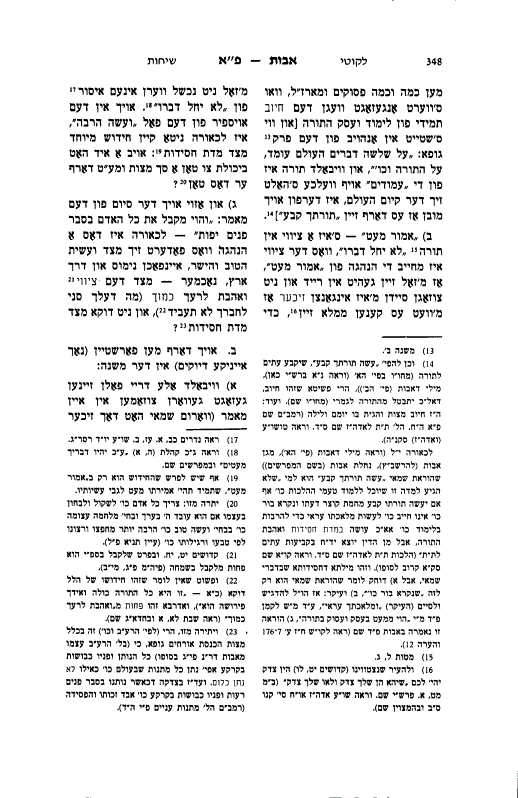
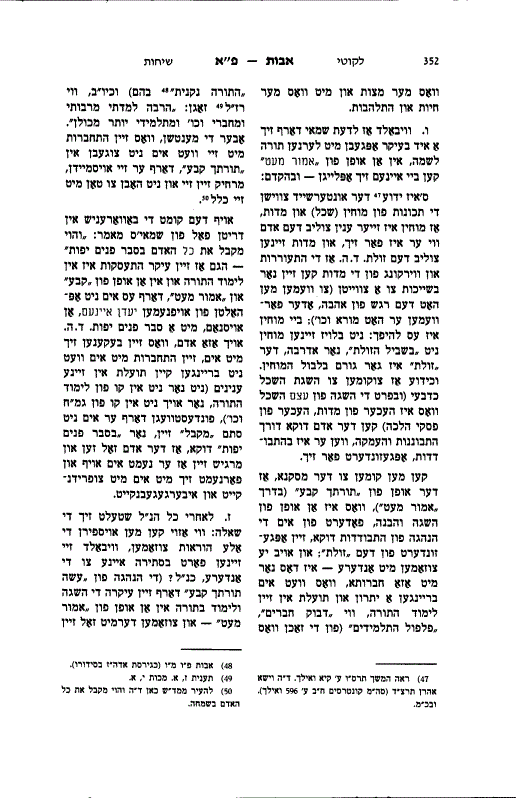
1. "שמאי אומר עשה תורתך קבע, אמור מעט ועשה הרבה, והוי מקבל את כל האדם בסבר פנים יפות" ("Shammai says: Make your Torah study fixed; say little and do much; and receive every person with a pleasant countenance").1
The simple meaning of the three clauses of this Mishnah is (as the commentators say)2: "Make your Torah study fixed" — "that your main occupation, by day and by night, should be in Torah, and when you are weary of study, do work; and that your main occupation should not be work," as our Sages say,3 "עשו תורתן קבע ומלאכתן עראי" ("They made their Torah study fixed and their work occasional"). "Say little and do much" — commit to little, and "do much," more than you said you would, "as we find with Avraham, who said at first,4 'ואקחה פת לחם' ('I will fetch a morsel of bread'), and in the end,5 'ויקח בן בקר רך וטוב' ('He took a calf, tender and good')." "And receive every person with a pleasant countenance" — "When you bring guests into your home, do not give to them while your face is downcast to the ground."
Accordingly, this is puzzling. Tractate Avos speaks of (only) milei d'chassidusa, matters of pious conduct, as our Sages say,6 "האי מאן דבעי למהוי חסידא וכו' לקיים מילי דאבות" ("One who wishes to be pious... let him fulfill the words of Avos"). That is, these are modes of conduct to which a Jew is not obligated by the letter of the law and halachah; rather, he should practice them out of the trait of piety — going beyond7 the line of the law.8 Yet the three matters mentioned above are seemingly not in the category of "matters of piety" at all. Their obligation is self-understood, or they can be understood and derived from other commands in Torah and halachah:9
a) "Make your Torah study fixed" — this very wording is already found among the obligations set by our Sages, and it is brought down as halachah:10 "Make your Torah study fixed11 and your work occasional" (so what then is the novelty here as a trait of piety?12). We also find a great many verses and sayings of our Sages which declare the constant obligation of Torah study and occupation [and as it says at the beginning of this very chapter: "על שלשה דברים העולם עומד, על התורה וכו'" ("The world stands on three things: on Torah..."),13 and since Torah is one of the "pillars" upon which the existence of the world rests, it is understood from this as well that one's Torah study must be "fixed"14].
b) "Say little" — there is a command in the Torah,15 "לא יחל דברו" ("He shall not profane his word"), and this command already requires the conduct of "say little": that one be careful with one's speech and not commit to anything unless one is entirely certain that one will be able to fulfill it,16 so as not to stumble into the prohibition17 of "He shall not profane his word."18 Likewise, in the continuation of this clause, "and do much," there is seemingly no special novelty in terms of the trait of piety:19 if a Jew is able to do many mitzvos and good deeds, he must do them!20
c) And so too the conclusion of the saying: "And receive every person with a pleasant countenance" — this is seemingly conduct demanded by "ועשית הישר והטוב" ("You shall do what is right and good"), by simple courtesy and derech eretz, and even more so by the command21 "ואהבת לרעך כמוך" ("You shall love your fellow as yourself") ("מה דעלך סני לחברך לא תעביד" — "What is hateful to you, do not do to your fellow"22), and not specifically by the trait of piety?23
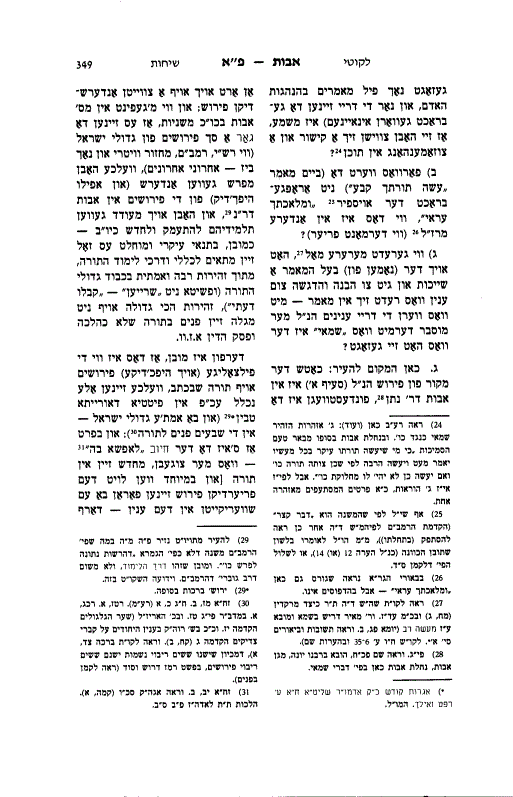
2. We must also understand (several more precise points) in this Mishnah:
a) Since all three clauses were said together in one saying (for Shammai certainly said many more sayings about human conduct, yet only these three are brought here together), the implication is that they have a connection and relationship with one another in their content.24 What is it?
b) Why is the continuation25 "and your work occasional" not brought here (in the saying "make your Torah study fixed"), as it is in other sayings of our Sages26 (as mentioned above)?
c) As has been discussed many times,27 the (name of the) author of a saying also has a connection to, and lends understanding and emphasis to, the matter discussed in the saying. How are the three matters above further explained by the fact that it was "Shammai" who said them?
3. This is the place to note: Although the source of the above explanation (section 1) is in Avos d'Rabbi Nosson,28 there is nonetheless room for a second, different explanation as well. Indeed, we find in tractate Avos, in very many mishnayos, that there are a great many explanations by the great Torah leaders of Israel (such as Rashi, the Rambam, the Machzor Vitri, and onward — down to the very latest authorities) who explained differently (and even in the opposite way) from the explanations in Avos d'Rabbi Nosson,29 and who also encouraged their students to delve deeply and bring forth new insights of this kind — understood, of course, on the fundamental and absolute condition that it accord with the rules and methods of Torah study, with great and genuine care for the honor of the Torah giants (and certainly not "shouting" — "Accept my view!"), and the very greatest care not to interpret the Torah contrary to halachah and the legal ruling, and so on.
From this it is understood that this is like the many (even opposing) explanations of the Written Torah, all of which are included at least in "פיטטיא דאורייתא טבין" ("The words of Torah are good"29*) (and among the genuine Torah giants of Israel — in the "seventy faces of the Torah"30). This is especially so given the obligation "לאפשא בה" ("to increase in it")31 — to add more and more, to bring forth new insights in Torah [and particularly when, according to the earlier explanation, there are difficulties in the matter — one must certainly make the effort, as far as one's intellect can reach,32 to explain it in a way that resolves the questions, etc., since without this the understanding of the matter will be lacking — and this is indeed a necessity in the study of the Oral Torah32*].
4. The explanation of this:
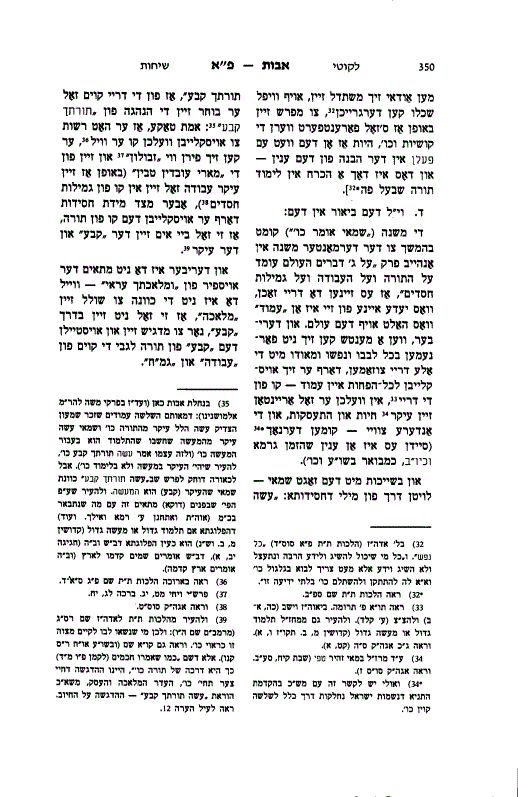
The Mishnah ("Shammai says…") comes in continuation of the Mishnah mentioned above at the beginning of the chapter, "על ג' דברים העולם עומד, על התורה ועל העבודה ועל גמילות חסדים" ("The world stands on three things: on Torah, on Divine service, and on acts of kindness") — that there are three things, each one of which is a "pillar" that upholds the world. Therefore, when a person is unable to devote himself with all his heart, soul and might to all three together, he must choose for himself at least one pillar — one line out of the three — into which he will put his main33 vitality and occupation, while the other two come afterwards3434* (unless it is a matter bound to a specific time, and the like, as explained in the Shulchan Aruch, etc.).
In connection with this, Shammai says — following the path of "matters of piety": "Make your Torah study fixed," meaning that of the three lines he should choose the conduct of "your Torah study fixed."35 True, he has permission to choose whichever line he wishes;36 he may conduct himself like "Zevulun"37 and be one of the "מארי עובדין טבין" ("masters of good deeds") (such that his main service is in the line of acts of kindness38). But by the trait of piety he should choose the line of Torah, so that for him it will be the "fixed" thing and the main thing.39
This is why the continuation "and your work occasional" does not fit here — for the intent here is not to negate "work," that it should not be in a "fixed" manner, but to emphasize and single out the "fixedness" of Torah relative to the lines of "Divine service" and "acts of kindness."
This also explains why he does not conclude (after saying "your Torah study fixed") that "Divine service" and "acts of kindness" should be "occasional." For the instruction "make your Torah study fixed" was said also to the masters of good deeds, whose main occupation is (not in Torah — they fulfill their obligation even with "פרק אחד שחרית ופרק אחד ערבית" ("one chapter in the morning and one chapter in the evening"),40 but) in the line of acts of kindness. Nevertheless, of them too is demanded "your Torah study fixed": their Torah study in that small (in quantity) amount of time must be fixed (in quality), engraved in the soul, until it affects the whole day.41
Moreover, the term "occasional" does not fit "Divine service" and "acts of kindness," because they are essential and fundamental matters in the service of Hashem, and they must be in a "fixed" manner. Only among the three things themselves must the main "fixedness" be specifically in the line of Torah.
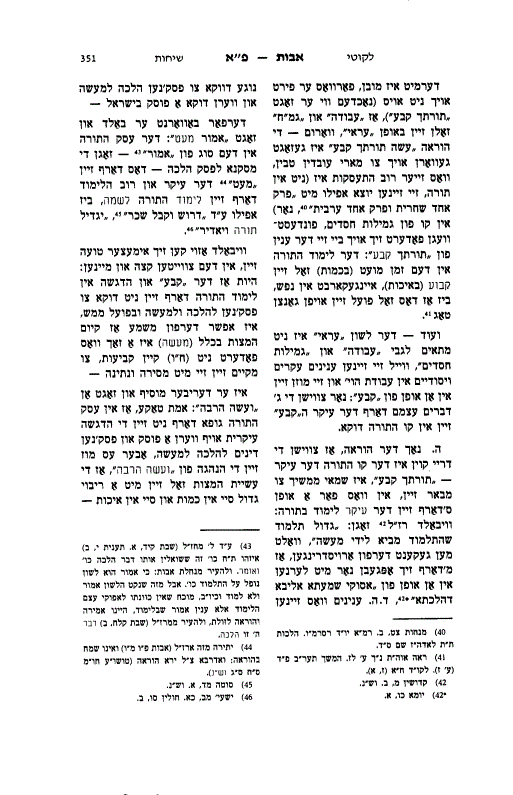
5. After the instruction that among the three lines the line of Torah is the main one — "your Torah study fixed" — Shammai continues to explain in what manner the main Torah study must be. Since our Sages say,42 "גדול תלמוד שהתלמוד מביא לידי מעשה" ("Study is greater, for study leads to action"), one could infer from this that one should occupy oneself only with study in the manner of "אסוקי שמעתא אליבא דהלכתא" ("bringing the teaching to its halachic conclusion"42*) — that is, matters that bear specifically on ruling halachah in practice, and specifically on becoming a halachic authority in Israel —
therefore he immediately cautions and says, "Say little": occupation with Torah of the type of "saying"43 — stating the conclusion as a halachic ruling — should be "little";44 the main part and most of one's study should be Torah study for its own sake, even to the extent of "דרוש וקבל שכר" ("Expound and receive reward"),45 "יגדיל תורה ויאדיר" ("He will make the Torah great and glorious").46
Since someone could then err toward the other extreme and think: Because the "fixedness" and emphasis in Torah study need not be specifically on ruling halachah for actual practice, perhaps this implies that the fulfillment of mitzvos in general (action) is something that does not (heaven forbid) require fixedness, to fulfill them with dedication and devotion —
he therefore adds and says, "and do much": True, within Torah study itself the main emphasis need not be on becoming a halachic authority and ruling laws for practice, but there must be the conduct of "do much" — that the performance of mitzvos be with great abundance, both in quantity and in quality — as many mitzvos as possible, and with as much vitality and fervor as possible.
6. Since, in Shammai's view, a Jew must occupy himself mainly with Torah study for its own sake, in the manner of "say little," someone might conclude — and to preface:
It is known47 that the difference between the natures of mochin (intellect) and middos (emotions) is that the purpose of intellect is for the person as he is by himself, whereas the emotions exist for the sake of another. That is, the arousal and activity of the emotions can occur only in relation to another (toward whom one feels love, or of whom one is afraid, etc.). With the intellect it is the opposite: not only is the intellect not "for the sake of another," but on the contrary, "another" actually causes confusion of the mind. As is known, a person can arrive at proper intellectual comprehension (especially the comprehension of the essence of intellect, which is higher than the emotions, higher than halachic rulings) specifically through contemplation and in-depth study, when he is in seclusion, set apart by himself.
One might therefore conclude that the manner of "your Torah study fixed" (in the way of "say little"), which is a manner of comprehension and understanding, demands of him specifically the conduct of seclusion, being separated from "others"; and if he is together with others after all — it is only with the kind of study partners who will bring him advantage and benefit in his Torah study, such as "דבוק חברים" ("cleaving to colleagues") and "פלפול התלמידים" ("the sharp discussion of students") (among the things by which "התורה נקנית" — "the Torah is acquired"48), and the like, as our Sages say:49 "הרבה למדתי מרבותי ומחברי וכו' ומתלמידי יותר מכולן" ("I learned much from my teachers, and from my colleagues... and from my students more than from all of them"). But people whose company will add nothing to his "fixed Torah study" — he must avoid them, distance himself from them, and have nothing to do with them at all.50
Regarding this comes the caution in the third clause of Shammai's saying: "And receive every person with a pleasant countenance" — although his main occupation is in Torah study, in the manner of "fixed" and "say little," this must not keep him from receiving every single person, without exception, with a pleasant countenance. That is, even a person whose acquaintance and company will bring him no benefit in his own matters (not only not in the line of Torah study, but also not in the line of acts of kindness, etc.) — nevertheless he must not merely "receive" him, but specifically "with a pleasant countenance," so that the person will see and feel that he receives him and attends to him with gladness and devotion.
7. After all the above, the question arises: How can one carry out all these instructions together, since they nonetheless contradict one another, as explained above? (The conduct of "make your Torah study fixed" must consist mainly of comprehension and study of Torah in the manner of "say little" — and together with this there must be "and do much": to increase in the fulfillment of mitzvos, and with abundant vitality and fervor besides. And on top of all this, one is required to "receive every person with a pleasant countenance," which is even more contradictory: while the main success of "your Torah study fixed" comes specifically through seclusion, one must occupy oneself not only with performing mitzvos in abundance, but also with others. How can one overcome all these contradictions?)51
So the Mishnah first informs us that the author of the saying is "Shammai": through (the content alluded to in the name) "Shammai," he will be able to carry out all three instructions.
It is explained in Likkutei Torah52 regarding (the name) "Shammai," that "ע"כ נק' שמאי כענין שארז"ל53 ע"פ54 ושם דרך כו' כל השם אורחותיו, דהיינו ששוקל דרכיו איך ומהו כו'" ("He is therefore called Shammai, in the sense of what our Sages said on the verse 'ושם דרך' ('and one who sets his way'): whoever appraises his paths — that is, he weighs his ways, how and what they are"). The name "Shammai" (from the expression "שם אורחותיו," appraising and weighing one's paths) alludes to and teaches that a Jew must appraise and weigh his ways, his time, and the powers that were given to him.
When he appraises and weighs the powers given to him from Above, he will find that he has the power and ability to carry out his service in all three of the above ways (especially at the time set aside for the study of Pirkei Avos, when special powers are given to successfully fulfill all the instructions of (the matters of piety in) Pirkei Avos). And when he properly appraises and measures the time he has, he will see that the time can be divided in such a way that it will suffice to act in each of the three instructions above.51
8. More deeply and more inwardly, the connection between the three instructions above and the author of the saying, "Shammai," can be explained.
To preface: in the three instructions there is a common denominator. In the first matter — that the main "fixedness" must be in Torah, and in the manner of "say little," i.e., study for its own sake, not for the purpose of ruling halachah (as above) — it is expressed that his Torah study is not for the sake of some other matter, not even for the sake of fulfilling mitzvos, but for the sake of Torah.55
So too the second instruction, "and do much": even when his Torah study is fixed and "say little," he must increase in the fulfillment of mitzvos, which means that his fulfillment of mitzvos is not for the sake of (success in) Torah study — (as the instruction of our Sages56 cautions, "כל האומר אין לו אלא תורה אפילו תורה אין לו" ("Whoever says he has only Torah does not even have Torah")), meaning that even one who dwells in the tent of Torah must have the service of acts of kindness and the fulfillment of mitzvos in general — for his doing (of mitzvos) is then in the category of "little"57 — out of necessity: when the time demands it, such as eating matzah on Pesach, etc., or so that his Torah study will be as it should be.58
And since it says here, "and do much," it is understood that his performance of mitzvos is solely because "אשר קדשנו במצותיו וצונו" ("Who has sanctified us with His mitzvos and commanded us") (not even as a means of ensuring that his Torah (which is fixed) "endures" — will have permanence).
Similarly with the third instruction, "receive every person with a pleasant countenance," which speaks, as discussed above, of someone from whom he will have no benefit, not even in fulfilling the mitzvah of acts of kindness, since the person needs no favor at all from him (as the wording "every person"59 indicates) —
[for when the other person needs a favor (even the favor of lifting him (by receiving him with a pleasant countenance) from his low spirits and the like), it is possible that one does it because of the benefit one gains from it — that through him one fulfills a mitzvah of acts of kindness, etc.],
rather, the instruction is to receive every Jew with a pleasant countenance only because that is the trait of piety.*
And in this common point — that Torah study, the fulfillment of mitzvos, and receiving every Jew are each a goal and purpose in itself (and not for the purpose of something else) — it is expressed that "ישראל אורייתא וקוב"ה כולא חד" ("Israel, the Torah, and the Holy One, blessed be He, are all one").60 Therefore, just as it is impossible to say that the Al-mighty is (heaven forbid) a "means" to something else, so too it is impossible to say this regarding His Torah and His mitzvos, and (regarding the conduct of the children of) Israel.
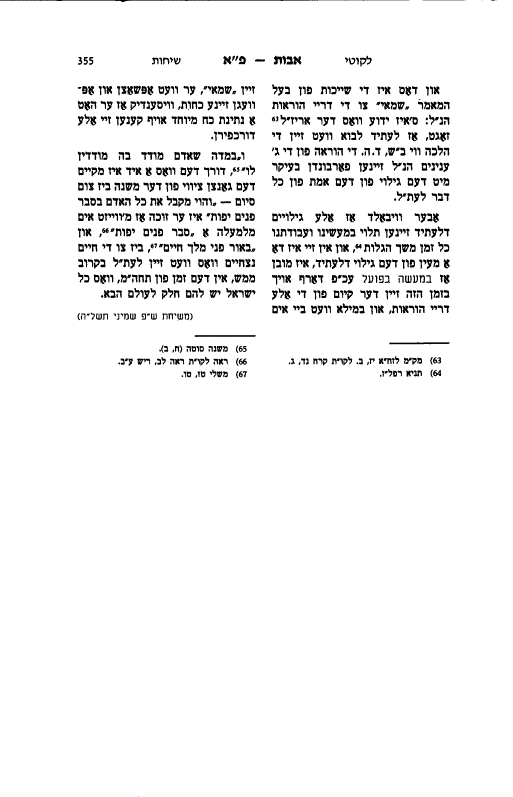
9. This matter — that Torah, mitzvos and Jews are all one with the Holy One, blessed be He — will be openly perceived in the Time to Come, when the truth of every thing will be revealed. In the present time, however, it is concealed in the service of each individual. Therefore there are (and there must be) different types among Jews:61 masters of Torah — whose occupation with acts of kindness and mitzvos is in "the minority of their days,"57 or those for whom it is for the sake of Torah, since "whoever says he has only Torah..." as above; or masters of good deeds, whose main concern is to make the world a dwelling place for Him, blessed be He, through fulfilling mitzvos, while (the obligation of) Torah study is for them little, or is so that their fulfillment of mitzvos will be as it should be (and similarly this very distinction exists in the succession of the generations62).
This is the connection between the author of the saying, "Shammai," and the three instructions above: it is known what the Arizal says,63 that in the Time to Come the halachah will follow Beis Shammai. That is, the instruction of the three matters above is connected mainly with the revelation of the truth of every thing in the Time to Come.
But since all the revelations of the Time to Come depend on our deeds and service throughout the duration of the exile,64 and within them there is a foretaste of the revelation of the Time to Come, it is understood that, in actual practice at least, the fulfillment of all three instructions must take place in the present time as well. Consequently, he will have "Shammai": he will appraise and weigh his powers, knowing that he has a special empowerment to be able to carry them all out.
And "במדה שאדם מודד בה מודדין לו" ("With the measure a person measures, so is he measured"):65 through a Jew fulfilling the entire command of the Mishnah, up to its conclusion — "and receive every person with a pleasant countenance" — he merits that he is shown a "pleasant countenance" from Above,66 and "באור פני מלך חיים" ("In the light of the King's countenance is life"),67 up to the eternal life that will be in the Time to Come, very soon indeed, at the time of the Resurrection of the Dead, when "כל ישראל יש להם חלק לעולם הבא" ("All Israel have a share in the World to Come").
(From the sichos of Shabbos Parshas Shemini, 5735)
Notes
1) Mishnah 15 (and so it is in the Siddur of the Alter Rebbe). In the Rambam's Commentary on the Mishnah (Kafich edition) it is Mishnah 14.
2) Bartenura. See also Rashi, Rambam, Rabbeinu Yonah and Meiri. And see below, section 3 and note 28.
3) Berachos 35b.
4) Vayeira 18:5.
5) Ibid., 7.
6) Bava Kamma 30a.
7) In Bava Kamma there, in our texts (the view of Rav Yehudah): "to fulfill the matters of Nezikin (damages)." Here too one can say that the intent is that he fulfills the matters of damages in a manner beyond the line of the law (and similarly according to those who say "the matters of Berachos" there — in the manner of Berachos 20b). See the introduction of the Maharal of Prague to his work Derech Chaim, s.v. "U'mipnei" and s.v. "V'seder."
8) See Rambam, Hilchos De'os 1:5; Hemshech 5672, vol. 2, ch. 377 (p. 973). Well known is the Alter Rebbe's proof from [OCR unclear — likely nail parings] (Niddah 17a and Tosafos there): "One who burns them is pious," even though it harms him — Likkutei Dibburim vol. 1, 68a.
9) A similar question can be raised regarding several of the explanations in Midrash Shmuel (a work cited in many places in Chassidus).
10) Rambam, Hilchos Talmud Torah 3:6; Tur and Shulchan Aruch (and the Alter Rebbe's Shulchan Aruch), Orach Chaim, beginning of sec. 156; the Alter Rebbe's Hilchos Talmud Torah 3:2. From the above sources it is understood that "your Torah study fixed" is meant literally — in terms of time: most and the main part of one's time should be spent on Torah, and only a minority of time on work. See below, note 14.
11) Furthermore, this is derived from an explicit verse, "ודברת בם" ("and you shall speak of them") (Va'eschanan 6:7, and Sifri; Yoma 19b; the Alter Rebbe's Shulchan Aruch, Hilchos Talmud Torah, ibid., par. 2. See Kuntres Acharon there, subpar. 1, near the end, that the Rambam holds it is a full Scriptural derivation and not merely a supporting allusion).
12) From the wording of the Tur (ibid., sec. 157) it is evident that this conduct — making one's Torah fixed and one's work occasional — is a trait of piety ("as we find among the early pious ones") — see the above Kuntres Acharon at its end. But if so, Shammai would have needed to add (here as well) "and your work occasional" (as below, section 2, second question), since that is where the main emphasis lies. Note that in the Tur there, "his work occasional" precedes "and his Torah fixed." See below, note 14.
13) Mishnah 2.
14) So too according to the explanation that "make your Torah study fixed" means that one should set fixed times for Torah (Meiri, first explanation (see also Rashi here); Milei d'Avos (second explanation)) — it is obvious that this is an obligation, for otherwise one would neglect Torah altogether (Meiri, ibid.). Furthermore: this is the obligation of the mitzvah "והגית בו יומם ולילה" ("You shall meditate in it day and night") (Rambam, ibid., 1:8; the Alter Rebbe's Hilchos Talmud Torah, ibid., par. 4. See Tur and Shulchan Aruch (and the Alter Rebbe's), sec. 155).
One could seemingly say (see Milei d'Avos (first explanation), Magen Avos (by the Rashbatz), Nachalas Avos (in the name of the commentators)) that Shammai's instruction "make your Torah study fixed" is for one "who has not reached the level of being able to learn the reasons of the halachos, etc., even if he makes his Torah fixed, because of his limited understanding, and is called ignorant, etc. — he is not obligated... to make his work occasional in order to increase in study, etc., unless he does so out of the trait of piety and love of Torah; but by the letter of the law he fulfills his obligation by setting times for Torah study" (the Alter Rebbe's Hilchos Talmud Torah, ibid., par. 4; see Kuntres Acharon there, subpar. 1, near the end). This would be the matter of piety in Shammai's words. However: a) it is forced to say that Shammai's instruction is only for one "who is called ignorant, etc."; b) and mainly: he should then have emphasized and concluded with (the main point) "and your work occasional," similar to what is said below, 4:10, "הוי ממעט בעסק ועסוק בתורה" ("Minimize your business and occupy yourself with Torah"); c) that instruction is stated in Avos ch. 4, there (see Likkutei Sichos vol. 7, p. 176–[?] and note 12).
15) Matos 30:3.
16) Note that we were commanded (Kedoshim 19:36), "הין צדק יהיה לכם" ("You shall have a just hin") — "that your 'yes' be just and your 'no' be just" (Bava Metzia 49a, and Rashi there. See the Alter Rebbe's Shulchan Aruch, Orach Chaim sec. 156, par. 2, and the sources cited there).
17) See Nedarim 22a, 77b; Shulchan Aruch, Yoreh De'ah, beginning of sec. 203.
18) See also Koheles (5:1), "על כן יהיו דבריך מעטים" ("Therefore let your words be few"), and the commentators there.
19) Although one could explain that the novelty lies only in "say little" — that one's speaking should always be little relative to one's doing.
20) Even more: every person must... weigh and examine himself whether he serves Hashem in the manner and category of a mighty battle... in the category of "do good"... much more than his desire and will according to his nature and habit, etc. (see Tanya, ch. 30).
21) Kedoshim 19:18. Especially since receiving with a pleasant countenance is less than "receiving with joy" (Commentary on the Mishnah, ch. 3, mishnah 12).
22) It is obvious that one cannot say this is a novelty of Hillel specifically (rather, "this is the entire Torah, and the rest is its explanation"); on the contrary, it is less than "You shall love your fellow as yourself" (see Shabbos 31a, and Chiddushei Aggados there).
23) Even more: (according to the Bartenura, etc.) this is included in the mitzvah of hospitality itself, for (in the words of the Bartenura himself, from Avos d'Rabbi Nosson, end of ch. 13) "whoever gives while his face is downcast to the ground, even if he gave all the gifts in the world... it is as if he gave nothing." Similarly with tzedakah: when one gives it with an unpleasant countenance and with his face downcast to the ground, etc., he loses his merit and forfeits it (Rambam, Hilchos Matnos Aniyim 10:4).
24) See Bartenura here (and others): "Shammai gave three warnings corresponding to..." And at the end of Nachalas Avos he explains the reason for their juxtaposition: one who makes his Torah the main thing in all his deeds will say little and do much, because the Torah so commands, etc.; and if he does so he will have no disputes, etc. But according to this they are not three instructions, but details branching out from one warning.
25) Although one could say that this is because the Mishnah is a "concise statement" (introduction of the Rambam to his Commentary on the Mishnah, s.v. "achar kach ra'isi l'hastapek" (at its beginning)), nevertheless he should have stated it in wording that conveys the intent (as above, note 12 (or) 14), or to exclude the explanation given below in section 4.
26) In the Biurei HaGra it appears that he reads "and your work occasional" here as well — but it is not in the printed editions.
27) See Likkutei Torah, Shir HaShirim, discourse "Tanu Rabbanan Keitzad Merakdin" (48c), and similarly in many places. Rabbi Meir would interpret names, and a story is brought about this as a precedent (Yoma 83b. See Teshuvos U'Biurim, sec. 1;* Likkutei Sichos vol. 6, p. 356, and the notes there).
*) Igros Kodesh of the Rebbe, vol. 1, p. 280 and on. — The publisher.
28) Ch. 13. See there, ch. 28, cited by Rabbeinu Yonah, Magen Avos, and Nachalas Avos here in explaining Shammai's words.
29) Note the Tosafos Yom Tov on Nazir 5:5, regarding the Rambam's explaining a mishnah not according to the explanation of the Gemara, "for permission is given to explain, etc." It is understood that this is the way of study, and not because of the Rambam's greatness. The discussion of this is well known.
29*) Yerushalmi, Berachos, at its end.
30) Zohar I, 47b; III, 20a (Ra'aya Mehemna), 215a, 223a; Bamidbar Rabbah ch. 3[?], 16. And in the writings of the Arizal (Sha'ar HaGilgulim, Introduction 17; similarly in Sha'ar Ruach HaKodesh, on the unifications at the graves of tzaddikim, Introduction 3 (108b). See Likkutei Torah, Berachah 94a) that since there are six hundred thousand souls, there are six hundred thousand explanations, in pshat, remez, drush and sod (see below in the text).
31) Zohar I, 12b. See Iggeres HaKodesh, sec. 26 (145a); the Alter Rebbe's Hilchos Talmud Torah 2:2.
32) In the words of the Alter Rebbe (Hilchos Talmud Torah, end of 1:4): "every soul." And "whoever is able to grasp and know much, and was lazy and grasped and knew only a little, must come back in a reincarnation, etc., and it cannot be rectified and perfected without this knowledge."
32*) See Hilchos Talmud Torah, ibid., end of ch. 2.
33) See Torah Or, Parshas Terumah; Biurei HaZohar, Vayeishev (25a–b) and Lehatzitz (p. 134). Note also the saying of our Sages, "Is study greater or is action greater?" (Kiddushin 40b; Tikkunei Zohar 6a). See also Iggeres HaKodesh, sec. 5 (109a).
34) Similar to the saying of our Sages, "In what was he most careful?" (Shabbos 118b, end. See Iggeres HaKodesh, end of sec. 7).
34*) Perhaps this can be connected with what is written in the introduction to Tanya, that the souls of Israel are divided, in general, into three lines, etc.
35) In Nachalas Avos here (and similarly in Pirkei Moshe by R. Moshe Almosnino): of the three pillars mentioned by Shimon HaTzaddik, Hillel made Torah the main thing, etc., and Shammai made action the main thing, for they held that study is for the sake of action, etc. (and to this itself he said, "make your Torah study fixed," etc., to note that the main thing should be action and not study, etc.). But it is seemingly forced to explain that in "make your Torah study fixed" Shammai meant that the main thing (the fixed part) is action. Note that (specifically) according to the explanation in the text, this accords with what is explained in many places (Or HaTorah, Va'eschanan, p. 241ff., and elsewhere) that the dispute whether study is greater or action is greater (Kiddushin 40b, and sources cited there) is akin to the dispute between Beis Shammai and Beis Hillel (Chagigah 12a), where Beis Shammai say the heavens preceded the earth (and Beis Hillel say the earth preceded).
36) See at length Hilchos Talmud Torah, ibid., 3:1–4.
37) Rashi on Vayechi 49:13; Berachah 33:18.
38) See Iggeres HaKodesh, end of sec. 9.
39) Note the Alter Rebbe's Hilchos Talmud Torah, ibid., beginning of ch. 3 (from Rambam, ibid., 3:3[?]): "Therefore one whose heart moves him to fulfill this mitzvah properly, etc." See also Kuntres Acharon there (and Shulchan Aruch, Orach Chaim, beginning of sec. 156). But there, "as the Sages said (below, 6:4), 'Such is the way of Torah, etc.'" — that is, the emphasis is on "you shall live a life of hardship," etc., the absence of work and business; whereas in the instruction "make your Torah study fixed" the emphasis is on the obligation. See above, note 12.
40) Menachos 99b; Rema, Yoreh De'ah, end of sec. 246; the Alter Rebbe's Hilchos Talmud Torah, ibid., par. 4.
41) See Or HaTorah, Nach, p. 37; Hemshech 5672, ch. 4 (p. 7); Likkutei Dibburim vol. 1 (7a).
42) Kiddushin 40b, and sources cited there.
42*) Yoma 26a.
43) Similar to the wording of our Sages (Shabbos 114a; Ta'anis 10b), "Who is a Torah scholar...? One who is asked a matter of halachah... and he says [the answer]." Note Nachalas Avos: "for 'say' is a term applied to study, etc." But from the fact that he used the word "say" and not "learn" or the like, it is evident that his intent is not to exclude study itself, but rather the aspect of "saying" within study, i.e., stating and instructing others. Note the saying of our Sages (Shabbos 138b), "'The word of Hashem' — this is halachah."
44) Even more, our Sages said (Avos 6:6), "and does not rejoice in issuing rulings"; on the contrary, one must be fearful of issuing rulings (Tur and Shulchan Aruch, Choshen Mishpat, sec. 8, par. 3, and sources cited there).
45) Sotah 44a, and sources cited there.
46) Yeshayahu 42:21; Chullin 66b.
47) See Hemshech 5667, p. 111ff.; the discourse "Vayisa Aharon" 5694 (Sefer HaMaamarim Kuntreisim vol. 2, p. 596ff.), and elsewhere.
48) Avos 6:6 (in the Alter Rebbe's version in his Siddur).
49) Ta'anis 7a; Makkos 10a.
50) Note Midrash Shmuel here, s.v. "And receive every person with joy."
51) Note also Likkutei Sichos vol. 14, p. 318ff.
52) Shir HaShirim 48, beginning of column c.
53) Mo'ed Katan 5a, end.
54) Tehillim, end of Psalm 50.
55) Note further that in the instruction "make your Torah study fixed" relative to "Divine service and acts of kindness," the point stated in the text is also emphasized: the main purpose of performing mitzvos, and especially acts of kindness, is to refine the animal soul and one's portion in the world, whereas through occupation with Torah one becomes united with the Holy One, blessed be He (see Tanya, ch. 37, and elsewhere).
56) Yevamos 109b. See Likkutei Torah, Vayikra 5a.
57) Iggeres HaKodesh, sec. 5.
58) See Likkutei Torah, Re'eh 23c.
59) And although he says "כל האדם" ("every person," with the definite article hei), which includes also the nations of the world [OCR unclear] (Yevamos 61a) — one can say that something similar applies also to the nations of the world: that one should receive him with a pleasant countenance even when he is an idolater, [OCR unclear], because he is the work of Hashem, "the Craftsman Who made him" (Ta'anis 20b). Note Berachos 17a: they said of Rabban Yochanan ben Zakkai that no one ever greeted him first, not even a gentile in the marketplace — which is because of the matter of human dignity — see Likkutei Sichos vol. 16, pp. 263–4, and the notes there.
*) Note the conduct of Shammai (Shabbos 31a). See Shoshanim L'David, cited in the "Likkutim" to the Mishnayos here. But one can say that the case there is different, for had he received him with a pleasant countenance, the gentile could have understood that there was room for his view.
60) See Zohar III, 73a.
61) See the sources noted above, note 33. Note also Likkutei Sichos vol. 8, p. 189ff.
62) Iggeres HaKodesh, end of sec. 9.
63) Mikdash Melech on the Zohar I, 17b; Likkutei Torah, Korach 54c.
64) Tanya, beginning of ch. 37.
65) Mishnah, Sotah (8b).
66) See Likkutei Torah, Re'eh 32, [?].
67) Mishlei 16:15.
Key Lesson
Shammai's name teaches a Jew to "weigh his ways" — to appraise the powers and time G‑d has given him — and he will find he can make Torah study his fixed priority, abound in mitzvos, and greet every person warmly, all at once. Each of these is to be done for its own sake, since Israel, the Torah and the Holy One, blessed be He, are all one; and one who shows others a pleasant countenance is shown a pleasant countenance from Above.