Likkutei Sichos Vol. 4 – Sukkos – The Essence of Chag HaSukkos
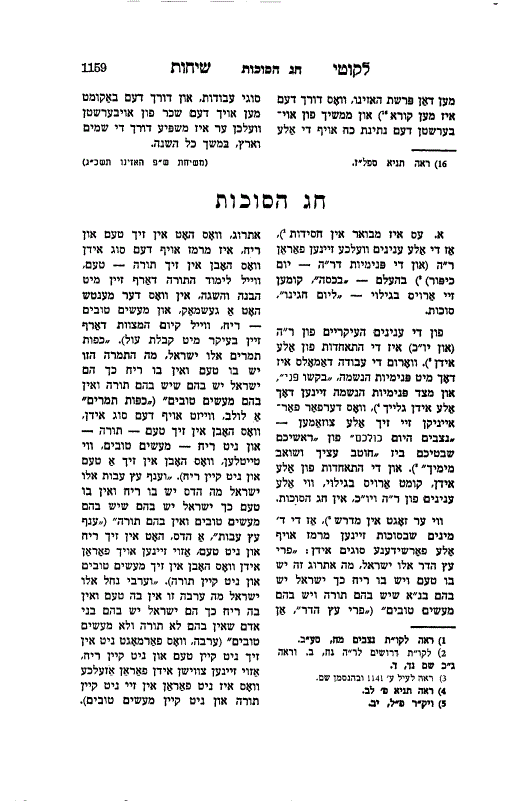
1. It is explained in Chassidus that all the matters which exist in a concealed state during Rosh Hashanah (and the inner aspect of Rosh Hashanah — Yom Kippur) — "in concealment" — are revealed during "the festival of our rejoicing," Sukkos.
One of the primary aspects of Rosh Hashanah (and Yom Kippur) is the unity of all Jews. This is because the service at that time is with the innermost part of the soul, "seek My face," and from the perspective of the innermost part of the soul, all Jews are equal. Therefore, all are united together — "You are all standing today, all of you, from your heads of tribes to your woodcutters and water drawers." And the unity of all Jews is revealed, like all matters of Rosh Hashanah and Yom Kippur, during the festival of Sukkos.
As it is stated in the Midrash, the four species of Sukkos symbolize all different types of Jews: the etrog, which has both taste and fragrance, symbolizes those Jews who possess both Torah — taste, since the study of Torah should be with understanding and comprehension, in which a person finds pleasure — and good deeds — fragrance, since the fulfillment of mitzvos should primarily be with acceptance of the yoke. The lulav, which has taste but no fragrance, represents those Jews who have Torah but lack good deeds. The myrtle, which has fragrance but no taste, symbolizes those Jews who have good deeds but lack Torah.
2. The Midrash explains that the four species of Sukkos symbolize all different types of Jews. The etrog, which has both taste and fragrance, symbolizes those Jews who possess both Torah and good deeds. This is because Torah is associated with taste, as the study of Torah should be with understanding and comprehension, in which a person finds pleasure. Good deeds are associated with fragrance, as the fulfillment of mitzvos should primarily be with acceptance of the yoke. The lulav, which has taste but no fragrance, represents those Jews who have Torah but lack good deeds. The myrtle, which has fragrance but no taste, symbolizes those Jews who have good deeds but lack Torah.
The unity of all Jews is revealed during the festival of Sukkos, similar to the unity experienced during Rosh Hashanah and Yom Kippur. This unity is expressed through the four species, which encompass all types of Jews. The etrog is considered the highest among them because it possesses both qualities. This demonstrates the importance of combining Torah and good deeds, as it brings out the inner essence of a Jew.
The unity achieved during Sukkos is a continuation of the unity from Rosh Hashanah and Yom Kippur, where all Jews stand together, from the heads of tribes to the woodcutters and water drawers. This unity is not only spiritual but also manifests physically, as all Jews come together to perform the mitzvah of the four species. The etrog, with its dual qualities, serves as a reminder of the ideal balance between Torah and mitzvos.
3. The essence of the soul; it is indeed true that the soul does not find satisfaction in mere physicality, until it fulfills the prohibition according to the Shulchan Aruch, for it has the will of the soul by default, as soon as it is not merely good deeds. This is because the soul desires only what is connected to the essence of G‑dliness. And so it is even with Torah, where it means that even if one does not have Torah, it is still about the fulfillment of mitzvos, which express the nullification of a Jew to the Almighty. A Jew performs good deeds, but only for the sake of the Almighty, doing as much as he is obligated. He follows the supreme will; however, the laws of the Shulchan Aruch and the dedication remain. The one who fulfills the mitzvah is engaged in Torah, not in his own existence. He is not a unique living entity of G‑dliness.
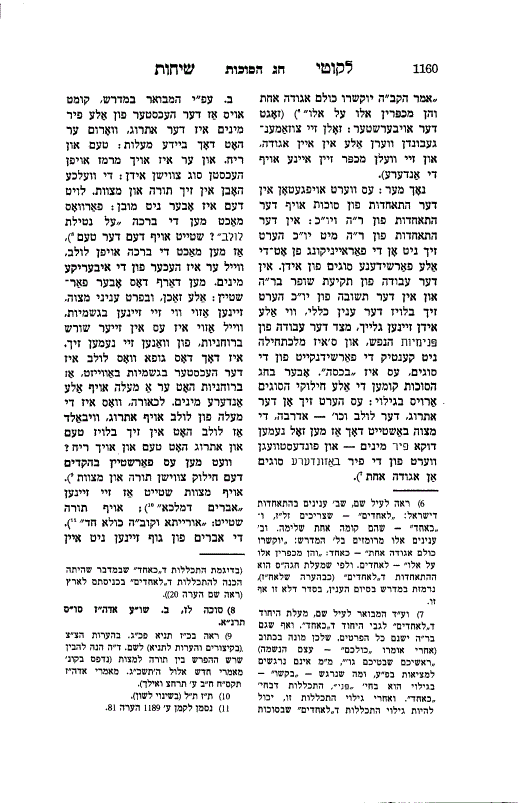
Unlike through learning Torah with comprehension and understanding, where the essence of the Jew is connected to the mitzvos. Because when he comprehends, the truth of the Holy One, blessed be He, is revealed in his intellect, and his intellect becomes a vessel for the Divine. He is transformed through this engagement, and he becomes one with the wisdom of the Almighty, as it is stated, "He and His wisdom are one." The connection with G‑dliness is through mitzvos, since the unique quality of Torah, as mentioned above, is not in the unity with the Almighty, but in the unity with the essence of the Almighty. This is understood, as the taking of the four species has the quality of the lulav, which represents the unity with the Almighty that is achieved through the study and understanding of Torah. The more a Jew dedicates himself to learning and understanding Torah, the more he becomes united with G‑dliness.
4. The other species represent the concept of Torah study. This indicates that Torah must be learned with understanding and comprehension. To clarify a matter in Torah, one must delve into it with intellectual effort, which is contrary to the simple shaking of the lulav. Nevertheless, the shaking during Torah study is necessary to demonstrate that even Torah, as it is grasped in understanding, is the wisdom of the Holy One, blessed be He. The shaking of the lulav shows that the lulav must have the required measure. This is because the shaking with the lulav is significant, and therefore the lulav must have the proper measure to fulfill the mitzvah.
All four species are, however, shaken together. The shaking is done specifically with the lulav, and particularly according to halacha, one must give it a shake. Only after this is the bringing of the offering performed. To this extent, the shaking with the lulav is important, so much so that the lulav must have the required measure. This is because the shaking of the lulav is significant, and therefore the lulav must have the proper measure to fulfill the mitzvah.
In general, the shaking of the lulav is on one level, because the levels of the infinite are beyond measure. The soul descends below into a body and performs its service in Torah. The main aspect of Torah is that it is beyond measure. Therefore, the concept of shaking is related to Torah — the lulav. The connection through Torah achieves this.
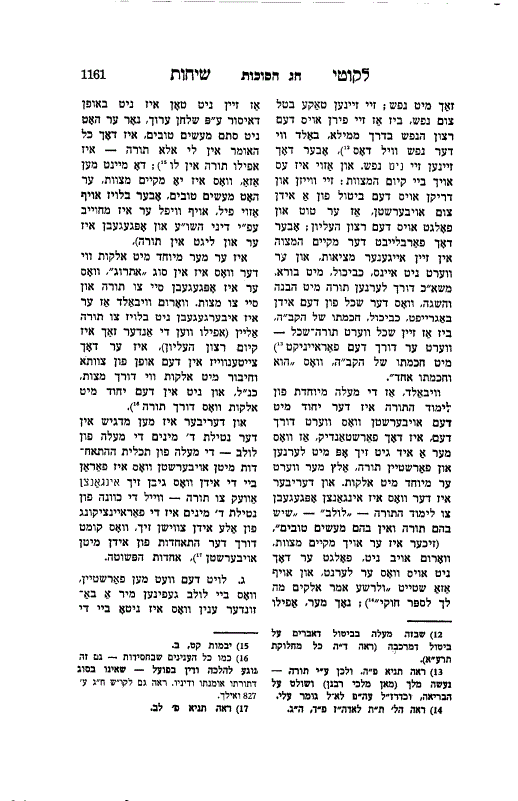
5. The study of Torah is such that it is a piece of another's essence. One must stand in a manner of "all that is in it" and with self-nullification. This adds to the unity with another. A person studying Torah must open himself to learning in a manner of nullification. This is true not only in the spiritual sense but also in the physical realm. There is a distinction between Torah and prayer or the mitzvah of the four species. In prayer, every day is the same, and the concept of nullification is constant. However, in Torah, every day is a new attainment. One must primarily come to the understanding that "a person does not grasp the words of Torah unless he has stumbled in them." The higher and greater the understanding, the more one must first nullify his own existence. The more one illuminates the intellect, the more he must first nullify his own existence. The reasoning comes first, and then the understanding follows. In the case of the esrog, which has taste and fragrance, one must first prepare himself. Later, he sees the taste and fragrance, and in the third stage, he moves the reasoning to the understanding. The esrog is an acronym for "do not touch the anointed one," until he feels the truth of the matter he is learning. As mentioned earlier, in the study of Torah, there is a unique advantage in the lulav.
6. A person is compared to a tree, and the main quality of a person is compared to fruits, which are the primary quality of a tree. Especially, the intellect is compared to a date palm, whose essence is taste (not fragrance). As mentioned in the Midrash, a person who is involved in Torah, the leaves, the foliage of a tree, have their quality in that they protect the fruits. This is also true in the intellect itself: the truth of the reasoning, the conclusion, is the fruit. The dialectic of the reasoning, which takes up the questions and protects from contradictions on the matter, is like the leaves that protect the fruits.
The natural inclination of a person is that the pleasure of the intellect is when a person reaches the conclusion, the outcome of the reasoning. While a person is in the midst of the dialectic, before he has resolved and removed the questions and contradictions,
7. All of this is but a drop in the ocean, and even less, because the Torah is "longer than the earth and broader than the sea," and the true essence of the Torah is hidden from us. The awareness that one is merely at the beginning negates any arrogance or pride that might come from knowledge of the Torah. On the contrary, knowing how far one is from the true essence of the Torah brings about humility and self-nullification. This is also hinted at in the "branches of palm trees" (lulav). "Branches" (כפות) can also mean "bound" (כפות), indicating that one is not separate or independent, G‑d forbid, but through this humility, one becomes connected and united with the Almighty.
It is specifically through the humility of the lulav that one reaches the highest level, because the more one is nullified, the higher one ascends and comes to truly understand the halacha. As our sages say about Beis Hillel, they were humble and therefore the halacha follows them.
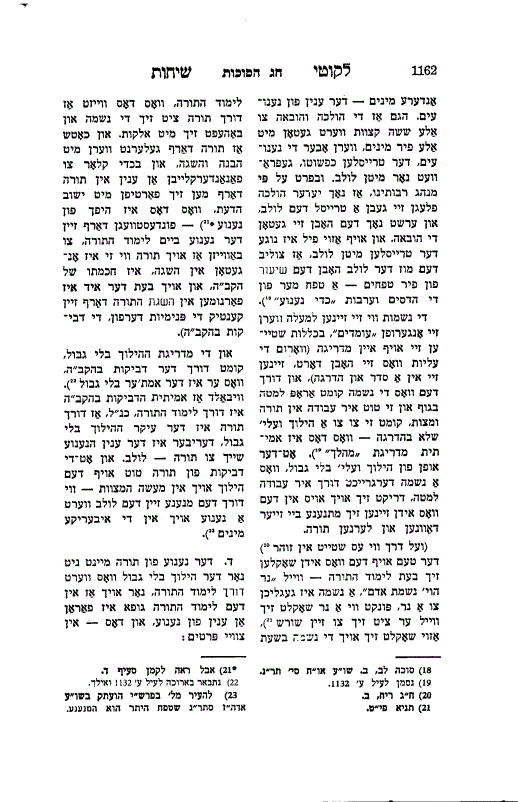
8. As mentioned earlier, all four species must be taken together as one unit, so that each type possesses the qualities of all the others. Even those who are in the category of the willow must have fixed times when they are in the state of the lulav — learning Torah in a manner of complete unity.
And during the times when they learn Torah in this manner, it influences them to move beyond their current state and status, so that they experience an unlimited progression in all other matters as well — like the movement of the lulav, which causes movement in the other three species, as mentioned earlier — in the fulfillment of mitzvos, etc., and even in mundane matters, in the spirit of "In all your ways, know Him," throughout the entire day, in a manner of progression.
The beginning of this for everyone is the toil and immersion in Torah study every day, "for its own sake," and the more one toils, the greater the promise that "you will find," according to the effort, like a discovery that comes unexpectedly. Through this, one will ultimately also reach the revelation of the inner dimensions of the Torah through our righteous Mashiach — whose coming is also a matter of discovery, as it is said, "I have found David, My servant," which refers to Mashiach, who will come unexpectedly. And the matters on which one has toiled and only grasped their revealed aspect, one will then merit to understand their reasons — the reasons of the Torah — with the coming of our righteous Mashiach, speedily in our days.
108. However, even that which is not subject to comprehension and will be revealed later is related to the soul and is not a new Torah, G‑d forbid. It is not that a new Torah will be given, but rather the revelation of the essence of the Torah, which was given to every Jew at Mount Sinai. The essence of the Torah is not something that can be grasped through comprehension. It belongs to the soul, and through learning Torah, one takes, as it were, G‑d Himself, as it is said, "You take Me with you." This is because the essence of the Torah is beyond comprehension, and even the greatest intellect is not a vessel for it.
Accordingly, the depth of these matters is such that even a small child who begins to learn Torah learns (at least in a hint) these profound matters. The usual order of study is from the easier to the more difficult, and one begins with simpler matters, then progresses to more complex ones. This is because, from the perspective of the created beings themselves, the small intellect is not a vessel for the essence of the Torah, just as the great intellect is not a vessel for it. It is only because "He chose us from all the nations" that He gave us His essence, and because He, the Omnipotent, chose us, He gave us His essence.