Likkutei Sichos Vol. 34 – Ha'azinu
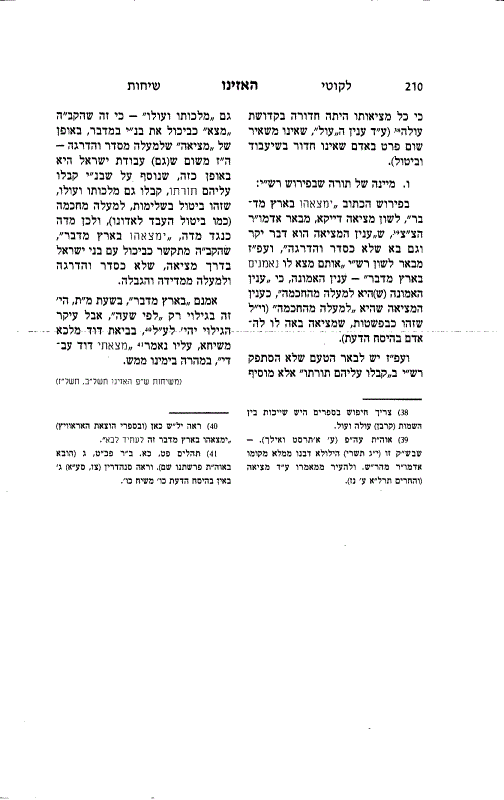
1. "He found them in a desert land," and Rashi explains: "He found them faithful to Him in the desert land, for they accepted His Torah, His sovereignty, and His yoke, unlike Ishmael and Esau, as it is said, 'He shone forth from Seir unto them; He appeared from Mount Paran.'"
The reason Rashi did not interpret this verse ("He found them in a desert land") according to its simple meaning, that G‑d "found" the Jewish people in the desert, meaning G‑d's choice of the Jewish people at Mount Sinai (at the time of the giving of the Torah), can be explained as follows: The beginning of G‑d's choice of the Jewish people was before they came to the desert, while they were still in Egypt, as it is explicitly stated in the verse "to take for Himself a nation from within a nation." Therefore, it is difficult to say that the "finding" of the Jewish people occurred in the desert. Consequently, Rashi interprets "He found them in a desert land" to mean that G‑d found the children of Israel "faithful to Him in the desert land, for they accepted His Torah, etc."
However, this interpretation also seems problematic — in the words of the Ramban: "This is not the theme of the passage, for the verse rebukes Israel and mentions the kindnesses that G‑d did for them, and they repaid Him with evil instead of good" — and how does it fit to insert in the midst of these words of rebuke, a praise of Israel "faithful... who accepted His Torah, etc."?
Based on this, Rashi should have brought (only) the translation of Onkelos: "He found them — He provided them with all their needs in the desert."
Especially since the continuation of this very verse "He encompassed them, He gave them understanding, He protected them, etc.," refers to "the kindnesses that G‑d did for them," as Rashi explains: "He encompassed them, He surrounded them and encircled them with clouds and surrounded them with banners... and surrounded them at the foot of the mountain, etc. He gave them understanding, there with the Torah and understanding. He protected them from the snake, the fiery serpent, and the scorpion, and from the nations" — and therefore, it would certainly be more fitting to interpret the beginning of the verse as also describing "the kindnesses that G‑d did for them."
Some explain the difficulty with the translation of Onkelos — because "the language of the verse does not bear it, for it should have said 'He provided them.'" But seemingly, this is not sufficient, because (besides the fact that it can be interpreted like the Rashbam "similar to 'and He found for them,' G‑d was their sufficiency" — in any case) this difficulty (which is only with the word "He found them") is not as great as the difficulty with Rashi's first interpretation, which is a general difficulty with the content of the interpretation, that "it is not the theme of the passage" (and also not the "theme" of the end of this very verse) — and at the very least, Rashi should have preceded the translation of Onkelos (as the first and primary interpretation in the simple meaning of the verse).
2. The Bera'am explains that this interpretation comes as a continuation to the verses and Rashi's interpretations before it, "because he gave the reason for the salvation of the generation of the dispersion from destruction and said it was because the future number of the children of Israel would emerge from them [when the Most High gave nations their inheritance, when He separated the children of man, He set the boundaries of the peoples according to the number of the children of Israel, as Rashi explains there], and afterwards, he explained what the matter of the number of the children of Israel was that the generation of the dispersion merited to be saved from destruction because of them, and he said it was because they are the portion of the L‑rd and His inheritance [as Rashi explains there 'Why all this? Because His portion was captured among them, etc., and who is His portion... His people Jacob, the lot of His inheritance'], he needed to make known further why these merited to be His people and His inheritance more than the children of Ishmael and the children of Esau, who are from the children of Abraham and Isaac like these, and he said it was because He found these faithful to Him in the desert land, for they accepted His Torah and His sovereignty."
2. However, Rashi's explanation requires further examination, as it is explicitly stated in Rashi's commentary on the preceding verse a different reason for "why these merited to be His people and His inheritance more than the children of Ishmael and the children of Esau." Rashi writes: "Jacob, the lot of His inheritance, and he is the third among the patriarchs, who is tripled with three merits: the merit of his grandfather, the merit of his father, and his own merit, which are like a rope made of three strands, and he and his children were His inheritance, not Ishmael, the son of Abraham, nor Esau, the son of Isaac" (since they do not have "three merits"). So why "was it necessary to make known further why these merited more than the children of Ishmael and the children of Esau"?
Moreover, and primarily: even if we say there is room to interpret that this verse follows the previous one ("for the L‑rd's portion is His people"), it still requires explanation: since the second part of the verse ("He encircled him, He granted him understanding, etc.") speaks about the goodness that G‑d did for Israel (and as is the content of the entire portion) — what is the necessity to divide the verse into two parts, and to interpret that its first part is a continuation and conclusion to "for the L‑rd's portion is His people," and its second part is an independent matter?
3. We also need to understand the lengthy wording of Rashi: "He found them faithful to Him in the desert land, for they accepted His Torah and His sovereignty and His yoke":
Rashi's introduction "He found them faithful to Him in the desert land" is understandable, as it refers (also) to the continuation of the verse "and in the wasteland, a howling desert," as Rashi explains there, "even there they followed faith and did not say to Moses, 'How shall we go out into the wilderness, etc., following you into the desert,'" meaning that the generality of the verse is that the Holy One, blessed be He, "found them faithful to Him in the desert land," and in this, there are two details: (a) they accepted His Torah, etc., (b) they did not say, "How shall we go out into the wilderness, etc."
But it needs clarification why Rashi specifies three matters in connection with the acceptance of the Torah — "for they accepted His Torah and His sovereignty and His yoke," and did not simply say, "for they accepted His Torah" [as he does later on the verse "He shone forth from Seir unto them, He appeared from Mount Paran" — which he brings here at the end of his explanation — "that they should accept the Torah and they did not want"]?
It also needs clarification what the two matters "His sovereignty and His yoke" are — seemingly, they are the same, as in the usual expression "the yoke of the kingdom (of Heaven)"?
Seemingly, one could say that "His yoke" means "the yoke of the mitzvos" — but it is difficult to interpret it this way, because (a) seemingly, the yoke of mitzvos is included in the acceptance of "His Torah" (which simply refers not only to the study of Torah but also to the observance of the mitzvos of the Torah); (b) in any case, Rashi should not have left "His yoke" ambiguous (which can also be interpreted as the yoke of sovereignty) but should have clarified "and the yoke of His mitzvos" or something similar.
4. And it can be explained as follows:
Rashi's explanation on "He found him" is a continuation of his explanation on the previous verse — "for the L‑rd's portion is His people, why all this [that He did not destroy the nations] because His portion was captured among them and was destined to emerge, and who is His portion — His people, and who is His people — Jacob, the lot of His inheritance," and he continues to explain it (not about the people of Israel — who are called by the name "Jacob" in many verses — but) about Jacob our forefather, who is "the lot of His inheritance" ("the third among the patriarchs, tripled with three merits... like a rope made of three strands") — and seemingly, the beginning is not the end, as it started with "His people" and concluded with "Jacob (our forefather)," and it should have said "the children of Jacob, the lot of His inheritance"?
From this, Rashi is compelled to explain that "He found him in the desert land" is a continuation of "Jacob, the lot of His inheritance," that initially, the verse explains the virtue of Jacob our forefather (because of which only he is the portion and inheritance of the Holy One, blessed be He, and not Ishmael and Esau) — "Jacob, the lot of His inheritance," "tripled with three merits": and afterwards, the verse continues that the triple merits of Jacob our forefather extended to his children ("His people") — therefore "the L‑rd's portion is His people" — that they too have three merits, "for they accepted His Torah and His sovereignty and His yoke" — corresponding to the "three merits" of Abraham, Isaac, and Jacob, as will be explained further.
4. Based on this, we understand why Rashi reiterates the exclusion of the descendants of Esau and Ishmael. Just as Ishmael and Esau themselves did not possess "three merits" (and therefore are not "His inheritance"), the same applies to their descendants (the nations of Ishmael and Esau). The three merits of the Jewish people (corresponding to the three patriarchs, as mentioned above), who "accepted His Torah, His sovereignty, and His yoke," are not found among them, "which Ishmael and Esau did not do."
5. Explanation of the matter:
The essence of the three aspects of "His Torah, His sovereignty, and His yoke" in simple terms is as follows:
"His Torah," meaning (in general) the study of Torah, is an aspect related to human intellect. Therefore, even the observance of the mitzvos of the Torah, expressed as "acceptance of His Torah," does not emphasize the acceptance of the decrees of the Holy One, blessed be He, but rather the instructions of the Torah that have a rational basis.
When a person accepts the "sovereignty" of the Holy One, blessed be He, it includes accepting His decrees, for this is the essence of sovereignty: that the people accept upon themselves to listen to the king and accept his decrees, even if they do not know or understand the reason, etc.
However, accepting "His yoke" is a deeper matter, where not only do they accept upon themselves to fulfill the king's commandments, but they subjugate their very being to Him, so that His yoke is always upon them.
This is the novelty of "His yoke" over "His sovereignty": mere acceptance of sovereignty does not negate complete freedom in one's personal life, similar to a mortal king, whose rule and laws do not pertain to all aspects of a person's life, but only to matters related to the state, the kingdom, or the king. In contrast, accepting a yoke is like a true servant who is constantly and perpetually subjugated to his master, day and night, and his life is not his own because his master's yoke is always upon him.
These are the three aspects that were innovated in the Jewish people through the acceptance of the Torah: in addition to accepting to fulfill the Torah's instructions, they also accepted His sovereignty (and said "we will do" before "we will hear"), and furthermore, they accepted the yoke of the Holy One, blessed be He, "to be subjugated to Me."
Based on this, we also understand the connection between these three aspects and the three patriarchs, Abraham, Isaac, and Jacob — for each of the patriarchs was distinguished — according to the simple meaning of the text — in one of these three qualities:
"His Torah" — we find particularly with Jacob our forefather, who was engaged in Torah study, as it is written, "Jacob was a wholesome man, dwelling in tents," "the tent of Shem and the tent of Eber" (and even in his mother's womb, Jacob "struggled to come out" when Rebecca "passed by the study halls of Shem and Eber").
"His sovereignty" — is among the virtues of Abraham our forefather, who was involved in proclaiming the sovereignty of the Holy One, blessed be He, in the world, as it is said, "and he called there in the name of the L‑rd, G‑d of the world," and as Rashi explains there, that Abraham caused the name of the Holy One, blessed be He, to be called "G‑d of the entire world," and Rashi also explains that through Abraham, the Holy One, blessed be He, was called "G‑d of the land."
And "His yoke" — which is a constant yoke, to the extent that a person has no freedom for himself at all — this corresponds to the service of Isaac, as Rashi explains that through the binding, Isaac became a "perfect offering" (which is wholly for G‑d) — and therefore he was not permitted to leave the Land of Israel or marry a maidservant, because his entire being was imbued with the sanctity of an offering (similar to the concept of "yoke," which leaves no aspect of a person unimbued with subjugation and nullification).
6. The inner dimension of Torah in Rashi's commentary:
In the explanation of the verse "He found him in a desert land," the specific use of the term "found" is explained by the Tzemach Tzedek, who states that "finding" implies something precious and also something that comes unexpectedly and without order. Based on this, he explains Rashi's words "He found them faithful in a desert land" as referring to the concept of faith, because "faith is above wisdom," similar to a finding which is "above wisdom" (and it can be said that this is like the simple understanding, that a finding comes to a person unexpectedly).
7. Based on this, we can explain why Rashi does not suffice with "they accepted His Torah" but also adds "His kingship and His yoke." The reason that the Holy One, blessed be He, "found" the Jewish people in the desert, in a manner of "finding" that is beyond order and hierarchy, is because the service of the Jewish people is also in such a manner. In addition to accepting His Torah, they also accepted His kingship and His yoke, which represents complete nullification, beyond wisdom (like the nullification of a servant to his master). Therefore, measure for measure, "He found them in a desert land," meaning that G‑d, as it were, connects with the Jewish people in a manner of finding, beyond order and hierarchy, and beyond measure and limitation.
However, "in a desert land," at the time of the giving of the Torah, this was revealed only temporarily, but the main revelation will be in the future, with the coming of David, the King Messiah, about whom it is said, "I have found David My servant," speedily in our days, amen.