Likkutei Sichos Vol. 34 – Aseres Yemei Teshuvah
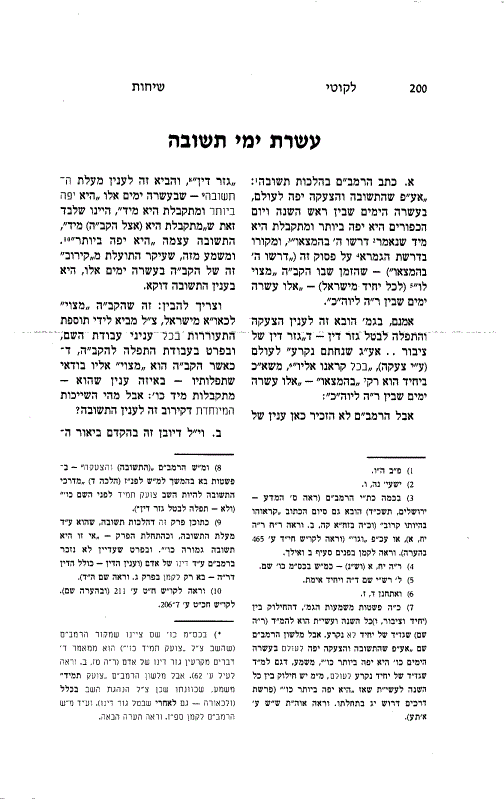
1. The Rambam writes in Hilchos Teshuvah: "Although repentance and crying out [to G‑d] are always appropriate, during the ten days between Rosh Hashanah and Yom Kippur they are especially beautiful and are accepted immediately, as it is stated, 'Seek G‑d when He is to be found.'" The source of this is the Gemara's interpretation of this verse ("Seek G‑d when He is to be found") — that the time when G‑d is "found" for each individual Jew is "these ten days between Rosh Hashanah and Yom Kippur." However, in the Gemara, this is brought in the context of crying out and prayer to annul a decree — for "a communal decree, even if it is sealed, can be torn up" through crying out, "whenever we call to Him," whereas for an individual, it is only "when He is to be found" — "these ten days between Rosh Hashanah and Yom Kippur." Yet, the Rambam does not mention the concept of a "decree" here, and he brings this in relation to the virtue of repentance — that during these ten days "it is especially beautiful and is accepted immediately," meaning that besides the fact that "it is accepted (by G‑d) immediately," the repentance itself "is especially beautiful." This implies that the primary benefit of this "closeness" of G‑d during these ten days is specifically in the matter of repentance. We need to understand: the fact that G‑d is "found" for each and every Jew should lead to an increased awakening in all matters of serving G‑d, especially in the service of prayer to G‑d, for when G‑d is "found" to him, certainly his prayers — in any matter — are accepted immediately, etc.; but what is the special connection of this closeness to the matter of repentance?
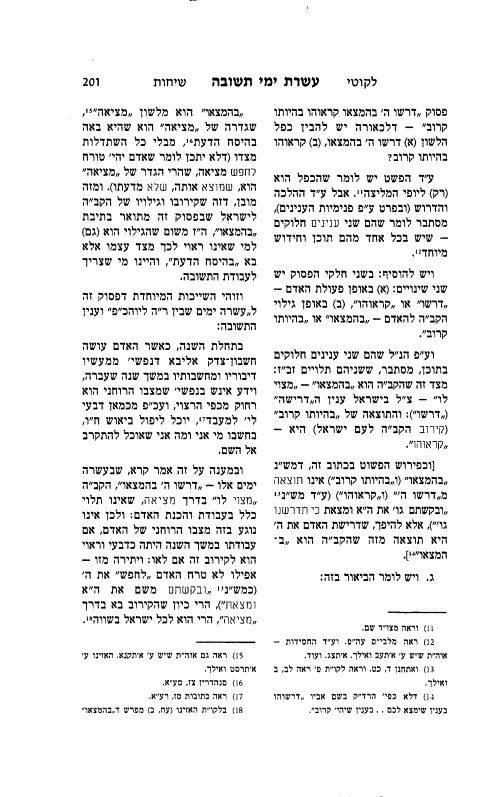
2. It can be explained by first understanding the verse "Seek G‑d when He is to be found, call upon Him when He is near" — seemingly, we need to understand the repetition: (a) Seek G‑d when He is to be found, (b) call upon Him when He is near? In the simple sense, one could say that the repetition is (only) for the beauty of expression. However, according to halacha and drush (and especially according to the inner dimensions of the matters), it is reasonable to say that they are two distinct matters — each with its own content and unique innovation. Furthermore, in the two parts of the verse, there are two differences: (a) in the manner of the person's action — "seek" or "call upon," (b) in the manner of G‑d's revelation to the person — "when He is to be found" or "when He is near." Based on the above, that they are two distinct matters in content, it is reasonable that they are interdependent: because G‑d is "when He is to be found" — "found to him" — there must be in Israel the matter of "seeking" ("Seek"); and the result of "when He is near" (G‑d's closeness to the people of Israel) is — "call upon Him." [And as the simple interpretation of this verse, that what is stated "when He is to be found" (and "when He is near") is not a result of "Seek G‑d" (and "call upon Him") (as is stated "And you will seek the L‑rd your G‑d and you will find Him if you search for Him"), but rather the opposite, that the person's seeking of G‑d is a result of the fact that G‑d is "when He is to be found"].
3. It can be said that the explanation is as follows: "When He is to be found" is from the language of "finding," which is defined as something that comes unexpectedly, without any effort on his part (for it is not possible to say that a person would toil to find a "finding," as the definition of a "finding" is that he finds it without his knowledge). From this, it is understood that the closeness and revelation of G‑d to Israel described in this verse with the term "when He is to be found" is because the revelation is (also) to someone who is not worthy of it on his own but comes "unexpectedly," meaning someone who needs the service of repentance. This is the special connection of this verse to "the ten days between Rosh Hashanah and Yom Kippur" and the matter of repentance: at the beginning of the year, when a person makes a true accounting of his deeds, words, and thoughts over the past year, and a person knows within himself that his spiritual state is far from what is desired, and at least from what he ought to be doing.
4. A person might fall into despair, G‑d forbid, thinking, "Who am I, and what am I, that I can draw close to G‑d?" In response to this, the verse states that during these ten days — "Seek the L‑rd while He may be found," the Holy One, blessed be He, is "found" like a discovery, which does not depend at all on the person's effort or preparation. Therefore, the person's spiritual state is irrelevant in this matter, whether his service throughout the year was as it should be and he is worthy of this closeness or not. Moreover, even if the person did not exert himself to "search" for G‑d (as it is written, "And you will seek the L‑rd your G‑d from there and you will find Him"), since the closeness comes in the manner of a "discovery," it is equal for all of Israel.
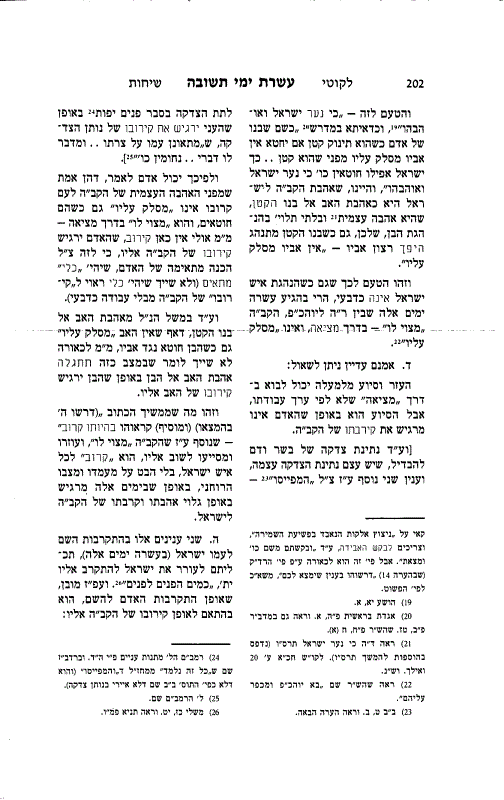
The reason for this is "for Israel is a youth, and I love him," as it is stated in the Midrash, "Just as a person's son, when he is a small child, if he sins, his father does not abandon him because he is a child... so too, Israel, even when they sin, etc., for Israel is a youth, and I love him." This means that G‑d's love for Israel is like a father's love for his young son, which is an intrinsic love and not dependent on the son's behavior. Therefore, even when his young son behaves contrary to his father's will, "his father does not abandon him." This is the reason that even when a Jewish person's conduct is not as it should be, when these ten days between Rosh Hashanah and Yom Kippur arrive, G‑d is "found" to him like a discovery and does not "abandon him."
5. However, one might still ask: The help and assistance from above can come in a manner of "discovery," not commensurate with his service, but the assistance is such that the person does not feel G‑d's closeness. [Similar to the giving of charity by a human being, where there is the act of giving charity itself, and an additional aspect must be "to appease him" — to give the charity with a pleasant demeanor, in a way that the poor person feels the closeness of the giver, who "sympathizes with him in his distress... and speaks comforting words to him."]. Therefore, a person might say that while it is true that because of G‑d's intrinsic love for His close nation, He does not "abandon them" even when they sin, and He is "found" to them like a discovery — nevertheless, perhaps there is no closeness that the person feels G‑d's closeness to him, because for this, there must be a proper preparation of the person, to be a fitting "vessel" (and it is not possible to be a fitting vessel for G‑d's "closeness" without proper service). Similar to the above analogy of a father's love for his young son, even though the father does not "abandon him" even when the son sins against his father, nevertheless, it would seem that in such a state, the father's love for the son would not be revealed in a way that the son feels his father's closeness to him. This is what the verse continues to say, "(Seek the L‑rd while He may be found) (and adds) call upon Him while He is near" — that in addition to G‑d being "found" to him, and helping and assisting him to return to Him, He is "near" to every Jewish person, regardless of his spiritual state, in a way that during these days, he openly feels G‑d's love and closeness to Israel.
6. These two aspects of G‑d's closeness to His people Israel (during these ten days) are intended to awaken Israel to draw close to Him, "as water reflects a face to a face." Based on this, it is understood that the manner of a person's closeness to G‑d corresponds to the manner of G‑d's closeness to him:
The fact that G‑d is "found" to each and every one of Israel, like a discovery (without any effort on the person's part) — this awakens the person, that in exchange for his relationship to matters of Torah and mitzvos being like a "discovery" (where there was a lack of effort and toil in the service of G‑d), he must strive and toil to draw close to G‑d. This is what the verse states — "Seek the L‑rd while He may be found," that the state of "while He may be found" awakens the person to seek the L‑rd, and therefore the verse specifically uses "seek" (and not "search" or similar terms) — because the term "seek" indicates a very strong request and search.
7. The term "seek" implies a demand, as seen in the words of our Sages: "We make a remembrance for the Temple... Zion... requires seeking" — the emphasis here is specifically on seeking, indicating that a mere request for redemption is insufficient. Rather, there must be a constant demand, as our Sages have stated (and this has been brought into halacha) that the reason we pray three times a day for redemption is because Israel must demand the redemption from the Holy One, blessed be He. This demand is expressed in the phrase "May the offspring of Your servant David speedily flourish," a demand and insistence that our righteous Mashiach should come quickly, immediately.
The second aspect mentioned in the verse — "while He is near" — refers to the heavenly assistance in such a way that a person can feel the closeness and revealed love of the Holy One, blessed be He, to His people Israel. This brings a person to a similar state and service — measure for measure — where his service is in the manner of "call upon Him." It is known that "calling" (with voice and speech) indicates revelation (like a person's speech that reveals what was hidden and concealed in his thought). This means that he does not suffice with seeking (which comes from the inner depths of his soul), but he does everything in his power to ensure that the Divine Presence shines upon him in a revealed manner, in all the faculties of his soul.
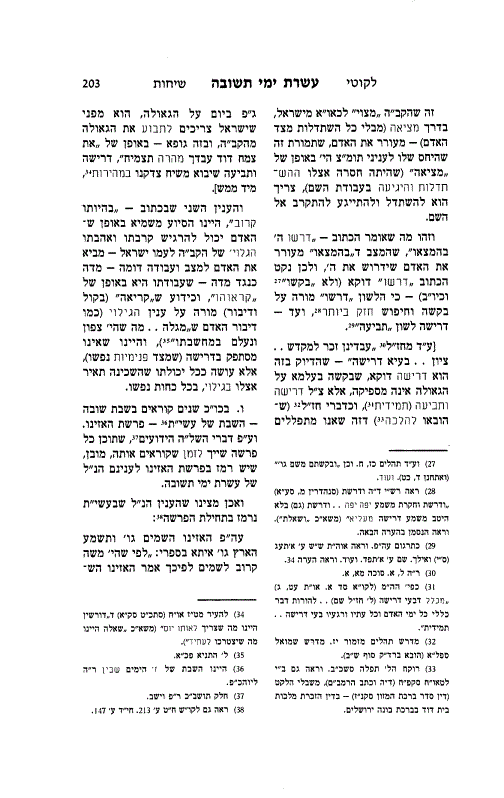
8. For many years, on Shabbos Shuvah — the Shabbos of the Ten Days of Repentance — we read Parshas Haazinu. According to the well-known words of the Shelah, that the content of each parsha is connected to the time it is read, it is understood that there is an allusion in Parshas Haazinu to the aforementioned matters of the Ten Days of Repentance. Indeed, we find that this concept of the Ten Days of Repentance is hinted at the beginning of the parsha: On the verse "Give ear, O heavens, and I will speak; and let the earth hear the words of my mouth," the Sifri states: "Since Moshe was close to the heavens, he said 'Give ear, O heavens,' and since he was far from the earth, he said 'and let the earth hear.'" The connection of this matter to the Ten Days of Repentance is simple — since during this time the Holy One, blessed be He, is "found... near" to every Jew, every Jew has the ability to be "close to the heavens," to feel himself close to the Holy One, blessed be He ("heavens"), and consequently — "far from the earth" (earthly and material matters).
Based on the detailed explanation above, that in this verse — "Seek the L‑rd while He may be found, call upon Him while He is near" — two aspects of G‑d's closeness to Israel are hinted at, and accordingly, two ways of a person's closeness to G‑d, it can be said that these two aspects are also hinted at in the aforementioned statement of the Sifri.
9. This can be understood by prefacing with an additional explanation of the Sifri's words "Since Moshe was close to the heavens... far from the earth": The Alter Rebbe interprets the verse "Give ear, O heavens... and let the earth hear..." as referring to two aspects in the service of G‑d: "Heavens" refers to Torah, "for the Torah is from the heavens" ("I spoke to you from the heavens"), and "the earth" refers to mitzvos, which are performed in actual physical deeds (as most mitzvos, if not all, are fulfilled with physical and earthly things).
10. According to this, it seems necessary to clarify: How can we explain the aforementioned statement of the Sifri, that Moshe was "far from the earth," according to the Alter Rebbe's interpretation that "earth" refers to mitzvos? The explanation can be given as follows: According to the simple interpretation, "heavens" indicates spiritual matters and "earth" indicates earthly matters — thus, being far from the earth is merely a negative aspect, where a person is distant and removed from earthly matters. However, according to the Alter Rebbe's interpretation, where "earth" also refers to spiritual matters, it must be said that the concept of "distance" is not one of negation and separation, but rather it itself is a path in the service of G‑d. That is, the service of G‑d in matters of "earth" (mitzvos) is in the aspect of "distance."
The explanation of the matter is as follows: The service in the aspect of "closeness" means that a person feels close to G‑d, which occurs when he understands and comprehends the greatness of G‑d with his intellect, and similarly, he feels in his soul a love for G‑d, etc. The service in the aspect of "distance" is the acceptance of the yoke of the Kingdom of Heaven, meaning that even when there is a deficiency in the service of intellect and emotions (when his understanding is limited in comprehending the greatness of G‑d and he has not yet reached a state where his heart is aroused with love for G‑d, etc., so that he feels himself "distant" from G‑d), nevertheless, he serves out of acceptance of the yoke of His blessed Kingdom.
This is the (inner) explanation of "close to the heavens (Torah)... far from the earth (mitzvos)" in the service of G‑d itself: Through the study of Torah, a "wondrous unification" occurs between the intellect of man and the wisdom of the Blessed One, until they become "truly united and one from every side and angle," because when a person understands and comprehends the words of Torah properly, the Torah he learns becomes united with his intellect and they become one — this is "close to the heavens," that concerning "heavens" — Torah — a person must be "close," that the grasp of the words of Torah is in a manner of "closeness." In contrast, with mitzvos, the primary intention is the acceptance of the yoke of mitzvos, "Who sanctified us with His commandments and commanded us." Therefore, the main aspect of mitzvos is (not the intention of the mitzvos — through which a person feels his connection to the mitzvah and the benefit, etc., in its performance — but rather) the actual performance of the mitzvos, because it is specifically through the actual deed that the expression of doing it because "He commanded us" is revealed, the nullification of the person to the Holy One, blessed be He, and the acceptance of His yoke. This is the explanation of "far from the earth" according to the interpretation that it refers to mitzvos — that the service of "earth," the fulfillment of mitzvos, should be in a manner of "distance," the service of acceptance of the yoke.
11. According to this, it can further be said that these two paths correspond to the two aspects hinted at in the verse "Seek the L‑rd while He may be found, call upon Him while He is near": "Seek the L‑rd while He may be found" — which is the seeking of a person when the Holy One, blessed be He, is (only) "found to him," but there is not yet a feeling of closeness and revelation to the person — is akin to the service of acceptance of the yoke, where the person feels himself "distant" from G‑d, yet he accepts upon himself His blessed yoke. In contrast, "call upon Him while He is near" — is the service in a manner of "closeness" and revelation, where the person exerts himself with his intellect to understand His blessed wisdom, until a "wondrous unification" occurs as mentioned above; as also explained in Tanya
regarding why "the study of Torah is called by the term 'calling'... that through the study of Torah one calls to the Holy One, blessed be He, to come to him, as it were, like a person who calls to his friend to come to him and like a small child who calls to his father to come to him to be with him together" (and as explained there that this "calling" is specifically through Torah)
— similar to what was explained above in the interpretation of "close to the heavens." "(From the talks of 6 Tishrei 5747, Shabbos Shuvah 5727)"