Likkutei Sichos Vol. 34 – Chag HaSukkos
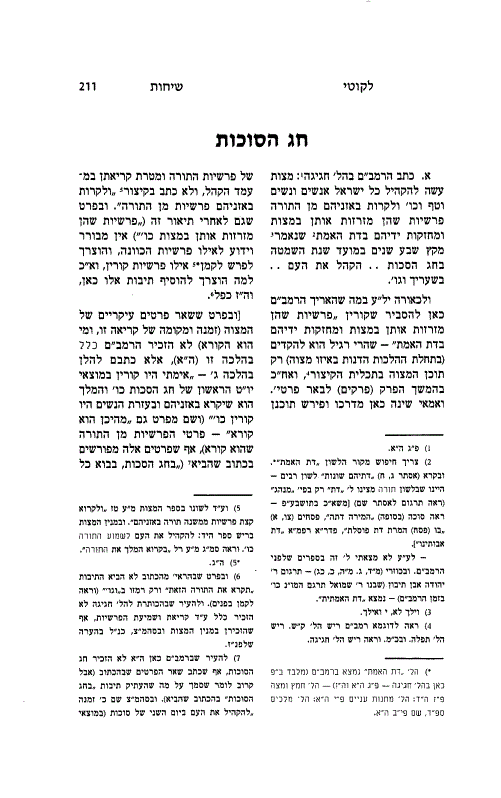
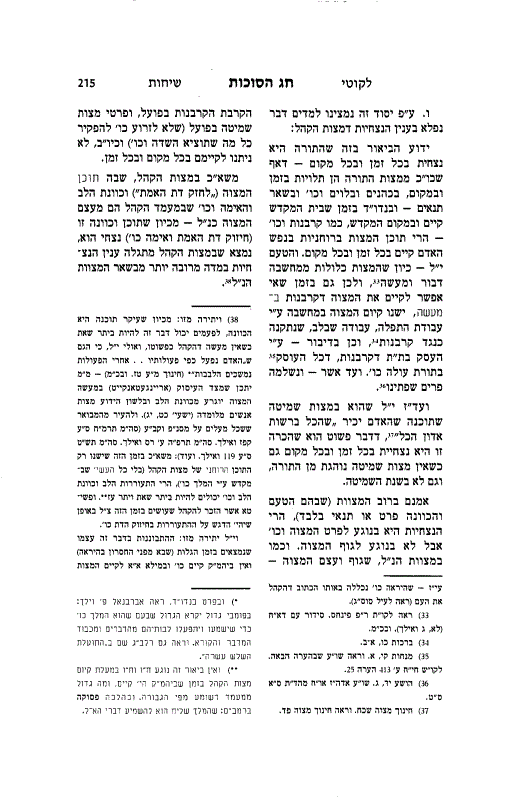
1. The Rambam writes in Hilchos Chagigah: "It is a positive commandment to gather all of Israel—men, women, and children, etc.—and to read in their ears from the Torah sections that encourage them in the mitzvos and strengthen their hands in the true religion, as it is stated, 'At the end of seven years, at the appointed time, in the festival of Sukkos, gather the people... at your gates, etc.'"
At first glance, one might question why the Rambam elaborates here to explain that they read "sections that encourage them in the mitzvos and strengthen their hands in the true religion." Typically, he begins (at the start of the laws discussing a particular mitzvah) with only a very brief summary of the mitzvah's content, and then later in the chapter(s) elaborates on its details. Why did he deviate from his usual practice here and explain the content of the Torah sections and the purpose of their reading at the Hakhel assembly, instead of briefly stating, "and to read in their ears sections from the Torah"? Especially since even after this description ("sections that encourage them in the mitzvos, etc."), it is not clear or known to which sections he is referring, and he needed to explain later which sections are read. If so, why did he need to add these words here, as it seems redundant?
[Particularly since other essential details of the mitzvah (the time and place of this reading, and who reads) are not mentioned by the Rambam at all in this halacha (halacha 1), but are written later in halacha 3—"When would they read? On the night following the first day of the festival of Sukkos, etc., and the king would read in their ears, and in the women's courtyard they would read, etc." (and there he also specifies "from where he reads"—the details of the Torah sections he reads), even though these details are explicitly mentioned in the verse he brought ("in the festival of Sukkos, when all Israel comes to appear before the L‑rd your G‑d, in the place which He shall choose, you shall read, etc.")—whereas the content of the sections is not specified in the verse, and it only states, "you shall read this Torah," yet this is what he explains immediately at the beginning of the halacha.]
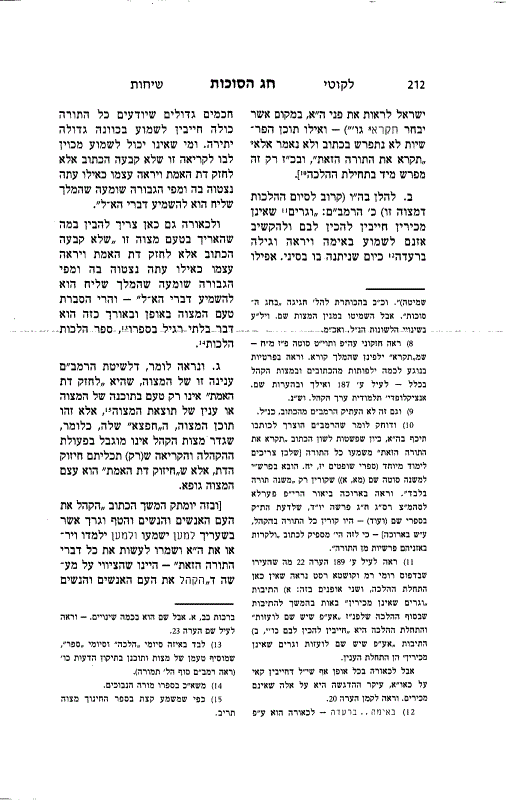
2. Later, in halacha 6 (near the end of the laws of this mitzvah), the Rambam writes: "And converts who do not understand must prepare their hearts and listen with their ears to hear with awe and reverence, joy and trembling, as on the day it was given at Sinai. Even great sages who know the entire Torah are obligated to listen with great intent. And one who cannot hear should focus his heart on this reading, for the Torah only established it to strengthen the true religion, and he should see himself as if he is now commanded in it and hears it from the mouth of the Almighty, for the king is the emissary to convey the words of G‑d."
Here too, it seems necessary to understand why he elaborates on the reason for this mitzvah "for the Torah only established it to strengthen the true religion, and he should see himself as if he is now commanded in it and hears it from the mouth of the Almighty, for the king is the emissary to convey the words of G‑d"—for explaining the reason for a mitzvah in such a manner and length is unusual in his book, the Book of Laws.
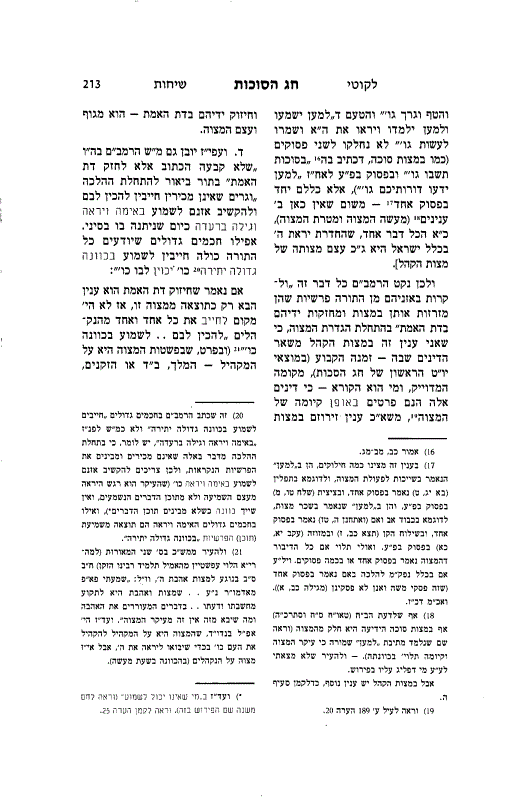
3. It seems one could say that according to the Rambam, this aspect of the mitzvah, which is "to strengthen the true religion," is not merely a reason within the content of the mitzvah or an outcome of the mitzvah, but it is the essence of the mitzvah, its "object." In other words, the definition of the mitzvah of Hakhel is not limited to the act of gathering and reading, whose (only) purpose is to strengthen the religion, but rather "strengthening the true religion" is the very mitzvah itself.
[This clarifies the continuation of the verse, "Gather the people, the men, the women, and the children, and your stranger who is within your gates, that they may hear and that they may learn and fear the L‑rd your G‑d, and observe to do all the words of this Torah"—meaning that the commandment to "gather the people, the men, the women, and the children, and your stranger, etc." and the reason "that they may hear and that they may learn and fear the L‑rd your G‑d, and observe to do, etc." are not divided into two verses (as in the mitzvah of Sukkah, where it is written "You shall dwell in booths, etc." and in a separate verse afterwards "that your generations may know, etc."), but are included together in one verse—because there are not two separate matters (the act of the mitzvah and the purpose of the mitzvah), but rather it is all one thing, that instilling the fear of G‑d within the Jewish people is also the very essence of the mitzvah of Hakhel.]
3. Therefore, the Rambam begins his definition of the mitzvah of Hakhel with "and to read in their ears from the Torah sections that encourage them in the mitzvos and strengthen their hands in the true religion." This is because this aspect of the mitzvah of Hakhel is different from other laws associated with it—such as its fixed time (on the night following the first day of the festival of Sukkos), its precise location, and who is the reader—since these laws are details in the manner of fulfilling the mitzvah. However, the aspect of encouraging them in the mitzvos and strengthening their hands in the true religion is part and parcel of the essence of the mitzvah itself.
4. Based on this, we can also understand what the Rambam writes in Halacha 6: "The Torah only established it to strengthen the true religion," as an explanation for the beginning of the halacha: "And converts who do not understand must prepare their hearts and listen with awe and reverence, joy and trembling, as on the day it was given at Sinai. Even great sages who know the entire Torah are obligated to listen with great intent, etc., and should focus their hearts, etc."
If we were to say that strengthening the true religion is merely a result of this mitzvah, then there would be no reason to obligate each and every one of those gathered to "prepare their hearts... to listen with intent, etc." (especially since, simply put, the mitzvah is upon the one who gathers—the king, the court, or the elders, according to the different opinions on this). However, since "the Torah established it... to strengthen the true religion," meaning that this is the essence of the mitzvah—it is obvious that the obligation of "intent" rests upon each individual.
Just as the definition of the mitzvah of Hakhel includes reading sections from the Torah "that encourage them in the mitzvos and strengthen their hands in the true religion," so too it includes the obligation upon each individual that their presence and listening at the time of the event should be in a manner of "preparing their hearts and listening with awe, etc."
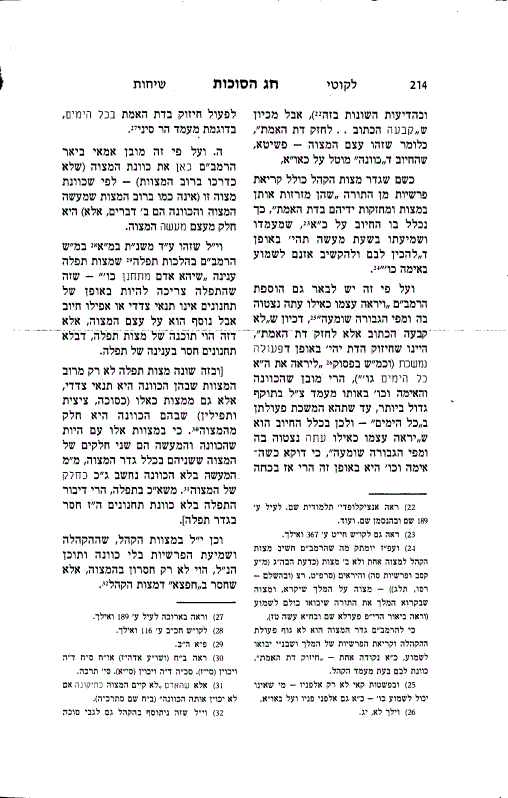
Accordingly, we can also explain the Rambam's addition: "and he should see himself as if he was now commanded in it and hears it from the mouth of the Almighty," because since "the Torah only established it to strengthen the true religion," meaning that the strengthening of the religion should be in a manner of continuous effect (as it is written in the verse "to fear the L‑rd your G‑d all the days, etc."), it is understood that the intent and awe, etc., at that moment must be with the greatest intensity, so that their effect continues "all the days"—and therefore, included in the obligation is that "he should see himself as if he was now commanded in it and hears it from the mouth of the Almighty," because only when the awe, etc., is in this manner can it effectively strengthen the true religion all the days, similar to the event at Mount Sinai.
5. Based on this, we understand why the Rambam explains the intent of the mitzvah here (unlike his usual approach with most mitzvos)—because the intent of this mitzvah (is not like in most mitzvos where the act of the mitzvah and the intent are two separate matters, but rather) is part of the very act of the mitzvah.
It can be said that this is similar to what is explained elsewhere regarding what the Rambam writes in the laws of prayer that the mitzvah of prayer involves "that a person should supplicate, etc."—that the requirement for prayer to be in the manner of supplication is not an additional condition or even an obligatory addition to the essence of the mitzvah, but rather this is the content of the mitzvah of prayer, for without supplication, the essence of prayer is lacking.
[In this, the mitzvah of prayer differs not only from most mitzvos where intent is a side condition, but also from those mitzvos (like Sukkah, Tzitzis, and Tefillin) where intent is part of the mitzvah. For in these mitzvos, although intent and action are two parts of the mitzvah, both are included in the definition of the mitzvah, yet the action without intent is also considered a part of the mitzvah. However, in prayer, the words of prayer without the intent of supplication lack the definition of prayer.]
Similarly, it can be said regarding the mitzvah of Hakhel, that the gathering and hearing of the sections without the above-mentioned intent and content is not only a deficiency in the mitzvah, but it lacks the "object" of the mitzvah of Hakhel.
6. Based on this foundation, we learn a wondrous thing about the eternal nature of the mitzvah of Hakhel:
7. It is known that the explanation regarding the eternity of the Torah in every time and place is that even though many mitzvos of the Torah are dependent on time and place, on Kohanim and Leviim, etc., and on other conditions—and in our case, on the time when the Beis Hamikdash exists and in the place of the Mikdash, like the offerings, etc.—the essence of the mitzvos in their spiritual form within the soul of a person exists at all times and in all places. The reason for this can be explained as follows: Since the mitzvos are comprised of thought, speech, and action, therefore, even at a time when it is impossible to fulfill the mitzvah of offerings in action, the mitzvah can be fulfilled in thought through the service of prayer, the service of the heart, which was instituted in place of the offerings, and also in speech—through the study of the Torah concerning the offerings, as it is said, "Whoever engages in the study of the Torah of the burnt offering, etc." And to the extent that "we will render the bulls of our lips."
Similarly, it can be said regarding the mitzvah of Shemittah, whose essence is that a person should recognize "that everything is under the domain of the Master of all," it is obvious that this recognition is eternal at all times and in all places, even when the mitzvah of Shemittah is not practiced by Torah law, and even not in the Shemittah year.
However, in most mitzvos (where the reason and intent are merely a detail or condition), the eternity pertains to the detail of the mitzvah, etc., but not to the essence of the mitzvah. For example, in the aforementioned mitzvos, the essence and core of the mitzvah—the actual offering of sacrifices, and the specific details of the mitzvah of Shemittah in practice (not to sow, etc., to relinquish ownership of all that the field produces, etc.) and similar, were not given to be fulfilled in every place and at all times.
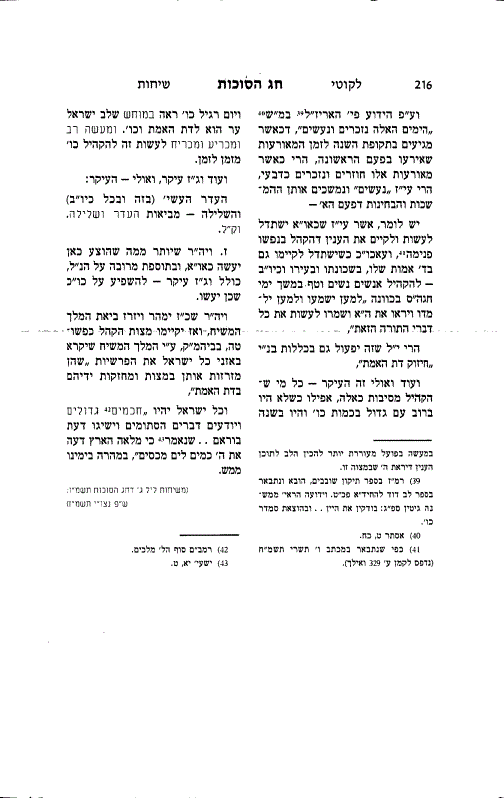
In contrast, in the mitzvah of Hakhel, where the essence of the mitzvah ("to strengthen the true religion") and the intent of the heart and the awe, etc., in the Hakhel assembly are part of the essence of the mitzvah as mentioned above—since this essence and intent (strengthening the true religion and awe, etc.) are eternal, it follows that in the mitzvah of Hakhel, the aspect of eternity is revealed to a greater extent than in the aforementioned mitzvos.
And according to the known explanation of the Arizal on the verse "these days are remembered and performed," that when we reach the time of year when the events originally occurred, when these events are properly remembered, they are "performed" and the same influences and aspects of the first time are drawn down—
It can be said that by each person striving to fulfill the matter of Hakhel within his own soul, and certainly when striving to fulfill it also within his four cubits, in his neighborhood and city, etc.—to gather men, women, and children during the days of the festival of Sukkos with the intent "that they may hear and that they may learn and fear the L‑rd your G‑d and observe to do all the words of this Torah,"
it can be said that this will also have an effect on the entirety of the Jewish people, "strengthening the true religion,"
and perhaps this is the main point—everyone who gathered such assemblies, even when they were not with a large multitude quantitatively, etc., and were on an ordinary day and year, etc., saw tangibly that the heart of Israel is awake to the true religion, etc. This is a great and decisive action that compels one to do this, to gather, etc., from time to time.
And furthermore, and this too is essential, and perhaps—the main point:
The absence of action (in this and in all similar matters) and the negation—bring about absence and negation. And it is easily understood.
8. May it be G‑d's will that more than what has been proposed here, each one will do, and with much addition to the above, including—and this is also essential—to influence many others to do so as well.
And may it be G‑d's will that all this will hasten and speed up the coming of King Moshiach, and then the mitzvah of Hakhel will be fulfilled in its literal sense, in the Beis Hamikdash, by King Moshiach who will read in the ears of all Israel the sections "that urge them in the mitzvos and strengthen their hands in the true religion,"
and all Israel will be "great sages and knowers of hidden matters and will attain the knowledge of their Creator... as it is said, 'For the earth shall be full of the knowledge of the L‑rd as the waters cover the sea,'" speedily in our days, amen.
"(From the talks of the night of the third day of the festival of Sukkos 5746; Parshas Nitzavim 5747)"