Likkutei Sichos Vol. 34 – Rosh Hashanah
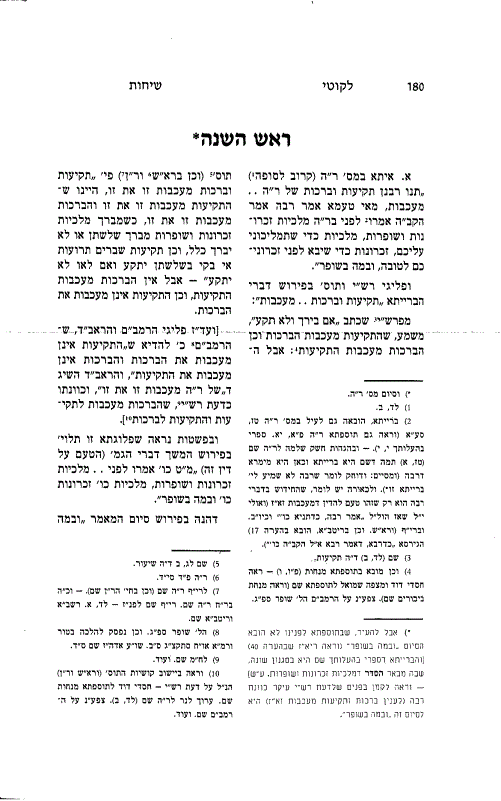
1. It is stated in the tractate Rosh Hashanah (near its end): "The Rabbis taught: The blasts and blessings of Rosh Hashanah... are indispensable. What is the reason? Rabba said: The Holy One, blessed be He, said: Say before Me on Rosh Hashanah [the verses of] Kingship, Remembrances, and Shofros. Kingship, so that you will make Me your King; Remembrances, so that your remembrance will come before Me for good; and with what? With the shofar."
Rashi and Tosafos disagree on the interpretation of the words of the Baraisa "the blasts and blessings... are indispensable":
Rashi writes, "If one blessed but did not blow," implying that the blasts are indispensable for the blessings and likewise, the blessings are indispensable for the blasts. However, Tosafos (as well as the Rosh and Ran) explain, "The blasts and blessings are indispensable to each other," meaning that the blasts are indispensable to each other and the blessings are indispensable to each other. When one blesses Kingship, Remembrances, and Shofros, he must bless all three or not bless at all, and similarly with the blasts, if one is proficient in all three types, he should blow, and if not, he should not blow at all — but the blessings do not impede the blasts, nor do the blasts impede the blessings.
[Similarly, Rambam and Raavad disagree, with Rambam explicitly stating that "the blasts do not impede the blessings, and the blessings do not impede the blasts," while Raavad contends that "those of Rosh Hashanah are indispensable to each other," intending, like Rashi, that the blessings impede the blasts and the blasts impede the blessings.]
It seems that this dispute hinges on the interpretation of the continuation of the Gemara's words (the reason for this law): "What is the reason? Say before Me... Kingship, Remembrances, and Shofros. Kingship... Remembrances... and with what? With the shofar."
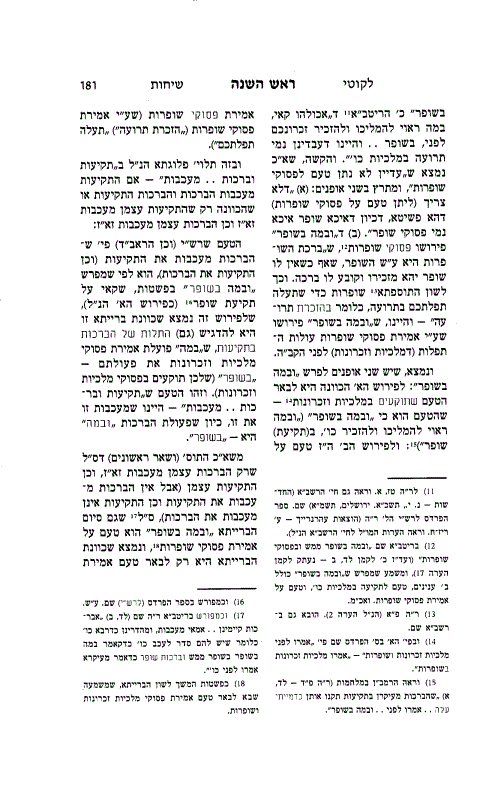
Regarding the explanation of the conclusion of the statement "and with what? With the shofar," the Ritva writes that "it refers to all of them, with what is it fitting to make Him King and to bring your remembrance before Him? With the shofar... and therefore we also perform a teruah with Kingship, etc." He questions that if so, it turns out that "a reason has not yet been given for the verses of Shofros," and he resolves this in two ways: (a) "There is no need (to give a reason for the verses of Shofros) because it is obvious, since there is a shofar, there are also verses of the shofar." (b) That "and with what? With the shofar" means the verses of Shofros, that "the blessing of Shofros is named after the shofar, that even when one does not have a shofar, he should mention it and establish a blessing for it. And so is the language of the Tosefta: Shofros, so that your prayer will ascend with the teruah, meaning with the mention of the teruah" — meaning that "and with what? With the shofar" means that through the recitation of the verses of Shofros, the prayers (of Kingship and Remembrances) ascend before the Holy One, blessed be He.
Thus, there are two ways to interpret "and with what? With the shofar": According to the first interpretation, it is meant to explain the reason for blowing during Kingship and Remembrances — that the reason is because "and with what? With the shofar" ("and with what is it fitting to make Him King and to bring... with the blowing of the shofar"); according to the second interpretation, it is a reason for the recitation of the verses of Shofros (that through the recitation of the verses of Shofros ("the mention of the teruah") "your prayer will ascend").
This is the basis of the aforementioned dispute regarding "the blasts and blessings... are indispensable" — whether the blasts impede the blessings and the blessings the blasts, or whether it means only that the blasts themselves are indispensable to each other and the blessings themselves are indispensable to each other:
The reason Rashi (and similarly Raavad) interprets that the blessings impede the blasts (and likewise the blasts the blessings) is because he interprets "and with what? With the shofar" in its simple sense, referring to the blowing of the shofar (as per the first interpretation above), which according to this interpretation means that the intention of this Baraisa is to emphasize (also) the dependence of the blessings on the blasts, that "with what" the recitation of the verses of Kingship and Remembrances accomplishes their effect — "with the shofar" (therefore, they blow during the verses of Kingship and Remembrances). This is the reason that "the blasts and blessings... are indispensable" — meaning they are indispensable to each other, because the effect of the blessings "and with what" is — "with the shofar."
In contrast, Tosafos (and other Rishonim) maintain that only the blessings themselves are indispensable to each other, and likewise the blasts themselves (but the blessings do not impede the blasts, nor do the blasts impede the blessings), they hold that the conclusion of the Baraisa "and with what? With the shofar" is also a reason for the recitation of the verses of Shofros, and thus the intention of the Baraisa is only to explain the reason for the recitation of...
2. The verses of Kingship, Remembrances, and Shofros (and the connection between these three types of blessings) — this is the reason why these three blessings are indispensable to each other.
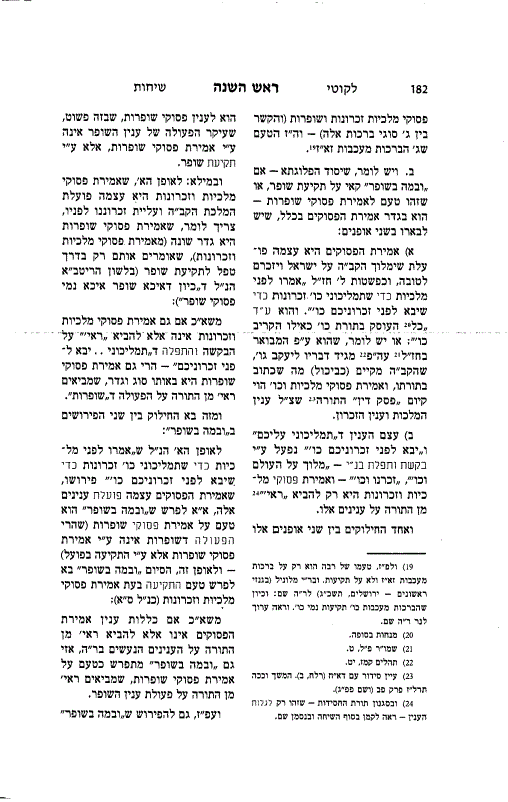
3. It can be said that the foundation of the dispute — whether "and with what? With the shofar" refers to the blowing of the shofar, or if it is a reason for the recitation of the verses of Shofros — lies in the nature of the recitation of the verses in general, which can be explained in two ways:
1) The recitation of the verses itself causes that the Holy One, blessed be He, should reign over Israel and remember them for good, as is the simple understanding of the words of our Sages: "Say before Me Kingship so that you will make Me king... Remembrances so that your remembrance will come before Me..." This is similar to "whoever engages in Torah, it is as if he has offered..." Alternatively, it can be said that it is based on what our Sages explain on the verse "He declares His words to Jacob," that the Holy One, blessed be He, fulfills (so to speak) what is written in His Torah, and the recitation of the verses of Kingship, etc., is the fulfillment of the Torah's "verdict" that there must be the concept of kingship and remembrance.
2) The essence of "make Me king over you" and "your remembrance will come before Me" is achieved through the request and prayer of the Jewish people — "Reign over the world, etc.," "Remember us, etc." — and the recitation of the verses of Kingship and Remembrances is merely to bring proof from the Torah for these matters.
One of the differences between these two approaches is regarding the verses of Shofros, where it is clear that the main effect of the matter of the shofar is not through the recitation of the verses of Shofros, but through the actual blowing of the shofar.
Consequently, according to the first approach, where the recitation of the verses of Kingship and Remembrances itself causes the coronation of the Holy One, blessed be He, and the elevation of our remembrance before Him, it must be said that the recitation of the verses of Shofros is of a different nature (than the recitation of the verses of Kingship and Remembrances), and they are recited only as a secondary aspect to the blowing of the shofar (in the words of the Ritva mentioned above, "since there is a shofar, there are also verses of the shofar").
However, if the recitation of the verses of Kingship and Remembrances is only to bring proof for the request and prayer of "make Me king... your remembrance will come before Me," then the recitation of the verses of Shofros is of the same type and nature, bringing proof from the Torah for the effect of the matter of the shofar.
From this arises the difference between the two interpretations of "and with what? With the shofar":
According to the first approach mentioned above, where "Say before Me Kingship so that you will make Me king... Remembrances so that your remembrance will come before Me" means that the recitation of the verses itself causes these matters, it is impossible to interpret "and with what? With the shofar" as a reason for the recitation of the verses of Shofros (since the effect of Shofros is not through the recitation of the verses of Shofros but through the actual blowing) — and for this approach, the conclusion "and with what? With the shofar" comes to explain the reason for the blowing during the recitation of the verses of Kingship and Remembrances (as mentioned above in section 1).
However, if the general matter of the recitation of the verses is only to bring proof from the Torah for the matters done on Rosh Hashanah, then "and with what? With the shofar" is also interpreted as a reason for the recitation of the verses of Shofros, bringing proof from the Torah for the effect of the matter of the shofar.
Accordingly, even according to the interpretation that "and with what? With the shofar" is a reason for the recitation of the verses of Shofros, it is not necessary to force the interpretation that "and with what? With the shofar" means the verses of Shofros (contrary to the simple interpretation that it refers to the blowing of the shofar) — rather, this matter of "and with what? With the shofar" (that the matters of Kingship and Remembrances are achieved through the blowing of the shofar) is itself the reason for the recitation of the verses of Shofros. Since all matters of Rosh Hashanah are achieved through the blowing of the shofar [as is also hinted in the words of our Sages "the mitzvah of the day is with the shofar," meaning that the blowing of the shofar is the primary mitzvah of the entire day, including all matters of this day] — therefore, the verses of Shofros are recited to bring proof from the Torah about the content of the matter of the shofar.
[In a slightly different style: the intention in the recitation of the verses of Shofros is not merely to bring proof that one is obligated to blow the shofar on Rosh Hashanah, but about the content of the matter of Shofros. Therefore, the Gemara states (as a reason for the recitation of the verses of Shofros) "and with what? With the shofar," which emphasizes what is achieved through the blowing of the shofar, for which proof is brought from the Torah in the verses of Shofros.]
3. We can further explain Rashi's (and the Raavad's) view that the blessings are indispensable to the shofar blasts (and vice versa) by first examining the Ritva's interpretation of "and with what? With the shofar." The Ritva explains, "With what is it fitting to crown Him and to mention your remembrances before Him? With the shofar, as it is written, 'And the people blew with the shofars and made Saul king over them,' and the earthly kingdom is a reflection of the heavenly kingdom."
At first glance, the phrase "with what is it fitting to crown Him" does not imply that the shofar itself effects the crowning of the king, but rather that it is appropriate to blow the shofar at the time of coronation. According to this, the expression "and with what? With the shofar" seems to suggest that the shofar itself accomplishes these matters.
This can be understood through two parables brought regarding the blowing of the shofar:
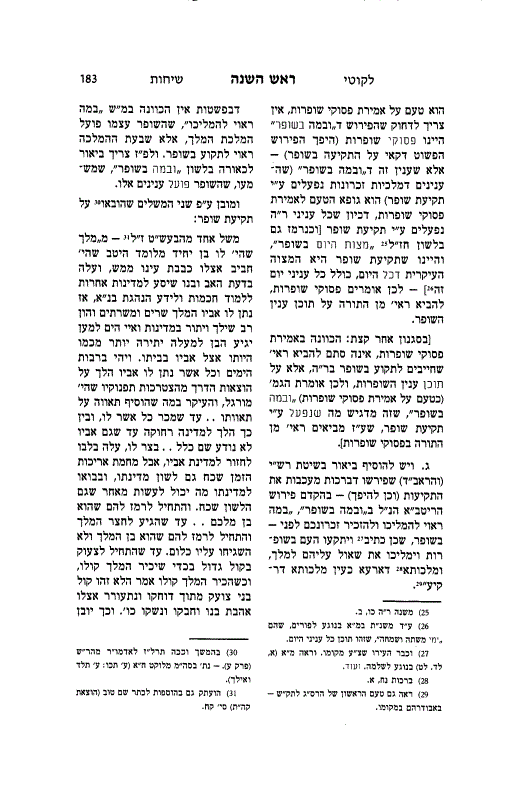
One parable from the Baal Shem Tov, of blessed memory, speaks of "a king who had an only son, well-educated and as dear to him as the apple of his eye. It occurred to both the father and son that the son should travel to other lands to learn wisdom and understand the ways of people. The king provided his son with ministers, servants, and great wealth to journey through lands and islands so that the son might reach a higher level than he would have at home with his father. Over time, the son spent all that his father had given him on the journey's expenses and his accustomed luxuries, primarily indulging his desires. Eventually, he sold everything he had and traveled to a distant land where even his father's name was unknown. In his distress, he decided to return to his father's land, but due to the long absence, he had forgotten even his native language. Upon arriving in his father's land, he could do nothing, having forgotten the language. He began to gesture that he was the king's son until he reached the king's palace and gestured that he was the king's son, but no one paid attention to him. Finally, he began to cry out in a loud voice so that the king would recognize his voice. When the king recognized his voice, he said, 'This is the voice of my son crying out in distress,' and his love for his son was awakened, and he embraced and kissed him, etc."
Similarly, the analogy above can be understood: the Jewish people are called children of the Omnipresent. The soul is sent into the body, akin to the king's son traveling a distant path to learn, meaning that through mitzvos and good deeds, the souls are elevated to a higher level than before. However, due to the love of the body and desires, they become very distant, to the point where they do not know their father's name at all, having forgotten even the language. Until they begin to return and cry out with a simple voice. This is the blowing of the shofar, which is an inner cry from the depths of the heart, expressing regret for the past and a commitment for the future to heed the voice of their father. Through this cry, the Holy One, blessed be He, the King of Kings, is aroused and shows His love for His only son, forgiving and pardoning him for the past, etc."
4. The second analogy is from the sefer "Kedushas Levi" by the esteemed chassidic sage Rabbi Levi Yitzchak of Berditchev. It describes a human king who traveled into a great forest. He ventured deep into the forest and lost his way back home. He encountered villagers in the forest and asked them for directions, but they did not recognize the king and could not help him, as they had never known the path of the great king. Eventually, he found a wise and understanding man and asked him for directions. The wise man realized that this was the king, and he was taken aback. He immediately complied with the king's request and showed him the way, for his wisdom allowed him to know the correct and straight path of the king. He led the king back to the royal palace, seated him on his throne, and found favor in the king's eyes. After many days, this man sinned against the king, and the king became angry with him. The king commanded the ministers who sat first in the kingdom to judge the man according to the law for transgressing the king's command. The man was greatly distressed, knowing that his judgment would be severe due to his sin against the king. He fell before the king and pleaded for his life, asking that before the judgment was pronounced, he be granted one request: to wear the clothes he wore when he led the king out of the forest, and for the king to wear the clothes he wore then as well. The king agreed to this request. When the king donned those clothes and the man his own, the king remembered the great kindness the man had done for him by returning him to the royal palace and seating him on his throne. The king's compassion was stirred, and the man found grace and favor before him, and the king forgave his sin and restored him to his position. Similarly, we, the children of Israel, at the time of the giving of the Torah, the Holy One, blessed be He, offered the Torah to every nation and tongue, but they did not accept it. We, the children of Israel, accepted the Torah with joy and delight, even preceding "we will do" to "we will hear," accepting the yoke of Heaven and crowning Him as our king, to fulfill His mitzvos, statutes, and holy Torah. Now, however, we have sinned and rebelled against Him. Therefore, we blow the shofar, which is akin to the garment worn at the giving of the Torah, so that He will remember that we accepted the Torah and crowned Him with the shofar, as it is written, "And the sound of the shofar was very strong." Through the remembrance of this merit, He forgives us for all our sins and inscribes us for a good life immediately, etc.
We can say that the content of these two analogies corresponds to the two aspects of "Kingship" and "Remembrances":
In the first analogy, the emphasis is on the action of the king's son, who returns and cries out with a simple voice and accepts upon himself the yoke of His kingship — this is the concept of "Crown Me as your king"; whereas in the second analogy, the emphasis is on the remembrance of the greatness of Israel (which was revealed) at the giving of the Torah — this is the concept of "May your remembrance come before Me for good."
Accordingly, we understand the explanation of "And with what? With the shofar," that the two aspects of "Crown Me as your king" and "May your remembrance come before Me for good" are actualized through the shofar — for the shofar is akin to the cry with a simple voice ("Crown Me as your king"), and also akin to the garment worn at the time of the giving of the Torah ("May your remembrance come before Me for good"), as is evident from these two analogies.
This is the straightforward reason for Rashi's (and the Raavad's) view that the blessings and the shofar blasts are interdependent — because the content of these blessings is actualized through the shofar.
5. As mentioned earlier, the Tosefta brings a version of this Baraisa that reads, "Say before Me... shofaros so that your prayer will ascend with the teruah before Me," which according to this version, the Baraisa explicitly provides a reason for the recitation of the verses of shofaros.
Moreover, even according to what was explained earlier, that there is room to interpret the Gemara's "And with what? With the shofar" as the reason for the recitation of the verses of shofaros — it is emphasized that the action itself is through the shofar [to the extent that the Talmud simply states "And with what? With the shofar," without even mentioning "shofaros" (like "and shofaros, because with what? With the shofar," etc.)] — unlike in the Tosefta, where it is explicitly stated "shofaros so that your prayer will ascend, etc.," which proves that the recitation of the verses of shofaros is what causes "your prayer to ascend, etc."
6. Based on this, we can say that according to the Tosefta, the recitation of the verses of shofaros has an additional aspect beyond the actual blowing of the shofar itself (and not that the recitation is merely secondary to the blowing, as mentioned earlier in section 2). It has a separate effect from the act of blowing the shofar — the recitation of the verses of shofaros is what causes "your prayer to ascend with the teruah [— 'with the mention of the teruah'] before Me."
We find these two approaches — whether the recitation of the verses of shofaros is merely secondary to the action of the shofar, or whether it is an independent action — also in the inner dimensions of the Torah, where there are two explanations for the reason behind the recitation of the verses of shofaros:
1) The Torah is called "Torah Ohr," light and revelation. This is the concept of reciting the verses of shofaros — verses from the Torah — so that the effect of the shofar will be drawn down and revealed below, we recite Torah verses concerning the shofar.
2) The effect through the recitation of the verses of shofaros is higher than the effect of the shofar blowing itself. Although the blowing of the shofar is a mitzvah from the Torah, and the recitation of the verses is only rabbinic — nevertheless, due to the superiority of words of Torah over the fulfillment of a mitzvah, there is an advantage in the effect brought about by the recitation of the verses of shofaros compared to the shofar blowing itself. It is explained regarding this that "the true revelation that will be in the future at the highest level... is drawn down now on Rosh Hashanah through the recitation of (the verses of) shofaros."
This matter is particularly relevant in a year when the festival of Rosh Hashanah falls on Shabbos [as in this year] — even though we do not blow the shofar, we still recite the verses of shofaros, drawing down an exceedingly high revelation, similar to "the true revelation that will be in the future, speedily in our days, Amen."
"(From the sichah of 10 Shevat, 5746)"