Likkutei Sichos Vol. 34 – Nitzavim 2
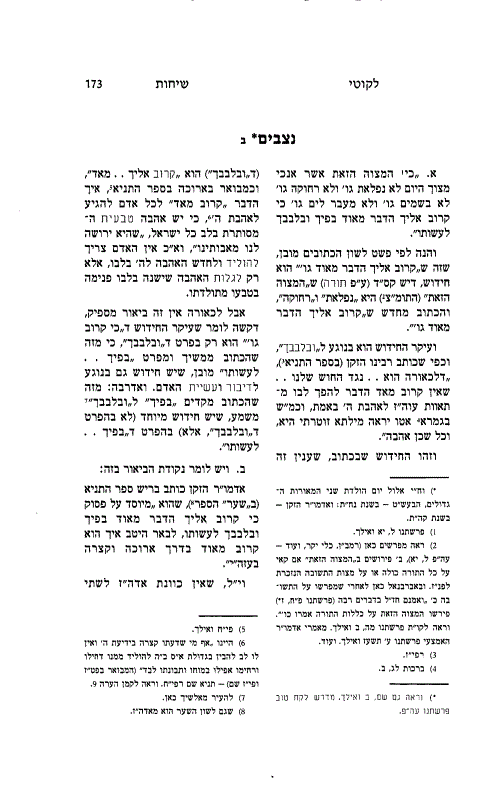
1. "For this commandment which I command you today is not too wondrous for you, nor is it far away. It is not in heaven, nor is it across the sea, for the matter is very close to you, in your mouth and in your heart, to do it."
According to the simple meaning of the verses, it is understood that the statement "for the matter is very close to you" is a novelty. There is an assumption (based on the Torah) that "this commandment" (the mitzvos) is "wondrous" and "distant," and the verse reveals that "the matter is very close to you."
The main novelty concerns "in your heart," as the Alter Rebbe writes in the Tanya, "For seemingly it is against our perception... that it is not very close to turn one's heart from the desires of this world to the love of G‑d in truth, as the Gemara states, 'Is fear a small matter?' and certainly love."
This is the novelty in the verse, that this matter ("in your heart") is "very close to you," as explained at length in the Tanya, how it is "very close" for every person to reach the love of G‑d, because there is a natural love hidden in the heart of every Jew, "which is an inheritance from our ancestors." Therefore, a person does not need to create and innovate love for G‑d in his heart, but only to reveal the love that is already in his heart naturally from birth.
However, this explanation seems insufficient, for it is difficult to say that the main novelty of "for it is very close" is only regarding "in your heart," because from the fact that the verse continues and specifies "in your mouth... to do it," it is understood that there is also a novelty concerning speech and action. Moreover, from the fact that the verse precedes "in your mouth" to "in your heart," it implies that there is a special novelty (not in the detail of "in your heart," but) in the detail of "in your mouth... to do it."
2. We can say the essence of the explanation is as follows:
The Alter Rebbe writes at the beginning of the Tanya (in the "Gate" of the book) that it is "based on the verse 'for the matter is very close to you, in your mouth and in your heart, to do it,' to explain well how it is very close in a long and short way with G‑d's help."
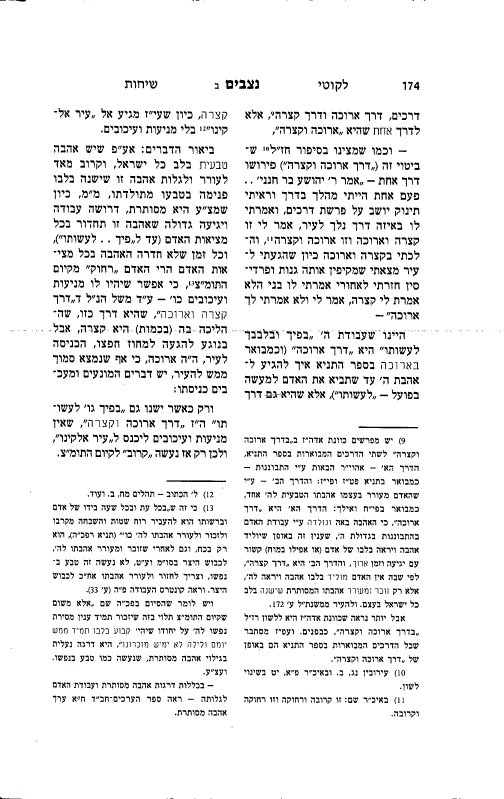
It can be said that the Alter Rebbe does not refer to two paths, a long path and a short path, but to one path that is "long and short."
— As we find in the story of the Sages that this expression ("a long and short way") means one path — "Rabbi Yehoshua ben Chanania said... Once I was walking on the road and I saw a child sitting at a crossroads, and I asked him which way leads to the city. He told me, 'This way is short and long, and this way is long and short.' I went on the short and long way, and when I reached the city, I found it surrounded by gardens and orchards. I returned and said to him, 'My son, did you not tell me it was short?' He said, 'Did I not also tell you it was long?'" —
This means that the service of G‑d "in your mouth and in your heart, to do it" is a "long way", but it is also a short way, because through this one reaches "the city of our G‑d" without obstacles and delays.
The explanation of the matter: Although there is a natural love in the heart of every Jew, and it is very close to awaken and reveal this love that is already in his heart naturally from birth, nevertheless, since it is inherently hidden, great effort and toil are required for this love to penetrate the entire being of the person (until "in your mouth... to do it"), and as long as the love has not penetrated the entire being of the person, the person is "distant" from fulfilling the mitzvos, because there may be obstacles and delays, etc. — similar to the above parable of the "short and long way," which is a path where the journey (in quantity) is short, but concerning reaching the destination, entering the city, it is long, because even though one is very close to the city, there are things preventing and delaying his entry;
Only when there is also "in your mouth... to do it," it is a "long and short way," with no obstacles and delays to enter "the city of our G‑d," and therefore only then does one become "close" to fulfilling the mitzvos.
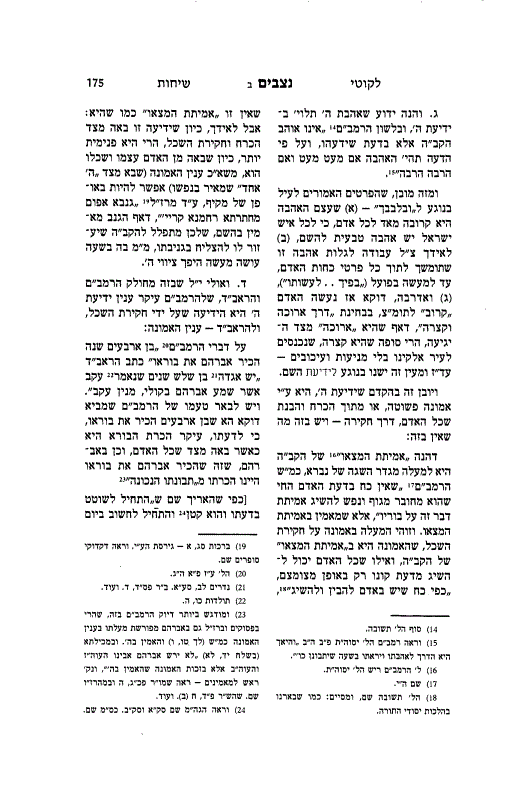
3. It is known that the love of G‑d depends on the knowledge of G‑d, as the Rambam states, "One does not love the Holy One, blessed be He, except through the knowledge with which one knows Him, and according to the knowledge will be the love, if little, little, and if much, much."
From this, it is understood that the aforementioned details regarding "in your heart" — (a) that the essence of the love is very close to every person, because every Jew has a natural love for G‑d, (b) on the other hand, there must be effort to reveal this love so that it extends into all aspects of a person's faculties, until it results in actual deed ("in your mouth... to do it"), (c) and indeed, only then does a person become "close" to fulfilling the mitzvos, in the manner of a "long and short way," for although it is "long" due to the effort, its end is short, as one enters the city of our G‑d without obstacles and delays — similarly and in a similar manner, this applies to the knowledge of G‑d.
This can be understood by prefacing that the knowledge of G‑d can be through simple faith, or through the necessity and understanding of human intellect, via investigation — and each has what the other does not:
For the "truth of His existence" of the Holy One, blessed be He, is beyond the grasp of a created being, as the Rambam writes, "There is no power in the mind of a living person, which is a composite of body and soul, to grasp the truth of this matter completely," but one believes in the truth of His existence. This is the advantage of faith over intellectual investigation, as faith pertains to the "truth of His existence" of the Holy One, blessed be He, whereas human intellect can only grasp the knowledge of its Creator in a limited manner, "according to the capacity that a person has to understand and grasp," which is not the "truth of His existence" as it is; however, on the other hand, since this knowledge comes from necessity and intellectual investigation, it is more internal, as it comes from the person himself and his own intellect, unlike the matter of faith (which comes from the "One G‑d" that shines in his soul) which can be in a manner of encompassing, as our Sages say, "A thief at the mouth of the tunnel calls upon the Merciful," for even the thief believes in G‑d, and therefore prays to the Holy One, blessed be He, to help him succeed in his theft, yet at the same time he acts contrary to the commandment.
4. And perhaps it can be said that this is the disagreement between the Rambam and the Raavad, that according to the Rambam, the main aspect of the knowledge of G‑d is the knowledge that comes through intellectual investigation, whereas for the Raavad, it is the aspect of faith:
Regarding the Rambam's statement "At the age of forty, Abraham recognized his Creator," the Raavad writes, "There is an Aggadah that says at the age of three, as it is said, 'Because Abraham obeyed My voice,' from where do we derive 'because'." The reason for the Rambam's view, that he specifically brings the idea that at the age of forty Abraham recognized his Creator, is because, according to him, the main recognition of the Creator is when it comes from human intellect, and so it was with Abraham, that his recognition of his Creator was from "his correct understanding."
[As the Rambam elaborates there, "He began to wander in his mind while he was young and began to think by day and by night, and he was astonished at how it was possible for this sphere to always operate without having a guide, and who would revolve it, etc., and he had no teacher or informer, etc., and his heart wandered and understood until he attained (at the age of forty) the way of truth and understood the line of justice from his correct understanding and knew that there is one G‑d and He guides the sphere, etc."]
— Therefore, he brought (in his work, the Yad) the opinion that "at the age of forty, Abraham recognized his Creator," as forty is the age of understanding; whereas according to the Raavad, the main knowledge of the Creator by Abraham was through faith by revelation from the Holy One, blessed be He, and therefore he brought that he was "three years old," as in simple terms, a three-year-old is not capable of recognizing his Creator in a manner of full comprehension and recognition.
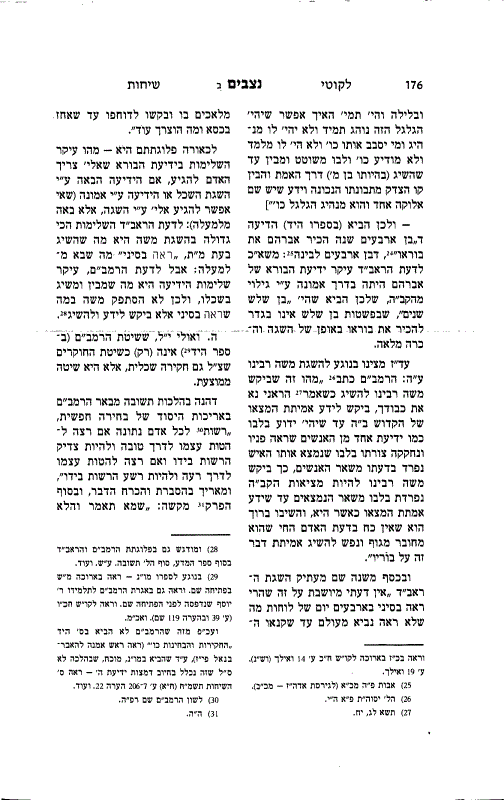
Similarly, we find regarding the attainment of Moshe Rabbeinu, peace be upon him: the Rambam wrote, "What did Moshe Rabbeinu request to attain when he said, 'Show me, I pray You, Your glory'? He requested to know the truth of the existence of the Holy One, blessed be He, until it would be known in his heart like the knowledge of one of the people whose face he saw and whose form was engraved in his heart, so that this person would be distinct in his mind from other people. So too, Moshe Rabbeinu requested that the existence of the Holy One, blessed be He, be distinct in his heart from other existences until he would know the truth of His existence as it is, and the Holy One, blessed be He, answered him that there is no power in the mind of a living person, which is a composite of body and soul, to grasp the truth of this matter completely."
4. In the Kesef Mishneh there, he quotes the Raavad's critique: "My mind is not settled with this, for he saw at Sinai during the forty days of the Tablets what no prophet had ever seen, to the extent that the angels envied him and sought to push him away until he grasped the Throne. What more did he need?"
It seems that their disagreement is about the essence of the ultimate perfection in the knowledge of the Creator that a person should attain. Is it the knowledge that comes through intellectual comprehension, or the knowledge through faith (which cannot be attained through comprehension but comes from above)? According to the Raavad, the greatest perfection in Moshe's attainment was what he achieved at the time of the Giving of the Torah, "he saw at Sinai" what came from above. However, according to the Rambam, the essence of perfect knowledge is what one understands and comprehends with one's intellect, and therefore Moshe was not satisfied with what he saw at Sinai but requested to know and comprehend more.
5. Perhaps it can be said that the Rambam's approach (in the Mishneh Torah) is not (only) like the approach of the philosophers who say there must also be intellectual inquiry, but it is a middle approach.
For in the Laws of Repentance, the Rambam elaborates on the foundation of free choice, "Every person is given the ability to incline himself to the good path and be righteous, or to incline himself to the bad path and be wicked," and he extends the explanation and necessity of this matter. At the end of the chapter, he poses a question: "You might say, does not the Holy One, blessed be He, know whether this person will be righteous or wicked, or does He not know? If He knows that he will be righteous, it is impossible for him not to be righteous. And if you say that He knows he will be righteous and it is possible for him to be wicked, then He does not know the matter perfectly. Know that the answer to this question is longer than the earth and wider than the sea, and many great principles and lofty mountains depend on it. But you need to know and understand this matter that I say, as we have already explained... that the Holy One, blessed be He, does not know with knowledge that is outside of Himself like human beings, who are separate from their knowledge, but He, blessed be His name, and His knowledge are one. And the human mind cannot grasp this matter completely, just as there is no power in a person to grasp and find the truth of the Creator, as it is said, 'For no man shall see Me and live,' so too there is no power in a person to grasp and find the knowledge of the Creator. This is what the prophet said, 'For My thoughts are not your thoughts, nor are your ways My ways.' And since this is so, we have no power to know how the Holy One, blessed be He, knows all creatures and actions, but we know without a doubt that the actions of a person are in his own hands, and the Holy One, blessed be He, does not compel him nor decree upon him to act in a certain way. And this is not known only because of the acceptance of the faith but through clear proofs from the words of wisdom."
And in the Raavad's critique there, "This author did not behave in the manner of the sages, for no person begins a matter without knowing how to complete it. He began with difficult questions and left the matter unresolved, returning it to faith. It would have been better for him to leave the matter to the simplicity of the simple ones... And although there is no conclusive answer to this, it is good to rely on a partial answer, and I say, if the righteousness or wickedness of a person were dependent on the decree of the Creator, blessed be He, we would say that His knowledge is His decree, and the question would be very difficult for us. But now that the Creator has removed this authority from His hand and placed it in the hands of the person himself, His knowledge is not a decree but is like the knowledge of astrologers who know from another source what the ways of this person will be, etc."
It seems to me, according to the Rambam, that in his view, the requirement for intellectual inquiry is not only in matters that the intellect can fully grasp, but also in matters "that we have no power to know," there is an obligation to toil and achieve the understanding that this matter is beyond one's comprehension.
This is the dispute between the Rambam and the Raavad: the Raavad also wrote there, "It is good to rely on a partial answer," but according to the Raavad, "the simplicity of the simple ones" and comprehension are two separate matters and should not be mixed. Faith is something beyond human intellect, stemming from the nature of a Jewish person, whereas intellect is something connected with the reality and intellect of a person. Therefore, the "partial answer" that the Raavad relied on is something that settles in the human intellect — and in matters where faith is required, the intellect should not be mixed in.
6. According to the Rambam, the obligation to strive to recognize, know, and comprehend is not limited to matters that a person is capable of grasping with their intellect. It also applies to matters that are beyond the reach of simple intellect and understanding. Even these matters must be placed and absorbed in one's intellect. Therefore, the Rambam writes that even the manner of G‑d's knowledge, which "is beyond human capacity to grasp and comprehend the knowledge of the Creator... we do not have the power to know how G‑d knows, etc.," a person must "know and understand this matter." Through this, one will understand and recognize that G‑d's knowledge does not contradict human choice.
Based on this, it can be said that this is also one of the explanations for the two expressions (according to the version of some commentators) that the Rambam wrote regarding the first mitzvah. In Sefer HaMitzvos, he wrote that it is a mitzvah to believe, while in the Mishneh Torah, he used the term "to know." The foundation of the matter is faith, because in the "truth of His existence," it is impossible to have a complete understanding, only a matter of faith. However, on the other hand, within this itself, knowledge ("to know") is necessary. A person must contemplate to the extent that their intellect can reach, to understand and know even these matters that are beyond intellectual necessity.
This is also the intention of the Rambam regarding Moshe's request (mentioned above) "to know the truth of the existence of the Holy One, blessed be He... and G‑d informed him of what no man knew before him, etc., until he attained from the truth of His existence, etc." This was in a manner of comprehension, meaning not only vision and faith, but it entered Moshe's understanding. This came specifically after Moshe's request to know the truth of G‑d.
7. Accordingly, it is found that even in the matter of knowledge of G‑dliness that leads to love, there are the same aspects mentioned above regarding love:
Initially, there must be simple faith, "to believe" in the truth of His existence. This is very close to every person, because the matter of faith is inherent in the nature of every Jew, as they are believers, the children of believers.
However, faith alone is a "short and long path," as it does not completely negate things that prevent and hinder, etc., because faith by itself is like something wondrous and distant from human conduct (as mentioned above regarding "a thief at the mouth of the tunnel, etc.").
Therefore, there must also be the effort in a person's intellect, even in matters "that we do not have the power to know." Although comprehension (especially in these matters) requires great effort and is a "long path," it is precisely then that it becomes a "short path," entering the city of our G‑d without obstacles and hindrances. For knowledge and comprehension affect the heart of a person, "Know the G‑d of your father and serve Him with a complete heart."
8. Just as it is with the mitzvah of knowing G‑d in general, and the service of the heart ("and serve Him with a complete heart"), so it is regarding the revelation of the teachings of Chassidus. "He has made everything beautiful in its time," and when the time came, "the L‑rd revealed His holy arm," and "one descended from the heavens," our teacher the Baal Shem Tov, through whom the teachings of Chassidus were revealed. This means that the secrets of the Torah, which by the nature of the Torah are in the category of secrets and hidden, were drawn down and revealed by the Baal Shem Tov and the righteous of the world, his students and their students. Through this, the hidden aspects of the Holy One, blessed be He, were revealed as they are beyond the bounds of human intellect.
The order of this revelation is that initially, faith in the inner dimension of the Torah was revealed, which in general is the path of "the righteous shall live by his faith," "do not read 'shall live' but 'shall enliven,'" through the revelation of the soul of each and every Jew. However, the perfection of the revelation of the teachings of Chassidus, in a manner that it is a "long and short path" (whereby one enters the city of our G‑d without obstacles and hindrances, etc.), is when faith penetrates a person's intellect, in a way that their intellect understands and knows G‑d in accordance with the faith. Likewise, in their emotions, not only does the intellect and contemplation generate love and fear of G‑d in the heart (not just a general vitality in the heart), but also this love and fear are connected with G‑d, who is beyond reason and understanding.
5. This path is the "long and short path" in the service of G‑d. The process by which the faith stemming from the essence of the soul penetrates all the faculties of the soul in an internal manner is indeed a "long path." However, it is the short and sure path to enter the "city of our G‑d," as there remain no obstacles or hindrances that could impede one's entry into the city of our G‑d. This is because all the faculties of the soul, the Chabad (Chochmah, Binah, Daas) of the soul, the Chagas (Chesed, Gevurah, Tiferes) within it, as well as the levels of Nehi (Netzach, Hod, Yesod) within it, are all internally infused with vitality in the service of G‑d. Consequently, the entire person, both in general and in detail, enters the city of our G‑d.
The perfection of this matter will be "at that time... (when) the Jewish people will be great sages and know hidden things, and they will grasp the knowledge of their Creator to the extent of human capability, as it is stated, 'For the earth will be filled with the knowledge of the L‑rd as the waters cover the sea.'"
"(From the talks of Shabbos Parshas Tazria-Metzora and Shabbos Parshas Emor, 5742)"