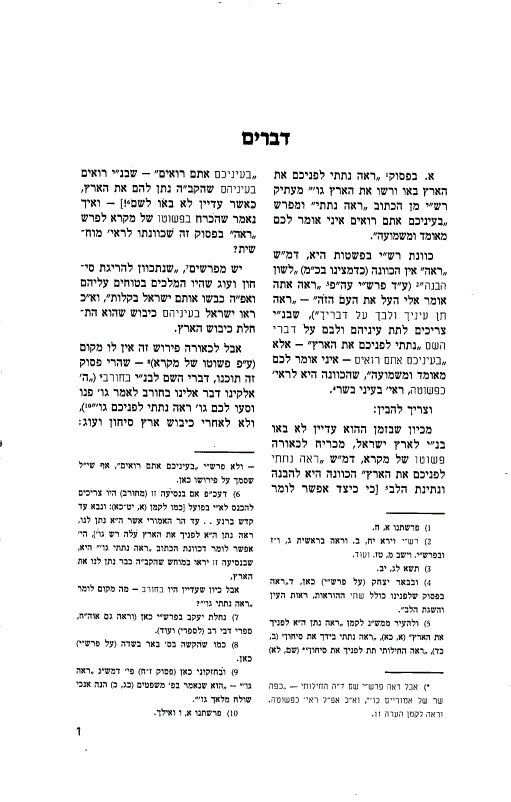
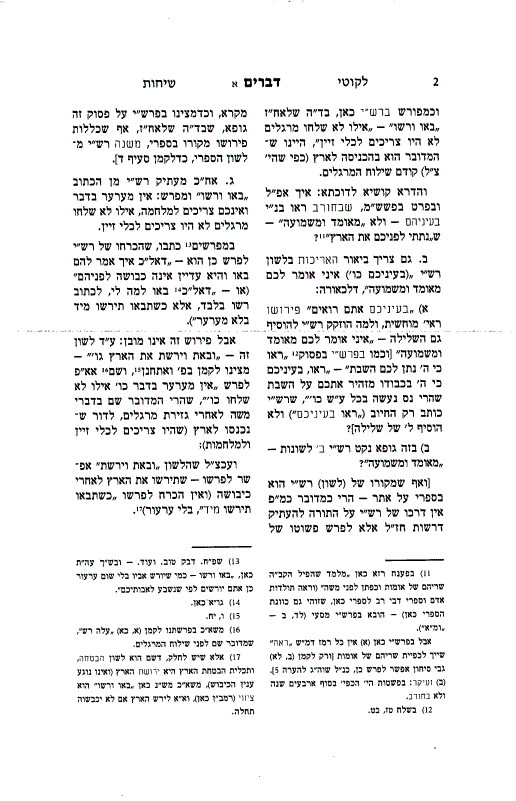
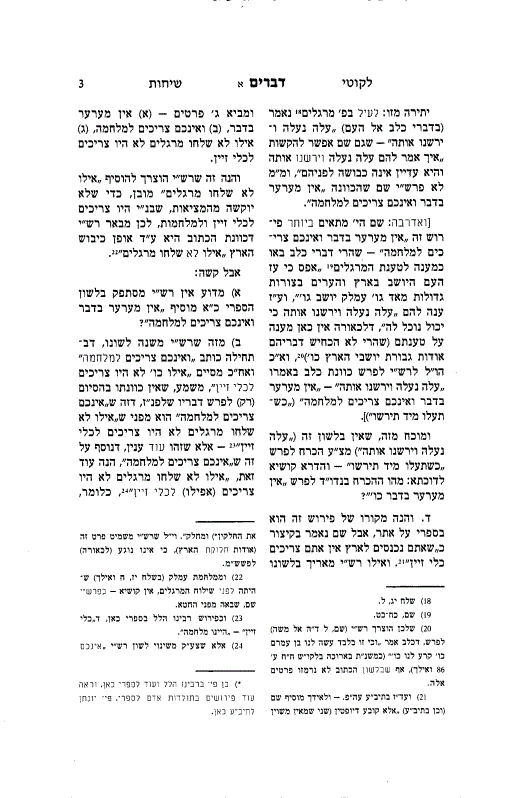
Rashi comments on the verse "See, I have set the land before you; go in and possess the land..." by quoting the words "See, I have set" and explaining, "You see with your own eyes; I am not telling you based on estimation or hearsay."
Rashi's intention, simply put, is that the word "see" here does not mean "understand" (as we find in many places), such as Rashi's commentary on the verse "See, You say to me, 'Bring up this people'" — "See, pay attention with your eyes and heart to your words." In this context, the Children of Israel are not being told to focus their eyes and hearts on G‑d's words "I have set the land before you." Rather, "You see with your own eyes — I am not telling you based on estimation or hearsay," meaning the seeing is literal, with physical eyes.
This raises a question:
Since at that time the Children of Israel had not yet entered the Land of Israel, the simple meaning of the text seems to compel the interpretation that "See, I have set the land before you" refers to understanding and paying attention [because how could it be said "You see with your own eyes" — that the Children of Israel see with their eyes that G‑d has given them the land, when they had not yet entered it!] — so how can we say that the simple meaning of the text requires interpreting "see" in this verse as literal seeing?
Some commentators explain that it refers to the defeat of Sihon and Og, who were kings that the Israelites easily conquered, thus the Israelites saw with their own eyes a conquest that was the beginning of the conquest of the land.
However, this explanation seems out of place (according to the simple meaning of the text) — because this verse is about G‑d's words to the Children of Israel at Horeb, not after the conquest of the lands of Sihon and Og;
As Rashi explicitly states here, in the commentary on the following phrase "Go in and possess" — "If they had not sent spies, they would not have needed weapons," meaning that the discussion is about entering the land (as it should have been) before the sending of the spies.
Thus, the question returns: How can it be said, especially according to the simple meaning, that at Horeb the Children of Israel saw with their own eyes — and not "based on estimation or hearsay" — that "I have set the land before you"?
Additionally, we need to understand the lengthiness in Rashi's wording "(with your own eyes...) I am not telling you based on estimation or hearsay," because seemingly:
a) "You see with your own eyes" implies literal seeing, so why did Rashi need to add the negation — "I am not telling you based on estimation or hearsay" [as in Rashi's commentary on the verse "See that the L‑rd has given you the Sabbath" — "See, with your own eyes that the L‑rd Himself warns you about the Sabbath, for a miracle occurs every Friday...," where Rashi only writes the positive without adding a negation]?
b) Within this, Rashi uses two expressions — "based on estimation or hearsay"?
[And even though Rashi's wording is sourced in the Sifrei on this passage — as discussed many times, Rashi's approach to the Torah is not to copy the Midrashic interpretations of the Sages but to explain the simple meaning of the text, as we find in Rashi's commentary on this very verse, where in the following commentary, even though the general explanation is sourced in the Sifrei, Rashi changes the wording of the Sifrei, as will be explained in section 4].
Rashi then quotes from the verse "Go in and possess" and explains: There is no one contesting the matter, and you do not need to wage war; if they had not sent spies, they would not have needed weapons.
The commentators write that Rashi's necessity to explain this is — "otherwise, how could it be said to them 'Go in' when it was not yet conquered before them" (or — "otherwise, why say 'Go in,' it could have just said 'Possess,' meaning when you come, you will immediately possess without contest").
But this explanation is not understood: We find similar wording — "And you shall come and possess the land..." — later in Parshas Va'eschanan, and there it is impossible to explain "there is no one contesting the matter... if they had not sent..." because there it refers to Moses' words after the decree of the spies, to the generation that entered the land (who needed weapons and wars);
Therefore, it must be said that the phrase "And you shall come and possess" can be interpreted — that you will possess the land after its conquest (and there is no necessity to interpret it as "when you come, you will immediately possess, without contest").
Furthermore, earlier in the section of the spies, it is stated (in Caleb's words to the people) "We shall surely go up and possess it" — where one could also question, "How could he say to them 'We shall surely go up and possess it' when it was not yet conquered before them?" Yet, Rashi does not explain there that the intention is "there is no one contesting the matter and you do not need to wage war."
On the contrary, there it would have been most fitting to explain "there is no one contesting the matter and you do not need to wage war," since Caleb's words were a response to the spies' claim, "However, the people that dwell in the land are strong, and the cities are fortified and very great... Amalek dwells there..." To this, he answered them, "We shall surely go up and possess it, for we are well able to overcome it." Seemingly, this is not a response to their claim (as he did not deny their words about the strength of the inhabitants of the land, etc.). Therefore, Rashi should have explained Caleb's intention in saying "We shall surely go up and possess it" as "there is no one contesting the matter and you do not need to wage war" ("when you go up, you will immediately possess it").
This proves that in this phrase ("We shall surely go up and possess it") there is no inherent necessity to interpret it as "when you go up, you will immediately possess it" — and the question returns to its place: What is the necessity in our case to interpret "there is no one contesting the matter, etc."?
The source of this interpretation is in the Sifrei on the spot, but there it is stated briefly, "when you enter the land, you will not need weapons." However, Rashi elaborates in his language and brings three details — (a) there is no one contesting the matter, (b) and you do not need to wage war, (c) if they had not sent spies, they would not have needed weapons.
It is understandable why Rashi needed to add "if they had not sent spies," to avoid the difficulty from reality, that the Children of Israel needed weapons and wars. Therefore, Rashi explains that the intention of the verse is regarding the manner of conquering the land "if they had not sent spies."
But it is difficult:
a) Why does Rashi not suffice with the language of the Sifrei and instead adds "there is no one contesting the matter and you do not need to wage war"?
b) From Rashi's change in language, as he first writes "and you do not need to wage war" and then concludes "if... they had not needed weapons," it implies that his intention in the conclusion is not merely to explain his previous words, that "you do not need to wage war" is because "if they had not sent spies, they would not have needed weapons" — but that this is another matter, in addition to "you do not need to wage war," there is also "if they had not sent spies, they would not have needed (even) weapons," meaning,
that they would not have needed even weapons to instill fear and dread upon the inhabitants of the land [similar to what we find in Rashi later regarding Moab, that although they were forbidden "war," nevertheless "they feared them and appeared to them as if they were armed"].
But according to this, the order in Rashi's language is puzzling: He first says "there is no one contesting the matter," meaning that there would not even be a verbal contest, and it must be said that Rashi's words are stated in the language of "this and needless to say this" — "there is no one contesting the matter and (needless to say) you do not need to wage war"; and then Rashi continues in the manner of "not only this but also this" — not only "you do not need to wage war" but "they would not have needed (even) weapons"!
c) Seemingly, Rashi should have started with "if they had not sent spies, there is no one contesting, etc." — since in practice, the conquest of the land was through wars (and certainly there were contests), so why does Rashi mention "if they had not sent spies" only at the conclusion regarding "weapons," and not before regarding "there is no one contesting the matter and you do not need to wage war"?
The implication of the matter is that the fact there were contests and wars is not due to the sending of the spies, and only regarding weapons did Rashi need to specify that the need for them was because of the sending of the spies.
What is the precision in Rashi's wording "if they had not sent spies"? Seemingly, it should have stated "if not for the sin of the spies" or something similar, since the very sending of the spies was "according to your opinion" of Moshe, and "by the word of G‑d" — with the permission of the Holy One, blessed be He.
We can explain all this as follows:
Rashi's intention in his commentary is to address a general question regarding this verse: This verse follows the statement "The L‑rd our G‑d spoke to us at Horeb, saying, 'You have dwelt long enough at this mountain. Turn and take your journey and come to the mountain of the Amorites and to all its neighbors in the plain, etc., the land of the Canaanites and Lebanon, as far as the great river, the Euphrates.'" (Meaning, the entire land of Israel to all its borders.) Therefore, it is puzzling: After He already commanded them to come to the land, what does the subsequent verse add, "See, I have set the land before you; come and possess the land, etc."?
And even though this verse adds regarding the promise of giving the land, so that the Children of Israel would not fear entering the land, it is still difficult. It should have started with this verse regarding the promise of the land — "See, I have set the land before you; come and possess it, etc." (and then continue with the details of the command) "Turn and take your journey and come to the mountain of the Amorites, etc., in the plain, etc., as far as the great river, etc."
Therefore, Rashi explains that the intention of the verse is not merely to inform once again about the promise of giving the land — for it was already well-known and publicized among all Israel (as the Children of Israel sang at the splitting of the Sea of Reeds, "You will bring them and plant them on the mountain of Your inheritance"), but there is a novelty here (regarding this promise) that they did not know until now.
And Rashi explains that there are two novelties here:
(1) "See, I have given" — that the Children of Israel see tangibly that the land of Israel is already given to them ("I have given" in the past tense). Until then, the promise of the land was only in the form of "hearing" or "estimation": Initially in Egypt, the Israelites were promised "I will bring you up out of the affliction of Egypt to the land of the Canaanites, etc.," "and I will bring you to the land, etc." — "and the people believed" (as they are believers, the children of believers), which is only in the category of "hearing" (acceptance of words) alone; and afterwards, after the miracles in Egypt, and especially at the splitting of the Sea of Reeds when "all the inhabitants of Canaan melted away, terror and dread fell upon them, etc." (as in the song of Israel), the Israelites could estimate (in a way of "estimation") that surely G‑d would deliver the kings of Canaan into their hands and they would inherit the land miraculously.
However, now — "See, I have given, with your own eyes you see, I am not telling you by estimation or hearing" (as will be explained in section 6).
(2) "Come and possess" — since (already) "I have set the land before you" (not only as a promise, but) in a manner that you can see this giving "with your own eyes," it is understood that their entry into the land will be without delay ("when you come, you will possess it immediately"), "there is no one contesting, etc."
But there is still a lack of explanation: What is the connection of this promise to the journey from Mount Horeb specifically (that it was stated here specifically), and also — what is the reason Moshe repeated it now, after forty years?
The explanation is simple:
This speech of Moshe comes in continuation to the words of rebuke at the beginning of the parsha — "Eleven days from Horeb by way of Mount Seir to Kadesh Barnea," and as Rashi explains there, "Moshe said to them, 'See what you have caused. There is no shorter route from Horeb to Kadesh Barnea than by way of Mount Seir, and it is an eleven-day journey, and you traveled it in three days... And all this was because the Divine Presence was hastening for your sake to bring you quickly to the land, and because you corrupted, He turned you around, etc., for forty years.'
In other words: In this journey from Horeb, the Israelites traveled with miraculous speed (brought about by "the Divine Presence hastening for your sake"), to hasten their arrival to the land.
And after Moshe spoke briefly and allusively, he later returned to recount this journey in detail and more explicitly — "The L‑rd our G‑d spoke to us at Horeb, saying, 'You have dwelt long enough at this mountain. Turn and take your journey and come, etc.'"; and this is also what he added, "See, I have set before you the land."
When Moshe said, "See, I have set the land before you; go in and possess it," it can be explained that he was hinting to them about the wonders they witnessed during this journey. By seeing the miraculous speed with which G‑d hastened their arrival to the land, it was a tangible proof that, from G‑d's perspective, the land was already given to them in actuality, without any delay or hindrance. What was missing was only their actual entry into the land. However, due to their sins, as recounted in the subsequent verses, they caused a delay, remaining in the desert for an additional thirty-eight years.
Based on the above, we can also explain the specific language Rashi uses in his commentary on "go in and possess":
Just as in the verse "Eleven days from Horeb," Rashi emphasizes the extreme contrast caused by the actions of the Israelites—not only was there a short route to the Land of Israel (an eleven-day journey to Kadesh Barnea, which is on the border of the Land of Israel), but this short route itself was traveled with miraculous speed (in three days). Instead of this miraculous speed, where the Divine Presence was eager to bring them to the land, they were delayed in the desert until the completion of forty years.
Similarly, in these verses, which were also said as a rebuke, Rashi emphasizes the great speed in the content of the matter (meaning the absence of any hindrances or delays of any kind) that should have been in their entry into the land.
The explanation of the matter:
"I have set the land before you" includes two things: (a) The granting of legal ownership, for although the land was initially under the control of the Canaanites, who could claim it as theirs, as Rashi states at the beginning of his commentary on the Torah, "The entire earth belongs to G‑d; He created it and gave it to whomever was right in His eyes. By His will, He took it from them and gave it to us." (b) The actual giving of the land, by G‑d driving out the nations before the Children of Israel, allowing them to inherit and settle in it in actuality.
These are the two matters in Rashi — (a) "There is no one who will contest the matter," (b) "And you will not need to wage war" — in these two matters, there will be no hindrances or delays from the nations:
"(There is no) contesting the matter" means — a legal contest, where the nations would claim that according to law, the land is theirs. It can be said that this includes a contest from the descendants of Edom [since the route to the Land of Israel "from Horeb... to Kadesh Barnea" is "by way of Mount Seir," and as Rashi explains, "Had they not sinned, they would have passed through Mount Seir to enter the land"], who are also descendants of Isaac; as we find that the Children of Israel needed to emphasize in their message to the king of Edom to pass through his land — "You have no right to contest the inheritance of the Land of Israel just as you did not repay the debt."
And to this, G‑d promised them, "See, I have set the land before you," that it will be visibly apparent that "the Divine Presence is eager for your sake to hasten your arrival to the land," so the nations will not even consider contesting Israel's ownership of the Land of Israel.
However, even if there is no legal contest, this still does not eliminate "hindrance and delay" from the inhabitants of the land, who, even if they know that the Children of Israel are right legally, still may not want to leave their land and homeland, etc., for Israel, and will not allow Israel to enter the land.
Therefore, Rashi continues, "And you will not need to wage war" — because the nations will vacate before the Children of Israel (like the Girgashite who stood and vacated before them).
Since the journey from Mount Horeb to Kadesh Barnea was with miraculous speed beyond nature, it is reasonable to say that in the continuation "See, I have set... go in and possess," there is an element of a miracle beyond nature.
Therefore, Rashi does not suffice with "And you will not need to wage war," because this could also occur naturally, that when they see the Children of Israel armed and ready for battle, fear and dread will fall upon them, and they will flee before the Children of Israel. Rather, he adds — "Had they not sent spies, they would not have needed weapons," meaning, there should be no action on the part of Israel to instill fear and dread upon the enemy, not even to show themselves armed.
This approach — where no natural action is required to expel the nations from the Land of Israel — was immediately denied to the Children of Israel with the sending of the spies. For the very fact that the Children of Israel came and said, "Let us send men before us, and they will explore the land for us," indicated that they believed the conquest of the land would occur naturally (hence the need to send spies to know "the way by which we should go up," etc.). Since the Children of Israel did not rely on the Holy One, blessed be He, to bring them into the Land of Israel in a manner beyond nature, this caused that even when G‑d performed miracles for them in expelling the nations from the land, they still required a natural action, at least weapons, to instill fear and dread upon the enemy.
This is the intent of Moses' rebuke — how the conduct was reversed from one extreme to the other. Instead of not needing any natural action, not even weapons, the nations contested the inheritance of the land (as we find that the king of Edom did not allow Israel even to pass through his land and succeeded), and furthermore, the Children of Israel had to fight with the kings of Canaan to inherit the land.
From this, there is a lesson for our time:
The scripture clearly states, "As in the days of your exodus from the land of Egypt, I will show you wonders." Therefore, it can be said that the promise of the complete redemption of the entire land to its borders in our final redemption is similar to "as in the days of your exodus from the land of Egypt," where from G‑d's perspective, it will be in a manner of "there will be no contesting the matter, and you will not need to wage war," not even needing weapons.
However, this depends on the Children of Israel, that when they trust properly in G‑d, and certainly when they are not hesitant to declare (even before the nations) that the land is the eternal inheritance of the people of Israel, because G‑d, "the entire earth is His," "took it from them and gave it to us" — then it is clear that "there will be no contesting the matter," and furthermore, "you will not need to wage war," G‑d forbid, and even not needing weapons.
And they will merit with the speed of "wonders" the redemption of the entire land, the building of the Holy Temple, and the ingathering of the exiles — all in a manner of "I will hasten it," very soon in our days, truly.