
Hoshana Rabbah
1. Among the matters in which Hoshana Rabbah1 is distinguished from the other days of Sukkos:
a) On all the days of Sukkos the altar was encircled2 only once, but on Hoshana Rabbah — seven times3.
b) On all the days of the festival, the standing of the aravah (willow) at the sides of the altar4 took place only when it fell on one of the six weekdays: "חל יום שבת להיות בתוך החג אין זוקפין ערבה אלא אם כן חל יום שביעי להיות בשבת זוקפין אותה בשבת כדי לפרסמה שהיא מצוה" ("If Shabbos falls during the festival, the aravah is not stood up, unless the seventh day falls on Shabbos; then it is stood up on Shabbos, in order to publicize that it is a mitzvah")5.
All this applies in the time of the Beis HaMikdash. In the present time, however, "אין נוטלין אותה כל שבעת ימי החג זכר למקדש אלא ביום השביעי בלבד הוא שנוטלין אותה בזמן הזה" ("it [the aravah] is not taken all seven days of the festival in remembrance of the Mikdash; only on the seventh day alone is it taken in the present time")6. That is, on the earlier days of Sukkos the matter of "aravah" does not exist at all.
2. Another matter in which Hoshana Rabbah is distinguished after the Destruction:
Care was taken in fixing the months that Hoshana Rabbah should not fall on Shabbos: when it was seen that the day of the aravah would fall on Shabbos, they would make one of the months full, so that Hoshana Rabbah would be on Sunday (after Shabbos) and it would not be necessary to cancel the taking of the aravah7; and as it is stated in the Yerushalmi8: "ר' סימון מפקד לאילין דמחשבין יהבון דעתכון דלא תעבדין לא תקיעתה בשבת ולא ערבתא בשבתא ואין אדחקתון עבדון תקיעתה ולא תעבדון ערבתא" ("Rabbi Simon instructed those who calculate [the calendar]: Take care not to make either the shofar-blowing on Shabbos or the aravah on Shabbos; and if you are pressed, make the shofar-blowing [fall on Shabbos], but do not make the aravah [fall on Shabbos]").
So too afterwards (when the months were no longer sanctified on the basis of sighting [the new moon]), when the fixing of the months is by calculation, this is distinguished in that Hoshana Rabbah never falls on Shabbos9 (and according to several opinions among the Rishonim10 this is the reason for the rule "לא אד"ו ראש" ("Rosh Hashanah does not fall on Sunday, Wednesday or Friday"), because if Rosh Hashanah were to fall on Sunday, Hoshana Rabbah would fall on Shabbos) — even though regarding shofar and lulav "לא חיישינן, אע"פ שיום ראשון דאורייתא" ("we are not concerned, even though the first day is a Torah obligation").
Tosafos asks11: How can one say that "איום ערבה שהוא זכר למקדש בעלמא חיישינן ואהני דאורייתא לא חיישינן" ("regarding the day of the aravah, which is merely a remembrance of the Mikdash, we are concerned, yet regarding these, which are Torah obligations, we are not concerned")? And Tosafos answers that "אין הכי נמי דהני דכתיבי בהדיא לא אתי לפקפוקי בהו בשאר שנים אבל ערבה דרבנן אתי לפקפוקי בה" ("indeed so; these, which are written explicitly, people will not come to treat lightly in other years, but the aravah, which is Rabbinic, people will come to treat lightly")12 (and in the words of the Perishah13: "ומפני היראה שלא ישתכח מישראל מצוה זו שיהא קלה על האדם עשו חיזוק לדבריהם יותר משל תורה" ("out of concern that this mitzvah not be forgotten from Israel, should it be light in a person's eyes, they made a reinforcement for their words more than for those of the Torah")14).
3. All matters of Torah are precise to the utmost. It is understood, then, that the very fact that solely for the sake of the mitzvah of aravah a month is made full, in order to fulfill the mitzvah of aravah, shows that this mitzvah contains a special quality by which it is distinguished from the other mitzvos.
This will be understood by first explaining the definition of the mitzvah of aravah in general, which was a separate mitzvah in the Beis HaMikdash (apart from the mitzvah of the aravah in the lulav): "כיצד היתה מצותה בכל יום ויום משבעת הימים היו מביאין מורביות של ערבה וזוקפין אותן על צדדי המזבח וראשיהן כפופין על גבי המזבח, ובעת שהיו מביאין אותה וסודרין אותה תוקעין ומריעין ותוקעין" ("How was its mitzvah performed? On each of the seven days they would bring large willow branches and stand them at the sides of the altar, with their tops bent over the altar; and when they brought it and arranged it, they would sound a tekiah, a teruah and a tekiah")15.
The fact that the aravah was a separate mitzvah unto itself can be understood in two ways:
a) That it is only a separate action, a separate act of mitzvah performed with the aravah; i.e., the definition of the aravah is the same as that of the aravah in the lulav, only there is an additional mitzvah that is performed with the aravah16.
b) It is not only a separate act of mitzvah on the part of the person (gavra) (in the Beis HaMikdash), but a different object (cheftza) of aravah.
One of the practical halachic ramifications of this: According to the first way, it would follow that the measure of the aravah in the Mikdash is the same measure as that of the aravah in the lulav, since it is the same cheftza of aravah in both mitzvos. But according to the second way — that the novelty of the aravah of the Mikdash is that it is a different cheftza of aravah — it can be said that there is a difference between them in the measure of the aravah.
Accordingly, it can seemingly be said that this is connected with the dispute in the Gemara17 regarding the measure of the aravah of the Mikdash — whether it must have three branches with moist leaves18 (like the aravah in the lulav19), or whether even one leaf on one branch suffices for it.
Moreover: the Rambam rules20: "הלכה למשה מסיני שמביאין במקדש ערבה אחרת חוץ מערבה שבלולב ואין אדם יוצא ידי חובתו בערבה שבלולב ושיעורה אפילו עלה אחד בבד אחד" ("It is a halachah leMoshe miSinai that another aravah, apart from the aravah in the lulav, is brought in the Mikdash, and a person does not fulfill his obligation with the aravah in the lulav; and its measure is even one leaf on one branch").
From the precise wording of the Rambam ("another aravah apart from the aravah in the lulav, and a person does not fulfill etc.")21 it is implied that this is not merely a separate action and deed of the person, but a different cheftza of aravah; and therefore (a) "a person does not fulfill his obligation with the aravah in the lulav" — which, from the plain meaning of the wording, seemingly implies that one does not fulfill it even when one takes the aravah by itself, not together with the lulav22; b) "its measure is even one leaf on one branch"23, as above24.
Accordingly it follows that, according to the Rambam's view, this is the substance of the dispute between Abba Shaul and the Rabbis25: Abba Shaul derives the aravah of the Mikdash from "ערבי נחל כתיב שתים אחת ללולב ואחת למקדש" ("'willows of the brook' — two are written, one for the lulav and one for the Mikdash"), and the Rabbis say "הלכתא גמירי לה" ("it is a received halachah"), it is a halachah leMoshe miSinai (like "עשר נטיעות . . וניסוך המים" ("the ten saplings . . . and the water libation")).
According to Abba Shaul, since the mitzvah of aravah was stated and is derived from the verse "willows of the brook," which is said explicitly regarding the aravah in the lulav, the cheftza of the aravah of the Mikdash is the same as that of the aravah in the lulav; one derives only that there is a separate mitzvah, or at least a separate action, with the aravah.
But according to the Rabbis, who hold that the aravah of the Mikdash is a halachah leMoshe miSinai26, and its substance and obligation have no connection to the verse "willows of the brook" that is said regarding the aravah in the lulav, it can (— it must) follow that the mitzvah of aravah also has a different definition, a different cheftza, as above.
4. The inner explanation of why the mitzvah of aravah is a different kind of cheftza than the aravah in the lulav:
Regarding the content of the aravah, my father-in-law, the Rebbe [the Previous Rebbe], says27 that "ערבה הם אנשים פשוטים דקיום המצות הוא רק באמונה פשוטה" ("the aravah is the simple people, whose fulfillment of the mitzvos is only with simple faith"). It can be said that this brings out a depth in the well-known words of the Midrash28, that the four species correspond to the four kinds of Jews: "אתרוג זה יש בו טעם ויש בו ריח . . ישראל . . שיש בהם תורה ויש בהם מעשים טובים, כפות תמרים . . יש בו טעם ואין בו ריח . . ישראל . . שיש בהם תורה ואין בהם מע"ט . . הדס שיש בו ריח ואין בו טעם . . ישראל . . שיש בהם מע"ט ואין בהם תורה . . ערבה זו אין בה טעם ואין בה ריח . . ישראל . . שאין בהם לא תורה ולא מע"ט" ("The esrog has taste and has fragrance . . . Israel . . . who have Torah and have good deeds; the palm branch . . . has taste but has no fragrance . . . Israel . . . who have Torah but do not have good deeds . . . the hadas has fragrance but has no taste . . . Israel . . . who have good deeds but do not have Torah . . . the aravah has neither taste nor fragrance . . . Israel . . . who have neither Torah nor good deeds").
From the surface meaning of the Midrash's words it follows that only the esrog alludes to the kind of Jews who have both matters, Torah and good deeds; whereas in the other kinds one detail is lacking — Torah or the fulfillment of the mitzvos — or both matters are lacking.
On this, my father-in-law, the Rebbe, explains — as he says there — "דכל ישראל הם שוים בענין קיום התורה ומצות" ("that all Israel are equal in the matter of fulfilling Torah and mitzvos"). That is, in all four kinds there is the fulfillment of both matters — the fulfillment of Torah and mitzvos, the study (knowledge) of Torah and the fulfillment of the mitzvos. It can be said that this interpretation is compelling, for the kind "lulav" — the study of Torah as it should be — also fulfills mitzvos, since study leads to action29; and the one who does good deeds (mitzvos) has knowledge of Torah, to know how to fulfill the mitzvos. From this it is understood also regarding the kind "aravah," that among the Jews of this kind, too, there is the fulfillment of Torah and mitzvos (in actual practice).
Rather, the (inner) interpretation of the Midrash's words is that the difference lies in the manner and quality of their fulfillment of Torah and mitzvos: Torah is connected with the virtue of the intellect, and good deeds — with the virtue of the emotional attributes (middos); and this is the difference among the four kinds: "esrog" alludes to the Jews in whose fulfillment of Torah and mitzvos there is both the virtue of the intellect and the virtue of the middos; in "lulav" are alluded the Jews who have (primarily) the virtue of the intellect, and in "hadas" — (primarily) the virtue of the middos; and "aravah" alludes to the simple people in whose fulfillment both the virtue of the intellect and the virtue of the middos are lacking, and their fulfillment is only with simple faith.
From this itself it is understood that the kind "aravah," too, has an advantage30 over the other three species. As is known, the saying of the Baal Shem Tov31 that the simplicity of simple people is one with the simplicity of the Essence32.
5. The above-mentioned superiority in the kind of Jews of "aravah" — that specifically in them the quality of simplicity is expressed — is reflected also in the aravah in its plain sense:
The explanation is known33 of the reason why the mitzvah "ולקחתם לכם גו'" ("And you shall take for yourselves etc.") consists specifically of the four species: because in them the quality of unity is discernible and felt:
The lulav is "עליו כפותין" ("its leaves are bound together") (all its leaves are gathered together, in unity); in the hadas the leaves are "תלתא בחד קינא" ("three in one stem"); the aravos are called "אחוונא" ("brothers")34, because they grow in brotherhood35; and the esrog "דר באילנו משנה לשנה" ("dwells on its tree from year to year") — in it are united all four changes of climate of the four seasons of the year, and more: it grows from all of them.
The fact that certain things in the world possess the quality of unity — even though, by the nature of the yeshus (self-existence) of the world, they ought to have the quality of division and separation, like the matters of the world (olam, from the word helem, concealment) — comes from the fact that in them shines the simplicity Above, "אחדות הפשוטה" ("the simple unity")36. And the simplicity Above brings about this unification and inclusion in each of the four species, so that even openly their yeshus (due to the nature of the world) is not so felt in them, but (also) their bittul (self-nullification), which brings about open unity in them37.
But within the quality of unity of the four species themselves, too, a difference is seen: in the three species, esrog, lulav and hadas, the unity is within each one by itself — in the leaves of the lulav or of the hadas branch themselves ("its leaves are bound together," "three in one stem"), and similarly the esrog (which "dwells on its tree etc.") — but not a uniting of one lulav, hadas and esrog with a second lulav etc.
Whereas the aravah — in it the uniting is in that one aravah grows in "brotherhood" and unity with the other aravos.
And since the unity in the aravah is in a broader manner than in the other three species38 [to the point of being contrary to the nature of the world, which is one of division and separation between one and another], it is understood that this is because in it the simplicity Above shines more openly than in the other three species.
And this is also the reason why specifically in the aravah the unity is connected with its name — it is called achvana (brothers) (which is not so with the other species).
6. It can be said that the reason for this (that the matter of unity is more revealed in the aravah) is connected with the above-mentioned matter itself:
In the other kinds, "lulav," "esrog" and "hadas," since each of them possesses (a virtue, or) particular virtues of intellect and middos — it has taste (lulav), it has fragrance (hadas), or it has both (esrog) — the revealed "virtues" (of intellect and middos) overshadow the "simplicity" Above that is present in them, and consequently — the matter of unity in them (which comes, as above, from the fact that the simplicity Above shines in them). To the point that one could think that they were chosen (not because of their unity, but) because of their virtues (taste and fragrance).
Whereas in the kind "aravah," which has no revealed virtues (it has neither taste nor fragrance), the matter of unity stands openly and plainly, to the point that apart from the reason of unity there is no rationale why the aravah is one of the four species — because the simplicity of the Essence is revealed in it, in its nature and even in its name.
— Similar to the difference seen among Jews39: although in every Jew there is "חלק אלקה ממעל ממש" ("an actual part of G‑d Above")40, which is connected with the simplicity of the Essence, it is seen, however, that in those Jews who are "rich" in intellect and middos, these revealed virtues conceal the simple faith — the simplicity and wholeheartedness that stem from the essence of the soul;
Specifically in simple people, who have no revealed virtues (of intellect and middos), the simple faith is revealed in them, for their simplicity is, as above, one with the simplicity of the Essence.
7. Based on this, the accomplishment (and special quality) of the mitzvah of the aravah of the Mikdash over the aravah in the lulav is also understood:
The aravah in the lulav — although in itself it has no revealed virtues, and therefore the virtue of unity is felt in it all the more, "growing in brotherhood" — nevertheless, since it is joined and combined together with the other three species, to the point that they become one mitzvah, therefore the matter of simplicity in it (which comes to revelation specifically through the absence of virtues, as above) is not "in its purity": through the bond and connection with the other species, virtues are added to the aravah as well.
Whereas the aravah of the Mikdash — its mitzvah and substance is a separate aravah, which has no bond or connection with other species and kinds (possessors of virtue)41 — this is a mitzvah in which there is no concealment due to virtues etc., and the simplicity of the Essence stands openly in it.
It can be said that this is the reason for the opinions42 that when the altar is encircled seven times on Hoshana Rabbah, the circling is only with the lulav and its species, and not with the aravah, which is a mitzvah unto itself.
And therefore the aravah "אינה ניטלת אלא בפני עצמה, ואין אדם יוצא ידי חובתו בערבה שבלולב" ("is taken only by itself, and a person does not fulfill his obligation with the aravah in the lulav")43, and also its measure is not similar to the measure of the aravah of the lulav — "three moist leaves"44 — but "even one leaf on one branch," which signifies that it is (not a unity composed of particulars, but) simple unity.
8. Based on this it is understood why the aravah of the Mikdash is a halachah leMoshe miSinai and not a matter stated explicitly (and not even a matter derived from a verse) in the Written Torah —
Similar to what is explained in Likkutei Torah45 regarding the difference between the water libation on the seven days of the festival — which is a "halachah leMoshe miSinai"46 — and the wine libation, which is stated explicitly in the Written Torah in several places4748: that the water libation stems from a higher level than the wine libation, and therefore it cannot descend into writing, into a form of letters in the Written Torah, as explained there at length;
Similarly, this is the superiority of the aravah of the Mikdash over the aravah in the lulav: it does not descend into an explicit command in the Written Torah, because it stems from such a level that is higher than coming to revelation in Torah in writing and form.
In the human soul this is connected with such a lofty level in the soul, which is united with G‑d — the simplicity of the soul, regarding which a Jew need not be commanded explicitly, in the manner of explicit letters in the Written Torah.
9. According to the above it is understood that the matter of the aravah in the present time — that "it is taken" only on the seventh day, and that (in the present time) it is not even a matter of halachah leMoshe miSinai, but a "custom of the prophets"49 [especially according to the interpretation among the Rishonim50 that "custom of the prophets" means (not that they instituted it for the people51, but) "מנהג שנהגו כן והעם רואים ועושים כמותם מאליהם" ("a custom that they practiced thus, and the people saw and did likewise of their own accord")52] —
this itself is proof that inwardly it is even higher than the mitzvah of the aravah of the Mikdash, which is a halachah leMoshe miSinai. Similar to what is explained in Likkutei Torah there53 regarding "הקפות שבשמע"צ שלא נכתבו אפילו בתשבע"פ ואינו אלא מנהג" ("the hakafos of Shemini Atzeres, which were not written even in the Oral Torah and are only a custom")54, that they are even higher in their virtue than the water libation, which is (at least) a halachah leMoshe miSinai.
For55 the matter of a Jewish custom — the fact that Jews conduct themselves in this way — shows that it is connected with the root of the souls of Israel, which preceded the Torah56, higher than Torah: because the simplicity of Jews is one with the simplicity of the Essence, they sense even those matters that are higher than being drawn down into writing and form — that is, as G‑d's wisdom and will became revealed in the Torah and its mitzvos, and also in those of the words of the Scribes — and they conduct themselves in this way without any instruction or command in any manner whatsoever.
And because Jews conduct themselves in this way, because it is a Jewish custom, it is brought about that it becomes Torah — "מנהג ישראל תורה הוא" ("a Jewish custom is Torah"), as explained elsewhere57.
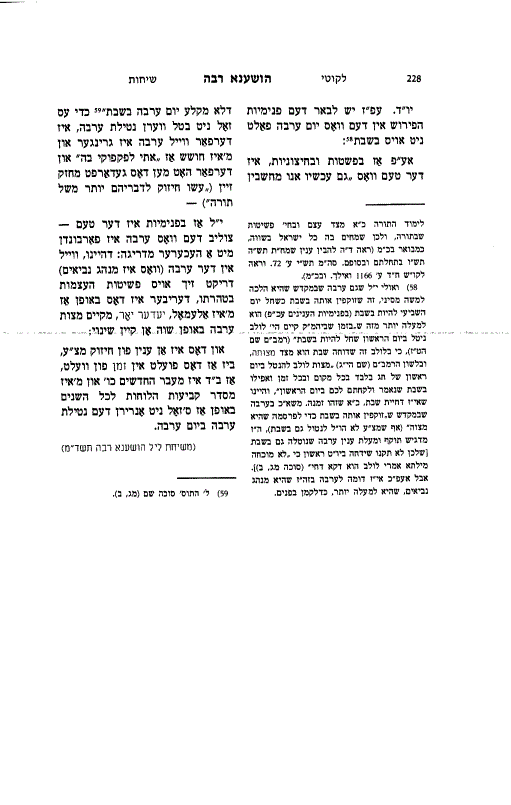
10. Based on this, the inner meaning can be explained of why the day of the aravah does not fall on Shabbos58:
Although simply and outwardly, the reason that "גם עכשיו אנו מחשבין דלא מקלע יום ערבה בשבת" ("even now we calculate so that the day of the aravah does not occur on Shabbos")59, so that the taking of the aravah not be cancelled, is because the aravah is lighter and there is concern that "people will come to treat it lightly," and therefore it needed to be reinforced ("they made a reinforcement for their words more than for those of the Torah") —
it can be said that inwardly the reason is because the aravah is connected with a higher level: namely, because in the aravah (which is a custom of the prophets) the simplicity of the Essence is expressed in its purity, therefore it is in such a manner that one always, every year, fulfills the mitzvah of aravah in the same way, without any change;
and this is a reinforcement from its own side, to the point that it affects the time of the world: the court makes months full etc., and arranges the fixing of the calendar for all years in a manner that it should not affect the taking of the aravah on the day of the aravah.
(From the sichos of the night of Hoshana Rabbah, 5744)
Notes
1) On the details of Hoshana Rabbah and its laws, see Encyclopedia Talmudis, under that entry, and the sources cited there.
2) Whether this matter pertains to the mitzvah of aravah seemingly depends on the question and dispute whether the circling is done with the aravah or with the lulav — Sukkah 43b (and in the Rambam (cited in the next note): that it is with the lulav). See at length the sources cited in Encyclopedia Talmudis ibid., section 2.
3) Mishnah ibid. 45a. Rambam, Laws of Lulav 7:20–23.
4) The language of the Mishnah (Sukkah 45a, "they would stand them up etc.") and of the Rambam ibid., halachah 21 ("they would stand them up . . . they stand up the aravah"). See Sukkah 43b — the dispute whether the aravah is by standing it up or by taking it; and Tosafos s.v. zokfin (ibid. 45a), that according to the view that it is by taking — they stand them up afterwards.
5) The language of the Rambam ibid. — from the Mishnah, Sukkah 42b; Gemara ibid. 43, beginning of side b. In the Gemara there: "in order to publicize that it is from the Torah" — see Rashi there (and Ritva there: because the Boethusians dispute a matter that is not explicit in Scripture etc.; see further on in the Ritva there, s.v. u'parkinan d'lo ikla). And in the Rambam's Commentary on the Mishnah, Sukkah 4:3: "in order to publicize it, so that they know that it is an obligation; and so they said, 'in order to publicize that it is from the Torah.'" See Rabbeinu Manoach on the Rambam ibid., halachah 21. This is not the place to elaborate.
6) The language of the Rambam ibid., halachah 22. Note that the Rambam writes about the taking of the aravah in the present time in remembrance of the Mikdash in the continuation of (the same) halachah concerning the taking of the aravah (in the Mikdash) on Shabbos. See Beis Yosef and Levush, Orach Chaim 664 (section 2), on the reason the seventh day was fixed for the aravah: because in the Mikdash, too, this day was more special for the aravah, as they would take it even when it fell on Shabbos.
7) Sukkah 43b; and in Rashi and Tosafos there, s.v. lo ikla.
8) Sukkah 4:1 — cited in Tosafos there (with a slight variation).
9) Tosafos ibid. Ran (s.v. u'parchinan tu) and Ritva (s.v. u'parchinan d'lo ikla) ibid. Tur and Shulchan Aruch, Orach Chaim 428:1.
10) The Raavad in his glosses, Laws of Sanctification of the New Moon 6:7. Tashbetz, vol. 1, §135, in the name of Rav Saadia Gaon. See also Magen Avraham and Machatzis HaShekel (in the name of the Rashba) ibid., and elsewhere. See Likkutei Sichos vol. 9, p. 52, note 28; Encyclopedia Talmudis ibid., section 4.
11) The language of Tosafos ibid.
12) Ibid. See also Ritva, Ran, Sefer HaMichtam, and elsewhere — Sukkah ibid.
13) On the Tur, Orach Chaim, beginning of 428.
14) In Korban HaEdah on the Yerushalmi there: "the aravah is divrei kabbalah and needs reinforcement." Seemingly his intention is not "divrei kabbalah" as in many places, since the discussion concerns the period after the Mikdash, when it is a custom of the prophets (and not in the category of divrei kabbalah). Note Sefer HaPardes of Rashi (Ehrenreich edition, p. 176), and Raavyah (Laws of Lulav, §699), that the aravah is a halachah leMoshe miSinai and needs reinforcement. See Rabbeinu Manoach, cited above at the end of note 5.
*) Note the language of the Gemara there (44, beginning of side b): "here, in the outlying regions." And in Tosafos Yom Tov, Sukkah 4:3: in the outlying regions it is only a custom of the prophets, even in the time of the Beis HaMikdash.
15) The language of the Rambam ibid., halachah 21 — from the Mishnah, Sukkah 45a.
16) It requires further examination whether, according to the view that it is derived from "willows of the brook" (see further in the text), it is counted in the number of the mitzvos, only that it is included in the mitzvah of the four species. See Lechem Mishneh, Laws of Lulav ibid., halachah 22. This is not the place to elaborate.
17) Ibid. 44b.
18) See Ran ibid. 44b (and note Ritva there, s.v. amar Rabbi Ami; Pri Megadim (Eshel Avraham), Orach Chaim 664, subsection 8), that the reason of [OCR unclear], who holds three branches with moist leaves etc., is that "sometimes a person takes the aravah by itself to fulfill with it the mitzvah of the aravah that is with the lulav (and because the Tannaim disputed regarding the aravos — one says one aravah and one says two aravos — Rav Nachman required three branches, so that it be recognizable that he is taking it for the sake of the mitzvah of aravah and not for the sake of the mitzvah of the aravah in the lulav), and [OCR unclear] disagrees etc."
19) See ibid. 33a (regarding the hadas of the lulav). Rambam ibid., halachah 8: "three moist leaves are valid," regarding the (hadas and) aravah of the lulav.
20) Ibid., halachah 20 — from Sukkah ibid. 44b.
21) For seemingly it should have said briefly: "It is a halachah leMoshe miSinai that another aravah is brought in the Mikdash, and a person does not fulfill his obligation for it with the aravah in the lulav," or the like.
22) See the Gemara ibid. And in the Meiri there, after explaining (the words of the Gemara), "and even if he lifted the lulav for the sake of the lulav and then lifted it again for the sake of the aravah, it is nothing, for it must be taken by itself," he adds: "and needless to say, one should not remove it from the lulav to take it by itself, for it is set aside for its mitzvah." It can be said that this is not (only) a side point, but that it depends on the above: if it is a different cheftza of aravah, it can be said that [the aravah in the lulav] was set aside for the mitzvah of the four species and may not be taken from the lulav; which is not so if it is only a difference (a mitzvah unto itself) in the action of the person. This requires further examination. But see Bikkurei Yaakov on Shulchan Aruch, Orach Chaim 664, subsection 8.
23) Unlike what he writes there in halachah 8 concerning the measure of the hadas and the aravah of the lulav, that it is three moist leaves, provided that they are at the top of the branch.
24) See Rashi ibid. 44b, s.v. aleh echad: "And when we said above three handbreadths, that is regarding the lulav etc.; but the aravah, with which we circle by itself, any amount suffices." The Ran cited in note 18 concludes: "However, it is reasonable that the measure of its length is like the measure of the length of the aravah of the lulav, since we do not find that they were lenient with it in this" (and so it is in the Shulchan Aruch ibid., section 4; and in the Rema there: and anything that disqualifies the aravah of the lulav disqualifies this aravah). But in Minchas Chinuch, mitzvah 324: that from the words of the Rambam, too, it appears that he holds that any amount suffices, as in Rashi, "since he stated it without qualification and did not specify."
25) Ibid. 44a.
26) See Tosafos s.v. v'heivi'u (ibid. 43, end of side b): "according to Abba Shaul, 'of yours' is required for the aravah of the Mikdash just as for the lulav; but according to the Rabbis, for whom the aravah is a halachah leMoshe miSinai, we do not derive 'of yours.'"
Note Kiryas Sefer of the Mabit ibid., end of chapter 6: "and a person does not fulfill his obligation with the aravah in the lulav, since it was necessary [OCR unclear]."
27) Maamar beginning "VeYom Tov shel Rosh Hashanah" 5710, end of chapter 1.
28) Vayikra Rabbah 30:12.
29) See at length Likkutei Sichos vol. 4, p. 1161ff.
30) See Likkutei Torah, Shir HaShirim (27d): "And like [OCR unclear] the willow branches, which have no taste etc.; nevertheless their root is higher etc." See also Or HaTorah, Vayikra (vol. 4), p. [OCR unclear]ff.
31) See Likkutei Dibburim vol. 3, p. 491, beginning of side b; vol. 4, p. 578b ff.
32) See also Likkutei Sichos vol. 22, p. 134ff.
33) Sefer HaMaamarim 5568, p. 446. Siddur, Shaar HaLulav, 264d ff. Hemshech VeKachah 5637, chapter 15; ibid., chapter 93ff.
34) Shabbos 20, end of side a.
35) So it is cited in Sefer HaMaamarim and the Siddur ibid. (and in many places in Chassidus) — from the commentators on Shabbos ibid. It is not found in our version of Rashi.
36) Sefer HaMaamarim and the Siddur ibid.
37) See also Likkutei Sichos vol. 19, p. 358.
38) In Hemshech VeKachah ibid., chapter 94: that the esrog has an advantage over the three species of the lulav, in that it has the power to unite even the climates etc., and also grows from all the climate. But this matter is not visibly seen in the growth of the esrog itself at every time, for one must know and see that it dwells on its tree from year to year, and also grows from them. Whereas in the aravah it is seen plainly and openly by everyone, in the very manner of their growth, that they grow in brotherhood.
39) See the maamar beginning "Ein HaKadosh Baruch Hu Ba BeTrunya" 5685 (in Sefer HaMaamarim Kuntreisim vol. 3) and in Sefer HaMaamarim Yiddish; the maamar beginning "Ani Yeshenah" (in Sefer HaMaamarim Yiddish and in Sefer HaMaamarim 5709); and elsewhere.
40) Tanya, beginning of chapter 2.
41) This can be connected with the daily study (three chapters a day) of the Rambam for Hoshana Rabbah (5745) — Laws of Disqualified Offerings, chapters [OCR unclear]–13 — in which (chapter 11) meal-offerings are discussed, which are the offering of the poorest of the poor (and note Moreh Nevuchim, part 3, chapter 46). Its parallel is the matter of the aravah, which has neither taste nor fragrance, and relative to the other three species is in the category of "the poorest of the poor." According to the above it is understood that the essence of "the poorest of the poor" is in the aravah when it is by itself on the day of the aravah — when it lacks even the virtue of "being a neighbor to the esrog" — and specifically from this "Hoshana" it becomes — Hoshana Rabbah.
42) In the Gemara (Sukkah 43b), and likewise as the halachah — Rambam, Laws of Lulav ibid., halachah 23. And regarding the circling in the present time — see Rema, Orach Chaim ibid., section 6: "And it is better not to take it with the lulav at all*; and even one who takes it with the lulav — it seems to me that after he has circled, he should remove the lulav from his hand and hold the aravah, which are the hoshanos that are made separately etc."
*) And in Magen Avraham there, subsection 8: "And the Arizal warned greatly not to join them, and so one should conduct oneself." See Pri Etz Chaim, Shaar HaLulav, chapter 6; Shaar HaKavanos, the matter of Sukkos, discourse 6, at its end; and elsewhere.
43) The language of the Gemara ibid. 44, beginning of side b. See the language of the Rambam cited above.
44) Rambam ibid., halachah 8.
45) [OCR unclear] 79d ff. See also the Siddur, Shaar HaSukkos, 268a ff.
46) "And it is a halachah leMoshe miSinai (Sukkah 34a; Zevachim 110b*), which is not stated explicitly in the Written Torah, only that the Rabbis based it on a verse" (Likkutei Torah ibid., at the beginning of the maamar, 79d).
*) So it is cited in Likkutei Torah ibid. And so it is in Sukkah 44a; Taanis 3a (in the discussion of the water libation); Moed Katan 3b. This is not the place to elaborate.
47) Rambam, Laws of Daily and Additional Offerings, chapter 10, halachah 10 — from the daily study of the days of the festival of Sukkos (5745).
48) So it is in Likkutei Torah ibid., at the beginning of the maamar.
49) Sukkah 44a ff. (and see Rabbeinu Chananel there). Rambam, Laws of Lulav ibid., end of halachah 22.
50) Meiri, Sukkah ibid. Sefer HaMichtam, in the name of some. Ritva ibid. And elsewhere.
51) Rashi ibid. 44a, s.v. minhag.
52) The language of the Meiri ibid. And similarly in the others.
53) 80, end of column c. Siddur ibid., 269b.
54) In the Siddur there: "And this is the matter of the custom of the prophets in the hakafos, which is not even of the words of the Scribes but only a custom of the prophets [OCR unclear]." It is very forced to say that this also alludes to the hakafos of Hoshana Rabbah, especially since the custom of the prophets is "the beating of the aravah," as in the text of the "Yehi Ratzon" (which is said after the beating of the aravah), and as is explicit in the Rambam there. This requires further examination. This is not the place to elaborate.
55) On what follows — see Likkutei Sichos vol. 19, p. 385ff., and the sources cited there.
56) Bereishis Rabbah 1:4.
57) According to the above, the connection of Hoshana Rabbah to Shemini Atzeres (and Simchas Torah) — that Hoshana Rabbah is the eve of Shemini Atzeres — is understood: for also the day of the aravah, the beating of the aravah on Hoshana Rabbah, is a custom, and specifically in it is expressed the level of simplicity Above (more than in the aravah of the lulav); similar to the joy and the hakafos of Shemini Atzeres, which is specifically a custom; and in the joy of the hakafos we dance with the Torah scroll wrapped, for the joy is not on account of [OCR unclear]
*) Note Levush ibid., section 3: "And all these customs (including the beating of the aravah on Hoshana Rabbah) are on account of joy."
58) And perhaps it can be said: on account of the essence and the level of simplicity in the Torah; and therefore all Jews rejoice in it equally, as explained in many places (see the maamarim beginning "Lehavin Inyan Simchas Torah" 5705 and 5706, at their beginning and end; Sefer HaMaamarim 5710, p. 72; see also Likkutei Sichos vol. 4, p. 1166ff.; and in many places).
59) The language of Tosafos, Sukkah ibid. (43b).
Key Lesson
The aravah, which has neither taste nor fragrance, represents the simple Jew whose service rests on simple faith — and precisely that simplicity is one with the simplicity of G‑d's Essence. That is why the separate aravah of Hoshana Rabbah, kept today as a custom of the prophets, is so precious that the calendar itself is arranged so that it never falls on Shabbos.