Likkutei Sichos Vol. 29 – Vezos HaBerachah / Simchas Torah
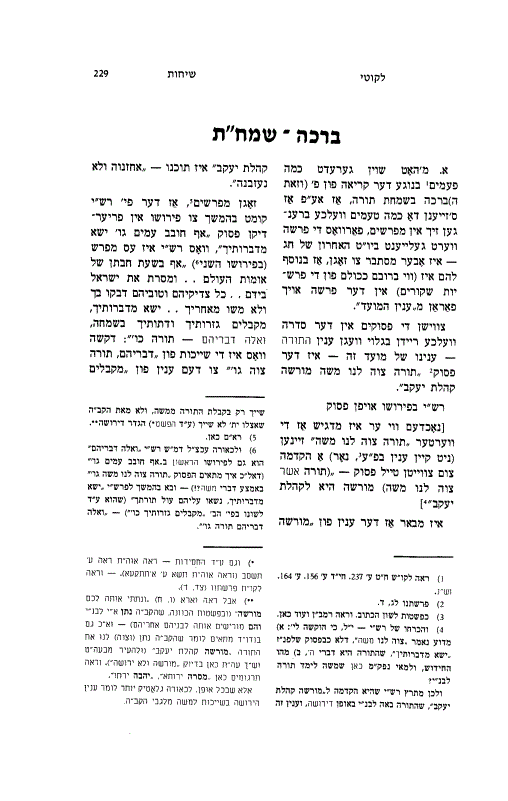
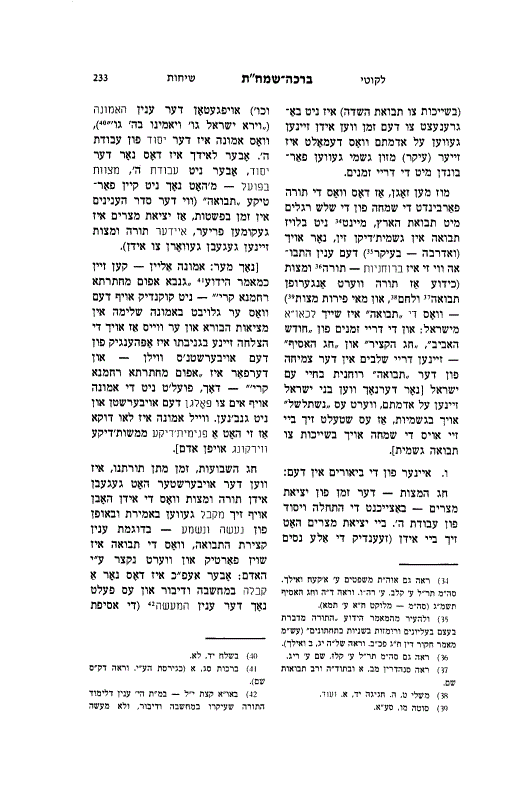
1. It has been discussed several times regarding the reading of the portion of V'Zos HaBerachah on Simchas Torah. Although there are several reasons brought by the commentators as to why this portion is read on the last day of the festival, it is reasonable to say that in addition to these reasons, there is also an element of "the theme of the festival" present in this portion, as is the case with most of the portions that are read.
Among the verses in this portion that openly speak about the theme of the Torah — which is the essence of this festival — is the verse: "The Torah that Moses commanded us is the heritage of the congregation of Jacob."
Rashi, in his commentary on this verse, after emphasizing that the words "The Torah that Moses commanded us" are not an independent matter but rather an introduction to the second part of the verse — "(The Torah that Moses commanded us) is a heritage for the congregation of Jacob" — explains that the concept of "heritage" means "we shall hold onto it and not abandon it."
The commentators say that Rashi's explanation follows his commentary on the previous verse, "Indeed, He loves the peoples... He carries Your words," which Rashi interprets (in his second explanation) as "Even at the time of the nations' favor... You delivered Israel into their hands... all their righteous and good ones clung to You and did not move away from You... He carries Your words, accepting Your decrees and laws with joy, and these are their words — Torah, etc." The question arises: what is the connection between "their words, the Torah that Moses commanded us" and the concept of "accepting Your decrees, etc."? Rashi explains that with "it is a heritage for the congregation of Jacob," they mean to say "we shall hold onto it and not abandon it".
However, we need to understand: how is "we shall hold onto it and not abandon it" connected to the fact that the Torah is "a heritage for the congregation of Jacob," an aspect of inheritance? Seemingly, the same "words" ("we shall hold onto it and not abandon it") could also be said when the Torah was given to the Jews as a gift or as a "good acquisition" and the like.
On the contrary: with inheritance, which comes automatically and naturally, it is not at all certain that there will be "we shall hold onto it" from the heirs — a grasp and effort from the Jews in observing the Torah they inherited.
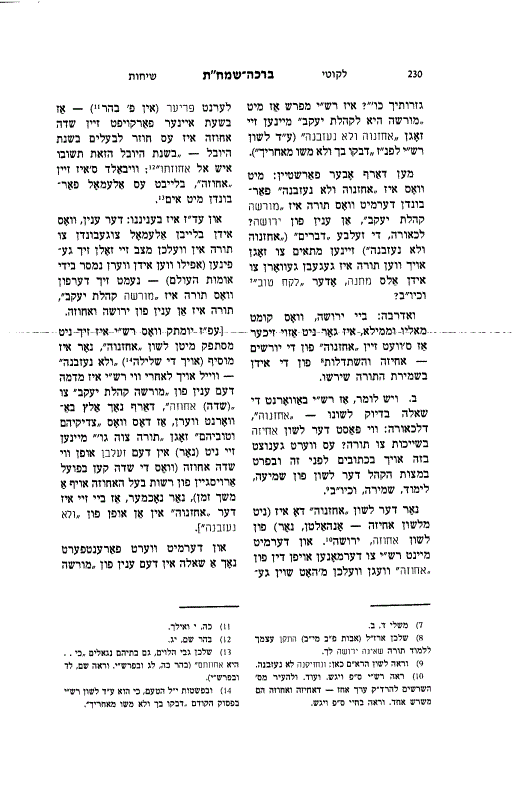
2. We can say that Rashi addresses this question with precision in his wording — "we shall hold onto it," for seemingly: how does the term "holding" fit in relation to the Torah? In this context, the terms used are hearing, learning, observing, and the like, especially in the mitzvah of Hakhel.
However, the term "we shall hold onto it" here is not from the language of holding — grasping, but from the language of inheritance. And with this, Rashi intends to remind us of the law of "inheritance" about which it has already been discussed.
3. It is explained earlier (in Parshas Behar) that when someone sells their ancestral field, it returns to the original owner in the Jubilee year — "In this Jubilee year, you shall return, each man to his possession." Since it is his "possession," it remains always connected to him.
Similarly, in our context: the idea that Jews remain always connected to the Torah, regardless of their situation (even when Jews are handed over to the nations of the world), stems from the fact that the Torah is "a heritage for the congregation of Jacob," meaning the Torah is an aspect of inheritance and possession.
Based on this, it becomes clearer why Rashi does not suffice with the term "possession" but adds (even the negative aspect!) "and we shall not abandon it" — because even after Rashi compares the concept of "a heritage for the congregation of Jacob" to a "field possession," there still needs to be a warning that when "their righteous and good ones" say "The Torah that Moses commanded us," they do not mean it in the same way as a field possession (which can actually leave the possession of the owner for a period of time), but rather more so, that for them, the "possession" is in a manner of "and we shall not abandon it."
And with this, another question regarding the concept of "a heritage for the congregation of Jacob" is answered: Since the Torah comes to the Jews as an inheritance (i.e., from father to son), it would seemingly follow that if the father who bequeaths is not a Torah scholar (and certainly if he is, G‑d forbid, not an observer of Torah and mitzvos), and he does not possess Torah, G‑d forbid, then the Torah cannot reach his children!
Rashi warns that this is analogous to a "field possession," where since it is "his possession," the connection between the field and the owner is not severed, even if he (because of this, and) sells the field.
Similarly, in our case: even when someone conducts themselves in a way that the Torah does not seem to have a direct connection to them, the Torah is theirs (an inheritance and possession), in all circumstances.
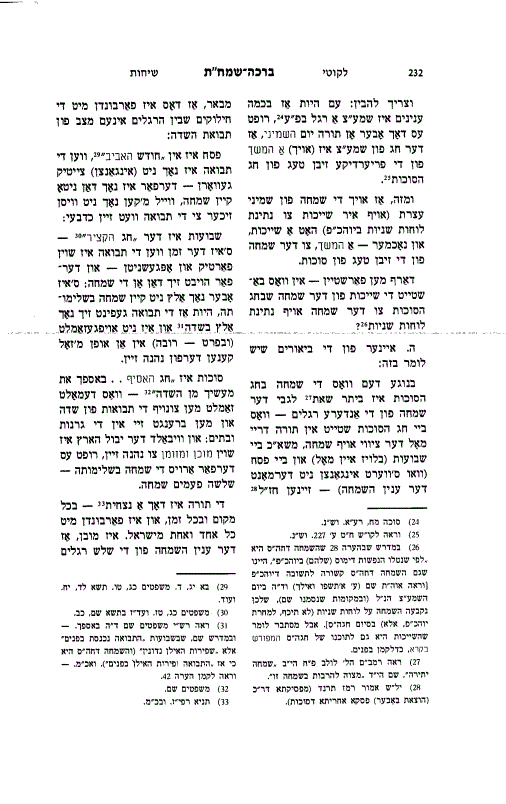
4. We have already discussed this, and it needs to be understood: Although in many aspects Shemini Atzeres is a festival in its own right, it is still called the eighth day of the festival, indicating that the festival of Shemini Atzeres is (also) a continuation of the previous seven days of the festival of Sukkos.
From this, it is understood that the joy of Shemini Atzeres (in its connection to the giving of the second Tablets on Yom Kippur) has a connection, and even more so — a continuation, to the joy of the seven days of Sukkos.
We need to understand — what is the connection between the joy of the festival of Sukkos and the joy of the giving of the second Tablets?
5. One of the explanations that can be given for this is:
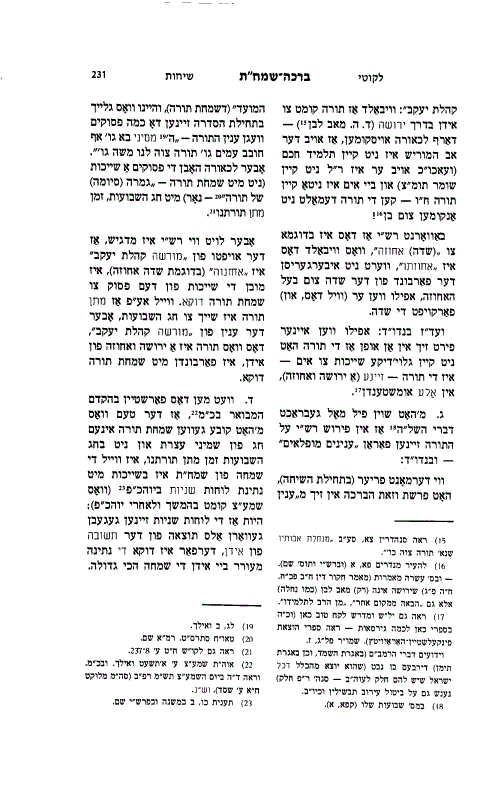
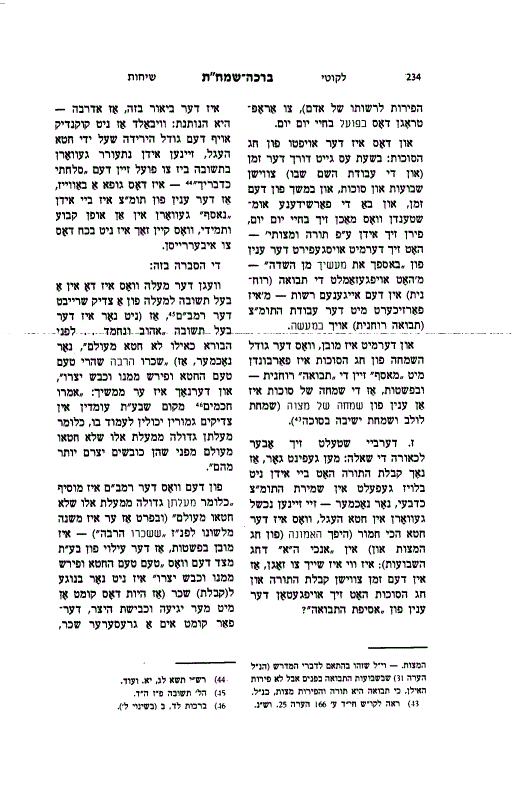
5. Regarding the fact that the joy during the festival of Sukkos is greater than the joy of the other festivals — as the Torah mentions the commandment of joy three times concerning Sukkos, whereas for Shavuos it is mentioned only once, and for Pesach, the concept of joy is not mentioned at all — our Sages explain that this is connected to the differences between the festivals in relation to the state of the field's produce:
Pesach occurs in the "month of spring," when the produce is not yet fully ripe. Therefore, there is no joy yet, because it is still uncertain whether the produce will turn out as expected.
Shavuos is the "festival of the harvest," the time when the produce is already ready and has been harvested. Thus, the joy begins then; however, it is still not complete joy, since the produce is still in the field and has not yet been gathered (especially the majority of it) in a manner that allows one to benefit from it.
Sukkos is the "festival of ingathering... when you gather in your work from the field," when the produce is collected from the field and brought into the granaries and houses. Since the yield of the land is now ready and available for enjoyment, it evokes complete joy — three times joy.
The Torah is eternal — in every place and at every time, and it is connected to every single Jew. It is understood, therefore, that the concept of joy during the three festivals (in connection to the field's produce) is not limited to the time when the Jews were on their land, when their primary physical sustenance was linked to these three times.
5. We must say that the Torah's connection of the joy of the three festivals with the produce of the land does not refer solely to physical produce. Rather, it also (and primarily) refers to the concept of produce in a spiritual sense — Torah and mitzvos. As is known, Torah is referred to as "produce" and "bread," and mitzvos as "fruits." This "produce" is relevant to every Jew, and the three times of "the month of spring," "the festival of the harvest," and "the festival of ingathering" represent three stages in the growth of this spiritual "produce" in the life of the Jewish people. Only afterwards, when the Jewish people are in their land, does this concept also manifest physically, so that their joy is also connected to physical produce.
6. One of the explanations for this is: The festival of Pesach — the time of the Exodus from Egypt — signifies the beginning and foundation of serving G‑d. During the Exodus, the Jewish people (witnessing all the miracles, etc.) developed faith ("And Israel saw... and they believed in the L‑rd"), which is the foundation of serving G‑d. However, on the other hand, this is only the foundation and not the actual service of G‑d, which involves mitzvos in practice — they have not yet produced any tangible "produce".
Moreover, faith alone — as the well-known saying goes, "A thief at the mouth of the tunnel calls upon G‑d" — despite his complete belief in the existence of the Creator and knowing that his success in theft depends on the will of the Almighty, still, his faith does not influence him to follow G‑d's will and refrain from stealing. This is because faith does not necessarily have an internal, substantial effect on a person.
The festival of Shavuos, the time of the giving of our Torah, is when G‑d gave the Jewish people the Torah and mitzvos, which they accepted with the declaration of "we will do and we will hear" — similar to the concept of harvesting the produce, where the produce is already ready and is harvested by man. However, this is still only an acceptance in thought and speech, and the aspect of action is still lacking (the gathering of the fruits into the person's possession), to bring it into practice in daily life.
5. This is the significance of the festival of Sukkos: During the time (and the service of G‑d within it) between Shavuos and Sukkos, throughout this period, and amidst the various circumstances that arise in daily life, Jews conduct themselves according to the Torah and its mitzvos. Through this, the concept of "when you gather in your produce from the field" is fulfilled — the spiritual "produce" has been gathered into one's own domain, ensuring that the service of Torah and mitzvos (spiritual produce) is also realized in action.
Thus, it is understood why the great joy of the festival of Sukkos is connected with the "gathering" of the spiritual "produce." Simply put, the joy of Sukkos is explained by the fact that, on the contrary, it is precisely because, despite the great descent caused by the sin of the Golden Calf, the Jews were aroused to repentance to the extent that they achieved "I have forgiven according to your word" — this itself is proof that the matter of Torah and mitzvos has been "gathered" by the Jews in a permanent and constant manner, which nothing has the power to uproot.
The explanation for this:
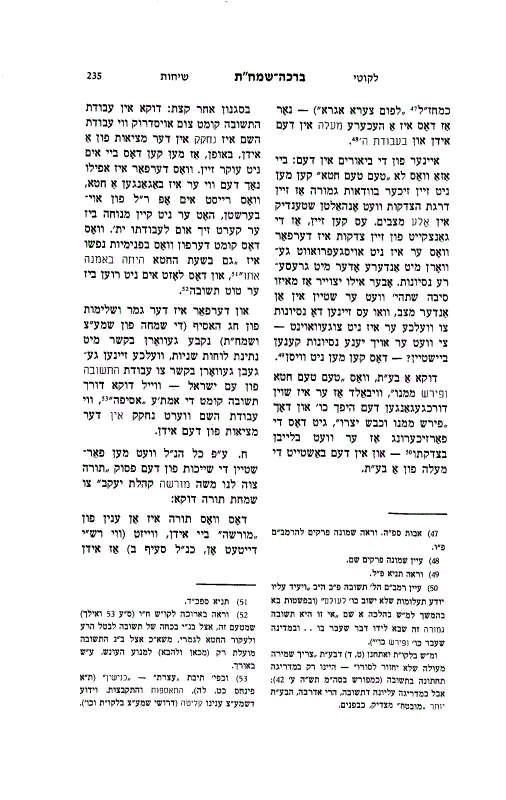
Regarding the advantage that a baal teshuvah has over a tzaddik, the Rambam writes that (not only is the baal teshuvah "beloved and cherished before the Creator as if he had never sinned," but furthermore, that) "his reward is great, for he has tasted the taste of sin and separated from it and conquered his inclination." He then continues: "The sages said, 'In the place where baalei teshuvah stand, even complete tzaddikim cannot stand,' meaning their level is greater than those who have never sinned, because they conquer their inclination more than them."
From the fact that the Rambam adds "meaning their level is greater than those who have never sinned" (especially since he changes his wording from earlier "his reward is great") — it is simply understood that the advantage of a baal teshuvah, because "he has tasted the taste of sin and separated from it and conquered his inclination," is not only regarding the (receiving of) reward (since this comes with more effort and conquering of the inclination, therefore he deserves a greater reward, as our sages say, "according to the effort is the reward") — but this is a higher level in the Jew and in the service of G‑d.
One explanation for this: For someone who has not "tasted the taste of sin," one cannot be absolutely certain that his level of righteousness will always endure in all situations. It is possible that the completeness of his righteousness is because he has not been tested with other or greater trials. But if, hypothetically, for whatever reason, he would find himself in a different situation, where there are trials to which he is not accustomed — would he withstand those trials as well? — This cannot be known.
Specifically, a baal teshuvah, who "has tasted the taste of sin and separated from it," since he has already gone through the opposite, etc., and yet "separated from it and conquered his inclination," this provides the assurance that he will remain in his righteousness — and in this lies the advantage of a baal teshuvah.
6. In a slightly different style: Specifically, the work of teshuvah expresses how the service of G‑d is engraved in the essence of a Jew, in such a way that it cannot be uprooted. Therefore, even after he has committed a sin, which tears him away, G‑d forbid, from the Almighty, he finds no rest until he returns to his service of G‑d. This is because, in the innermost part of his soul, "even at the time of the sin, he was with Him in faith," and this does not allow him to rest until he repents.
And therefore, the completion and perfection of the festival of Sukkos (the joy of Shemini Atzeres and Simchas Torah) was established in connection with the giving of the second Tablets, which were given in connection with the work of teshuvah of the Jewish people. For it is specifically through teshuvah that the true "gathering" occurs, as the service of G‑d becomes engraved in the essence of the Jew.
8. Based on all the above, we can understand the connection of the verse "The Torah that Moses commanded us is the heritage of the congregation of Jacob" specifically to Simchas Torah:
The fact that the Torah is an aspect of "heritage" for the Jews indicates that Jews remain connected to the Torah in all circumstances, similar to an ancestral field, which even when it leaves the owner's possession, it is only temporary, and ultimately, it returns (in the Jubilee year).
And this is also the connection to the concept of the "completion (conclusion) of the Torah" (which is the simple reason for the joy of Simchas Torah) — because the "completion" and perfection of Torah study is connected with the fact that the Torah becomes one with the Jew:
This is expressed specifically in the work of teshuvah, which brings out how the Torah is engraved in the very essence of a Jew, and therefore, in all circumstances, the connection cannot be nullified — in the well-known phrase: Israel, the Torah, and the Holy One, blessed be He, are all one.
Remaining connected to the Torah in all kinds of circumstances, similar to an ancestral field, which even when it leaves the owner's possession, it is only temporary, and ultimately, it returns (in the Jubilee year).
And the aspect of inheritance in the Torah is revealed openly in the work of teshuvah, where the Torah is connected with the very essence of a Jew, to the point that one cannot be separated from the Torah, and even when one has torn himself away, G‑d forbid, from the Almighty, it is only temporary, and ultimately, he is certain to return to his true essence — the service of G‑d.
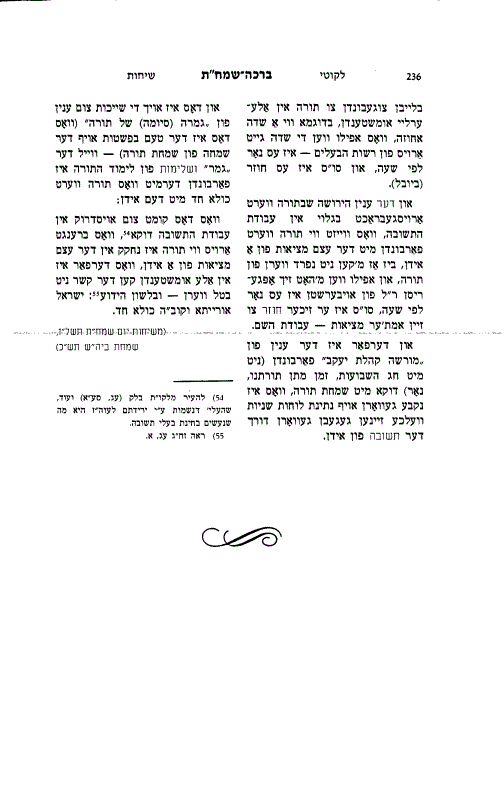
7. Therefore, the concept of "an inheritance of the congregation of Jacob" is specifically connected (not with Shavuos, the time of the giving of our Torah, but) with Simchas Torah, which was established in connection with the giving of the second Tablets, which were given through the teshuvah of the Jewish people.
(From the talks of Simchas Torah 5736, Simchas Beis Hashoeivah 5720)