Likkutei Sichos Vol. 29 – Vayeilech
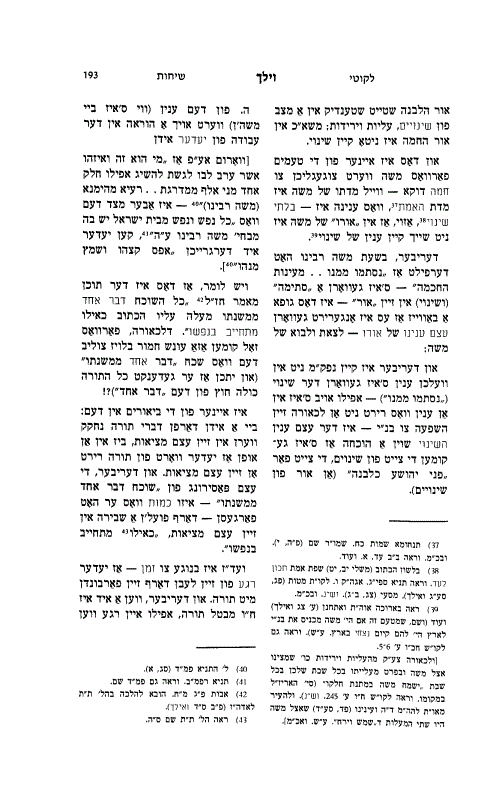
1. On the verse "I am one hundred and twenty years old today; I can no longer go out and come in," our Sages explain that this does not mean "to go out and come in" literally, because "his strength had waned," but rather it refers to "going out and coming in in matters of Torah." This teaches us that the gates of wisdom were closed to him.
This teaching is brought in Rashi's commentary on the Torah, but with a change in wording: instead of "gates of wisdom," Rashi uses the phrase "traditions and springs of wisdom."
In Ein Yaakov (and similarly in several early commentaries), the version brought is "springs" instead of "gates"; and in Tanchuma (Parshas Va'eschanan), the version is "tradition of wisdom."
However, aside from needing an explanation as to why Rashi does not bring the more common version ("gates of wisdom"), the main issue is: we do not find anywhere the phrase "that the words of Torah were closed to him"?
2. It can be said that Rashi is addressing a simple question (in common parlance: a "klotz kasha"), which I have not found anyone addressing:
How can it be said "I can no longer go out and come in in matters of Torah" when immediately afterwards, Moshe Rabbeinu conveyed to the Jewish people many matters of Torah — the three sections of Vayelech, Ha'azinu, and V'Zot HaBerachah?!
[And only regarding the last eight verses of the Torah — which begin with "And Moshe died there" — do we find two opinions whether Yehoshua wrote them, or "Moshe wrote them with tears":
But regarding Parshas Vayelech, Ha'azinu, and V'Zot HaBerachah (up to the last eight verses), there is no disagreement that Moshe said and wrote them.]
And one cannot answer that "matters of Torah" refers only to matters of halacha, because (aside from the fact that it is a great stretch to say that parts of the Written Torah do not fall under "matters of Torah" — moreover:) in these sections, there are also halachot.
Furthermore: every word of the Written Torah was given to Moshe with its explanation in the Oral Torah (because only through this can one clearly understand the intention of the Written Torah, as is obvious); and since these three sections (Vayelech, Ha'azinu, and Berachah) were also conveyed to the Jewish people by Moshe Rabbeinu, he certainly conveyed everything necessary for understanding these sections — that is, also the explanation of these sections in the Oral Torah.
— So how can it be said "I can no longer go out and come in in matters of Torah"?!
3. Therefore, Rashi adds "that the traditions and wellsprings of wisdom were sealed from him" — regarding these two matters ("traditions" and "wellsprings of wisdom"), it is possible to say that they were not included in the "matters of Torah" that Moshe Rabbeinu taught the Jews in these three sections, as will be explained.
The meaning of the word "traditions" is — the matters that were transmitted to Moshe from Sinai orally, especially those that do not even have a hint in the Written Torah.
[As the Gemara states, "The Torah is mostly written and a small part oral," and as Rashi explains: Most of the Torah depends on the Midrash, etc., the measures by which the Torah is expounded. And a small part is oral, which has no hint in the Torah but was told to Moshe orally.]
"Wellsprings of wisdom" means (not the actual laws of the Oral Torah, but rather) — the dialectics of Torah — for the dialectics of Torah there is no limit, as the verse states, "It is longer than the earth and broader than the sea," and this is evident in practice:
And from this, it is understood (and simply), that in the "matters of Torah" that Moshe Rabbeinu taught the Jews (even in the explanation of the Oral Torah), only the actual laws and explanations, etc., of the Oral Torah were included, but not the dialectics of the Torah (which has no limit).
[And certainly according to the statement of the Gemara, that the dialectics of the Torah "was not given... except to Moshe and his descendants," but "Moshe acted generously and gave it to Israel" — it is understood that even without the dialectics of the Torah, the "matters of Torah" received by the Jewish people from Moshe are a "complete matter"].
3. Based on this, it is understood how there is no contradiction: Even though "the traditions and wellsprings of wisdom were sealed from him," nonetheless, Moshe Rabbeinu transmitted to the Jews the three sections in their entirety — both the sections themselves (of the Written Torah) and their explanations (of the Oral Torah) — the actual explanations. This is because the "traditions" were not initially connected with the sections (the written text) themselves. Regarding the "wellsprings" (the dialectics of Torah), there is no necessity for Moshe to have to teach these matters to the children of Israel, as mentioned above.
[Therefore, Rashi does not write in the simple meaning of the verse the term "gates of wisdom," which has no relevance to the distinctions and content mentioned above.]
Based on this, we can explain why Rashi is precise in bringing the term "(wellsprings of) wisdom" and not "(wellsprings of) Torah" — to emphasize that the "wellsprings" are not necessary for the matter of Torah and instruction (because if they were, Moshe would have had to teach them to the Jews). Rather, it is an aspect of (additional) wisdom within the Torah.
4. However, it still seems not entirely smooth:
The matter of "the traditions and wellsprings of wisdom were sealed from him" comes as a reason for "I can no longer go out and come in with words of Torah," which means —
But concerning the "wellsprings of wisdom," since their study is not necessary for the children of Israel (as mentioned above) — how does it fit to say that because "the wellsprings of wisdom were sealed from him," he "can no longer go out and come in — to the Jews — with words of Torah"?
[And one cannot say that the "I can no longer go out and come in" is only because "the traditions were sealed from him" — because if so, why did the L‑rd cause that the "wellsprings of wisdom" should also be sealed from Moshe? And also: Why does Rashi need to bring it?]
One can explain this: From the very fact that a part of his Torah was sealed — even though it might not have changed his influence on the Jews — it is a sign that his going out and coming in to the children of Israel, his leadership, has ended, and it is time for Yehoshua to become the leader of Israel.
And in a deeper sense:
It is known what our Sages say — brought down in Rashi's commentary on the Torah — that "the face of Moshe is like the sun, the face of Yehoshua is like the moon." One of the differences between the light of the sun and the light of the moon is that the light of the moon is always in a state of change, ascents and descents; whereas in the light of the sun, there is no change.
4. This is one of the reasons why Moshe is specifically compared to the sun—because Moshe's attribute is the attribute of truth, whose essence is unchanging. Thus, in the "light" of Moshe, there is no concept of change.
Therefore, when Moshe Rabbeinu felt that "the wellsprings of wisdom were sealed from him"—it became a "sealing" (and change) in his "light"—this itself is evidence that his very essence of light, his going out and coming in, was affected.
Consequently, it does not matter in which aspect the change occurred ("it was sealed from him")—even if it is in an area that seemingly does not affect his influence on the children of Israel—the very fact of the change is already proof that the time for changes has come, the time for "the face of Yehoshua is like the moon" (a light of changes).
5. From this matter (as it is with Moshe), there is also a lesson in the service of every Jew.
[Because although "who is he and where is he who dares to approach to attain even one part of a thousand of the level of... the faithful shepherd (Moshe Rabbeinu)"—yet, since "every soul of the house of Israel contains within it a part of Moshe Rabbeinu, peace be upon him," every Jew can reach "a tiny bit and a trace of it."]
It can be said that this is the content of the teaching of our Sages: "Anyone who forgets even one thing from his learning, the Torah considers it as if he is liable for his life." At first glance, why should such a severe punishment come just because he forgot "one thing from his learning" (and it is possible that he remembers the entire Torah except for this "one thing")?!
One of the explanations for this is: For a Jew, the words of Torah must be engraved in his very essence, to the extent that every word of Torah speaks to his very being. Therefore, the very occurrence of "forgetting one thing from his learning"—regardless of the amount he forgot—should cause a break in his very essence, "as if" he is liable for his life.
Similarly, regarding time—every moment of his life must be connected with Torah. Therefore, when a Jew, G‑d forbid, neglects Torah study, even for one moment when "he could have been engaged in Torah study," it affects his very essence. Because here, it is not the amount of time he missed learning that matters, but the very fact that a moment passed when he was not connected with Torah.
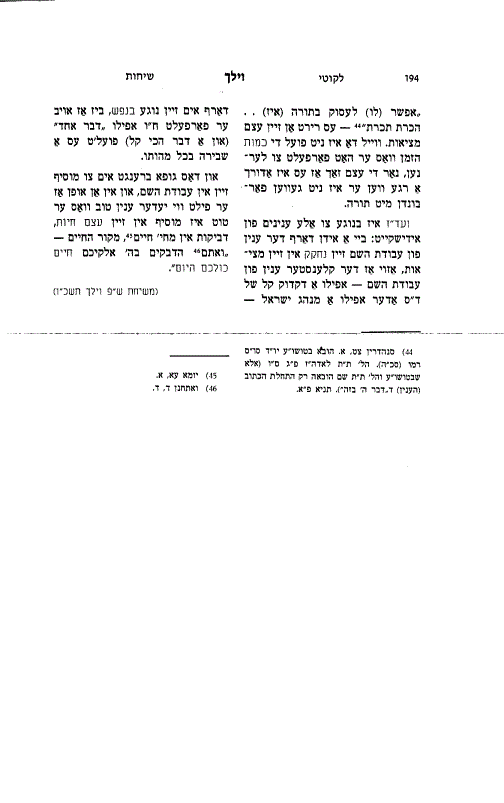
5. Similarly, this applies to all aspects of Jewish life: For a Jew, the concept of serving G‑d must be engraved in his very being, so that even the smallest detail of serving G‑d—even a minor rabbinic decree or even a Jewish custom—
must affect him deeply, to the extent that if he, G‑d forbid, neglects even "one thing" (even the smallest matter), it causes a break in his entire essence.
And this itself leads him to increase in his service of G‑d, in such a way that he feels how every good deed he performs adds to his essential vitality, his attachment to the Source of Life, "and you who cleave to the L‑rd your G‑d are all alive today."