Likkutei Sichos Vol. 29 – Ha'azinu
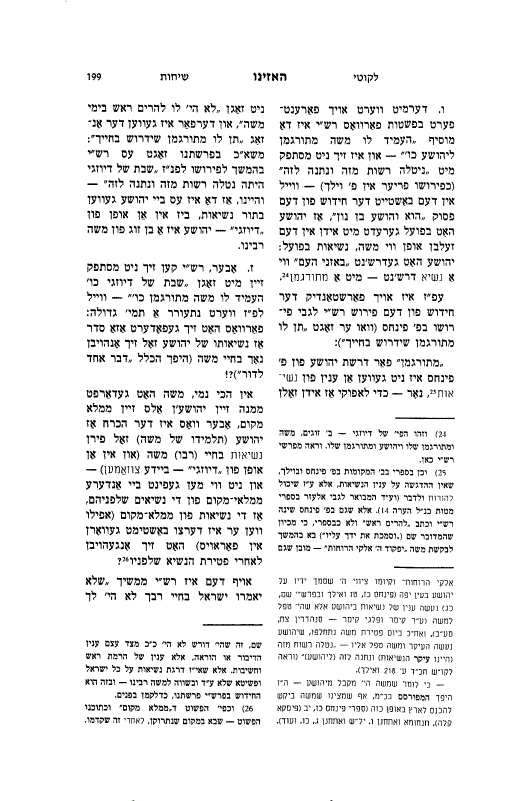
1. It has been discussed many times that Rashi's approach in his commentary on the Torah is, as he himself states, "I have come only to explain the plain meaning of the text." Even in places where it initially appears that Rashi is simply bringing a midrashic interpretation from the Sages, upon closer examination, it becomes clear that the midrash he brings (unless he explicitly states "our Rabbis interpreted" or similar) is necessary for the plain meaning of the text.
This is particularly evident in Rashi's commentary on our parsha. Rashi provides an interpretation which, when one examines the sources of this interpretation, reveals that it consists of three separate teachings of the Sages: one from the Gemara, the second from the Sifrei in Parshas Vayelech, and finally a teaching found in the Sifrei on this very verse. In their original sources, these teachings have no connection to each other. However, Rashi, in his commentary on the Torah, combines and includes all three into a single interpretation!
It must be that these teachings are relevant to the plain meaning of the text, which is what binds them together. Consequently, the order in which Rashi presents them in his commentary is also significant to the plain meaning of the text, as will be explained further.
2. On the verse "And Moses came and spoke... he and Hoshea the son of Nun," Rashi quotes the words from the verse "he and Hoshea the son of Nun" and explains: "It was a Sabbath of transition; authority was taken from one and given to the other. Moses appointed a translator for Joshua so that he would expound during his lifetime, so that the Israelites would not say, 'In your teacher's lifetime, you did not have the courage to raise your head.' And why is he called Hoshea here? To indicate that he did not become arrogant, for although greatness was given to him, he humbled himself as at the beginning."
The beginning of Rashi's explanation, "It was a Sabbath of transition; authority was taken from one and given to the other," is found in the Gemara Sotah. The continuation of Rashi's explanation, "Moses appointed a translator for Joshua, etc.," is found in the Sifrei in Parshas Vayelech. The content of the conclusion of Rashi's explanation, "And why is he called Hoshea here," is found in the Sifrei on our parsha.
Why does Rashi combine these three separate statements into one interpretation?
Moreover, it would be understandable if the first two elements in Rashi's commentary were combined —
in the same comment, but he connects it further with a conjunctive "and" — "And why is he called here, etc." — as if the question arises specifically after and in continuation of the previous interpretation "It was a Sabbath of transition, etc. Moses appointed a translator, etc."!
This question — why Rashi combines three separate elements together — becomes even more pronounced: not only do they come from different places and even different books and midrashim of the Sages, but Rashi himself brings these (first two) statements elsewhere, but each one separately! In Parshas Pinchas on the verse "And you shall lay your hand upon him," Rashi states, "Appoint a translator for him so that he will expound during your lifetime, so that they will not say about him, 'He did not have the courage to raise his head during Moses' days.'" And at the beginning of Parshas Vayelech, on the verse "I can no longer go out and come in," Rashi says, "I am not permitted, for authority has been taken from me and given to Joshua." This indicates that, according to Rashi, these two elements (authority was taken, etc., and Moses appointed a translator, etc.) are not dependent on each other. What compels Rashi to connect them together in our verse?
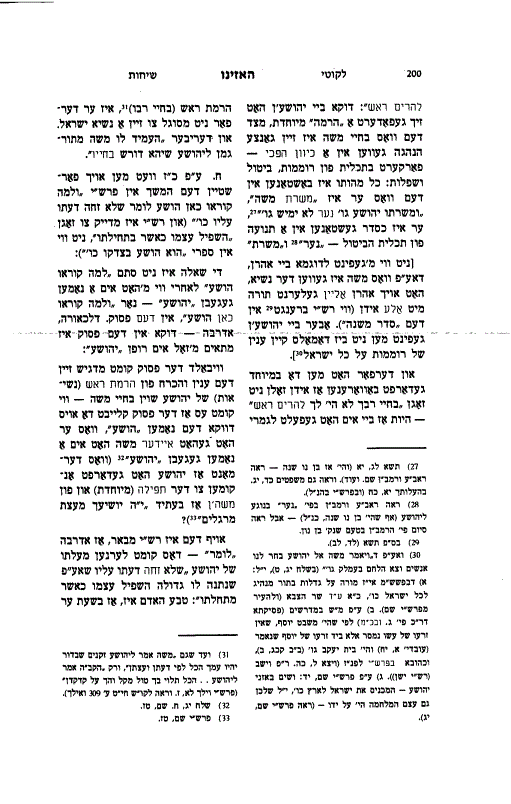
3. We must also understand: The statement "It was a Sabbath of transition, authority was taken from this one and given to that one" appears in the Gemara concerning a different (earlier) verse, in Parshas Vayelech — "And Moses and Joshua went and stood in the Tent of Meeting." Seemingly, Rashi should have provided the entire explanation on this verse in Parshas Vayelech, where it is mentioned in this language for the first time.
One cannot answer that since Rashi already brought the content of this explanation at the beginning of Parshas Vayelech (as mentioned above), he does not need to repeat the matter again later in the parsha on the verse "And Moses and Joshua went" — because if so, why does Rashi need to repeat it in our parsha? And furthermore: specifically in our parsha, he adds the element of "It was a Sabbath of transition."
Similarly, it is not understood regarding the matter of "Moses appointed a translator for him, etc.": Since Rashi already brought this matter in Parshas Pinchas (where G‑d commanded Moses, "Appoint a translator for him, etc." — which Moses certainly fulfilled) — why does Rashi need to repeat it in our parsha?
Even if one were to say that this is similar to what we find in many places in Rashi's commentary, that a matter he explained in an earlier book he repeats again in a later book; and all the more so in our case, where it is not exactly the same matter — in Parshas Pinchas it speaks about G‑d's command "Appoint a translator for him," and in our parsha — about the actual implementation "Moses appointed a translator for him."
— it is still not understood why he needs to repeat all the details, including the reason "so that the Israelites should not say, etc.," since he already explained this in Parshas Pinchas [because, as discussed many times, when Rashi repeats an explanation he has already given earlier, he only does so briefly, and in places where he repeats it with all the details, it is because it is necessary due to the verses at hand].
We must also understand: Rashi interprets the phrase "Sabbath of transition" as "there were two pairs, two companions in it, the beginning of the day for Moses and the end for Joshua," which clearly indicates that "transition" cannot be understood literally, as from the term pair — because the leadership of Moses was at the beginning of the day and of Joshua at the end (it was not a matter of a "pair," both together) — rather, it means "there were two companions."
It is not understood: Since Rashi in the Gemara needs to clarify this, it is obvious that he needs to do so in the study according to the simple meaning?
4. We will understand all this by first explaining the differences in language in Rashi's commentary, compared to the language in its original source in the Sifrei:
1. In the Sifrei, it states: "Give him a translator for Joshua, and he will ask, expound, and instruct in matters of law during your lifetime, and when you pass away, the Israelites will not say to him, 'In the lifetime of Moses, your teacher, you did not speak, and now you speak.'" In contrast, Rashi comments, "that he should expound during his lifetime... in the lifetime of your teacher, you did not have the audacity to raise your head." What is the precision in the language "to raise your head"?
2. Regarding the reason he is referred to here as "Hoshea," the Sifrei states: "To teach you the righteousness of Joshua, I might think that his mind became haughty once he was given authority, therefore it teaches us, 'he and Hoshea the son of Nun,' Hoshea in his righteousness, even though he was appointed as a leader over the community, he remained Hoshea in his righteousness." However, Rashi says something entirely different: "that his mind did not become haughty, that even though greatness was given to him, he humbled himself as he did initially."
5. The explanation for all this is as follows:
The reason Rashi does not mention the concept of "Sabbath of transition" immediately at the beginning of Parshas Vayelech is because there is no necessity to say that at that time Joshua's leadership had already begun in practice. For although Rashi states, "I am not permitted, for the authority has been taken from me and given to Joshua," Rashi immediately continues (in his commentary), "This is what He said to me, this is the explanation of 'I can no longer go out and come in,' because the L‑rd said to me (you shall not cross this Jordan)." This means that the granting of authority to Joshua is relevant (not on that day, but) due to the matter and consequently — the time of "you shall cross this Jordan," and therefore there is no necessity that at the time Moses said, "I can no longer go out and come in," Joshua's leadership had already begun in practice.
Similarly, the verse "Moses and Joshua went and stood in the Tent of Meeting" (later in Parshas Vayelech) — in this there is no indication that Joshua was already a leader over Israel in practice — this was still a fulfillment of the L‑rd's command "Call Joshua and stand in the Tent of Meeting, and I will command him."
However, when we come to our Parsha, where the verse states "and he spoke... he and Hoshea the son of Nun," the question arises: What is the intention of the verse in associating Joshua with Moses — how does Joshua (Hoshea) come into this? Indeed, Joshua "did not depart from the tent," he was always with Moses — but why does the Torah explicitly state it here?
We must say that the words "he and Hoshea the son of Nun" relate to the "and he spoke" at the beginning of the verse, meaning that after the Torah tells us that Moses said the song, the verse adds "he and Hoshea the son of Nun" — the song was not said by Moses alone, but also by Joshua the son of Nun.
4. "In the ears of the people." Furthermore, from the fact that the Torah states "he and Hoshea the son of Nun" — seemingly, the word "he" is superfluous — it is understood that the Torah is emphasizing that Moses and Joshua were both present equally (in this matter and manner of speech — in the style of a leader — to the Children of Israel).
Therefore, Rashi specifically states here that "it was a Shabbos of pairs," and Rashi does not need to explain what this means — his intention is straightforward, that they were both together as a pair of leaders.
[With this, Rashi clarifies that when he continues later with "authority was taken from this one and given to that one," it does not mean that Moses' leadership had already ended, but rather that it was in a manner of "pair," both together.
6. This also simply explains why Rashi adds here "Moses appointed a translator for Joshua, etc." — and does not suffice with "authority was taken from this one and given to that one" (as he explained earlier in Parshas Vayelech) — because this is the novelty of the verse "he and Joshua the son of Nun," that Joshua actually spoke to the Jews in the same manner as Moses, actual leadership; Joshua expounded "in the ears of the people" like a leader expounds — with a translator.
Accordingly, it is also understood the novelty of Rashi's explanation compared to his explanation in Parshas Pinchas (where he says "give him a translator so he can expound during your lifetime"):
The "translator" for Joshua's expounding in Parshas Pinchas was not a matter of leadership, but — to ensure that the Jews would not say "he did not have the authority to raise his head during Moses' days," and therefore the instruction was "give him a translator so he can expound during your lifetime"; whereas in our Parsha, Rashi states it in continuation to his previous explanation "it was a Shabbos of pairs, authority was taken from this one and given to that one" — meaning, here it was for Joshua in the capacity of leadership, even in a manner of "pairs" — Joshua was a partner with Moses our teacher.
7. However, Rashi cannot be satisfied with merely stating "a Shabbos of pairs, etc., Moses appointed a translator for him, etc." — because this raises a significant question: Why was it necessary for Joshua's leadership to begin during Moses' lifetime (contrary to the principle "one leader for a generation")?
Indeed, Moses needed to appoint Joshua as his successor, but what was the necessity for Joshua (Moses' disciple) to lead during the lifetime of his teacher Moses (and in a manner of "pairs" — both together) — unlike what we find with other successors of the leaders before them, where the leadership of the successor (even when appointed in advance) began only after the passing of the previous leader?
To this, Rashi continues, "so that the Israelites would not say, 'In the lifetime of your teacher, you did not have the authority to raise your head.'" Specifically for Joshua, a unique "elevation" was required, because during Moses' lifetime, his entire conduct was in the opposite direction — completely contrary to elevation, in self-nullification and humility: his entire essence was as "Moses' servant," "and his servant Joshua, a young man, did not depart from the tent," he stood in a state of utmost self-nullification — "a young man" and "a servant."
[Unlike what we find, for example, with Aaron, even though Moses was the leader, Aaron himself taught Torah to all the Jews. But with Joshua, we do not find until then any matter of elevation over all Israel.]
Therefore, it was particularly necessary here to ensure that the Jews would not say that because he did not have the authority to raise his head during his teacher's lifetime, he was therefore not fit to be a leader of Israel. Hence, "Moses appointed a translator for Joshua so that he would expound during his lifetime."
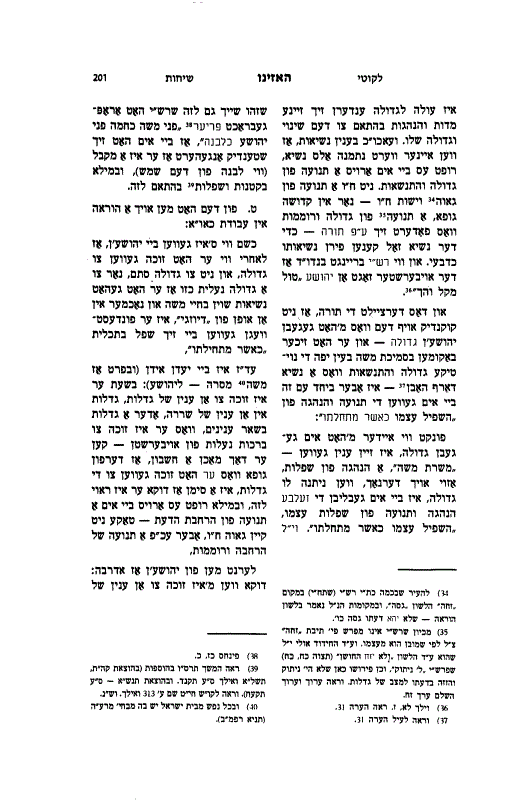
8. Based on all this, we can also understand the continuation in Rashi, "And why is he called here Hoshea? To say that his mind did not become haughty, etc.".
The question is not simply "why is he called Hoshea" after he was given the name "Joshua" — but "and why is he called here Hoshea," in this verse, where seemingly, on the contrary — specifically in this verse, it would be fitting to call him "Joshua":
Since the verse comes to emphasize the matter and necessity of Joshua's elevation (leadership) already during Moses' lifetime — how does it come that the verse specifically chooses the name "Hoshea," which he had before Moses gave him the name "Joshua"?
To this, Rashi explains, on the contrary, "to say" — this comes to teach the virtue of Joshua "that his mind did not become haughty even though greatness was given to him, he humbled himself as at the beginning": It is human nature that when one is
9. When one rises to greatness, their traits and behaviors often change in accordance with their new status and greatness. All the more so in the matter of leadership, when someone is appointed as a leader, it naturally evokes in them a sense of greatness and elevation. This is not, G‑d forbid, a movement of arrogance or self-importance, but rather within holiness itself, a movement of greatness and exaltation that is required according to Torah — so that the leader can conduct their leadership properly. As Rashi brings in our context, G‑d instructs Joshua, "Take a stick and strike" (to assert leadership).
And the Torah tells us that despite the fact that Joshua was given greatness — and he certainly received, with Moses' endorsement, the necessary beauty of greatness and elevation that a leader must have — nevertheless, along with this, he maintained the attitude and conduct of "he humbled himself as at the beginning."
Just as before he was given greatness, his role was "Moses' servant," a conduct of humility, so too afterward, when greatness was given to him, he retained the same conduct and attitude of personal humility, "he humbled himself as at the beginning." It can be said that this humility is the vessel that ensures the greatness given to him will endure.
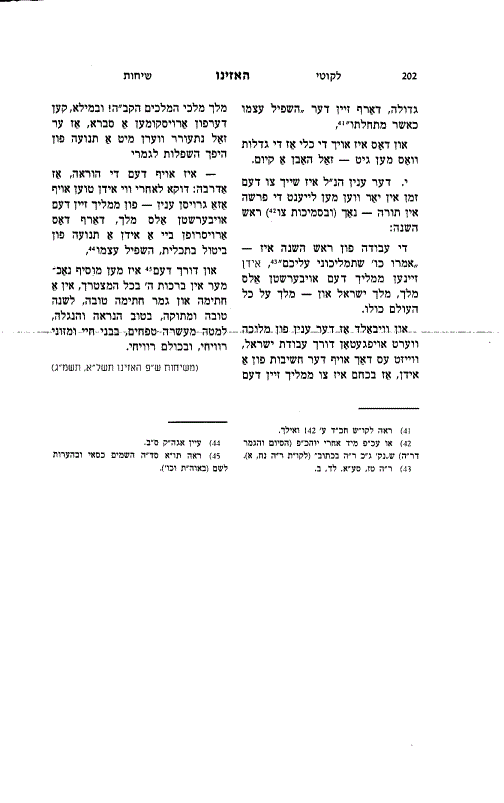
10. This concept is relevant to the time of year when this Torah portion is read — after (and in proximity to) Rosh Hashanah:
The service of Rosh Hashanah is — "Say before Me... that you should crown Me as King," Jews crown the Almighty as King, King of Israel, and — King over the entire world.
11. And since the concept of kingship is achieved through the service of the Jewish people, this indicates the significance of a Jew, as it is within their power to crown the King of Kings, the Holy One, blessed be He! Consequently, one might think that this could lead to an attitude completely opposite to humility.
However, the instruction is that, on the contrary: specifically after Jews accomplish such a great matter — crowning the Almighty as King — it should evoke within a Jew a complete sense of self-nullification, "he humbled himself."
And through this, one adds even more to the blessings of G‑d in all that is needed, in a sealing and a good final sealing, for a good and sweet year, with visible and revealed goodness, below ten handbreadths, in children, life, and abundant sustenance, and in all of them abundantly.
(From the talks of Shabbos Parshas Haazinu, 5731 and 5743)