
Likkutei Sichos Vol. 29 – Rosh Hashanah / Vav Tishrei
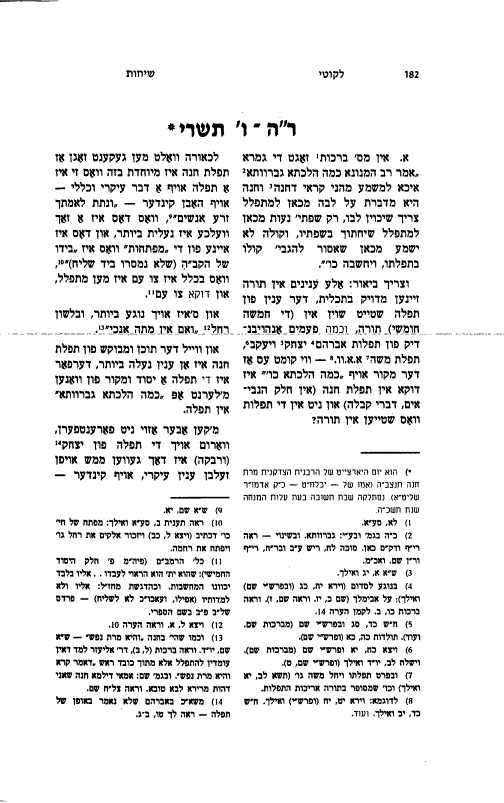
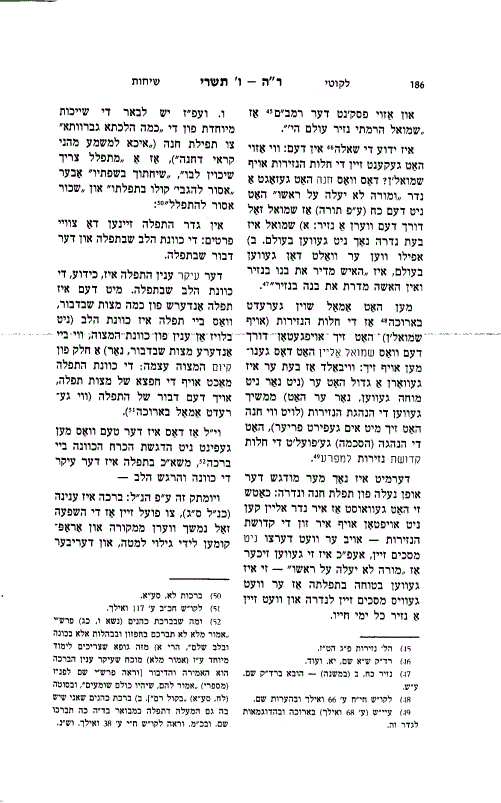
1. In Tractate Berachos, the Gemara states: "Rav Hamnuna said: How many significant halachic principles can be derived from these verses concerning Chana! 'And Chana was speaking to her heart'—from here we learn that one who prays must direct his heart. 'Only her lips moved'—from here we learn that one who prays must enunciate with his lips. 'But her voice was not heard'—from here we learn that it is forbidden to raise one's voice in prayer. 'And Eli thought she was drunk'..."
This requires explanation: All matters in the Torah are precise to the utmost degree. The concept of prayer is already mentioned in the (Five Books of) Torah, and several times, beginning with the prayers of Avraham, Yitzchak, and Yaakov, the prayer of Moshe, and so forth. How is it that the source for "how many significant halachic principles" is specifically from the prayer of Chana (in the section of the Prophets, the words of tradition) and not from the prayers that are mentioned in the Torah?
At first glance, one might say that the prayer of Yitzchak, "And Yitzchak entreated the L‑rd opposite his wife because she was barren" could serve as a source!
2. It cannot be answered that from the prayers of the Patriarchs one could not derive these principles, since "we do not learn from before the giving of the Torah"—
Because, firstly, this is not a direct derivation (from a verse), but rather a revelation of a matter (similar to an asmakhta) regarding how the conduct in prayer should be; especially since the entire (matter and) order of prayer, as the Gemara states, "The prayers were instituted by the Patriarchs"—"Avraham instituted the morning prayer, as it is stated... Yitzchak instituted the afternoon prayer, as it is stated...".
Furthermore: Regarding some of the "significant halachic principles" that "can be derived from these verses concerning Chana," the Maharsha states that "many of the matters mentioned here, such as that one must direct his heart and that it is forbidden to make one's voice heard, we also learn from other places as mentioned earlier, but it is stated that from these verses concerning Chana, too, they can be derived."
According to this: These "matters" that "we also learn from other places" could certainly have been alluded to in one of the...
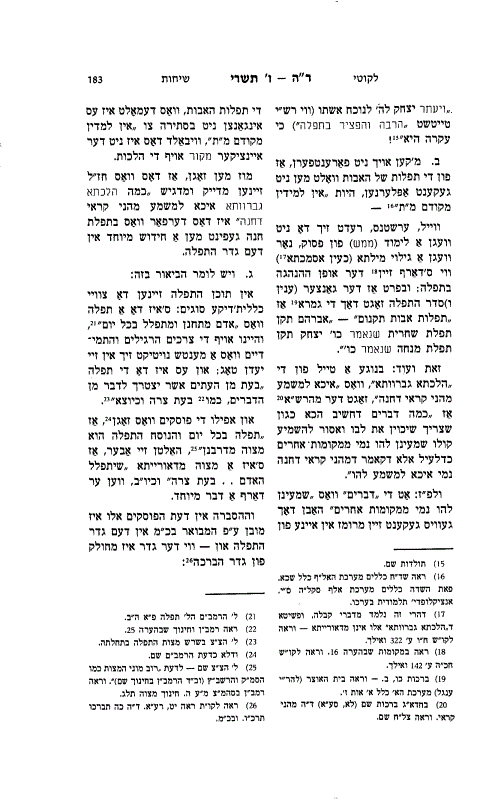
3. The term "blessing" (ברכה) is derived from the word "pool" (בריכה) — a place where water is gathered, from which water is drawn according to the necessary needs and details. Similarly, a blessing is also related to the term "to graft" (המבריך), which means to draw down. The essence of a blessing is to draw something from its source.
This means that the effect of a blessing is only when the matter (of the blessing) already exists (in its source), but for some reason, it is being withheld from reaching the one being blessed. The blessing causes it to be drawn from the source and descend below. As the verse states: "Each according to his blessing, he blessed them" — with the blessing that was fitting and prepared for each one, he blessed them. That is, the blessing drew down to each one below what was in the source above.
[As evidenced by the blessing that Jacob gave to the sons of Joseph, where Jacob placed "his right hand on Ephraim's head... and his left hand on Manasseh's head," and Joseph said to him, "This is the firstborn, place your right hand on his head," but his father refused, saying, "His younger brother will be greater than he, and his descendants will become a multitude of nations." Seemingly, since Jacob was the one blessing them, he could have blessed Manasseh with the very blessing that he should be greater than Ephraim?
However, the matter is as mentioned above: a blessing does not create something new — it merely draws down (מבריך) the matter of the blessing from its source. Therefore, Jacob could not effect with his blessing that Manasseh should be greater than Ephraim, because this was not in the source.]
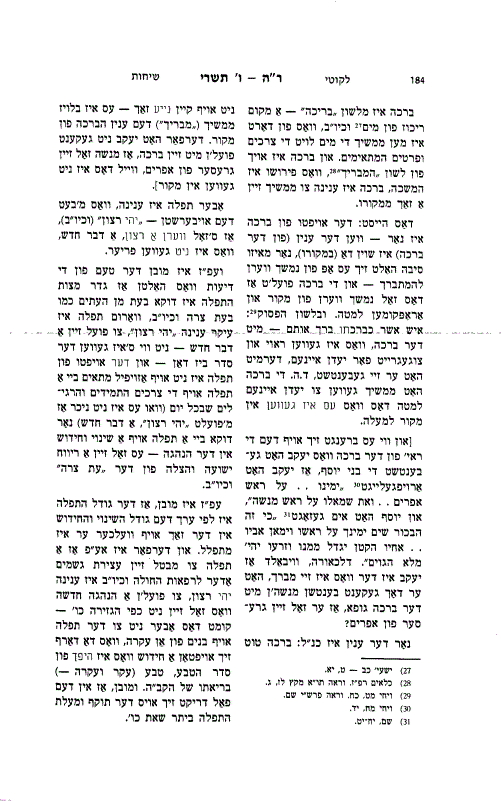
But prayer is about asking the Almighty — "May it be Your will" (and similar expressions), that a new will, a new matter, should be created, which did not exist previously.
Accordingly, it is understood why some opinions hold that the essence of the mitzvah of prayer is specifically at certain times, such as during a time of distress and the like. Because the main aspect of prayer is "May it be Your will," to effect a new matter — not as it was previously arranged — and the purpose of prayer is not as much suited for a prayer concerning the regular and daily needs (where it is not apparent that one is effecting "May it be Your will," a new matter) but specifically for a prayer for a change and innovation in conduct — that there should be relief, salvation, and rescue from the "time of distress" and the like.
Based on this, it is understood that the greatness of prayer is relative to the magnitude of the change and innovation in the matter for which one is praying. Therefore, although a prayer to annul a drought or to heal the sick and the like is about 'May it be Your will,' to effect a new conduct that should not be according to the decree, etc. — this does not compare to the prayer for children from a barren woman, where a novelty must occur that is contrary to the natural order, the nature (of barrenness) created by the Holy One, blessed be He. It is understood that in this case, the strength and virtue of prayer are expressed with greater intensity, etc.
4. And according to this, it will be understood in our context: Although a prayer for children in the aforementioned manner is of great virtue as mentioned (which was the matter with the Patriarchs as mentioned in section 1), the prayer of Chana is unique in this very aspect.
5. The explanation: The content of Chana's prayer is as it is written, "And she vowed a vow and said, 'L‑rd of Hosts, if You will indeed look upon the affliction of Your maidservant... and give Your maidservant a male child...'" Regarding this, Rashi explains that she meant "righteous ones." That is, she requested not just to have children, but "a male child — righteous ones."
Her intention was not only for a potential tzadik (that he should have the soul of a tzadik) but also an actual tzadik, as she stated in her vow (which was part and continuation of her prayer), "I will give him to the L‑rd all the days of his life," meaning he would actually be dedicated to G‑d all his life.
And since it was subsequently as she prayed — Shmuel was born to her, who indeed was actually dedicated to G‑d — it is reasonable to say that this came because G‑d fulfilled her prayer and request, giving her a son as she asked.
This is a matter that is contrary not only to the natural order that G‑d established in the world but also, so to speak, beyond the limitations as they are according to Torah:
It is known that "the angel appointed over conception says before Him (the Holy One, blessed be He), 'Master of the Universe... strong or weak, etc., but whether he will be wicked or righteous, he does not say,' because 'everything is in the hands of Heaven except for the fear of Heaven.' The matter of free choice, that 'every person is given the choice to incline himself to the good path and be righteous, or if he wishes, etc.,' is a great principle and the pillar of Torah and mitzvah."
Thus, it turns out that Chana's prayer was for a matter that is not only contrary to the natural order that the Holy One, blessed be He, embedded in His world, but also not according to the limitations and definitions that G‑d established in His Torah as a great principle and pillar.
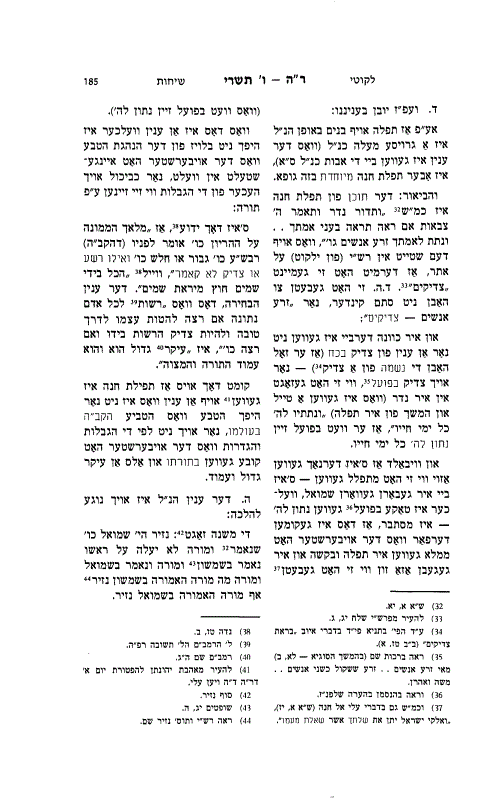
6. This matter is also relevant to halacha:
The Mishnah states: "Shmuel was a nazir, as it is said, 'and no razor shall come upon his head,' as it is said regarding Samson, 'and no razor,' and it is said regarding Shmuel, 'and no razor.' Just as the 'no razor' mentioned regarding Samson refers to a nazir, so too the 'no razor' mentioned regarding Shmuel refers to a nazir."
And so the Rambam rules that "Shmuel the Ramathite was a lifelong nazir."
There is a known question regarding this: How could the status of nazir be applied to Shmuel? The vow that Chana made, "and no razor shall come upon his head," does not have the power (according to Torah) to make Shmuel a nazir: a) Shmuel was not yet in the world at the time of her vow. b) Even if he were in the world then, "a man can vow his son as a nazir, but a woman cannot vow her son as a nazir."
7. It has been discussed at length that the status of nazir (for Shmuel) was achieved through Shmuel himself accepting it upon himself. Since when he became of age, he not only did not object, but he continued the practice of nazir (as Chana had conducted with him previously), this conduct (agreement) retroactively effected the sanctity of nazir.
This further emphasizes the elevated nature of Chana's prayer and vow: Even though she knew that her vow alone could not confer the sanctity of nazir upon her son—if he would not agree to it—nevertheless, she was certain that "no razor shall come upon his head." She was confident in her prayer that he would certainly agree to her vow and would be a nazir all his life.
8. Based on this, we can explain the special connection of the "many great halachic principles" to Chana's prayer ("we can learn from these verses of Chana"), such as "one who prays must direct his heart," "he should articulate with his lips," but "it is forbidden to raise one's voice in prayer," and "a drunk person is forbidden to pray":
In the concept of prayer, there are two components: the intention of the heart in prayer and the speech in prayer.
The primary aspect of prayer, as is known, is the intention of the heart in prayer. This distinguishes prayer from several mitzvos involving speech, for in prayer, the intention of the heart is not merely an aspect of the intention of the mitzvah, as with other mitzvos involving speech, but it is a part of the fulfillment of the mitzvah itself; the intention of prayer creates the object of the mitzvah of prayer, including the speech of the prayer (as discussed at length previously).
It can be said that this is the reason why we do not find an emphasis on the necessity of intention in blessings, whereas in prayer, the primary focus is the intention and feeling of the heart—
This is clarified based on the above: The purpose of a blessing is (as mentioned in section 3) to effect that the influence should be drawn from its source and come down to be revealed below, and therefore...
5. Chana was on Rosh Hashanah), because that is the time when a new will is established with the Almighty (not just in relation to a specific matter in creation, but) concerning the entirety of creation.
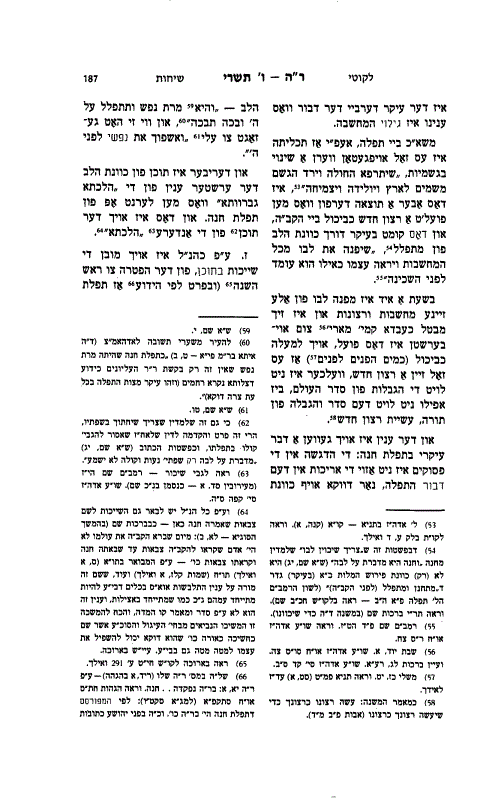
The explanation of this is: The primary service of Rosh Hashanah is to effect the "Crown Me as your King": Every year, we must anew crown the Almighty as the King of Israel (and thereby - the King of the world).
This is accomplished by arousing within the Almighty the desire to be a king. This is similar to the example of a mortal king, where a true king is "head and shoulders above all the people," meaning that the concept of kingship, to become a king and lead the people, is for him a descent, and therefore, one must arouse within him a desire for kingship.
The arousal of the desire for kingship is achieved through the submission that the people express towards the king, which is the concept of coronation.
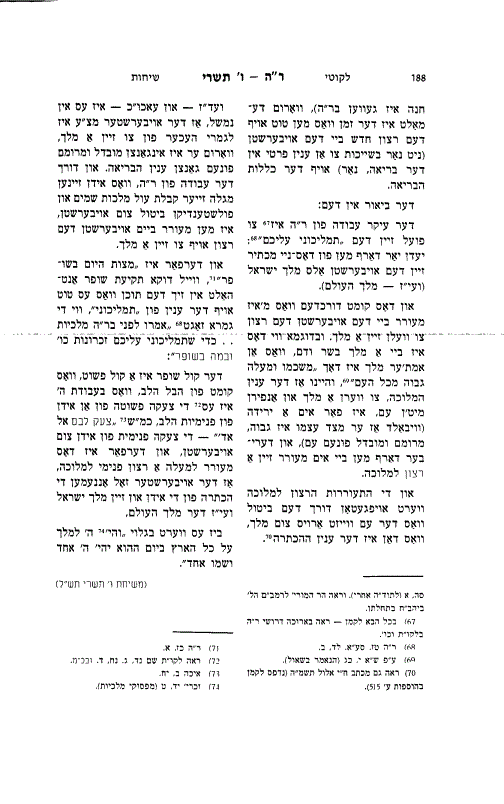
Similarly, and even more so, it is in the analogy: the Almighty, in essence, is entirely above being a king, as He is completely separate and exalted from the entire concept of creation. Through the service of Rosh Hashanah, where Jews reveal their acceptance of the yoke of the Kingdom of Heaven and complete submission to the Almighty, they arouse within the Almighty the desire to be a king.
Therefore, "the mitzvah of the day is with the shofar," because specifically the sounding of the shofar contains the essence that accomplishes the matter of "Crown Me," as the Gemara states: "Say before Me on Rosh Hashanah the verses of Kingship... so that you will crown Me as your King, Remembrances... and with what? With the shofar."
The sound of the shofar is a simple sound that comes from the breath of the heart, which in the service of G‑d is the simple cry of a Jew from the depths of the heart, as it is written, "Their heart cried out to the L‑rd" - the inner cry of Jews to the Almighty, and therefore it arouses above an inner desire for kingship, that the Almighty should accept the coronation from the Jews and be the King of Israel and thereby the King of the world,
until it is revealed, "And the L‑rd shall be King over all the earth; on that day the L‑rd shall be One and His Name One."
6. This concept is further emphasized in the teachings of Chassidus, which explain that the sound of the shofar is a simple sound, representing the essence of the soul. It is a sound that transcends words and intellect, reaching directly to the core of the Divine. This is why the shofar is so central to the service of Rosh Hashanah. It is not merely a commandment among others, but rather the mitzvah of the day, as it embodies the very essence of crowning G‑d as King.
The shofar's sound is likened to a cry from the depths of the heart, a cry that is beyond articulation. This cry is the expression of the innermost desire of the Jewish people for G‑d to be their King. It is this pure, unadulterated cry that has the power to awaken within the Almighty the desire to reign as King over the world. This is the ultimate purpose of Rosh Hashanah: to renew the coronation of G‑d as King, not only over the Jewish people but over the entire world.
Thus, the service of Rosh Hashanah, particularly through the sounding of the shofar, is a profound expression of the Jewish people's acceptance of the yoke of Heaven. It is through this acceptance and submission that they draw down the Divine will to be King, culminating in the ultimate revelation of G‑d's Kingship over the entire world, as it is prophesied, "And the L‑rd shall be King over all the earth; on that day the L‑rd shall be One and His Name One."