Likkutei Sichos Vol. 29 – Nitzavim-Vayeilech
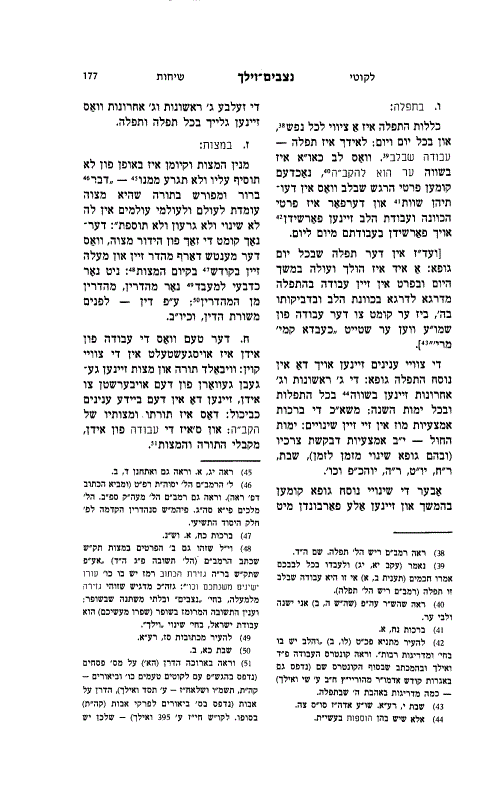
1. Regarding the Shabbos before Rosh Hashanah, it is known the saying of the Alter Rebbe, which he heard from the Maggid in the name of the Baal Shem Tov, that the "seventh month" is "blessed by the Holy One, blessed be He Himself" on Shabbos Mevarchim, which is the last Shabbos of the month of Elul. With this power, the Jewish people bless the months eleven times a year.
What constitutes the blessing of the Holy One, blessed be He, on this "Shabbos Mevarchim" of the month of Tishrei? The Baal Shem Tov continues:
"It is written, 'You are standing today,' where 'today' refers to Rosh Hashanah, which is the Day of Judgment, as it is written, 'And it was the day…' and the Targum translates, 'And it was the great Day of Judgment.' And 'You are standing' means you are established and standing, which implies that you are meritorious in judgment. On the Shabbos before Rosh Hashanah, which is the last Shabbos of the month of Elul, we read the portion of 'You are standing,' and this is the blessing of the Holy One, blessed be He."
From the precise language "we read then the portion of 'You are standing,' which is the blessing of the Holy One, blessed be He"—and not "we read then 'You are standing today'" (as he says earlier in the teaching, where he explains that this means "established and standing, which implies that you are meritorious in judgment")—it is understood that the "blessing of the Holy One, blessed be He" is not just the (three) words "You are standing (today)," but the entire portion of "You are standing," the whole section.
And according to what is explained elsewhere, that the two portions "You are standing" and "Vayelech" are essentially one portion, but sometimes this one portion is divided into two (as the precise language of the Rasa"g: "And among them (of the fifty-three portions) is a portion that is divided into two and is read on two Shabboses if necessary, and it is 'You are standing,' which is divided with 'Vayelech Moshe'"),
[Unlike other portions that are joined, which are essentially separate portions, but "sometimes joined two by two"],
it follows that "Vayelech Moshe" is also included in the blessing of the Holy One, blessed be He, because it is also part of the "portion of 'You are standing.'"
2. However, on the other hand, from the fact that there are years when the portion is divided into two, and "Vayelech Moshe" is read only after Rosh Hashanah—and certainly, even in those years, the blessing of the Holy One, blessed be He, is not, G‑d forbid, lacking in the "Shabbos Mevarchim" of the month of Tishrei—it is necessary to say that the primary blessing of the Holy One, blessed be He, is "Parshas Atem Nitzavim" itself, meaning the part of the portion up to "Vayelech Moshe," which according to Jewish custom is specifically called Parshas (Atem) Nitzavim, as printed in the Chumashim. And the fact that "Vayelech Moshe" is also part of the blessing of the Holy One, blessed be He, is a type of blessing that sometimes can manifest in actuality—revealed only after Rosh Hashanah.
3. The explanation for this is as follows:
In the aforementioned teaching, it concludes (as mentioned above): "And with this power (from the blessing of the Holy One, blessed be He), Israel blesses the months eleven times a year." And it can be said that this hints at the aspect of the blessing connected with Parshas Vayelech:
The essential aspect of "the Holy One, blessed be He, Himself blesses" is primarily connected with Parshas Atem Nitzavim, which is read every year on the last Shabbos of the month of Elul. And the fact that the blessing of the Holy One, blessed be He, imparts a power that allows the Jews to subsequently bless the months eleven times a year—this is primarily connected with Vayelech (Moshe).
Therefore, sometimes Vayelech Moshe is read after Rosh Hashanah—even though Vayelech Moshe is also connected with the blessing of "Shabbos Mevarchim" of the month of Tishrei, as mentioned above—because the aspect of the blessing (that "with this power, Israel blesses the months eleven times a year") is not so relevant on the Shabbos before Rosh Hashanah, since this "power" is revealed only in the subsequent Shabboses, and therefore it can sometimes be read—even after Rosh Hashanah.
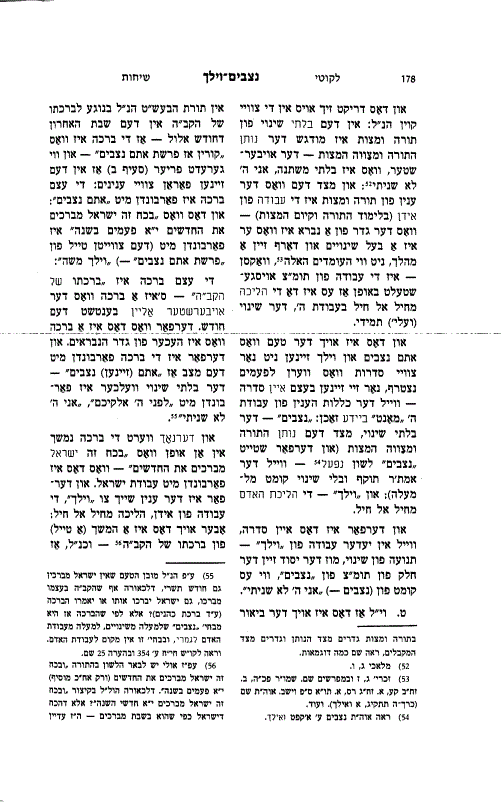
4. Every matter is expressed in the name it is called in the Holy Tongue. Similarly, it is understood simply regarding the names of the portions "Nitzavim" and "Vayelech," that their content is expressed in their respective names. The words "Nitzavim" and "Vayelech" contain two different—and moreover, opposite—concepts.
The meaning of Nitzavim is (as mentioned in the aforementioned teaching) "established and standing." Not just any standing, but a strong and firm standing. It is explained that Nitzavim is from the expression "Nitzav Melech," which indicates the strongest form of standing, similar to the "Nitzav" of a king:
In contrast, "Vayelech" implies movement, the opposite of standing in general, and certainly the opposite of Nitzavim—standing with strength.
5. And yet, it is said that Nitzavim and Vayelech are not just connected together (like other combined portions), but even more: they are essentially one portion.
4. The point of explanation here is: The overall service of G‑d is based on the necessity of having both of the aforementioned movements—"Nitzavim," a standing with strength, unchanging; and "Vayelech"—progressing from strength to strength, to the extent of "they have no rest," a constant change.
And this applies in all three pillars (lines) of Torah, service (prayer), and acts of kindness (mitzvos):
5. In Torah:
Torah is generally divided into two—Written Torah and Oral Torah. Although both were "given to Moses at Sinai," and in the words of the Rambam at the beginning of his introduction to the Mishneh Torah: "All the commandments given to Moses at Sinai were given with their explanation... This Torah is the Written Torah and the commandment is its explanation... called the Oral Torah"—there is, however, a difference in their manner of giving:
The Written Torah was given in a measured and limited manner, in letters and words, in which there can be no change;
In contrast, the Oral Torah—its "explanation"—came through the sages, who interpreted it through the thirteen (or thirty-two, etc.) principles of interpretation.
From a word or even a letter in the Torah comes an expansion in the Oral Torah, and from the expansion of the Tannaim comes an even greater expansion from the Amoraim, and so on—until the innovation of a diligent student, all of which becomes part of the Oral Torah, as the sages said: "Everything that a diligent student will innovate was already given to Moses at Sinai."
And this is also connected to the difference in the manner of their study: In the Written Torah, one makes the blessing over the Torah upon its reading, even if he does not understand what he is saying; however, in the study of the Oral Torah, if one does not understand what he is saying, he cannot make the blessing over the Torah. Its study is connected with human understanding, which varies between Beit Shammai and Beit Hillel, even though both received from the same Shemaiah and Avtalyon, who received it generation after generation back to Moses our teacher, who received the Torah from the Almighty—and over time, each of them added in wisdom, understanding, and knowledge of the Torah.
And yet, there are these two movements within the Oral Torah itself: There must be "to expand it every day," to innovate in Torah, but it must be connected and founded only on the principles and foundations of Torah and in full agreement with halacha—because in them (the foundations, principles, and halachot) there can be no change, "this Torah will not be exchanged."
And as the aforementioned saying of the sages, "Everything that a diligent student will innovate was already given to Moses at Sinai." At first glance, this seems to be a contradiction: to innovate means that the student has innovated it with his intellect, so how can it be said that it was given to Moses at Sinai?
4. However, the explanation for this (as has been discussed many times) is that the specific reasoning is an innovation of the diligent student.
[Every Jew is obligated to study all that is written in the Written and Oral Torah, and he must also "innovate... both in halachot and in aggadot, both in the revealed and in the hidden aspects."]
This innovation is built upon the principles that Moses received at Sinai, and the "innovation" consists of revealing the specific reasoning and halacha from the general principle—like a halacha.
If not, G‑d forbid, it is simply the opposite of the Torah, as stated in the Mishnah: "One who reveals a face in the Torah not according to halacha, even though he has Torah and good deeds, has no share in the World to Come."
6. In prayer:
The general commandment of prayer is for every soul, and it is required every single day. On the other hand, prayer is the service of the heart, where the heart of each individual is equal before the Holy One, blessed be He. After this, there are the specific feelings of the heart, which are not the same for everyone, and therefore, the specific intention and service of the heart differ, also varying from day to day.
[Similarly, in the daily prayer itself: A Jew progresses and ascends throughout the day, especially in his service during prayer, from level to level in the intention of the heart and his attachment to G‑d, until he reaches the service of the Amidah, when he stands "like a servant before his master."]
These two aspects are also present in the very text of the prayer: The first three and last three blessings are the same in all prayers and throughout the entire year. However, the middle blessings must have variations: on weekdays, there are twelve middle blessings requesting one's needs (and even within these, there are changes from time to time), on Shabbat, Rosh Chodesh, Yom Tov, Rosh Hashanah, Yom Kippur, etc.
But the variations in the text themselves come in continuation and are all connected with the same first three and last three blessings, which are the same in every single prayer.
7. In mitzvos:
The enumeration and fulfillment of mitzvos are in a manner of "do not add to it and do not detract from it"—"a clear and explicit matter in the Torah that it is a commandment that stands forever and ever, with no change, reduction, or addition." After this comes the matter of beautifying a mitzvah, where a person must strive to enhance and elevate in holiness in the fulfillment of the mitzvos: not only as required but with the highest level of beautification, the most meticulous of the meticulous; according to the law—beyond the letter of the law, and the like.
8. The reason why the service of the Jewish people is structured in these two directions is because the Torah and mitzvos were given by the Almighty to the Jewish people. Therefore, they contain both aspects, so to speak: they are His Torah and His mitzvos.
"Vayelech" is not a separate parsha but rather a part of "Parshas Atem Nitzavim," because the "Vayelech" of the Jewish people is founded and connected with the "Atem Nitzavim," with the giving from Above.
However, since in practice and openly, the fact that "Israel blesses the months" is a blessing and service of man, it is not necessary for this to always be revealed on the Shabbat before Rosh Hashanah. Therefore, we do not always read Parshas Vayelech before Rosh Hashanah; sometimes it is read on the Shabbat following (but close to) Rosh Hashanah.
10. The reading of Parshas Atem Nitzavim on the last Shabbat of the month of Elul is not only as a preparation for the coming year in general (because on this Shabbat, the blessing of the Almighty is drawn), but also because it is connected with the service of Rosh Hashanah itself. This is why "this parsha (Nitzavim) is always read before Rosh Hashanah."
Accordingly, the two aforementioned directions in Nitzavim and Vayelech are also present in the service of Rosh Hashanah.
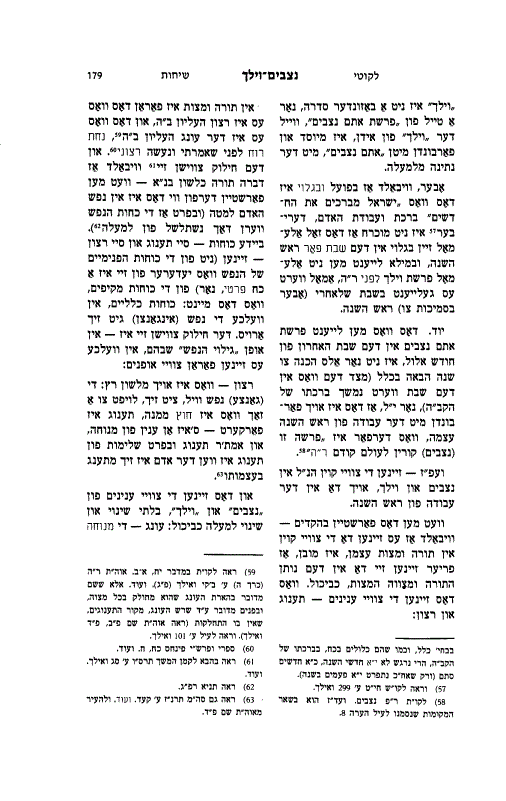
This will be understood by first explaining — since these two directions exist in the Torah and mitzvos themselves, it is understood that they are first present in the Giver of the Torah and the Commander of the mitzvos, so to speak. These are the two aspects — pleasure and will:
11. In Torah and mitzvos, there exists that which is the Supreme Will of the Holy One, blessed be He, and that which is the Supreme Pleasure of the Holy One, blessed be He, as it is said, "A satisfaction before Me that I spoke and My will was done." The distinction between them — since the Torah speaks in the language of man — can be understood from how it is in the human soul below (especially since the soul's faculties are derived from above). Both faculties — pleasure and will — are not from the internal faculties of the soul, where each is a specific power, but from the encompassing faculties, which means general faculties in which the soul (in its entirety) expresses itself. The difference between them is in the manner of "revelation of the soul" within them, where there are two modes: Will — which is also from the expression "runs": the (entire) soul desires, is drawn to, runs towards something external to it. Pleasure, on the other hand, is the opposite — it is a matter of rest, and the true pleasure, especially the completeness of pleasure, is when a person delights in his essence.
And these are the two concepts of "Nitzavim" and "Vayelech," the unchanging and the changing above, so to speak: Pleasure — the rest in its truth and completeness, in its essence — is a matter of absence of change; and Will — running and inclination — is a matter of movement and change.
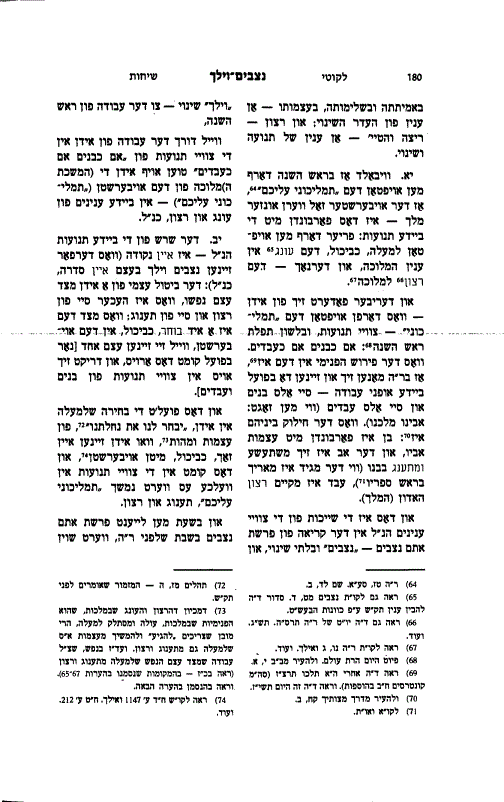
Since on Rosh Hashanah one must accomplish the "Crown Me over you," that the Almighty should become our King, this is connected with both movements: First, one must accomplish above, so to speak, the pleasure in the matter of kingship, and afterwards — the will for kingship.
Therefore, it is required of the Jewish people — who must accomplish the "Crown Me" — two movements, as expressed in the Rosh Hashanah prayer: whether as children or as servants. The inner meaning of this is that on Rosh Hashanah, both modes of service are demanded and present in actuality — both as children and as servants (as we say: "Our Father, our King"). The difference between them is: A son is connected with the essence of his father, and the father delights and takes pleasure in his son (as the Maggid elaborates at the beginning of his stories), while a servant fulfills the will of the master (the king).
And this is the connection of the aforementioned two concepts in the reading of Parshas Atem Nitzavim — "Nitzavim" and unchanging, and "Vayelech" changing — to the service of Rosh Hashanah.
12. Through the service of the Jewish people in the two movements of "whether as children or as servants," they draw down the kingship of the Almighty ("Crown Me over you") in both aspects of pleasure and will, as mentioned above.
The root of these two aforementioned movements is a single point (which is why Nitzavim and Vayelech are essentially one parsha, as mentioned above): the essential self-nullification of a Jew from the essence of his soul, which is above both will and pleasure. From this perspective, a Jew chooses, so to speak, the Almighty, because they are essentially one. However, in practice, this manifests and expresses itself in two movements of children and servants.
And this effects the choice from Above in the Jewish people, "He chooses our inheritance for us," from the Essence and Being, where Jews are, so to speak, one with the Almighty. This comes in the two movements through which "Crown Me over you" is drawn down, pleasure and will.
And when we read the parsha of Atem Nitzavim on the Shabbos before Rosh Hashanah, it is already immediately accomplished, "You are standing firm and enduring, which means that you are meritorious in judgment" — the blessing of the Holy One, blessed be He, on the Shabbos that blesses the seventh month, which is the month that is satiated and satiates with abundant goodness for all of Israel for the entire year.
And it is drawn down into a good and sweet inscription and sealing for a good and sweet year for each and every Jew, with visible and revealed goodness below ten handbreadths, in the most literal sense.