
Parshas Nitzavim
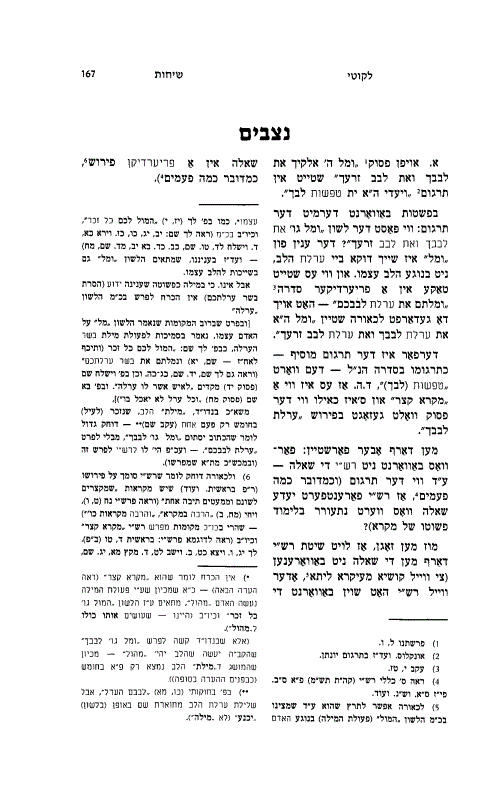
1. On the verse1 "ומל ה' אלקיך את לבבך ואת לבב זרעך" ("And the L‑rd your G‑d will circumcise your heart and the heart of your offspring"), the Targum2 says: "ויעדי ה' אלקך ית טפשות לבך" ("And the L‑rd your G‑d will remove the folly of your heart").
Simply put, the Targum thereby addresses the question: How does the wording "and He will circumcise your heart and the heart of your offspring" fit? The concept of "circumcising" applies specifically to the foreskin of the heart, not to the heart itself. And indeed, as it says in an earlier parsha3, "ומלתם את ערלת לבבכם" ("You shall circumcise the foreskin of your heart") — here too, seemingly, it should have said "And the L‑rd your G‑d will circumcise the foreskin of your heart and the foreskin of the heart of your offspring."
Therefore the Targum adds — as it translates in the aforementioned parsha — the word "folly (of your heart)," meaning that it is like a "מקרא קצר" ("a shortened verse"), and it is as if the verse had said explicitly "the foreskin of your heart."
We need to understand, however: Why does Rashi not address this question, as the Targum does (and as has been discussed many times4, Rashi resolves every question that arises in studying the plain meaning of Scripture)?
We must say that according to Rashi's approach, the question does not need to be addressed (either because the question does not arise in the first place5, or because Rashi has already addressed the question in an earlier explanation6, as has been discussed many times).
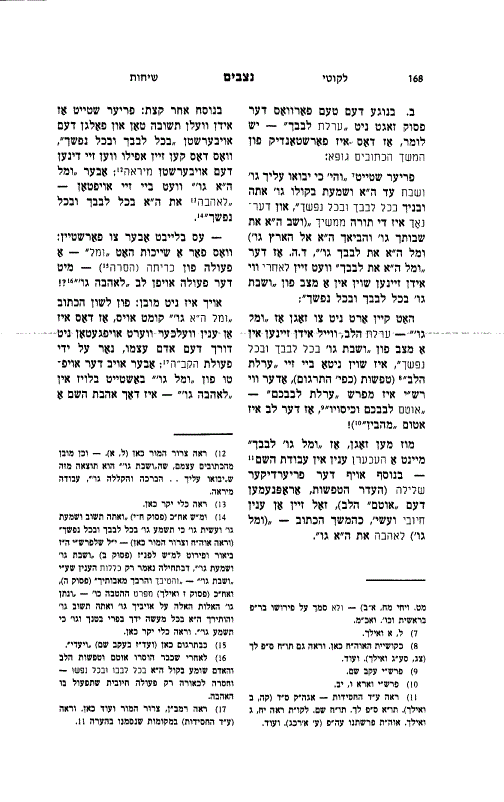
2. As for the reason why the verse does not say "the foreskin of your heart," it can be said that this is understood from the sequence of the verses themselves:
Earlier it says7: "והי' כי יבואו עליך גו' ושבת עד ה' אלקיך ושמעת בקולו גו' אתה ובניך בכל לבבך ובכל נפשך" ("And it shall be, when [all these things] come upon you… and you will return to the L‑rd your G‑d and listen to His voice… you and your children, with all your heart and with all your soul"), and afterwards the Torah continues: "(ושב ה' אלקיך את שבותך גו' והביאך ה' אלקיך אל הארץ גו') ומל ה' אלקיך את לבבך גו'" ("(The L‑rd your G‑d will bring back your captivity… and the L‑rd your G‑d will bring you to the land…) and the L‑rd your G‑d will circumcise your heart…"). That is, "And the L‑rd your G‑d will circumcise your heart" will take place after the Jewish people are already in a state of "and you will return… with all your heart and with all your soul."
There is therefore no room to say that "and He will circumcise…" refers to the foreskin of the heart, since the Jewish people are in a state of "and you will return… with all your heart and with all your soul," and so they no longer have a "foreskin of the heart"8 (folly (as the Targum puts it), or, as Rashi explains "ערלת לבבכם" ("the foreskin of your heart"), "אוטם לבבכם וכיסויו" ("the obstruction of your heart and its covering")9, meaning that the heart is blocked "from understanding"10)!
We must therefore say that "and He will circumcise… your heart" means a higher matter in the service of G‑d11: in addition to the earlier negation (the absence of folly, removing the "obstruction" of the heart), there is to be something positive and active, as the verse continues: "(and He will circumcise…) to love the L‑rd your G‑d…"
In somewhat different words: Earlier it says that the Jewish people will do teshuvah and obey G‑d "with all your heart and with all your soul," which can be even when they serve G‑d out of fear12; but "and the L‑rd your G‑d will circumcise…" will accomplish in them "to love13 the L‑rd your G‑d with all your heart and with all your soul"14.
But it remains to be understood: What connection does "and He will circumcise," an act of cutting (removal15), have with the effect upon the heart, "to love…"16?!
It is also not understood: From the wording of the verse "and the L‑rd your G‑d will circumcise…" it follows that this is something brought about not by the person himself but through the action of the Holy One, blessed be He17. But if the effect of "and He will circumcise…" consists only of "to love…," then love of G‑d is, after all, a command upon every Jew: "ואהבת18 את ה' אלקיך בכל לבבך ובכל נפשך"19 ("You shall love the L‑rd your G‑d with all your heart and with all your soul") — and twice every day!
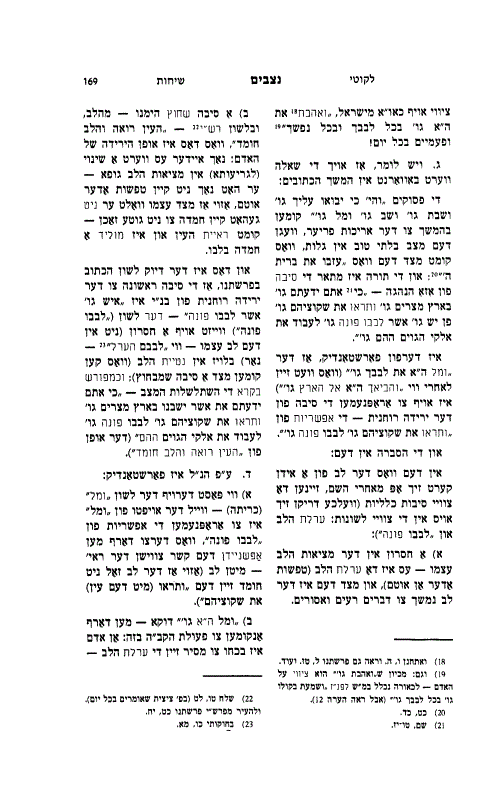
3. It can be said that this question too is resolved by the sequence of the verses:
The verses "And it shall be, when [these things] come upon you… and you will return… and He will bring back… and He will circumcise…" come in sequence to the lengthy passage before them about the unfortunate state in exile, which comes about because "עזבו את ברית ה'" ("they forsook the covenant of the L‑rd")20. And the Torah describes the cause of such conduct: "כי אתם ידעתם גו' בארץ מצרים גו' ותראו את שקוציהם גו' פן יש גו' אשר לבבו פונה גו' לעבוד את אלקי הגוים ההם גו'" ("For you know… in the land of Egypt… and you saw their abominations… lest there be… one whose heart turns away… to serve the gods of those nations…")21.
From this it is understood that "and the L‑rd your G‑d will circumcise your heart…" (which will come after "and the L‑rd your G‑d will bring you to the land…") is meant to remove the cause of the spiritual descent — the possibility of "and you saw their abominations… whose heart turns away…"
The explanation of this:
For a Jew's heart turning away from G‑d, there are two general causes (which are expressed in the two terms "the foreskin of the heart" and "whose heart turns away"):
a) A deficiency in the very being of the heart itself: there is a foreskin of the heart (folly or an obstruction), and because of this the heart is drawn to bad and forbidden things.
b) A cause external to it, to the heart — in the words of Rashi22, "העין רואה והלב חומד" ("the eye sees and the heart desires"). This is the manner of a person's descent: before any change (for the worse) has occurred in the very being of the heart — he does not yet have folly or obstruction, so that on his own he would have no desire for things that are not good — the seeing of the eye comes and gives birth to a desire in his heart.
And this is the precision of the verse's wording in our parsha, that the first cause of the spiritual descent of the Jewish people is "איש גו' אשר לבבו פונה" ("a man… whose heart turns away"). The wording ("whose heart turns away") indicates a deficiency (not in the heart itself — like "לבבם הערל" ("their uncircumcised heart")23 — but) only in the inclination of the heart (which can come from an external cause). And so the verse explicitly spells out the progression of the situation: "For you know how we dwelt in the land of Egypt… and you saw their abominations… whose heart turns away… to serve the gods of those nations" (the manner of "the eye sees and the heart desires").
4. Based on the above, it is understood:
a) How the wording "and He will circumcise" (cutting) fits: because the effect of "and He will circumcise" is to remove the possibility of "whose heart turns away," and for this one must cut the connection between seeing and the heart (so that the heart will not desire what is described in "and you saw (with the eye) their abominations").
b) Why specifically "and the L‑rd will circumcise…": the action of the Holy One, blessed be He, is needed for this. A person has the ability to remove the foreskin of the heart — its obstruction and folly; but the connection between the seeing of his eyes and his heart is something that G‑d implanted in him, and only He, may He be blessed, has the power to nullify it24.
And this is also why the verse continues: "(ומל ה' אלקיך את לבבך ואת לבב זרעך) לאהבה את ה' אלקיך בכל לבבך ובכל נפשך למען חייך" ("(And the L‑rd your G‑d will circumcise your heart and the heart of your offspring) to love the L‑rd your G‑d with all your heart and with all your soul, for the sake of your life"). Since the possibility of "whose heart turns away"25 will be entirely taken away, there will automatically be26 "to love the L‑rd your G‑d with all your heart and with all your soul, for the sake of your life" — not merely love of G‑d27, but in such a manner that it will become the entire life of a Jew28.
5. From the above there emerges a practical difference regarding the content of the service of the time when Parshas Nitzavim is read — the close of the month of Elul:
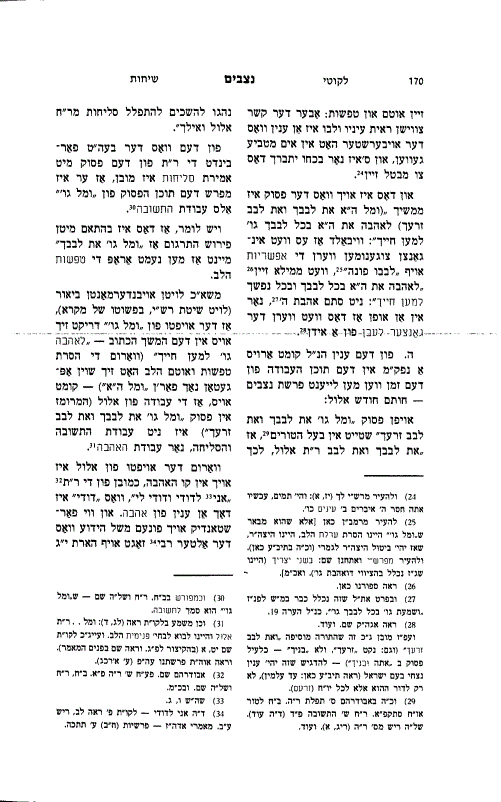
On the verse "and He will circumcise… your heart and the heart of your offspring," the Baal HaTurim29 says that "את לבבך ואת לבב ר"ת אלול, לכך נהגו להשכים להתפלל סליחות מר"ח אלול ואילך" ("Es levavcha ve'es levav are the initials of Elul; therefore it is the custom to rise early to pray Selichos from Rosh Chodesh Elul onward").
From the fact that the Baal HaTurim connects the initials of this verse with the recitation of Selichos, it is understood that he interprets the content of the verse "and He will circumcise…" as the service of teshuvah30.
It can be said that this is in keeping with the Targum's interpretation, that "and He will circumcise… your heart" means removing the folly of the heart.
However, according to the explanation above (following Rashi's approach, in the plain meaning of Scripture), the effect of "and He will circumcise…" is expressed in the continuation of the verse, "to love… for the sake of your life" (for the removal of the folly and obstruction of the heart was already accomplished before "and the L‑rd will circumcise"). It follows that the service of Elul (alluded to in the verse "and He will circumcise… your heart and the heart of your offspring") is not the service of teshuvah and forgiveness, but the service of love31.
For the effect of Elul is also in the line of love, as understood from the initials32 "אני33 לדודי ודודי לי" ("I am my Beloved's and my Beloved is mine"), and "my Beloved" is, after all, a matter of love. And as is also understood from the well-known parable that the Alter Rebbe34 gives regarding the illumination of the Thirteen Attributes of Mercy in the month of Elul: that it is like a king whom "מקבלין פניו בשדה . . והוא מקבל את כולם בסבר פנים יפות ומראה פנים שוחקות לכולם" ("they go out to greet in the field… and he receives them all graciously and shows a smiling face to all") — which, understandably, arouses in all of them love for the king, "כמים הפנים לפנים" ("as water reflects face to face")35.
6. It can be said that the reason why, according to the Baal HaTurim, the continuation of the verse, "to love…," is not included in the service of Elul (alluded to in the verse "and He will circumcise…"), is that according to study by way of allusion (the Baal HaTurim's interpretation), "to love…" is a higher level than the love of G‑d of the month of Elul.
By way of introduction: The Alter Rebbe explains36 the difference between the service of the month of Elul and the service of the Days of Awe that follow it. Elul is primarily the time of "I am my Beloved's," the arousal from below37; whereas the Days of Awe are primarily the time of "and my Beloved is mine" — "זמן התגלות מלכותו ית'" ("the time of the revelation of His sovereignty, may He be blessed") (like one who "מקבל38 פני המלך בהיכל מלכותו" ("greets the king in his royal palace"), which only "מובחרים שבעם ויחידי סגולה" ("the choicest of the people and the select few")39 merit). And specifically then does His love40, may He be blessed, become "planted in the heart of man."
That is to say, the level of love of the month of Elul is not as high as the love that is attained in the Days of Awe, the (primary) time of "and my Beloved is mine."
Accordingly, one can explain the difference between the two approaches mentioned above (whether "to love…" is part of the month of Elul):
Study by way of the plain meaning — study that is equal for every soul — corresponds to the less lofty levels in the service of G‑d, levels to which all Jews relate. In our case, "to love the L‑rd your G‑d…" in the "world of the plain meaning" is a level of love to which all Jews relate — and therefore it is part of the service of Elul, because it is a love that can be attained even when one is "in the field"41;
whereas in study by way of allusion — higher42 levels in (Torah study, and consequently in) the service of G‑d — "to love the L‑rd your G‑d…" is a higher level of love, which comes only (after the service of Elul) in the (primary) time of "and my Beloved is mine"43 (on the Days of Awe).
Therefore, the beginning of the verse, "and He will circumcise… your heart and the heart of your offspring," is the service of Selichos (from Rosh Chodesh onward, on all the days) of the month of Elul; and afterwards, on the Days of Awe (which follow the month of Elul), one attains "to love the L‑rd your G‑d with all your heart and with all your soul, for the sake of your life."
(From the sichos of Shabbos Parshas Nitzavim 5734, and Shabbos Parshas Nitzavim-Vayelech 5743)
Notes
1) Our parsha, 30:6.
2) Onkelos. And so too in Targum Yonasan.
3) Eikev 10:16.
4) See Sefer Klalei Rashi (Kehot, 5749), ch. 1, sec. 2; [OCR unclear], sec. 1; and the sources cited there. And elsewhere.
5) Seemingly one could answer that it is like what we find in many places, the wording "המול" ("be circumcised" — the act of circumcision) regarding the person himself*, as in Parshas Lech Lecha (17:10), "המול לכם כל זכר" ("Every male among you shall be circumcised"), and similarly in many places (see Lech Lecha, ibid., vv. 12, 13, 26, [OCR unclear]; Vayera 21:4; Vayishlach 34:15; ibid., 22, 24; Bo 12:44; ibid., 48). So too in our case, the wording "ומל" ("and He will circumcise") would fit also in connection with the heart itself. But this is not so. For with literal circumcision, whose meaning is known (removing "the flesh of your foreskin"), there is no need to specify "ערלה" ("foreskin") in every place [especially since in most places where the wording "מל" is said about the person himself, it is said in proximity to the act of circumcising the flesh of the foreskin, as in Lech Lecha, ibid.: "Every male among you shall be circumcised" (and immediately afterwards, ibid., 11), "ונמלתם את בשר ערלתכם" ("and you shall circumcise the flesh of your foreskin") (and see also Lech Lecha, ibid., 14; ibid., 23–25. And so too in Parshas Vayishlach, ibid. (v. 14), it first says "to a man who has a foreskin." And in Parshas Bo, ibid. (v. 48), "and no uncircumcised person shall eat of it")]. Whereas in our case, the "circumcision" of the heart, which is mentioned (earlier) in the Chumash only once (Eikev, ibid.)** — it is very forced to say that the verse would state "and He will circumcise… your heart" without specifying "the foreskin of your heart." Rashi should rather have explained this (all the more so since Targum Onkelos explains it).
*) There is no necessity to say that it is a "shortened verse" (see the following note); rather, since through the act of circumcision the person becomes "circumcised," the wording "Every male… shall be circumcised" and the like fits this (that is, they make him, as a whole, "circumcised"). (Except that in our case it is difficult to interpret "and He will circumcise… your heart" as meaning that the Holy One, blessed be He, will make the heart "circumcised," since the concept of "circumcision" of the heart appears only once in the Chumash (as in the text, and in the note at its end).)
**) In Parshas Bechukosai (26:41) there is "לבבם הערל" ("their uncircumcised heart"), but the negation of the foreskin of the heart is described there in the manner (wording) of "יכנע" ("will be humbled"), not "circumcision."
6) Seemingly it is forced to say that Rashi relies on his explanation (at the beginning of Parshas Bereishis, and elsewhere) that there are verses "שמקצרים לשונם וממעטים תיבה אחת" ("that shorten their wording and omit one word") (and see Rashi, Noach (9:6); Vayechi (48:2): "much in Scripture," "and many verses etc."). For in similar places Rashi does explain "a shortened verse" and the like (see, for example, Rashi: Bereishis 4:15 (twice); Lech Lecha 13:6; Vayeitzei 29:2; Vayeshev 39:4; Mikeitz 41:13; ibid., 49; Vayechi 48:1–2), and he did not rely on his explanation at the beginning of Bereishis etc. This is not the place to elaborate.
7) 30:1ff.
8) As the Or HaChaim asks here. And see also Toras Chaim, end of Parshas Lech Lecha (93, end of col. c ff.). And elsewhere.
9) Rashi, Eikev, ibid.
10) Rashi, Va'eira 6:12.
11) See the explanation according to Chassidus: Iggeres HaKodesh, sec. 4 (105b ff.); Torah Or, end of Parshas Lech Lecha; Toras Chaim, ibid.; Likkutei Torah, Re'eh 18c ff.; Or HaTorah on our parsha, on this verse (p. 1223). And elsewhere.
12) See Tzror HaMor here (30:1). This is also understood from the verses themselves, for "and you will return…" is a result of "[when all these things] come upon you… the blessing and the curse…" — service out of fear.
13) See Kli Yakar here.
14) As for what is said afterwards (vv. 8–10), "ואתה תשוב ושמעת גו' ועשית גו' כי תשמע גו' בכל לבבך ובכל נפשך" ("And you will return and listen… and you will do… when you listen… with all your heart and with all your soul") (and see Or HaChaim and Tzror HaMor here), it can be said that according to Rashi this is an explanation and elaboration of what is said before it (v. 2), "and you will return… and listen…": at first only the general matter is stated, that through "and you will return…" — "He will do you good and make you more numerous than your fathers" (v. 5); and afterwards (v. 7ff.) the good is spelled out in detail — "And the L‑rd will put all these curses upon your enemies… and you will return… and the L‑rd your G‑d will make you abundant in all the work of your hand, in the fruit of your womb… when you listen…." And see Kli Yakar here.
15) As in the Targum here (and similarly in Eikev, ibid.): "ויעדי" ("and He will remove").
16) After the obstruction and folly of the heart have already been removed, and the person listens to the voice of the L‑rd his G‑d with all his heart and with all his soul, seemingly all that is lacking is a positive act that will bring about love in him.
17) See Ramban, Tzror HaMor, and others here. And see (the explanation according to Chassidus) in the places cited in note 11.
18) Va'eschanan 6:5. And see also our parsha, 30:16. And elsewhere.
19) Also: since "You shall love…" is a command upon the person, seemingly it is included in what is said before it, "and listen to His voice… with all your heart…" (but see note 12).
20) 29:24.
21) Ibid., 16–17.
22) Shelach 15:39 (in the passage of tzitzis, which is recited every day). And note Rashi on our parsha, 29:18.
23) Bechukosai 26:41.
24) Note Rashi, Lech Lecha (17:1): "and be perfect — now you are lacking five organs: two eyes etc."
25) Note Ramban here [except that he explains that "and He will circumcise…" means the removal of the foreskin of the heart, i.e., the evil inclination, so that there will then be a complete nullification of the evil inclination (and so it is in Targum Yonasan ben Uziel here). And note Rashi, Va'eschanan, ibid.: "with both your inclinations" (meaning that this too is included in the command "You shall love…"; this is not the place to elaborate)].
26) See Sforno here.
27) Especially if we say that this is already included in what is said before it, "and listen… with all your heart…," as above, note 19.
28) See Iggeres HaKodesh, ibid. And elsewhere. Based on this, it is also understood why the Torah adds "and the heart of your offspring" (and also: it says "זרעך" ("your offspring") and not "בניך" ("your children"), as earlier in verse 2, "you and your children") — to emphasize that this will be an eternal matter in the Jewish people (see Targum Yonasan here: "forever"), not only for that generation but for all their descendants (and offspring).
29) And so it is in Abudraham, Seder Tefillas Rosh Hashanah; Bach on the Tur, Orach Chaim, sec. 581; Reishis Chochmah, Shaar HaTeshuvah, ch. 4 (s.v. Od); Shelah, beginning of Tractate Rosh Hashanah (213a). And elsewhere.
30) As stated explicitly in the Bach, Reishis Chochmah and Shelah, ibid., that "and He will circumcise…" is an allusion to teshuvah.
31) And so it is implied in Likkutei Torah, Re'eh (33d): "And He will circumcise… the initials of Elul, that is, to come to the level of the inner dimension of the heart." And see also Likkutei Torah, ibid., 19a (in the summary of ch. 3; and see there in the body of the maamar). And see Or HaTorah on our parsha, on this verse (p. 1223).
32) Abudraham, ibid.; Pri Etz Chaim, Shaar Rosh Hashanah, ch. 1; Bach, Reishis Chochmah and Shelah, ibid. And in many places.
33) Song of Songs 6:3.
34) Maamar beginning Ani LeDodi, Likkutei Torah, Parshas Re'eh 32, beginning of col. b; Maamarei Admur HaZaken — Parshiyos (vol. 2), p. 825.
35) See Tanya, chs. 46 and 49 (except that there it is cited in connection with "brings him into his palace etc.").
36) Likkutei Torah, ibid., at the beginning of the maamar.
37) The illumination of the Thirteen Attributes of Mercy in the month of Elul is only because before every arousal from below there must first be an arousal from above (see Likkutei Torah, Parshas Re'eh 25b–c; Or HaTorah, ibid., p. 769; Likkutei Sichos vol. 9, p. 159; above, p. 163).
38) The wording of Likkutei Torah, ibid., 25c.
39) Likkutei Torah, ibid., 32, beginning of col. b.
40) In the maamar beginning Ani LeDodi in Likkutei Torah, ibid., [it is stated] that Rosh Hashanah and Yom Kippur are the level of fear (due to the revelation of His sovereignty, may He be blessed). But from the very fact that he connects this time with "and my Beloved is mine," it is understood that it is then (also) a matter of love (and so it is stated explicitly in Likkutei Torah, end of Parshas Tavo (which is cited in the maamar Ani LeDodi, ibid.): "they receive… fear and love from Above." And see Likkutei Torah, ibid., 42a). And see Maamarei Admur HaZaken — Parshiyos, ibid. (p. 826): "On Yom Kippur… like the parable of the king's exceptionally close friend, when he receives the radiance of a countenance of intense love in a special chamber."
41) See Sefer HaMaamarim — Meluket, vol. 1, p. 468, that the "field" equalizes all who are found in it (and see Maamarei Admur HaZaken — Parshiyos, ibid.).
42) As is known, the four levels of PaRDeS in Torah correspond to the four worlds (Shaar HaGilgulim, Introduction 17, at its end; Etz Chaim (cited in Naggid UMetzaveh, at its beginning; Nahar Shalom, in the introduction to Rechovos HaNahar, at its end); Mishnas Chassidim, Tractate Chiyuv HaNeshamos 1:2. And elsewhere).
43) Love that comes from Above (as stated above in the text) — this fits the content of the verse "And the L‑rd your G‑d will circumcise… to love…," which comes from Above.
Key Lesson
A person can remove the "foreskin" of his own heart through teshuvah, but cutting the bond between what the eyes see and what the heart desires is accomplished by G‑d, and it brings a love of G‑d that becomes a Jew's entire life. The service of Elul, beginning with Selichos, leads to the higher love that is attained on the Days of Awe, the time of "and my Beloved is mine."