Likkutei Sichos Vol. 29 – Chai Elul
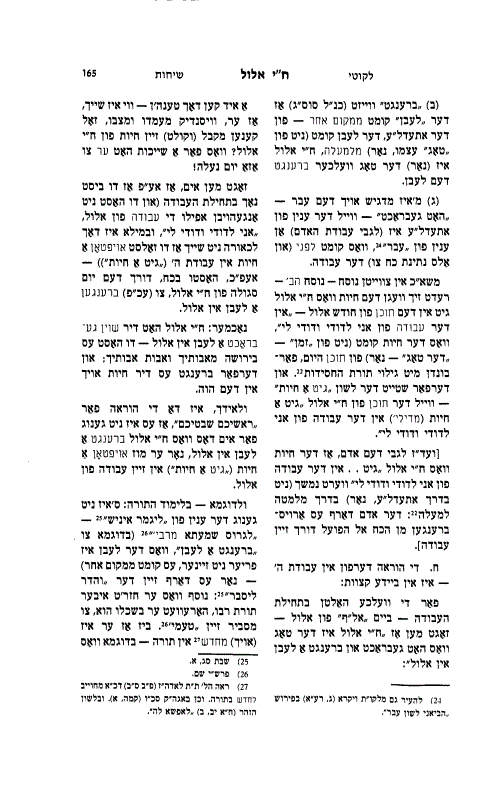
1. Regarding the day of Chai Elul — the birthday of the Baal Shem Tov (Chai Elul, the year Nachat) and the birthday of the Alter Rebbe (Chai Elul, the year Kat) — the Rebbe, my father-in-law, said in a sicha, and these are his words:
"Among Chassidim, there is an old Chassidic saying in two expressions: a) Chai Elul is the day that brought and brings life into Elul. b) Chai Elul gives vitality to the service of 'I am my beloved's, and my beloved is mine.'
From the fact that the Rebbe, my father-in-law, repeated both versions, it is understood that both are valid, and that each version has an advantage over the other.
Moreover, from the fact that the Rebbe, my father-in-law, first presents the idea that Chai Elul is "the day that brought and brings life into Elul," and only afterwards comes the "explanation" — the second (version —) idea in Chai Elul, which "gives vitality to the service of 'I am my beloved's, and my beloved is mine.'"
2. The differences between the two aforementioned versions are:
a) In the first version, the wording is "(Chai Elul) is the day that etc.," whereas in the second version, it simply states "Chai Elul," without the emphasis on "the day."
b) In the first version — "brought and brings life," whereas in the second version — "gives vitality," which contains two differences: (a) In the first version "brings," in the second "gives." (b) In the first version, it is in the past and present tense: "brought and brings," and in the second version, it is only in the present tense — "gives."
c) In the first version — "(life) in Elul"; however, in the second version — "(vitality) in the service of 'I am my beloved's, and my beloved is mine.'
3. Because these differences are not merely slight differences in wording, but significant differences in content:
a) The expression "Chai Elul is the day that etc." emphasizes the aspect of time —
It is a "day," one of the days of the year, but a special day, "the day that brought and brings life into Elul"; however, when one simply says "Chai Elul," the aspect of time is not (as) emphasized, but rather the content of the day itself.
In other words: In time, there are two aspects: a) the essence of time, b) the content of time. For example — the Sabbath day, which in time is (a) one of the seven days of the week, but being the seventh day — for all sevenths are cherished — it is a special day. (b) The seventh day possesses within it the sanctity of the Sabbath, which the sanctity (in itself) is "beyond the limits of space and time," but the sanctity illuminates in the time of the seventh day.
And this is the first difference between the two versions: According to the first version, the "life" comes from the time ("the day") of Chai Elul, it is a distinguished day that brings "life into Elul"; whereas according to the second version, the vitality comes from the content of the day, from "Chai Elul" itself.
2. The aforementioned difference is even more pronounced in the third variation mentioned earlier between the two versions. In the first version, the wording is "(a life) in Elul," while in the second version, it is "(a vitality) in the service of 'I am my Beloved's and my Beloved is mine'.
In the first version, it speaks about the "life" that is brought into the time of (the month of) Elul. In contrast, in the second version, it speaks initially about the content of the matter (service) — the "vitality" from the content of Chai Elul, which gives vitality to the content of the month of Elul, "in the service of 'I am my Beloved's and my Beloved is mine'" (which is the acronym for Elul), but the word "Elul" itself is not mentioned here.
3. The second difference mentioned earlier — "brings" or "gives" — is also a fundamental distinction: "Brings a life" indicates that the "life" itself is found elsewhere, and the day of Chai Elul is the "intermediary" that brings the life (from elsewhere) into Elul; whereas "gives a vitality" means that it (Chai Elul) gives vitality from its own.
4. And we can explain this as follows:
Regarding the month of Elul, we find two aspects:
The service of Elul is in the manner of an arousal from below. Elul is the acronym (as mentioned earlier) for "I am my Beloved's and my Beloved is mine" — first comes "I am my Beloved's" (the service of man), and then "my Beloved is mine" (the arousal from above). That is, the arousal from above ("my Beloved is mine") is a result of the service of man.
[Unlike the month of Nissan, whose essence is an arousal from above, as the verse states: "My Beloved is mine, and I am His" — first "my Beloved is mine," and then (through the arousal from above) "I am His"].
Furthermore, the Alter Rebbe states in Likkutei Torah that the "my Beloved is mine" of "Elul" — the "drawing down of His G‑dliness below in a revealed manner" — does not occur in the month of Elul, but rather afterward on Rosh Hashanah, etc. Because the essence of the month of Elul is the arousal from below.
On the other hand, the Alter Rebbe also states (in the same place) that Elul is a time of favor, "a time of the revelation of the Thirteen Attributes of Mercy," where the revelation from above is accomplished (not through the service of man, but) in the manner of an arousal from above. This is understood from the analogy the Alter Rebbe gives there — that it is like a king who "receives everyone in the field, and then anyone who wishes can go out to greet him, and he receives them all with a pleasant countenance and shows a smiling face to everyone."
— Because although Elul's essence is an arousal from below (as mentioned earlier), every service of a created being must reach a completion with assistance from above (an arousal from above) for that service.
5. Although Elul contains both aspects (the illumination of the Thirteen Attributes of Mercy from above and the arousal from below) as mentioned earlier, the acronym of the word "Elul" (אני לדודי ודודי לי — "I am my Beloved's and my Beloved is mine") specifically alludes to the concept of arousal from below.
The explanation for this is as follows: The arousal from above in Elul — the illumination of the Thirteen Attributes of Mercy — is connected to the times of Elul. There are several times in the year that are considered an "auspicious time," which are not dependent on the service of man, but rather, the Almighty has initially established them in the nature of the world as times that are inherently auspicious. Similarly, regarding the month of Elul, the illumination of the Thirteen Attributes of Mercy during this month is because Elul is an auspicious time from above, during which the King goes out into the "field."
However, the content and essence of the month (which has been instilled in this time) is, on the contrary, specifically the concept of arousal from below, the service of man.
6. Based on the above, we can also understand the difference between the two aforementioned versions regarding the 18th of Elul —
Just as there are the two aspects (the illumination of the Thirteen Attributes of Mercy and the arousal from below) in Elul, so too regarding the 18th of Elul. The vitality that the 18th of Elul brings into Elul is in both of its aspects, both concerning the arousal from above (the illumination of the Thirteen Attributes of Mercy) and concerning the arousal from below (the service of Elul):
The day of the 18th of Elul — the birthday of the Baal Shem Tov and the Alter Rebbe — is a day of special merit and a time of auspiciousness; therefore, it has brought a new "life" into the auspiciousness of Elul, into the awakening of Elul that comes from above (due to the illumination of the Thirteen Attributes of Mercy).
And then there is the aspect that the 18th of Elul, by its very nature — connected with the service of man according to the teachings of Chassidus — infuses vitality into the essence of the month of Elul, into the service of "I am my Beloved's, and my Beloved is mine," so that the service of the month of Elul is imbued with an entirely different vitality.
7. This distinction is emphasized in the variations of language in the two aforementioned versions (and in their order):
The first version — Version A — speaks about the initial aspect and impact in Elul, the illumination of the Thirteen Attributes of Mercy (which comes to awaken the arousal from below). Just as the illumination of the Thirteen Attributes of Mercy is an aspect of arousal from above, so too the "life" of the 18th of Elul, which is connected to it, comes in a manner of arousal from above (from above to below), due to the day, as mentioned above.
Therefore, the language used is "the day that brought and brings life into Elul":
(a) The time is emphasized — "the 18th of Elul is the day... a life into Elul."
(b) "Brings" indicates (as mentioned above in section 3) that the "life" comes from another place — from the arousal from above, the life comes (not from the "day" itself, but) from above; the 18th of Elul is (only) the day that brings the life.
(c) The past is also emphasized — "brought" — because the aspect of arousal from above is (in relation to the service of man) a matter of the "past," which comes before (and as an empowerment for) the service.
8. In contrast, the second version — Version B — speaks about the vitality that the 18th of Elul gives to the essence of the month of Elul — "in the service of 'I am my Beloved's and my Beloved is mine'." This vitality comes not from the "time" — "the day" — but from the essence of the day, connected with the revelation of the teachings of Chassidus. Therefore, the language used is "gives vitality" — because the essence of the 18th of Elul "gives vitality (from itself)" in the service of 'I am my Beloved's and my Beloved is mine'.
[Similarly, regarding the individual, the vitality that the 18th of Elul "gives... in the service of 'I am my Beloved's and my Beloved is mine'" is drawn (not in a manner of arousal from above, but) in a manner of from below to above: the individual must bring it out from potential to actual through his service.]
9. The lesson from this in the service of G‑d is in both extremes:
For those who are at the beginning of their service — at the "Aleph" of Elul — it is said that "the 18th of Elul is the day that brought and brings life into Elul":
A Jew might argue — how is it possible that he, knowing his own standing and situation, can receive (and absorb) vitality from the 18th of Elul? What connection does he have to such an exalted day?
He is told that even though he is still at the beginning of his service (and he has not even begun the service of Elul, "I am my Beloved's and my Beloved is mine," and therefore it seems that he cannot accomplish vitality in the service of G‑d ("gives vitality") — nevertheless, he has the potential, through the auspicious day of the 18th of Elul, to (at least) bring life into Elul.
Moreover: the 18th of Elul has already brought life into Elul for him — he has inherited it from his ancestors and forefathers; and therefore, it brings him vitality also in the present.
On the other hand, there is the instruction for the "heads of your tribes," that it is not enough for them that the 18th of Elul brings life into Elul, but they must accomplish vitality ("gives vitality") in their service of Elul.
For example — in the study of Torah: it is not enough the matter of "let a person learn" — "to recite the teachings from his teacher" (similar to "brings life," where the life is not originally his, it comes from another place) — but there must be the "and then explain" — in addition to reviewing his teacher's teachings, he toils with his own intellect to explain "reasons," until he also innovates in Torah — similar to how the 18th of Elul gives vitality in the service of 'I am my Beloved's and my Beloved is mine'.
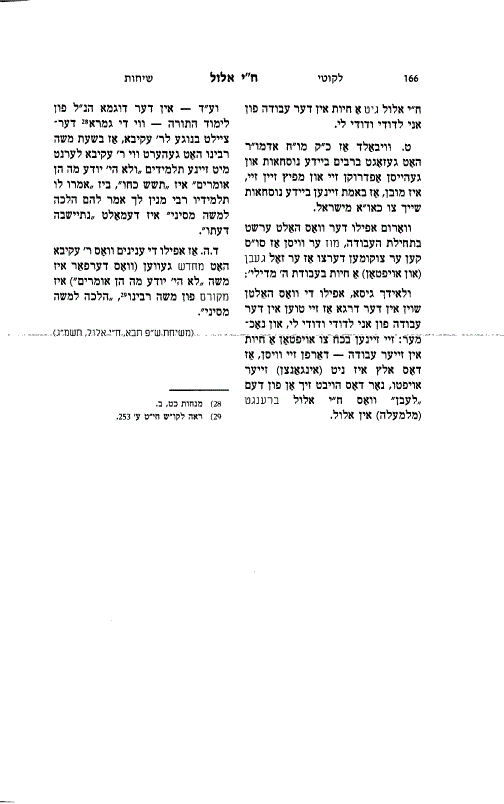
10. Since my revered father-in-law, the Rebbe, stated both versions publicly and instructed to print and disseminate them, it is understood that in truth, both versions are relevant to every Jew.
For even one who is just at the beginning of his service must know that ultimately he can reach the point where he will give (and accomplish) vitality in the service of G‑d from his own self;
11. On the other hand, even those who are already at the level where they actively engage in the service of 'I am my Beloved's and my Beloved is mine', and even more so, those who have the ability to infuse vitality into their service, must recognize that all of this is not entirely their own accomplishment. Rather, it begins with the "life" that the 18th of Elul brings (from above) into Elul.
For example, in the aforementioned instance of Torah study, as the Gemara recounts regarding Rabbi Akiva: When Moshe Rabbeinu heard Rabbi Akiva teaching his students and did not understand what they were saying, "his strength weakened," until "his students said to him, 'Rabbi, from where do you derive this?' He replied, 'It is a law given to Moshe at Sinai,'" at which point "his mind was settled."
This means that even the matters that Rabbi Akiva innovated (which is why Moshe "did not understand what they were saying") have their source in Moshe Rabbeinu, as they are "a law given to Moshe at Sinai."