
Parshas Shoftim
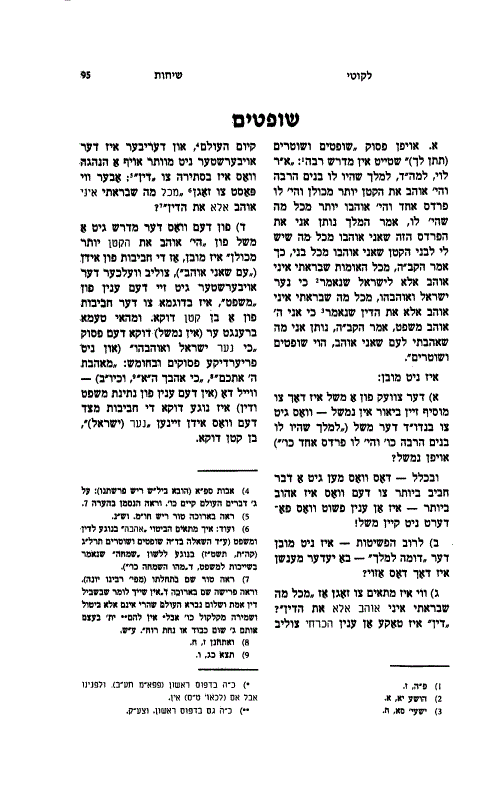
1. On the verse "שופטים ושוטרים (תתן לך)" ("Judges and officers (you shall appoint for yourself)"), it states in Midrash Rabbah1: "א״ר לוי, למה״ד, למלך שהיו לו בנים הרבה והי׳ אוהב את הקטן יותר מכולן והי׳ לו פרדס אחד והי׳ אוהבו יותר מכל מה שהי׳ לו, אמר המלך נותן אני את הפרדס הזה שאני אוהבו מכל מה שיש לי לבני הקטן שאני אוהבו מכל בני, כך אמר הקב״ה, מכל האומות שבראתי איני אוהב אלא לישראל שנאמר כי נער ישראל ואוהבהו, מכל מה שבראתי איני אוהב אלא את הדין שנאמר כי אני ה׳ אוהב משפט, אמר הקב״ה, נותן אני מה שאהבתי לעם שאני אוהב, הוי שופטים ושוטרים" ("Rabbi Levi said: To what may this be compared? To a king who had many sons, and he loved the youngest more than all of them. He also had one orchard, which he loved more than everything he had. The king said: I will give this orchard, which I love more than everything I have, to my youngest son, whom I love more than all my sons. So too, the Holy One, blessed be He, said: Of all the nations that I created, I love only Israel, as it is stated,2 'For Israel is a youth and I love him.' Of all that I created, I love only justice, as it is stated,3 'For I, the L‑rd, love justice.' The Holy One, blessed be He, said: I will give what I love to the people that I love — hence, 'Judges and officers.'")
This is not understood:
a) The purpose of a parable, after all, is to add explanation to the analogue. What, in our case, does the parable ("To a king who had many sons, etc., and he had one orchard, etc.") add to the analogue?
And in general — giving a most cherished thing to the one who is most beloved is a simple matter that requires no parable!
b) At the simplest level — the phrase "דומה למלך" ("compared to a king") is not understood: with every person, after all, this is so?
c) How is it appropriate to say that "of all that I created, I love only justice"? "Justice" is indeed a necessity for "the existence of the world"4, and therefore G‑d does not forgo a mode of conduct that contradicts "justice"5; but how is it fitting to say6 "of all that I created, I love only justice"7?
d) From the fact that the Midrash gives a parable of "he loved the youngest more than all of them," it is understood that the endearment of the Jewish people ("the people that I love"), on account of which G‑d gives them the matter of "justice," is comparable specifically to the endearment of a young son. For this reason he cites (in the analogue) specifically the verse "For Israel is a youth and I love him" (and not earlier verses in the Chumash: "מאהבת ה׳ אתכם" ("Because of G‑d's love for you")8, "כי אהבך ה׳ א-לקיך" ("For the L‑rd your G‑d loves you")9) — because here (in the matter of the giving of justice and law) what is relevant is specifically the endearment that stems from the Jewish people being a "youth (Israel)," specifically a young son.
Seemingly, the opposite is more logical: the matter of "justice" — "Judges and officers you shall appoint for yourself" — is connected with greatness in general, and especially with greatness in intellect. In the words of the Rambam10: "אין מעמידין בסנהדרין . . אלא אנשים חכמים ונבונים מופלגין בחכמת התורה בעלי דעה מרובה . . שנאמר והתיצבו שם עמך בדומין לך (למשה) בחכמה כו׳" ("Only wise and understanding men, outstanding in the wisdom of the Torah, possessors of great knowledge11 . . are appointed to the Sanhedrin . . as it is stated12, 'They shall stand there with you' — similar to you (Moshe) in wisdom, etc.").
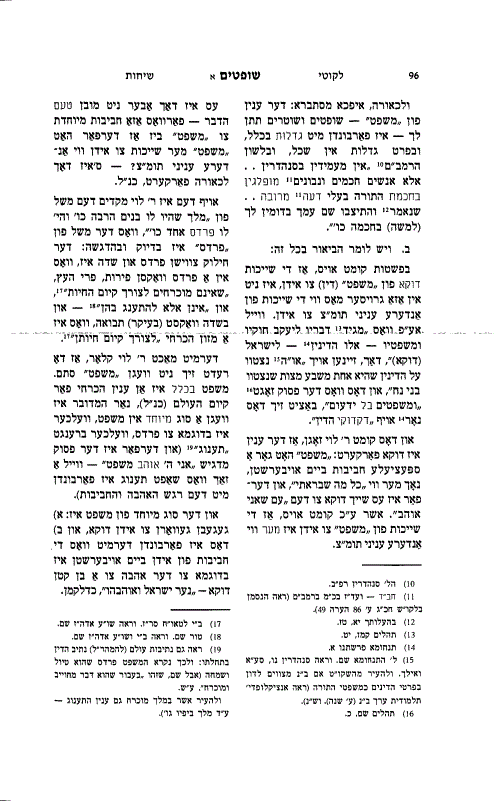
2. One may explain all this as follows:
At face value, it would seem that the connection of "justice" (law) specifically to the Jewish people is not as great as the connection of other matters of Torah and mitzvos to the Jewish people. For although "מגיד דבריו ליעקב חוקיו ומשפטיו — אלו הדינין — לישראל" ("He tells His words to Yaakov, His statutes and His judgments13 — these are the laws14 — to Israel" (specifically)), nevertheless "the nations of the world15 were also commanded regarding laws, which is one of the seven commandments that the children of Noach were commanded"; and what the verse says16, "ומשפטים בל ידעום" ("and judgments they have not known"), refers only to "the fine details of the law."
And this is what Rabbi Levi comes to say: that the matter is in fact the reverse. "Justice" has an altogether special endearment to G‑d, even more than "all that I created," and therefore it pertains specifically to "the people that I love." Consequently it emerges that the connection of "justice" to the Jewish people is greater than that of other matters of Torah and mitzvos.
However, the reason for this is not understood — why such a special endearment for "justice," to the point that because of it "justice" has a greater connection to the Jewish people than other matters of Torah and mitzvos? Seemingly, it is the reverse, as mentioned above.
To this end Rabbi Levi prefaces the parable of "a king who had many sons, etc., and he had one orchard, etc." The parable of an "orchard" is precise and emphatic: the difference between an orchard and a field is that in an orchard grow fruits, the fruit of the tree, "שאינם מוכרחים לצורך קיום החיות" ("which are not necessary for sustaining life")17, and "אינן אלא להתענג בהן" ("which serve only for enjoyment")18 — whereas in a field grows (mainly) grain, which is a necessary food "for sustaining life"17.
With this Rabbi Levi makes clear that here it is not speaking of "justice" in a plain sense. Justice in general is a necessity for the existence of the world (as mentioned above); rather, what is being spoken of is a special category within justice, which is comparable to an orchard, which brings "pleasure"19 (and therefore the verse emphasizes "I, the L‑rd, love justice" — because a thing that produces pleasure is bound up with the feeling of love and endearment).
And this special category of justice: a) was given specifically to the Jewish people; and b) this is connected with the fact that the endearment of the Jewish people to G‑d is comparable to the love for a young son specifically — "For Israel is a youth and I love him," as will be explained below.
3. The explanation of this:
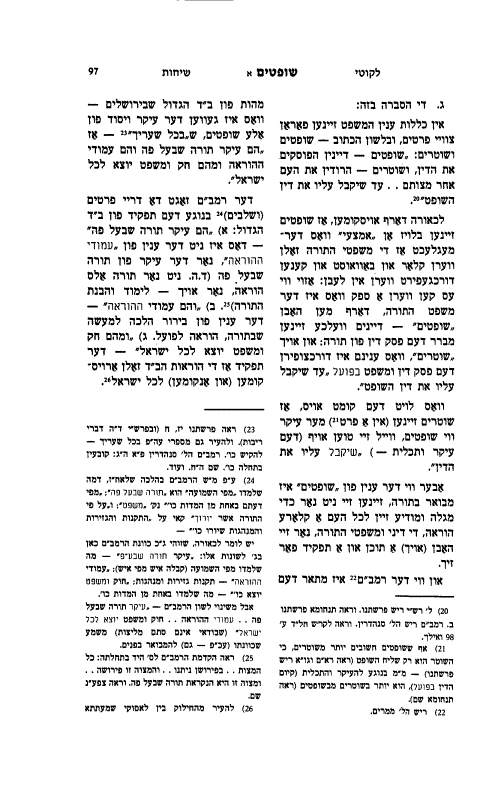
In the overall matter of justice there are two particulars — in the words of the verse, judges and officers: "שופטים — דיינין הפוסקים את הדין, ושוטרים — הרודין את העם אחר מצותם . . עד שיקבל עליו את דין השופט" ("Judges — the judges who rule on the law; and officers — those who compel the people to follow their command . . until he accepts upon himself the judge's ruling")20.
Seemingly it should follow that judges are merely a means that makes it possible for the laws of the Torah to become clear and known and able to be carried out in life: since a doubt may arise as to what the Torah's law is, one needs "judges" — judges who clarify the Torah's ruling; and also "officers," whose task is to carry out the ruling and the judgment in practice, "until he accepts upon himself the judge's ruling."
According to this it would emerge that officers are (in one respect)21 more essential than judges, because they accomplish (the main point and purpose —) "that he accepts upon himself the ruling."
However, as the matter of "judges" is explained in the Torah, they exist not only in order to reveal and make known to all the people a clear directive, the laws and judgments of the Torah; rather, they (also) have a content and a role of their own.
As the Rambam22 describes the essence of the Great Beis Din in Jerusalem — which was the main point and foundation of all the judges "בכל שעריך" ("in all your gates")23 — that "הם עיקר תורה שבעל פה והם עמודי ההוראה ומהם חק ומשפט יוצא לכל ישראל" ("they are the essence of the Oral Torah, and they are the pillars of instruction, and from them statute and judgment go forth to all Israel").
The Rambam states here three particulars (and stages)24 regarding the role of the Great Beis Din: a) "They are the essence of the Oral Torah" — this is not the matter of "pillars of instruction," but the very essence of the Oral Torah (i.e., not only Torah as instruction, but also — the study and understanding of the Torah)25. b) "And they are the pillars of instruction" — the matter of clarifying the practical halachah in the Torah, instruction for practice. c) "And from them statute and judgment go forth to all Israel" — the role that the directives of the Beis Din should go out (and reach) all Israel26.
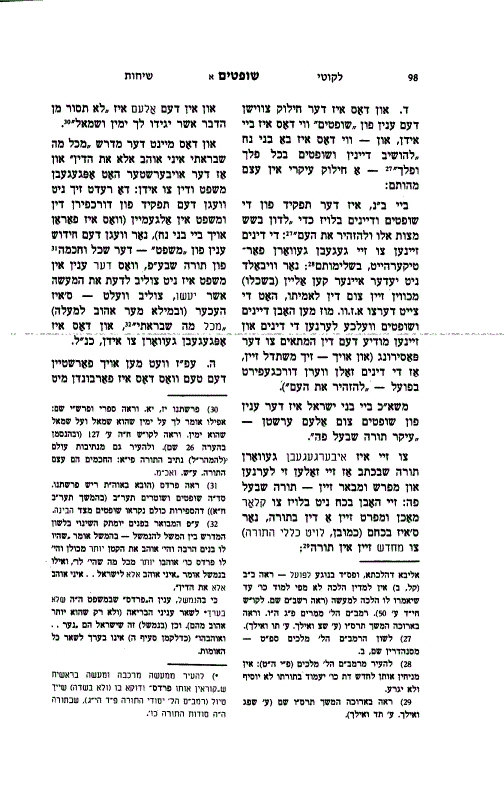
4. And this is the difference between the matter of "judges" as it is among the Jewish people, and as it is among the children of Noach — "להושיב דיינין ושופטים בכל פלך ופלך" ("to appoint judges and magistrates in every district")27 — a fundamental difference in their very essence:
Among the children of Noach, the role of the judges and magistrates is merely "לדון בשש מצות אלו ולהזהיר את העם" ("to judge regarding these six commandments and to warn the people")27: the laws were given to them ready-made, in their completeness28; but since not everyone is able on his own (with his intellect) to arrive at the true law, or has the time for it, and so on, there must be judges and magistrates who study the laws and make known the law appropriate to the given occurrence (and also — make efforts that the laws be carried out in practice — "to warn the people").
Among the Jewish people, by contrast, the matter of judges is first and foremost — "the essence of the Oral Torah."
To them the Written Torah was entrusted, that they should study it and interpret and explain it — the Oral Torah. They have the power not merely to clarify and detail a law in the Torah; rather, it is in their power (of course, according to the rules of the Torah) to make innovations in the Torah29; and in all this there applies "לא תסור מן הדבר אשר יגידו לך ימין ושמאל" ("You shall not deviate from the word that they tell you, right or left")30.
And this is what the Midrash means by "of all that I created, I love only justice," and that G‑d gave over justice and law to the Jewish people: it is not speaking here about the role of carrying out law and justice in general (which exists also among the children of Noach), but about the novel matter of "justice" — the intellect and wisdom31 of the Oral Torah, in which the point of justice is not for the sake of "לדעת את המעשה אשר יעשון" ("knowing the deed that they shall do"), for the sake of the world — it is higher (and consequently more beloved Above) "than all that I created"32, and this was given over to the Jewish people, as mentioned above.
5. Based on this, one will also understand the reason why this is connected with the endearment of the Jewish people as "נער ישראל" ("Israel, a youth") specifically33.
In clarifying the laws of the Torah, what matters chiefly34 is greatness in intellect and wisdom, as mentioned above. But the fact that G‑d gives over the Torah, so to speak, to the (judges of the) Jewish people, in such a way that they are "the essence of the Oral Torah" — this is not on account of their superiority in intellect and wisdom, but because "ישראל וקוב״ה כולא חד" ("Israel and the Holy One, blessed be He, are entirely one")35: the Jewish people are, so to speak, one thing with G‑d, with the Giver of the Torah.
And of this the endearment of a young son specifically is a parable. A father's love for a young son is not connected with the son's qualities (and especially — revealed ones) (for he is, after all, still young), but is because they (father and son) are one essence36.
Similarly in the analogue regarding the Jewish people: there exists an endearment toward the Jewish people because they are a "עם חכם ונבון" ("wise and understanding people")37; but G‑d's essential love for the Jewish people stems from their essence (not covered over by their qualities and the like) — they are "Israel, a youth."
And in avodah — this is openly expressed in the Jewish people when they hold themselves small38, in self-nullification — "ממעטין עצמכם" ("you make yourselves small")39 — by virtue of which the Jewish people become "masters," so to speak, over the Torah.
Therefore, the connection of justice to the Jewish people is deeper and stronger than that of other matters of Torah and mitzvos, for in the coming into being, the innovation, of justice there is expressed the "essential quality" of the Jewish people, that they are, so to speak, one essence with G‑d, the G‑d and King40 of justice.
This also explains why a parable of a king specifically is brought — because in the analogue, the Jewish people receive (not simply something cherished, but) something that only a king is capable of giving — "ownership" over justice, which comes (as mentioned above) from the G‑d and King of justice.
6. The above matter regarding "justice" — being a general matter of all (and within all) of Torah and mitzvos — has its counterpart in the fulfillment of every mitzvah, by each and every person. The explanation:
The difference between "judges" and "officers" is similar to the difference between "נעשה" ("we will do") and "נשמע" ("we will hear"): the role of "judges" is "we will hear" — the understanding41 of Torah and mitzvos and making them heard; and "officers" accomplish the "we will do" — the actual deed, including also "deed" in the sense of compulsion42 (like the officers), which in general is the matter of kabbalas ol (accepting the yoke).
One might think that "we will hear" is not a matter and purpose in its own right, but merely a kind of preparation and lead-up to a mitzvah, which brings to the performance of mitzvos. Regarding this there is the lesson of the above Midrash: G‑d commands that there be "we will hear" (judges) as an avodah in its own right.
This is also one of the explanations for why the order is "נעשה ונשמע" ("we will do and we will hear") ("we will do" preceding "we will hear"): this is not only for the sake of "we will do" — so that the movement of kabbalas ol be in its full strength and completeness, without an admixture of intellectual reasons from the side of "we will hear" — but also for the sake of "we will hear":
When "we will hear" comes before "we will do," it is possible that "we will hear" is merely a preparation and qualification for "we will do" — "לימוד מביא לידי מעשה" ("study leads to action");
but when "we will hear" comes after "we will do," after the doing has already been "accomplished" — it is understood that "we will hear" is (not for the sake of "we will do," but) an avodah (and a completeness) and a purpose in its own right.
The reason for this: the complete endearment and pleasure Above is when the Jewish people also have understanding and comprehension in matters of Torah and mitzvos. For "נתאוה הקב״ה להיות לו דירה בתחתונים" ("The Holy One, blessed be He, desired to have a dwelling place in the lower realms") — that all the "lower realms" should become a "dwelling" and a vessel for G‑dliness. When a Jew accomplishes only the "we will do" — action, kabbalas ol — then, although this expresses his nullification to the Supreme Will, it is nevertheless not something that permeates his entire being in all its particulars, including the inner faculties:
For the intent of "a dwelling in the lower realms"43 to be realized, it is not enough that a Jew nullifies himself to the Supreme Will; rather, he, entirely and in all his particulars, must become a "vessel" ("dwelling") for holiness — and this is specifically when there is (also) "we will hear" (his inner faculties), understanding and comprehension44.
7. Just as there is a superiority in the study (and understanding45) of the Torah ("we will hear") relative to the fulfillment of the mitzvos — similarly there are two aspects within the fulfillment of each mitzvah itself:
As is known46, there are two kinds of intention in mitzvos: a) the general intention, which is the same in all the mitzvos (the part of the blessing's text that is the same in all the mitzvos) — "אשר קדשנו במצותיו וצונו" ("Who has sanctified us with His commandments and commanded us"), fulfilling the Supreme Will, accepting the yoke of the mitzvos; b) the particular intention, which is connected with the particular content and special quality found in that mitzvah — "להניח תפילין" ("to put on tefillin") [and similarly: the 248 positive commandments correspond to the 248 limbs47 and the 365 prohibitions correspond to the 365 sinews — and each mitzvah effects a refinement in its own limb and part of the person48], which is a matter of reason and understanding.
The difference between the two intentions is connected with the two aspects in mitzvos49: a) the Supreme Will, blessed be He, in the mitzvos — and in will there is no division, so from its standpoint all the mitzvos are equal; b) the Supreme Pleasure, blessed be He (the inner dimension of the Supreme Will in the mitzvos) — and the "Supreme Pleasure" is different in each mitzvah.
[Similar50 to the difference between will and pleasure in the human soul: in will there is no division — the (force of the) will is equal in all desires alike; whereas in pleasure there is division — in each faculty there is a different kind of pleasure.]
Therefore there is an advantage in the particular intention of mitzvos relative to the general intention50 — for in it is found the Supreme Pleasure, blessed be He (as mentioned above, that "the Holy One, blessed be He, desired" specifically to have a dwelling in the lower realms, which is accomplished through the drawing down (also) into the inner dimension).
8. Although in every mitzvah there is the quality of "justice" (from the standpoint of the particular intention and content in that mitzvah) — it does not reach the quality found in "justice" in its plain sense.
For51: the G‑dly pleasure that is enclothed in the mitzvos (in each mitzvah a different kind of pleasure) is only a glimmer of the Supreme Pleasure, blessed be He, which is united with His Being and Essence, may He be blessed; and G‑d Himself is, after all, simple in utter simplicity, and no division whatsoever applies to Him; rather, He is the "source of pleasures," from which there is drawn down "a glimmer into the mitzvos, to each level according to its rank."
And this is what "justice" accomplishes — "Judges and officers you shall appoint for yourself" — by which is meant (not the particular matter of justice, but) the general matter, in connection with all of Torah and mitzvos (as explained above in section 4 at length). Therefore it is said of it, "I, the L‑rd, love justice" — because in it there is openly revealed (not merely a glimmer of the Supreme Pleasure, as in each particular mitzvah, but) the source of pleasures, the "desire" of His Essence, may He be blessed52.
This is also the reason why the matter of justice is given to the Jewish people on account of "Israel is a youth and I love him" — specifically because of their (quality of) smallness and self-nullification53 — because the bond with the source of pleasures is not through an avodah of reason and the feeling of pleasure, in which the person's own existence is felt; on the contrary: specifically through simplicity one connects with the simplicity Above54.
9. Parshas Shoftim is always read at the beginning of the month of Elul — in most years Shabbos Parshas Re'eh is still in the month of Menachem Av, Shabbos Mevarchim Elul; and even when it falls on Rosh Chodesh Elul, it is the first day of Rosh Chodesh (the 30th of Menachem Av), but the 1st of Elul always falls in Parshas Shoftim —
so it is understood that the above matter regarding judges has a special connection with the month of Elul, among whose Jewish customs (which begin from the 1st of Elul55) is the blowing of the shofar of Elul56:
Regarding the matter of the shofar, we find two extremes57: "shofar" derives from the term "שפרו מעשיכם" ("beautify your deeds")58, which is the matter of pleasure; on the other hand, the sound of the shofar instills fear and trembling59 (the opposite of pleasure).
The Tzemach Tzedek explains this60: "shofar" is the level of the "source of pleasures," which is entirely above the revelation of pleasure, and therefore it instills fear and trembling, because the revelation of the source of pleasures is bound up with self-nullification and simplicity, as mentioned above.
[As is known61, the Baal Shem Tov's parable regarding the sound of the shofar: it is comparable to the simple cry62 of the king's only son, of whom "אביו יכירו בטביעת עין דקלא" ("his father recognizes him by the distinctive tone of his voice").]
But on the other hand, "shofar" is a term of pleasure, since it is the source of pleasures from which all kinds of pleasure are drawn down.
This is similar to what the Midrash explains regarding justice — "Judges and officers you shall appoint for yourself" — that in it there is "I, the L‑rd, love justice," and therefore it is connected with the Jewish people as they are in the mode of "Israel is a youth and I love him," as mentioned above.
And through the matter of "justice" (the completeness of law in general) there is accomplished (as the Midrash concludes) "מיד אני גואל אתכם גאולה שלימה" ("immediately I will redeem you with a complete redemption")63.
(From the sichos of Shabbos Parshas Shoftim 5727 (maamar and sichah); maamar "Yom Tov shel Rosh Hashanah" 5742*)
Notes
1) Devarim Rabbah 5:7.
2) Hoshea 11:1.
3) Yeshayahu 61:8.
4) Avos, end of ch. 1 (cited in Yalkut Shimoni, beginning of our parsha): "On three things the world stands, etc." See also the sources cited in note 7.
5) See at length Tur, beginning of Choshen Mishpat, and the sources cited there.
6) Moreover: how is the expression "love" appropriate regarding law and justice? (Similar to the question in the maamar "Shoftim v'Shotrim" 5633 (Kehot, 5716) regarding the term "joy" stated in connection with justice: "What is the joy, etc.")
7) See Tur there, at its beginning (from Rabbeinu Yonah). See at length Perishah there: "It is not appropriate to say that the world was created for the sake of justice, truth and peace, for they are merely negation and guarding against corruption, etc. But* G‑d, may He be blessed, has in those three themselves no honor or gratification."** See there.
*) So it is in the first edition (Frankfurt am Main, 5472). In our editions it reads "but if" (apparently a printing error) "there is no."
**) So it is also in the first edition. This requires slight further study.
8) Va'eschanan 7:8.
9) Teitzei 23:6.
10) Laws of Sanhedrin, beginning of ch. 2.
11) Chochmah, Binah, Daas — and [OCR unclear] in many places in the Rambam (see the sources cited in Likkutei Sichos vol. 23, p. 86, note 49).
12) Beha'aloscha 11:16.
13) Tehillim 147:19.
14) Tanchuma, our parsha, 1.
15) Wording of the Tanchuma there. See Sanhedrin 56a, bottom, ff. Note the discussion whether the children of Noach are commanded to judge according to the detailed laws, like the laws of the Torah (see Encyclopedia Talmudis, entry "Ben Noach" (p. 355), and the sources cited there).
16) Tehillim there, 20.
17) Beis Yosef on Tur Orach Chaim, siman [OCR unclear]. See the Alter Rebbe's Shulchan Aruch there.
18) Tur there. See Beis Yosef and the Alter Rebbe's Shulchan Aruch there.
19) See also Nesivos Olam (by the Maharal), Nesiv HaDin, at its beginning: "Therefore justice is called an orchard, for it is a stroll and joy" (but there, this is "because it is something obligatory and necessary"; see there). And note that in a king the matter of pleasure is also necessary — as in "מלך ביפיו" ("a king in his beauty," etc.).
20) Wording of Rashi at the beginning of our parsha. See Tanchuma, our parsha, 2; Rambam, beginning of Laws of Sanhedrin. See Likkutei Sichos vol. 34, p. 98ff.
21) Although judges are more important than officers, for the officer is only the judge's agent (see Re'em and Gur Aryeh at the beginning of our parsha) — nevertheless, regarding the main point and purpose (the actual fulfillment of the law), it is more in the officers than in the judges (see Tanchuma there).
22) Beginning of Laws of Rebels (Hilchos Mamrim).
23) See our parsha 17:8 (and Rashi, s.v. "Divrei rivos"). Note also Sifri on the verse "in all your gates" — to compare, etc.; Rambam, Laws of Sanhedrin 1:3: "They first establish, etc."; ibid., halachah 8; and elsewhere.
24) Based on what the Rambam writes in the following halachah — that what they learned "from the oral tradition" is "Oral Torah"; what they derived "by their own reasoning through one of the hermeneutic principles, etc." is called "judgment"; and "according to the Torah which they will instruct you" refers to "the enactments, decrees and customs that they will instruct, etc." — one could seemingly say that this is also the Rambam's intent here in these three expressions: "the essence of the Oral Torah" — what they learned from the oral tradition (received from person to person); "pillars of instruction" — enactments, decrees and customs; "statute and judgment go forth, etc." — what they learned through one of the hermeneutic principles, etc. However, from the Rambam's change of wording — "the essence of the Oral Torah . . the pillars of instruction . . statute and judgment go forth to all Israel" (which are certainly not mere rhetoric) — it is implied that his intent is (at least — also) to what is explained in the text.
25) See the Rambam's introduction to his Yad, at the beginning: "All the mitzvos . . were given with their explanation . . and the mitzvah is its explanation . . and this mitzvah is what is called the Oral Torah." See Tzafnas Pa'neach there.
26) Note the distinction between arriving at a teaching in accordance with the halachah and a ruling regarding practice — see Bava Basra (130b): "One may not derive halachah from study, etc., until they tell him it is halachah for practice" (see Rashbam there; Likkutei Sichos vol. 10, p. 50); Rambam, Laws of Rebels 3:6. See at length Hemshech 5666 (p. 390ff; p. 406ff).
27) Wording of the Rambam, Laws of Kings, end of ch. 9 — from Sanhedrin there, 56b.
28) Note the Rambam, Laws of Kings (ch. 9, halachah 9): "They are not permitted to innovate a religion, etc.; he should remain in his law, neither adding nor subtracting."
29) See at length Hemshech 5666 there (p. 383ff; p. 404ff).
30) Our parsha 17:11. See Sifri and Rashi there: "Even if he tells you about right that it is left, and about left that it is right." See Likkutei Sichos vol. 5, p. 127 (and the sources cited in note 26 there). Note also Nesivos Olam (by the Maharal), Nesiv HaTorah, ch. 1: "The Sages are the essence of the Torah"; see there. This is not the place to elaborate.
31) See Pardes (cited in Ohr HaTorah, beginning of our parsha; end of the maamar "Shoftim v'Shotrim" 5672 (in Hemshech 5672, vol. 1)), that the Sefiros are all called "judges" from the aspect of Binah.
32) Based on what is explained in the text, the difference in the Midrash's wording between the parable and the analogue is better appreciated: in the parable it says that he had many sons and loved the youngest more than all of them, and he had an orchard, etc., which he loved more than everything he had; whereas in the analogue it says "I love only Israel . . I love only justice." For in the analogue, the "orchard" aspect of justice is beyond comparison with the other matters of creation (and not only that it is more beloved than them); and likewise (in the analogue) the fact that Israel are "a youth . . and I love him" (as explained below, section 5) is beyond comparison with all the other nations.
*) Note the Account of the Chariot and the Account of Creation, which "are called Pardes [orchard]," and specifically regarding it (and not a field) a fence applies (Rambam, Laws of the Foundations of the Torah 4:3); in the Torah this is the secrets of the Torah, etc.
33) On what follows — note (in a somewhat different manner) Ohr HaTorah, our parsha, p. 819ff; end of the maamar "Shoftim" 5672, mentioned above.
34) Although there must also be self-nullification; on the contrary — the reason the halachah was established according to Beis Hillel and not Beis Shammai (although Beis Shammai "are sharper" — Yevamos 14a) is "because they were gentle, etc., and moreover they would mention the words of Beis Shammai before their own" (Eruvin 13b) — see at length Sefer HaMaamarim 5627 (p. 277ff; p. 290ff); Hemshech 5666, p. 422ff; Likkutei Sichos vol. 21, p. 115; and elsewhere.
35) Note also Likkutei Sichos vol. 9, p. 386; see there, note 54.
36) See the maamar "Ki Naar Yisrael" 5666 (p. 553; in the 5751 edition — p. 577). See Likkutei Sichos vol. 21, p. 20ff (and the sources cited there); see there, note 6.
37) Va'eschanan 4:6.
38) See also Likkutei Sichos there, p. 21.
39) Chullin 89a. See also the commentary of the Maharzu on Midrash Rabbah there.
40) "And a king innovates laws" (Rambam, Laws of Kings, end of ch. 3; ibid., ch. 4). See Maharatz Chayes in Toras Nevi'im, ch. 7 (the law of a Jewish king). This is not the place to elaborate.
41) As in "[OCR unclear] . . for [OCR unclear] hears" (I Shmuel 3:9), and the like.
42) Beis Yosef on Tur Yoreh De'ah, siman 248. See Likkutei Torah, Bechukosai 48a. Note Iggeres HaKodesh, sec. 12 (118a–b), on the difference between "maaseh" (deed) and "avodah" (service). This requires slight further study.
43) And all the more so what is written in the Zohar (42b; Tanya, end of ch. 44), "בגין דישתמודעון ליה" ("so that they may know Him"); and in Etz Chaim (Shaar HaKelalim, at its beginning), "ויכירו גדולתו" ("and they will recognize His greatness").
44) See Ohr HaTorah, our parsha, there: "A dwelling in the lower realms . . [OCR unclear] . . that the light and flow are drawn down through the contraction of the Torah and mitzvos, and this is the ultimate purpose of His Will, may He be blessed." And in Hemshech 5672, there (p. 103): "And the matter of what is written, that He loves justice — one may say that this is the superiority of the inner over the encompassing . . for justice is in the ten Sefiros." See also Likkutei Sichos there, p. 22ff.
45) Note that in the Oral Torah the study must be specifically with understanding (the Alter Rebbe's Shulchan Aruch, Orach Chaim 50:2 (from Magen Avraham, end of siman 50); Laws of Torah Study, end of ch. 2).
46) See Likkutei Torah, Shelach 40a; Ateres Rosh 58b, bottom, ff.; and elsewhere.
47) "Each and every limb says to him: perform a mitzvah with me" (cited at the end of the Rambam's introduction to Sefer HaMitzvos; it is in Tanchuma, Teitzei 2, with slightly different wording).
48) See at length Likkutei Sichos vol. 9, p. 412ff, and the sources cited there.
49) See Likkutei Torah, Bamidbar 18a–b; Ohr HaTorah, Rosh Hashanah (vol. 5), p. 2110ff. See below, p. 179ff.
50) See the maamar "Adon Olam" 5743 (Sefer HaMaamarim Meluket, vol. 1, p. 432ff), the reconciliation with what is explained in most discourses (see the sources cited in note 46, and elsewhere) — that the general intention is higher than the particular intention.
51) See Likkutei Sichos there, p. 413ff.
52) See at length on all this — Ohr HaTorah, Rosh Hashanah, there.
53) See Likkutei Torah there (18c): "And this is through 'Ani' [I], the letters of [OCR unclear]" (and see the sources cited there). See Ohr HaTorah there, ch. 4 — cited below in the text.
54) Similar to the saying of the Baal Shem Tov (Keser Shem Tov, Additions, sec. 154ff, and the sources cited there) that the simplicity of the Essence is revealed in the simplicity of a simple person.
55) See the views on this in the commentaries on the Tur and Shulchan Aruch, Orach Chaim 581. We, however, have only the directive of our Nasi, the Previous Rebbe (Hayom Yom, Rosh Chodesh Elul), that on the second day of Rosh Chodesh Elul we begin to blow, and on the first day we blow (only*) to practice.
*) However, in the inner dimension of matters, the blowing to practice on the first day of Rosh Chodesh Elul is the beginning of the matter of the shofar — see at length Likkutei Sichos vol. 34, p. 95ff.
56) So too regarding the addition in Tehillim (three chapters per day), as opposed to the recitation of "לדוד ה׳ אורי" ("Of David: The L‑rd is my light," etc.) — which begins on the first day of Rosh Chodesh Elul. But note that these two matters continue also in the month of Tishrei, unlike the shofar of Elul (and although there is shofar on Rosh Hashanah — it is an entirely different kind of blowing*; this is not the place to elaborate).
*) Although one may say they are connected to each other — see Likkutei Sichos vol. 9, p. 129ff; ibid., p. 317, in the note.
57) See on all this — Ohr HaTorah there, chs. 2 and 4. Note Ohr HaTorah (Yahel Ohr), Tehillim, [OCR unclear] 292.
58) Wording of the Midrash — Vayikra Rabbah 29:6; Midrash Tehillim 81:4.
59) As it is stated (Amos 3:6), "אם יתקע שופר בעיר ועם לא יחרדו" ("Shall a shofar be blown in a city and the people not tremble?") — cited in [OCR unclear] Orach Chaim (and commentaries) there, regarding Elul.
60) In Ohr HaTorah there.
61) Cited in Hemshech VeKachah 5637, ch. 70.
62) In the parable there it says "a great cry," but in the analogue it says "a simple cry." See at length the Siddur, maamar "Lehavin inyan tekias shofar according to the intention of the Baal Shem Tov" (244c ff.), that the matter of the shofar blasts is a simple cry that arouses the simplicity Above.
*) And it stands to reason that in the parable as well the intent is a simple cry, for "due to the length of time he had forgotten even the language of his country," and the king recognized him (only) by his voice.
63) See the end of the maamar "Shoftim" 5672, explaining the conclusion of the Midrash's words (that in the merit of justice, "I . . raise My holiness among you . . immediately I redeem you with a complete redemption") — for through justice one draws down the Essence of the Infinite Light. See there. See also above, section 8.
*) Printed in full in Sefer HaMaamarim Meluket, vol. 1, p. 421ff.
Key Lesson
The "justice" G‑d loves above all creation is the wisdom of the Oral Torah, entrusted to the Jewish people not for their intellect but because of His essential love for them, like a father's love for a young son. So too, in every mitzvah a Jew should not suffice with kabbalas ol alone but seek understanding ("we will hear") as a goal in its own right, while approaching G‑d with humility and simplicity, through which one connects with the simplicity Above.