Likkutei Sichos Vol. 24 – Chai Elul
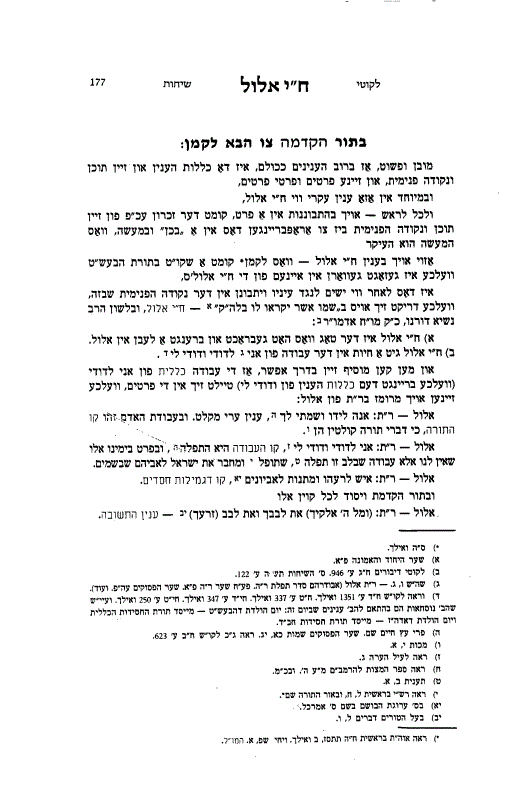
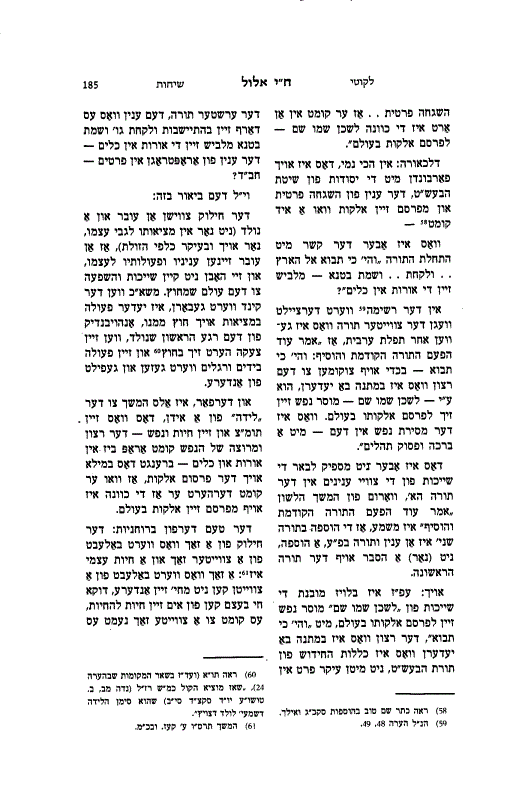
It is understood and simple that in most matters, if not all, there is the general concept and its inner essence and point, along with its details and finer details. This is especially true in such a fundamental matter as Chai Elul. First and foremost, even when contemplating a specific detail, one recalls at least its content and inner point, bringing it down into potential and action, as action is the main thing.
Similarly, regarding Chai Elul — later on, there is a discussion in the teachings of the Baal Shem Tov, which was said on one of the Chai Eluls. It is important to keep in mind and contemplate its inner point, which is expressed in "the name by which it is called in the Holy Tongue" — Chai Elul. In the words of the Rebbe, our leader of the generation, my father-in-law, the Rebbe:
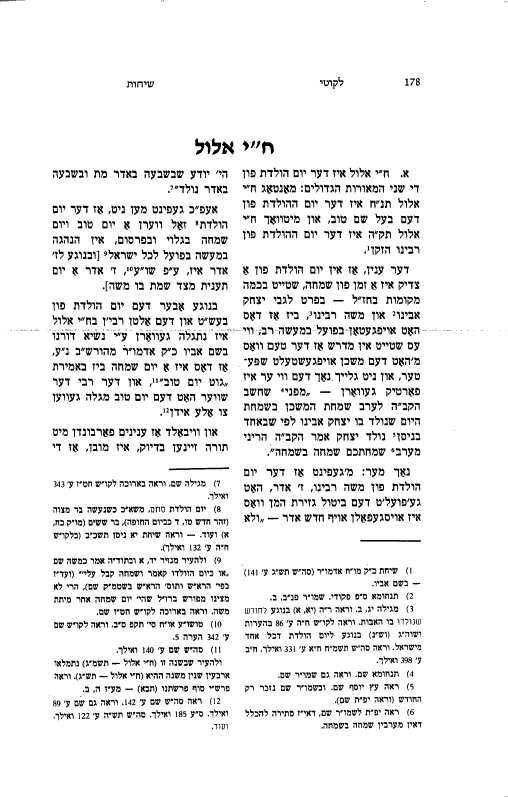
1. Chai Elul is the birthday of the two great luminaries: Monday, Chai Elul 5458, is the birthday of the Baal Shem Tov, and Wednesday, Chai Elul 5505, is the birthday of the Alter Rebbe.
The idea that the birthday of a tzadik is a time of joy is stated in several places in the words of our Sages, particularly regarding Yitzchak Avinu and Moshe Rabbeinu. This even had a practical effect, as it is stated in the Midrash that the reason the Mishkan was erected later and not immediately after it was completed was "because the Holy One, blessed be He, wanted to combine the joy of the Mishkan with the joy of the day Yitzchak Avinu was born. Since Yitzchak was born on the first of Nissan, the Holy One, blessed be He, said, 'I will combine your joy with joy.'"
Furthermore, we find that the birthday of Moshe Rabbeinu, the 7th of Adar, nullified Haman's decree, which fell in the month of Adar — "and he did not know that Moshe was born on the 7th of Adar."
Nevertheless, we do not find that the birthday should become a public and openly celebrated holiday and day of joy in practical conduct for all of Israel. Regarding the 7th of Adar, according to the Shulchan Aruch, it is a fast day because Moshe died on that day.
However, concerning the birthdays of the Baal Shem Tov and the Alter Rebbe on Chai Elul, it was revealed by the Rebbe of our generation, in the name of his father, the Rebbe Rashab, that this is a day of joy, even to the extent of saying "Good Yom Tov." The Rebbe, the father-in-law, revealed this Yom Tov to all Jews.
And since matters connected with Torah are precise, it is understood that these...
1. The joy and elevation of the birthday on Chai Elul is not only because through the Baal Shem Tov and the Alter Rebbe a new revelation in Torah and service of G‑d was accomplished — the revelation of the general teachings of Chassidus and the teachings of Chabad Chassidus to all of Israel — but also because the innovation of the concept of joy on a birthday is particularly connected with the Baal Shem Tov and the Alter Rebbe and the Chassidic teachings revealed by them.
Moreover, the connection is to both of them together. As the Rebbe Rashab expressed regarding Chai Elul, "Today is the birthday of our two great luminaries," meaning that the essence of this birthday is expressed through both "great luminaries" together, the Baal Shem Tov and the Alter Rebbe.
2. We will understand this by first explaining the simple meaning of what constitutes the joy on a birthday:
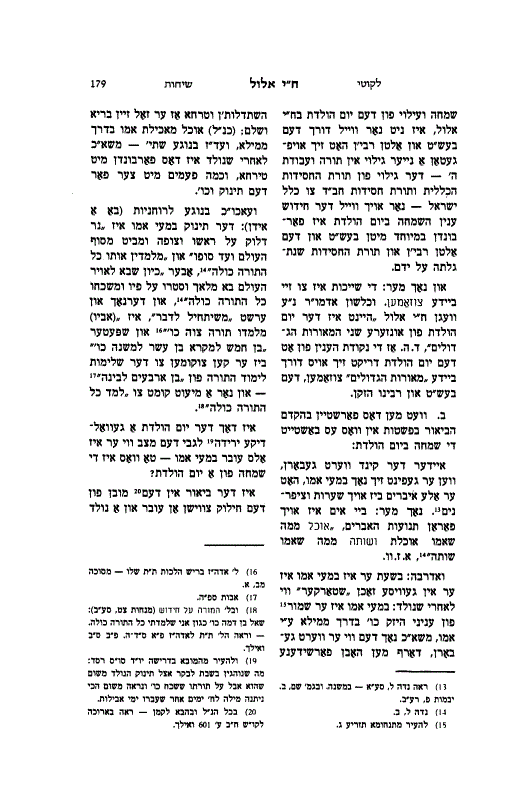
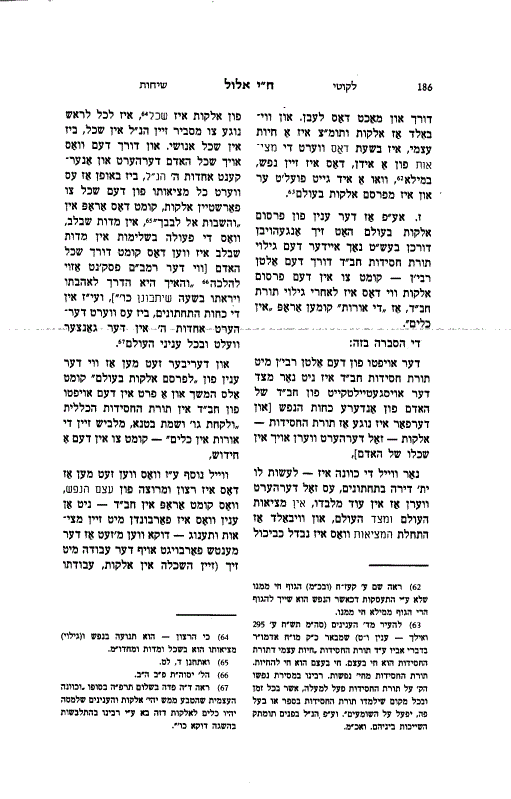
Before the child is born, when he is still in his mother's womb, he has all his limbs, including hair and nails. Furthermore, he also has limb movements, "he eats from what his mother eats and drinks from what his mother drinks," and so on.
Moreover, while he is in his mother's womb, he is, in certain respects, "stronger" than after he is born: in his mother's womb, he is naturally protected from harmful matters, etc., by his mother, whereas after he is born, various efforts and exertions are needed to ensure he is healthy and whole; (as mentioned) he eats from his mother's food naturally, and similarly regarding drinking — whereas after he is born, this involves effort, and often pain for the infant, etc.
And certainly regarding spirituality (for a Jew): the infant in his mother's womb has "a candle lit above his head and he sees and looks from one end of the world to the other" and "they teach him the entire Torah," but "once he comes into the air of the world, an angel comes and strikes him on his mouth and makes him forget the entire Torah," and only later, when he begins to speak, does "(his father) teach him 'Torah commanded us...'" and later "at five years for Scripture, at ten for Mishnah, etc." until he can reach the completeness of Torah study at "forty for understanding" — and only a minority reaches "having learned the entire Torah."
Thus, the birthday is a tremendous descent compared to the state he is in as a fetus in his mother's womb — so what is the joy of a birthday?
The explanation in this lies in understanding the difference between a fetus and a newborn.
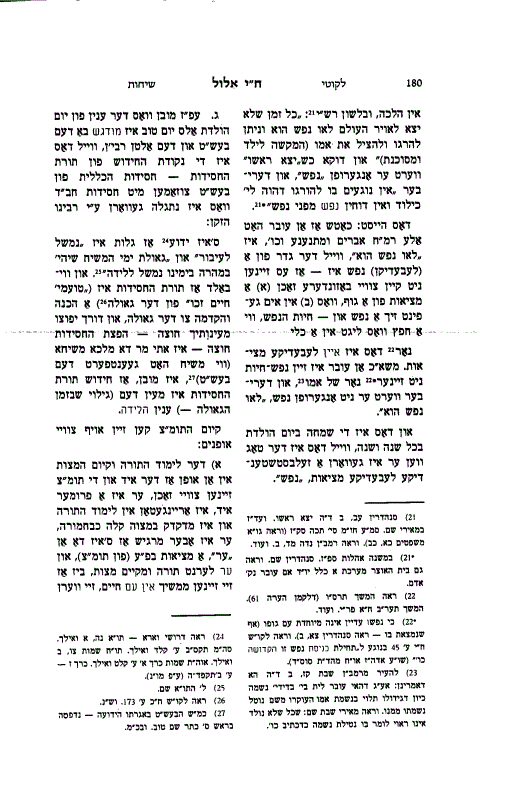
2. The halacha states, and in the words of Rashi: "As long as he has not come into the air of the world, he is not considered a living being and it is permissible to kill him to save his mother (who is in danger during childbirth)." Only when "his head has emerged" is he called a "living being," and then "we do not touch him to kill him, for he is considered born, and we do not push aside one life for another."
This means: Although a fetus has all 248 limbs and moves, etc., he is "not a living being," because the definition of a (living) soul is that there are not two separate entities: (a) a body that (b) contains a soul and — the vitality of the soul, like an object placed in a vessel. Rather, it is one living entity. In contrast, a fetus's soul-vitality is not his own but belongs to his mother, and therefore he is not called a soul, "not a living being."
And this is the joy of a birthday each year, because it is the day when he becomes an independent living entity, a "soul."
3. Based on this, we understand why the concept of a birthday as a yom tov is emphasized by the Baal Shem Tov and the Alter Rebbe, because this is the point of innovation in the teachings of Chassidus — the general Chassidus of the Baal Shem Tov together with Chabad Chassidus, which was revealed by the Alter Rebbe:
It is known that exile is "compared to pregnancy" and "the redemption of the days of Mashiach, may it be speedily in our days, is compared to birth." And since the teachings of Chassidus are (as "those who taste it merit life" from the redemption) a preparation and prelude to the redemption, and through "your wellsprings shall spread outward" — the spreading of Chassidus outward — when will the Master come, the King Mashiach (as Mashiach answered the Baal Shem Tov), it is understood that the innovation of the teachings of Chassidus is akin to the (revelation in the time of the redemption —) concept of birth.
The fulfillment of Torah and mitzvos can be in two ways:
4. The study of Torah and the observance of mitzvos can occur in a manner where the Jew and the Torah and mitzvos are seen as two separate entities. He is a devout Jew, deeply involved in Torah study and meticulous in observing even the lightest of mitzvos as the most stringent. However, he feels that there is an "I," an independent existence apart from Torah and mitzvos. He learns Torah and fulfills mitzvos to the extent that they draw from the Tree of Life, becoming "our life and the length of our days," because they are the wisdom and will of the Almighty, the Source of life.
This is akin to the state of pregnancy, where a fetus in its mother's womb, although it has all its limbs, is a living entity. Yet, its life force is not its own but that of its mother; its limbs themselves "are as if dead."
5. The Baal Shem Tov revealed and emphasized the inner and true meaning of "there is nothing besides Him" — that there is no existence other than the Divine. Consequently, there are not two entities — a being (the person) who observes Torah and mitzvos — because there is no existence outside of the Almighty. There is only one entity: the Almighty, His Torah, and His mitzvos (for He and His wisdom and will are one).
Therefore, there is only one existence; his life is Torah and mitzvos. This is similar to the concept of birth, where not two things are born, a body with a soul within, but one living entity.
This is emphasized in the words of our Sages: "I was not created (there is no creation of the existence of man) except to serve my Creator" — because in order to fulfill the will and wisdom of the Holy One, blessed be He — His Torah and mitzvos — there must be a Jew in this physical world to carry it out. Thus, from the outset, there was no creation of an independent being, but only a detail in (the manner of fulfilling) the will of G‑d, through whom His will is fulfilled.
6. For example, in practical halacha: "One who carries out food less than the required measure in a vessel is exempt even for the vessel, because the vessel is secondary to it." Although the vessel has a measure, and if one were to carry it out for its own sake, one would be liable for the carrying — since it has become a vessel for the food inside it, it is not an independent entity but "secondary to it." And since the food is less than the required measure, the carrying (including the carrying of the vessel) is not considered carrying. Since the intention of carrying the vessel is for the sake of the food, this is the true existence of the vessel; the vessel becomes a "part" of the food.
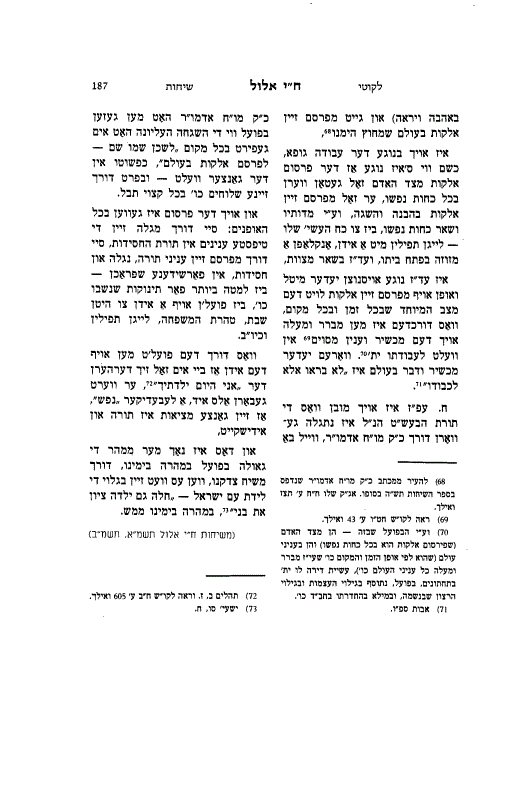
7. This also explains the connection between the birthday of the Baal Shem Tov and the birthday of the Alter Rebbe: the novelty of a newborn becoming a "living" entity is not only due to the general concept of life, but primarily connected with the details. The fact that a fetus is not a "soul" and is merely secondary and a detail (a limb) within its mother is mainly evident in the absence of the functions of the senses and limbs, as the Gemara states: "To what is the fetus in its mother's womb comparable? To a folded notebook, its head between its knees, etc., and it eats what its mother eats, etc." This means that although the fetus has the structure of all the limbs, head, eyes, and ears, "its head is folded and placed between its knees, it does not function, it does not think or contemplate," and also "it has eyes but does not see, and ears but does not hear, etc."
And this is the achievement of a newborn becoming an independent soul, not only in the general life of the body, but the function of its senses begins.
[Just as the general life, the fact that a person lives, permeates all the limbs and becomes unified with them — this is not connected with the specific function of each limb, but with the general point of all the limbs (which are part of the human body).]
However, the Alter Rebbe continued to infuse life into each power of the soul (and in each service in Torah and mitzvos) also from the specific content of the power (similar to the specific life that is measured according to the specific function of each limb): that faith descends and permeates even the intellect of man, until — his intellect itself understands and compels G‑dliness,
until every detail of the Jew becomes a living entity from its essence: starting from the Chabad of his soul, the revelation of G‑dliness in the intellect is such that it is perceived that his entire existence is to understand G‑dliness; and from the intellect come the emotions according to the nature of the intellect, it is felt that the entire existence of the attribute of love is so that there should be love of G‑d, and similarly with the attribute of fear and other attributes. And then each power from its essence is a living entity, its life is G‑dliness.
Therefore, the Rebbe of blessed memory said, "Today is the birthday of our two great luminaries" together (and only afterward explained each one individually) — because the
5. The birthday, as it pertains to each individual in a revealed manner, is such that one can say "Good Yom Tov" to Jews. This is when there is the revelation and influence of the general teachings of Chassidus from the Baal Shem Tov, through and together with the teachings of Chabad Chassidus by the Alter Rebbe. Because at that time, a Jew becomes a complete "soul" entity with all its details.
6. Every matter revealed by the tzaddikim is first expressed in their Torah. This is also true regarding the aforementioned connection between the Baal Shem Tov and the Alter Rebbe, which is openly and emphatically seen in the Torah that the Baal Shem Tov said on the Shabbos Parshas Ki Savo, the 18th of Elul, in the year 5652 (as the Previous Rebbe recounted about his father, the Rebbe Rashab, who heard the seven teachings that the Baal Shem Tov said on that 18th of Elul in Gan Eden):
The first teaching the Baal Shem Tov said after Kabbalas Shabbos was on the verse "And it will be when you come to the land, etc." He explained that "land" (ארץ) means desire, as the word ארץ has two interpretations as stated in the Midrash: why is it called ארץ? Because it desired to fulfill the will of its Creator, and ארץ means desire.
"And it will be when you come to the land" — when you reach the desire and fulfillment — "which the L‑rd your G‑d gives you as an inheritance and you shall possess it" — this is a gift from above, an inheritance in every Jew. The service in this is "and you shall dwell therein" — it should be with settlement — "and you shall take, etc." and "you shall place it in a basket" — to clothe the lights in vessels — "and you shall go to the place" — this is the concept of Divine Providence — "which the L‑rd your G‑d will choose" — when a Jew goes to a place, it is not that he goes, but he is led by the higher providence. When he arrives at a place, the intention is "to cause His name to dwell there" — to publicize G‑dliness in the world.
Since this Torah was said by the Baal Shem Tov on the 18th of Elul and was heard by the leaders of Chabad, it is understood that this emphasizes the point and novelty of the day of the 18th of Elul — the essence of the Baal Shem Tov and the Alter Rebbe.
It can be suggested (possibly) that there are two matters that the Baal Shem Tov states: 1) "And it will be when you come to the land" — you will reach the desire and fulfillment "which the L‑rd your G‑d gives you as an inheritance and you shall possess it," which is a gift from above, an inheritance in every Jew.
2. "One from Israel" — this generally refers to the revelation of the general teachings of Chassidus that the Baal Shem Tov accomplished, revealing the essential will of the soul that exists within every Jew.
3. The service required in this is — "and you shall dwell therein" — it should be with settlement, "and you shall take, etc., and place it in a basket" — to clothe the lights in vessels. This is the concept of Chabad Chassidus, where the will and desire of the soul are brought down in detail, lights in vessels. This is heard and accomplished in every specific power of the person, as mentioned above.
The Baal Shem Tov emphasizes that these are not two separate services and matters — "you shall reach the will and desire, etc., and (another thing) there must be the service to bring it down with settlement."
Rather, this was said as one matter: "that you will reach, etc." — meaning that within you, the birth has occurred, and in your very existence, the "gift from above, an inheritance in every Jew," the "will and desire" of the soul, has been heard and revealed. There must be the service in this — "to clothe the lights in vessels" — it should come down into Chabad, and through them — into all the faculties of his soul, as mentioned above. Then, this is the completeness of the birth.
6. Based on this, we can explain the continuation in the teaching "and you shall go to the place," which is the concept of Divine Providence. When one arrives at a place, the intention is to cause His name to dwell there — to publicize G‑dliness in the world.
Seemingly, this is indeed connected with the foundations of the Baal Shem Tov's approach, the concept of Divine Providence and publicizing G‑dliness wherever a Jew arrives.
But what is the connection with the beginning of the teaching "and it will be when you come to the land... and you shall take... and place it in a basket — to clothe the lights in vessels"?
In the account, it is told about the second teaching that was given after the evening prayer, that "he said again the previous teaching and added: 'And it will be when you come' — in order to reach the will that is a gift in everyone, it is through — to cause His name to dwell there — to give oneself over to publicize His G‑dliness in the world. What is the self-sacrifice in this — with a blessing and a verse from Psalms."
However, this is not sufficient to explain the connection between the two matters in the first teaching, because from the continuation of the language "he said again the previous teaching and added," it implies that the addition in the second teaching is a matter and teaching in itself, an addition, not merely an explanation of the first teaching.
Also, based on this, only the connection of "to cause His name to dwell there" — to give oneself over to publicize His G‑dliness in the world, with "and it will be when you come," the will that is a gift in everyone, which is the general novelty of the Baal Shem Tov's teachings, is understood, not with the main detail in the first teaching, the matter that it should be with settlement "and you shall take, etc., and place it in a basket" — to clothe the lights in vessels — the matter of bringing it down into details — Chabad?
We can say the explanation in this:
6. The difference between an unborn child and a newborn (not only in their own existence but primarily in relation to others) is that the activities and functions of an unborn child are internal, having no connection or impact on the outside world. In contrast, when a child is born, every action in its existence is also external, starting from the very first moment of birth when its cry is heard outside, and its movements with hands and feet are seen and felt by others.
Therefore, as a continuation of the "birth" of a Jew, the fact that his Torah and mitzvos and his vitality and soul—the will and desire of the soul—descend into lights and vessels naturally brings about the publicizing of G‑dliness. Wherever he goes, he senses that the intention is to publicize G‑dliness in the world.
The spiritual reason for this: The difference between something that is animated by another and something with intrinsic vitality is that something animated by another cannot animate others. Only something with intrinsic life can impart life to others. Since G‑dliness and Torah and mitzvos are intrinsic vitality, when this becomes the essence of a Jew, it is his soul. Consequently, wherever a Jew goes, he influences and publicizes G‑dliness in the world.
7. Although the matter of publicizing G‑dliness in the world began with the Baal Shem Tov even before the revelation of Chabad Chassidus by the Alter Rebbe, the publicizing of G‑dliness after the revelation of Chabad Chassidus is such that "the lights" descend "into vessels."
The explanation of this:
The contribution of the Alter Rebbe with Chabad Chassidus is not only due to the distinctiveness of Chabad (Chochmah, Binah, Daas) of a person from other faculties of the soul [and therefore it is important that the teachings of Chassidus—G‑dliness—be perceived also in the intellect of a person],
but because the intention is—to make for Him, blessed be He, a dwelling place in the lower realms, it should be perceived that there is nothing besides Him, not only in the existence of the world but from the perspective of the world itself. And since the beginning of existence, which is seemingly separate, is...
8. Since G‑dliness is intellect, it is primarily relevant to explain the aforementioned concept within the intellect, even within human intellect. Through this, when a person's intellect perceives and recognizes the unity of G‑d, to the extent that the entire existence of the intellect becomes to understand G‑dliness, it descends into "and you shall take it to your heart," into the emotions of the heart. The complete effect on the emotions of the heart is when it comes through human intellect [as the Rambam rules in halacha, "And how is the way to love and fear Him? When one contemplates, etc."], and through this, into the lower faculties, until the unity of G‑d is perceived in the entire world and in all matters of the world.
Therefore, we see that the concept of "publicizing G‑dliness in the world" comes as a continuation and a detail in the achievement of Chabad in general Chassidus, "and you shall take... and rejoice in your basket, clothing the lights in vessels"—there is a novelty in this.
Because in addition to seeing that this is the will and desire of the essence of the soul, which descends into Chabad—not something connected with his existence and pleasure—specifically when one sees that a person invests in this work with himself (his understanding in G‑dliness, his service in love and fear) and goes to publicize G‑dliness in the world outside of him,
it is also relevant to the work itself. Just as it is important that the publicizing of G‑dliness by a person should be done with all the faculties of his soul, he should publicize G‑dliness with understanding and comprehension, and through his emotions and other faculties of his soul, up to his power of action—putting on tefillin with a Jew, affixing a mezuzah on the doorpost of his house, and similarly with other mitzvos,
so too it is important to utilize every means and method to publicize G‑dliness according to the specific situation of each time and place. Through this, one clarifies and elevates also the specific instrument and matter in the world for His service. For every instrument and thing in the world is "created only for His glory."
8. Based on this, it is also understood why the teaching of the Baal Shem Tov mentioned above was revealed through the Previous Rebbe. We saw in practice how Divine Providence led him to every place "to establish His name there—to publicize G‑dliness in the world," literally throughout the entire world—especially through his emissaries, etc., in all corners of the earth.
And this publicizing was in all manners: both by revealing the deepest concepts in the teachings of Chassidus and by publicizing matters of Torah, both revealed and Chassidus, in various languages—even to the lowest level for those who were like children captured among the nations, etc., to the extent of influencing a Jew to observe Shabbat, family purity, putting on tefillin, and the like.
Through this, one influences the Jew so that he perceives "Today I have begotten you," he is born as a Jew, a living "soul," that his entire existence is Torah and Judaism.
And this hastens the redemption even more in actuality, speedily in our days, through our righteous Moshiach, when there will be the revelation of the birth of the Jewish people—"Zion has travailed and also given birth to her children," speedily in our days, truly.
10. The connection between the Baal Shem Tov and the Alter Rebbe is also emphasized in the fact that the Alter Rebbe was born on the eighteenth of Elul, the birthday of the Baal Shem Tov. This indicates that the Alter Rebbe is a continuation and extension of the Baal Shem Tov's path. The Baal Shem Tov revealed the inner dimension of the Torah, and the Alter Rebbe developed this further by establishing Chabad Chassidus, which explains the teachings of the Baal Shem Tov in a way that can be understood intellectually. This intellectual approach allows the teachings to be internalized and applied in daily life, thereby transforming the individual and the world.
Furthermore, the eighteenth of Elul is a significant date in its own right, as it is the day that infuses life ("chai") into the month of Elul, the month of preparation for the High Holidays. The teachings of the Baal Shem Tov and the Alter Rebbe provide the spiritual vitality necessary for this preparation, enabling a Jew to approach Rosh Hashanah and Yom Kippur with the proper mindset and heart.
May we merit to fully internalize these teachings and bring them into action, thereby hastening the coming of Moshiach, speedily in our days, amen.