Likkutei Sichos Vol. 24 – Ki Savo 2
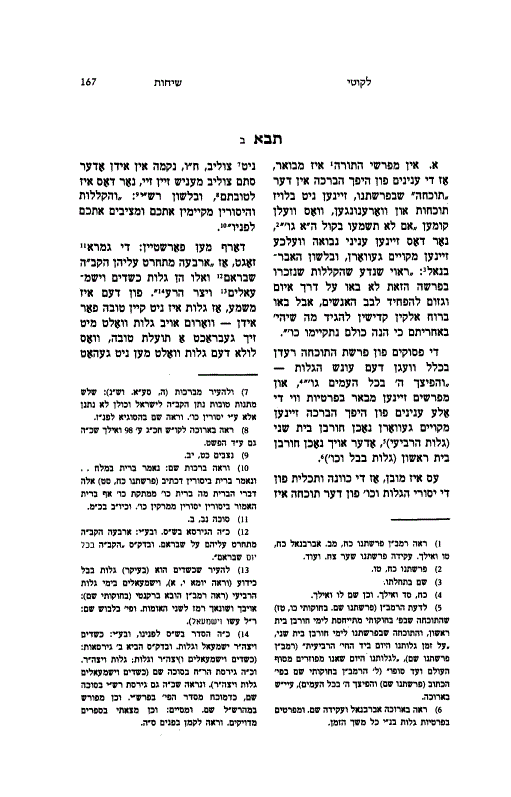
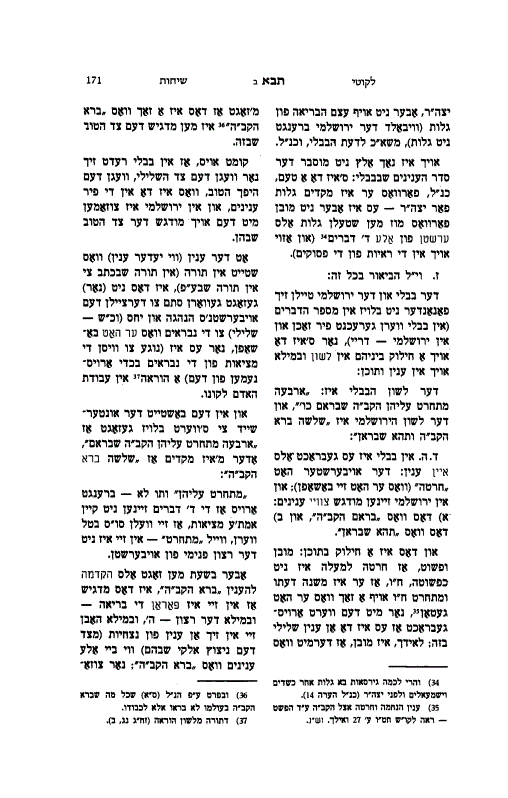
1. In the commentaries on the Torah, it is explained that the matters of the opposite of blessing in the "rebuke" of our parsha are not merely admonitions and warnings that will occur "if you do not listen to the voice of the L‑rd your G‑d," but rather they are prophetic matters that have been fulfilled. In the words of the Abarbanel: "It is fitting for you to know that the curses mentioned in this parsha did not come as a threat or exaggeration to frighten people's hearts, but they came with a holy divine spirit to tell what will be in their end, for behold, all of them were fulfilled, etc."
The verses of the parsha of rebuke generally speak about the punishment of exile — "And the L‑rd will scatter you among all the peoples, etc." Commentaries explain in detail how all these matters of the opposite of blessing were fulfilled after the destruction of the Second Temple (the fourth exile), or also after the destruction of the First Temple (the Babylonian exile, etc.).
It is understood that the intention and purpose of the sufferings of exile, etc., from the rebuke is not, G‑d forbid, for revenge against the Jews or merely to punish them, but it is for their benefit. In the words of Rashi: "The curses and the sufferings sustain you and establish you before Him."
We need to understand: The Gemara states that "there are four things that the Holy One, blessed be He, regrets having created, and these are: the exile of the Chaldeans, the Ishmaelites, and the evil inclination." From this, it is implied that exile is not a benefit for the Jews — for if exile brought with it a good benefit, which without the exile one would not have had...
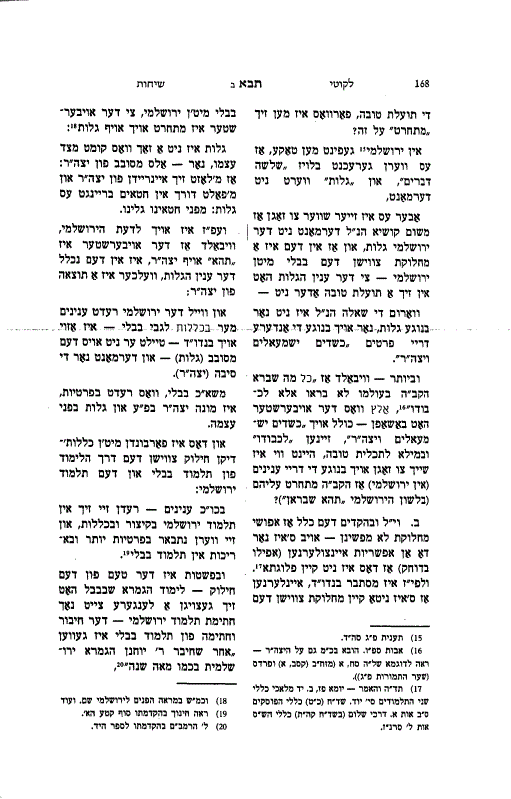
2. If exile indeed brings a good benefit, why then is there "regret" over it?
In the Jerusalem Talmud, we find that only "three things" are counted, and "exile" is not mentioned. However, it is very difficult to say that due to the above question, the Jerusalem Talmud does not mention exile, and that there is a disagreement between the Babylonian Talmud and the Jerusalem Talmud regarding whether exile has a good benefit or not.
This is because the above question is not only concerning exile but also regarding the other three items: "the Chaldeans, the Ishmaelites, and the evil inclination."
Moreover, since "everything that the Holy One, blessed be He, created in His world, He created only for His glory," everything that G‑d created — including "the Chaldeans, the Ishmaelites, and the evil inclination" — is for His glory and therefore for a good purpose. How, then, is it possible to say, even regarding these three matters, that the Holy One, blessed be He, regrets them?
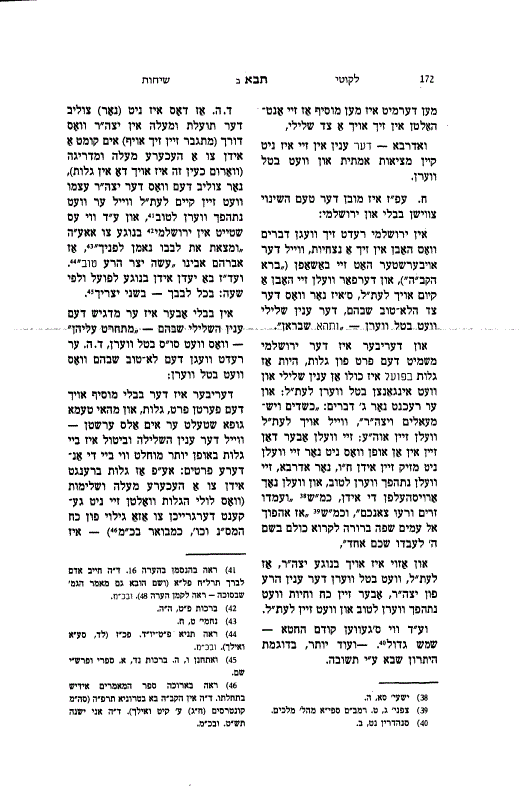
3. It can be explained by first introducing the principle that we do not increase disputes — if there is even a slight possibility to interpret (even with difficulty) that there is no disagreement. Based on this, it is reasonable in our case to interpret that there is no disagreement between the Babylonian Talmud and the Jerusalem Talmud regarding whether the Holy One, blessed be He, regrets exile:
Exile is not something that comes by itself; rather, it is a consequence of the evil inclination: when one is persuaded by the evil inclination and falls into sin, it brings exile: "because of our sins, we were exiled."
Accordingly, even according to the Jerusalem Talmud, since the Holy One, blessed be He, "regrets" the evil inclination, this includes the matter of exile, which is a result of the evil inclination.
And because the Jerusalem Talmud speaks more generally compared to the Babylonian Talmud, in this case as well, it does not specify the consequence (exile) and only mentions the cause (the evil inclination).
In contrast, the Babylonian Talmud, which speaks in detail, counts the evil inclination separately and exile separately.
This is connected to the general difference between the study approach of the Babylonian Talmud and the Jerusalem Talmud:
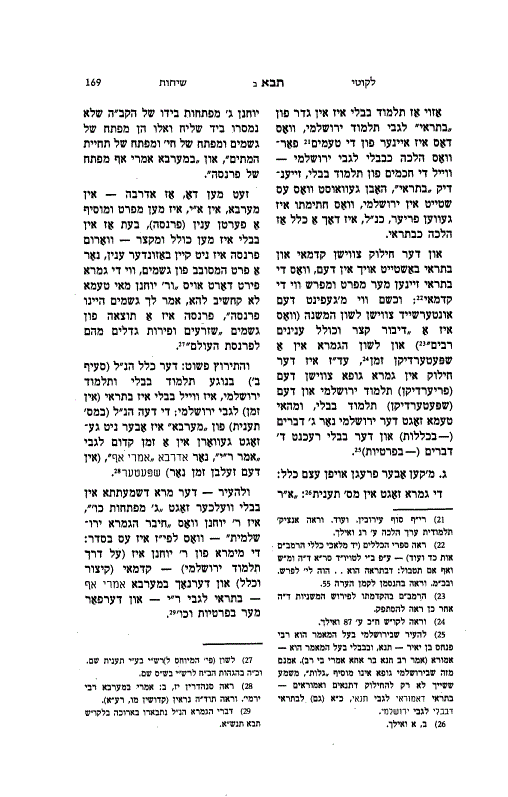
In many matters, the Jerusalem Talmud speaks briefly and generally, while they are explained in more detail and at length in the Babylonian Talmud.
The simple reason for this difference is that the study of the Gemara in Babylon continued for a longer time after the completion of the Jerusalem Talmud — the compilation and completion of the Babylonian Talmud occurred "after Rabbi Yochanan compiled the Jerusalem Talmud by about a hundred years."
Regarding the Jerusalem Talmud, this is one of the reasons why the halacha follows the Babylonian Talmud over the Jerusalem Talmud — because the sages of the Babylonian Talmud, being "later," knew what was in the Jerusalem Talmud, which was completed earlier, as mentioned above, and there is a rule that the halacha follows the later authorities.
3. The difference between the earlier and later sages also lies in the fact that the later sages are more detailed and explanatory than the earlier ones. Just as we find this distinction between the language of the Mishnah (which is a "concise speech that includes many matters") and the language of the Gemara in a later period, similarly, there is a difference within the Gemara itself between the earlier Jerusalem Talmud and the later Babylonian Talmud.
4. However, we need to understand the essence of the matter in our case:
Since there is regret and the negation of the primary cause (the evil inclination), it seemingly does not need to specify the consequence (exile), which is already negated automatically through the regret over its cause.
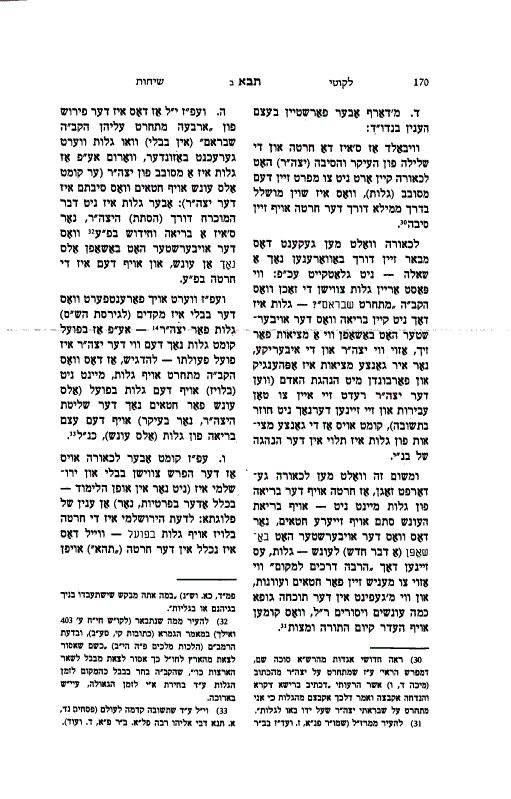
Seemingly, this could be explained by addressing another question — at least a lack of smoothness: How does exile fit among the things that the Holy One, blessed be He, "regrets having created"? Exile is not a creation that the Almighty made as an independent entity, like the evil inclination and the others. Rather, its entire existence depends on and is connected to human conduct (when the evil inclination persuades them to commit sins and they do not subsequently repent). Thus, the entire existence of exile is dependent on the conduct of people.
Therefore, it would seem that the regret over the creation of exile does not mean — regret over the creation of punishment merely for their sins, but rather that the Almighty created (a new entity) as a punishment — exile. There are indeed "many ways to the Omnipresent" regarding how to punish for sins and transgressions, as we find in the rebuke itself several punishments and sufferings, G‑d forbid, that come due to the lack of observance of the Torah and mitzvos.
5. Based on this, we can say that this is the explanation of "four things the Holy One, blessed be He, regrets having created", where exile is counted separately. Although exile is a consequence of the evil inclination (it comes as a punishment for sins whose cause is the evil inclination), exile is not the necessary outcome of the evil inclination's incitement. Rather, it is a creation and innovation in its own right that the Almighty created as an additional punishment, and for this, there is separate regret.
Accordingly, it also explains why the Babylonian Talmud precedes exile before the evil inclination — even though in practice, exile comes after the evil inclination has exerted its influence — to emphasize that the regret of the Holy One, blessed be He, over exile does not mean (only) over the actual exile (as a punishment for sins after the evil inclination's control, but primarily) over the very creation of exile (as a punishment), as mentioned above.
6. Based on this, it would seem that the difference between the Babylonian and Jerusalem Talmud is not only in the manner of study — generally or in detail — but also a matter of dispute: According to the Jerusalem Talmud, the regret is only over the actual exile — because this is included in the regret ("let it be") over the…
6. …evil inclination, but not on the very creation of exile, unlike the view of the Babylonian Talmud, as mentioned above.
Additionally, the order of matters in the Babylonian Talmud is still not explained: there is a reason, as mentioned, why it precedes exile before the evil inclination — but it is not understood why exile must be placed first among all four matters (and similarly in the proofs from the verses).
7. The explanation of all this is as follows:
The Babylonian Talmud and the Jerusalem Talmud differ not only in the number of matters, but there is also a difference between them in language and consequently in the matter and content:
The language of the Babylonian Talmud is: "Four things the Holy One, blessed be He, regrets having created, etc.," while the language of the Jerusalem Talmud is "Three things the Holy One, blessed be He, created and regrets having created":
That is, in the Babylonian Talmud, it is presented as one matter: the Almighty has "regret" (that He created them); and in the Jerusalem Talmud, two matters are emphasized: a) that "the Holy One, blessed be He, created them," and b) that "He regrets having created them."
And this is a difference in content: it is understood and clear that regret above is not literal, G‑d forbid, that He changes His mind and regrets, G‑d forbid, something He has done, but rather it expresses that there is a negative aspect in this; on the other hand, it is understood that by stating that this is something "the Holy One, blessed be He, created," it emphasizes the positive aspect within it.
It turns out that in the Babylonian Talmud, it speaks only about the negative aspect, about the opposite of good, which exists in these four matters, and in the Jerusalem Talmud, the positive aspect within them is also emphasized.
This matter (like every matter) that is stated in the Torah (whether in the Written Torah or in the Oral Torah), is not (only) said merely to recount the Almighty's conduct and attitude (especially — negative) towards the creations He has made, but it is (important to know the reality of the creations in order to derive from this) a directive in the service of man to his Creator.
And in this lies the difference whether it is only stated that "the Holy One, blessed be He, regrets having created them," or it is prefaced with "three things the Holy One, blessed be He, created":
"Regrets having created them" and nothing more — brings out that these four matters are not a true reality, that they will ultimately be nullified, because "regrets" — they do not contain the inner will of the Almighty.
5. However, when it is stated as an introduction to the matter "the Holy One, blessed be He, created," it emphasizes that within them there is creation — and consequently, the will of G‑d — and therefore they possess an aspect of eternity (due to the divine spark within them), like all matters that "the Holy One, blessed be He, created." However, it is added that they also contain a negative aspect, and indeed — the matter within them is not a true reality and will be nullified.
8. Based on this, the reason for the difference between the Babylonian Talmud and the Jerusalem Talmud is understood: In the Jerusalem Talmud, it speaks about matters that have an aspect of eternity, because the Almighty created them ("the Holy One, blessed be He, created"), and therefore they will have existence even in the future. It is only that the non-good aspect within them, the negative matter, will be nullified — "and their creation will be complete."
Therefore, the Jerusalem Talmud omits the detail of exile, since exile in actuality is entirely a negative matter and will be completely nullified in the future; it only counts three things: "Chaldeans, Ishmaelites, and the evil inclination," because even in the future, there will be nations of the world; however, they will then exist in a manner that not only will they not harm the Jews, G‑d forbid, but on the contrary, they will be transformed for the good and will even assist the Jews, as it is written, "And strangers shall stand and feed your flocks," and as it is written, "For then I will turn to the peoples a pure language, that they may all call upon the name of the L‑rd, to serve Him with one consent."
And so it is also concerning the evil inclination, that in the future, the evil aspect of the evil inclination will be nullified, but its power and vitality will be transformed for the good and will exist in the future.
Similar to how it was before the sin — a great sun. — And even more, akin to the advantage that comes through repentance.
That is to say, this is not (only) due to the benefit and advantage in the evil inclination, which through (overcoming it) a Jew reaches a higher level and stature (for something similar exists also in exile), but because the evil inclination itself will exist in the future because it will be transformed for the good, similar to what is stated in the Jerusalem Talmud regarding Abraham our father, "and found his heart faithful before You," that Abraham our father "made the evil inclination good." And similarly, it applies to every Jew in practice and temporarily: with all your heart — with both your inclinations.
In the Babylonian Talmud, however, it emphasizes the third aspect among them — "regrets having created them" — which will ultimately be nullified, meaning it speaks about the non-good aspect within them that will be nullified;
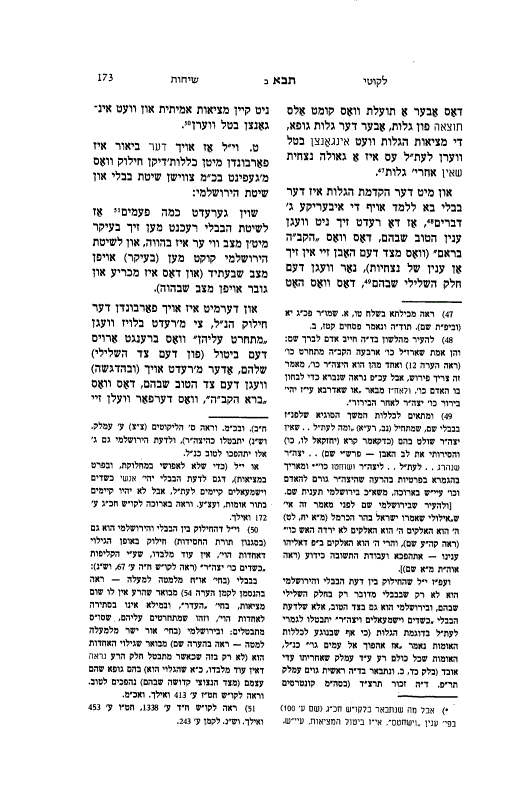
Therefore, the Babylonian Talmud also adds the fourth detail, exile, and for this very reason, it places it first — because the aspect of negation and nullification is more absolute in exile than in the other details: Although exile brings Jews to a higher level and perfection (which without the exile they could not have reached such a revelation of the power of self-sacrifice, etc., as explained in many places) — it is
9. However, the benefit that comes as a result of exile, the exile itself, the existence of exile, will be completely nullified in the future, as it is an eternal redemption after which there will be no exile.
10. Since this explanation is connected with the general distinction found everywhere between the approach of the Babylonian Talmud and the Jerusalem Talmud:
The Babylonian Talmud, by introducing exile, seeks to teach about the other three matters, that here it is not discussing the good aspect within them, that "the Holy One, blessed be He, created them" (which gives them an aspect of eternity), but rather about their third aspect, which does not have a true existence and will be completely nullified.
It has been discussed many times that according to the Babylonian Talmud, in the future, they will be transformed for the good: something that will be nullified in the future does not have a true existence even during its current existence. Therefore, we find that rivers that dry up once every seven years are called "deceptive rivers" (and they are invalid for the sanctification of the water of purification because they are not "living waters"), since they will certainly cease in the future, after seven years, they are not considered a true existence even at the first moment of their existence.
Thus, the lack of true existence within them is their current state and condition (before they are nullified), whereas the good aspect, that they will be transformed for the good, is a novelty, contrary to their natural state in this world, and will only be realized in the future — a state that will occur in the future.
Therefore, the Babylonian Talmud emphasizes the negative aspect of these four matters, because it follows its approach that considers the present.
11. All of this aligns with the general distinction between the Babylonian Talmud and the Jerusalem Talmud:
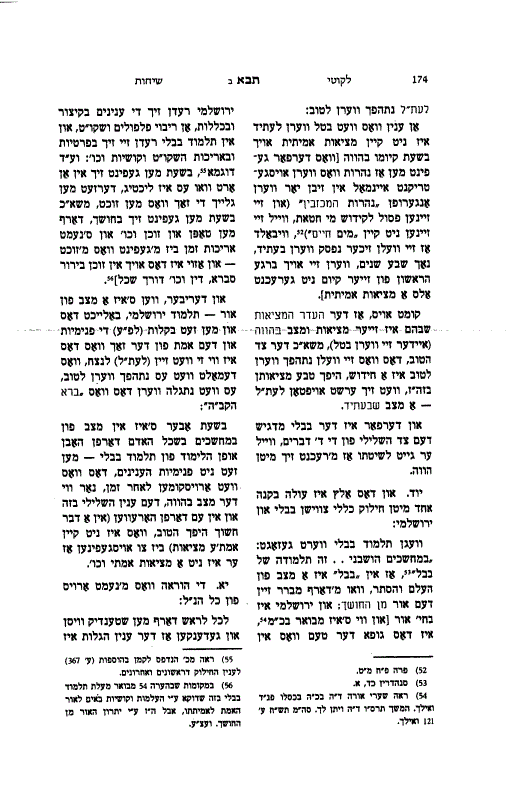
Regarding the Babylonian Talmud, it is said: "He has set me in dark places... this refers to the Talmud of Babylon," indicating that in "Babylon" there is a state of concealment and hiding, where one must clarify the light from the darkness; whereas the Jerusalem Talmud is in the aspect of light. As explained in many places, this is the reason why in the Jerusalem Talmud matters are discussed briefly and generally, without extensive debate and analysis, while in the Babylonian Talmud, they are discussed in detail and at length with debates and questions, etc. For example, when one is in a place where it is light, one immediately sees what one is looking for, whereas when one is in darkness, one must feel around and search, etc., and it takes a long time to find what one is looking for — and so it is also in the search for clarification of reasoning, law, etc., through intellect.
12. Therefore, when there is a state of light — as in the Jerusalem Talmud — it illuminates, and one can easily perceive (according to one's capacity) the inner truth of the matter, as it will be in the future, eternally. At that time, it will be clear that exile is not the true state that G‑d desires, G‑d forbid, for the Jewish people to be in. This is told to the Jews because they must feel "dissatisfaction" with exile: Exile is a punishment (due to our sins). When a Jew feels otherwise and says that this is a fitting state for Jews, he is saying the opposite of G‑d's will, for which the Holy One, blessed be He, regrets — and this regret is every day — even on Tisha B'Av and similar times. It is understood, therefore, the great darkness of being in exile within exile.
On the other hand, this should not lead to a state of depression, G‑d forbid, and one should not be affected by the gloom.
This is similar to the story told in the Gemara about how Gviha ben Psisa spoke with them.
This brings about that even during the time of exile, the conduct of the nations of the world is in the manner of "Kings shall be your foster fathers, and their queens your nursing mothers," and as it has already happened in actuality several times — until a significant event in practice, which the L‑rd has placed in the Torah — it should serve as a directive from the Torah of life, a directive in life:
Rav Ashi said, Huna bar Natan told me, "Once I was standing before Izgadar the king, and he adjusted my belt for me and said to me, 'It is written about you, "A kingdom of priests and a holy nation".' When I came before Amemar, he said to me, 'It is fulfilled in you, "Kings shall be your foster fathers."' When a Jew conducts himself in a way that it is evident that he belongs to a kingdom of priests and a holy nation, all the kings of the earth say that he must be in his splendor, and they come of their own accord to help in this and act in this manner, and it becomes known throughout all the ends of the earth.
The Torah is eternal, and as a bright guide and directive for every Jew, who is proud of the Torah as an inheritance of the congregation of Jacob, it is obvious that he does not bow to non-Jewishness and to non-Jews.
Together with the service of transforming and overturning the evil inclination, to the extent of "with all your heart, with both your inclinations," so that even now, in the time of "Erev Shabbat," one tastes from every dish that will be in the future.
And this is the essence of the promise, "He sets an end to darkness," the nullification of exile, and immediately comes the true and complete redemption through our righteous Moshiach.
(From the talks of Shabbos Parshas Chukas and Shabbos Parshas Balak, 5741)