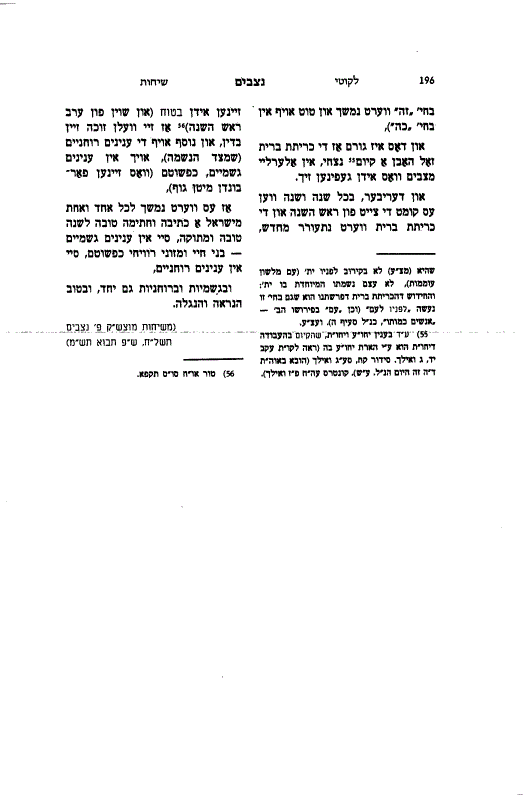
Likkutei Sichos Vol. 24 – Nitzavim
1. At the beginning of the parsha, it is recounted about the covenant that the Almighty made with the Jews — "to enter into the covenant of the L‑rd your G‑d... in order to establish you today as His people..." Rashi comments on "in order to establish you today as His people" and explains: "He is so eager to establish you before Him as a people."
We need to understand: What is Rashi adding in his explanation of the words "in order to establish..."?
Commentators explain that Rashi is troubled: the need for the covenant was not "in order to establish you today as His people," but rather "so that they will fear them and uphold the Torah," a covenant for the observance of the mitzvos. So what does the verse mean by "to enter into the covenant... in order to establish you today as His people and He will be your G‑d" (that through the observance of the Torah and mitzvos, the Jews will become "His people" and the Almighty "your G‑d")?
2. However, there is an issue with the above explanation: According to this interpretation, it seems that the novelty of Rashi is not in the words "to establish you today as His people," but only in the word "in order to."
This implies that it does not relate to "to enter into the covenant..." which is stated in the previous verse, but to "He is so eager to establish you" [or, that the "in order to" here does not mean "for the sake of", but "because" — it is a reason for the past, why "He is so eager to establish you"].
According to this, however, it is puzzling why Rashi needs to quote from the verse in his heading, and then in his explanation all the words "(in order to) establish you before Him as a people"?
Furthermore, Rashi changes the wording of the verse: (a) In the verse, it says "establish," and Rashi says "establish." (b) The verse says "as His people," and Rashi changes it to "before Him as a people." (c) Rashi omits the word "today."
From this, it is evident that the novelty in Rashi's explanation here is not in the words "He is so eager to establish" (with which he begins his explanation), but indeed in the words "(in order to) establish you before Him as a people": He does not intend to quote the verse, but rather to explain the simple meaning of the verse, that the meaning of "establish" in this verse is "establish," and "as His people" means "before Him as a people."
3. The explanation is as follows: Rashi is bothered here by a simple question: How can it be said that the covenant is "in order to establish you today as His people" — that the Jews become "today" (on the day when Moses gathered them before the Holy One, blessed be He, on the day of his death) established as a people for the Holy One, blessed be He — when the Jews had already long ago, at the giving of the Torah, become a people, as is explicitly stated in several verses?
4. This is why, when the verse says "This day you have become a people," Rashi immediately clarifies that it does not mean that on that day "you became a people," but rather "every day it should be in your eyes as if today you entered into a covenant with Him." Similarly, regarding the verse "This day the L‑rd your G‑d commands you," Rashi explains, "every day it should be in your eyes as if you were commanded on them today." From this, it is understood that this is also the meaning in "You have declared the L‑rd today... and the L‑rd has declared you today to be His treasured people," which follows the continuation of "This day the L‑rd your G‑d commands you."
Rashi answers that "in order to establish you" does not mean "to establish," but rather "to maintain," to uphold the Jews as a "people" (which is connected to an action from the Almighty):
The covenant at the giving of the Torah accomplished that the Jews became a people connected with the Almighty. However, it is possible that afterward, if the conduct of the Jews later (or in subsequent generations) would not be proper, G‑d forbid, there could be a change in this;
Thus, the effect of this covenant is "in order to maintain you as a people": it has brought a permanence into the covenant between Israel and the Holy One, blessed be He, forever and ever.
Accordingly, it is also understood why they stand "before Him" — they are and stand before Him (— together with Him). As it is stated at the beginning of the parsha, "You are standing today, all of you, before the L‑rd your G‑d."
Therefore, there can be no changes in this covenant: when they are merely "His people," but they can also be distant from the Almighty, it leaves room for them not to feel as if they are a people chosen by the Almighty, and consequently, changes can occur within it. However, through the fact that the Almighty makes it "maintain" that the Jews should (always) be and stand "before Him as a people," together with Him — it is assured that there will be no weakening in the covenant.
5. In this explanation, Rashi is not referring to separate and distant matters from the status of the king, but rather the opposite:
His people, who are like him and relate to him, and "in order to establish you as His people" is that the Almighty elevates the Jews "to the level of the supreme thought."
6. However, the concept of the inner meaning of the Torah in Rashi's commentary:
On "You are standing today," the Alter Rebbe says that "today refers to Rosh Hashanah," and he explains that every Rosh Hashanah should be the (remembrance of the) covenant between the Jews and the Almighty.
Similarly, he explains the aforementioned verses (in Parshas Tavo), "This day the L‑rd your G‑d commands you... You have declared the L‑rd today... and the L‑rd has declared you today to be His treasured people" — that this refers to the covenant that is established on Rosh Hashanah.
And according to what was said above, that these two verses are two aspects of the covenant between the Jews and the Almighty — "to be His people" and "to maintain you as His people before Him" — it turns out that on Rosh Hashanah, both of these aspects are accomplished.
We will understand this by first explaining the notes from my father on
7. The explanation is as follows:
Even though "today" (simply, but) with the definite article, indicates a "known day," it does not reach the level of "this day," which signifies not only that it is a "known day" (in intellect, etc.), but also...
7. This is also the explanation for the change in language in Rashi's commentary on the Torah:
On the verse (in Parshas Va'eschanan) "which I command you today," Rashi explains: "They should not be in your eyes like an old edict... but as something new" (with a kaf of comparison). However, on the verse in Parshas Tavo "this day the L‑rd your G‑d commands you," he says: "Every day they should be in your eyes as new" — without a kaf of comparison. Similarly, on the verse (in Parshas Yisro) "on this day they came to the wilderness of Sinai," Rashi says, "that the words of Torah should be new to you."
According to the above, we can say the reason: In Parshas Yisro and Tavo, where the verse states "this day," "on this day," it emphasizes that the day of the giving of the Torah is illuminated for him openly — it is "shown with a finger" (he sees it with his own eyes), and therefore, the words of Torah (from the giving of the Torah) are truly "new" to him.
However, in Parshas Va'eschanan, where it does not say "this," it implies that the day of the giving of the Torah is present (and "known") every day, but since it is not in a manner of "this" (shown with a finger), it is only "as new," with a kaf of comparison.
8. Similarly, there are these two aspects on Rosh Hashanah, as we say on Rosh Hashanah: (a) "This day is the beginning of Your works," (b) "a remembrance of the first day":
"This day is the beginning of Your works" refers to the sixth day of creation, the day of the creation of man, when the concept of "this" was realized — G‑dliness should be revealed here below, because the revelation of G‑dliness in a manner of "this" is present specifically with (the soul of) man.
"(A remembrance of (the first day)" refers to the 25th of Elul (the first day of creation), which is the aspect of "like": on that day, the concept of the "first day" — the creation of the world (which was realized for the first time on the 25th of Elul) — is also realized on Rosh Hashanah, because now all the influences depend on the actions of man, and even the creation of the world is renewed on Rosh Hashanah — the day of the creation of man.
9. The fact that on Rosh Hashanah the renewal of the creation of the world occurs is not a secondary or additional aspect (to its primary essence, which is the sixth day of creation, the day of the creation of man). Rather, it results from the fact that on Rosh Hashanah, the concept of "This day is the beginning of Your works" is renewed, which is the revelation of G‑dliness that is connected to man.
As it is explained with a parable of "a person who engages in work due to some pleasure and desire he has in it," when he becomes weary from the work, he needs to be reawakened to his pleasure in the work. By regaining pleasure in the work, there is naturally a strengthening in the performance of the work, so that it should not be done "with slack hands."
Similarly, on Rosh Hashanah: on Rosh Hashanah, "Crown Me," we draw down the pleasure from above in the matter of kingship, which is the internal influence from above (the essence of G‑dliness — "this") that is specifically connected with the Jewish people (man); and through this, the renewal of the creation and vitality of the world (the action) is also accomplished naturally.
It is understood that since the renewal of the creation and vitality of the world on Rosh Hashanah comes not as an independent matter, as on the 25th of Elul, but as a result of the renewal of the internal influence to the Jewish people, it is entirely superior to the renewal of the world as it was on the 25th of Elul:
The concept of the renewal of the world that occurs on Rosh Hashanah is not merely that there should be a world, but that within the world there should be a revelation of G‑dliness (the "this" of Rosh Hashanah is drawn into the "like"), similar to the sixth day of creation, when Adam not only crowned the Almighty as king himself but also influenced all creations to "Come, let us bow down and kneel; let us bless before the L‑rd, our Maker."
[Nevertheless, there is a significant difference between the revelation of G‑dliness within man and the revelation of G‑dliness in the world. In the soul of a Jew, there is a perception of the essence of G‑dliness, "this"; whereas in the world, even when G‑dliness shines, the light is not as revealed, and it shines only in a manner of "likeness," as mentioned above.]
10. This perfection that Rosh Hashanah (the day of the creation of man, "this") achieves in the renewal of the world (that even in the world, G‑dliness should be revealed) is not merely a natural result of the primary aspect of Rosh Hashanah, but this itself is a primary aspect of Rosh Hashanah.
[To the extent that the main judgment of Rosh Hashanah is "on the bodies," on physical matters — which is connected with the fact that the revelation of the "inner will of the Supreme" must be drawn down "below to be clothed in physicality."]
11. Based on all the above, we can also understand the connection between the covenant "to be for Him a people," "you have become a people" — with "this day" (the aspect of "this"), and between the covenant "in order to establish you for Him a people" with "the day" (simply, the aspect of "like").
The two aspects of "this" and "like" within man himself are his soul and body (or — the essence of his soul, and the part of the soul that is clothed in the body).
At the time of the Giving of the Torah, the essential covenant between the Jews and the Almighty was established ("you have become a people"), which is primarily from the perspective of the soul — where G‑dliness shines in a revealed manner in the form of "this." As long as the Jews were in the desert, removed from the physicality of the world, this covenant was sufficient to maintain their connection with the Holy One, blessed be He.
However, when they needed to enter the Land of Israel, a settled land, the covenant from the perspective of the soul alone was not enough. For it to endure even when a Jew descends into physical matters, it is achieved through the covenant from the perspective of the soul being realized also in the soul clothed in the body, and thereby — with the body itself, so that even in this state they should be "before Him a people" (as mentioned above, just as in the life of "this" it extends and affects the life of "like").
And this ensures that the covenant will have an eternal existence, in all kinds of situations in which the Jews find themselves.
7. Therefore, every year, when the time of Rosh Hashanah arrives and the covenant is renewed, Jews are assured (even from the eve of Rosh Hashanah) that they will be meritorious in judgment. In addition to the spiritual matters (which pertain to the soul), this also extends to physical matters, in their literal sense (which are connected with the body).
It is drawn down to each and every Jew a good inscription and sealing for a good and sweet year, both in physical matters — children, life, and abundant sustenance in their literal sense — and in spiritual matters, in both the physical and spiritual realms together, and in a way that is visibly and manifestly good.