Likkutei Sichos Vol. 24 – Ki Savo 1
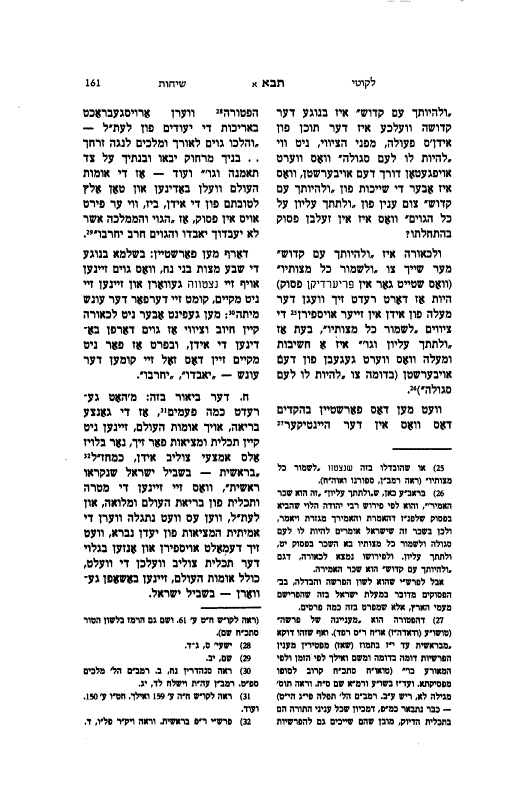
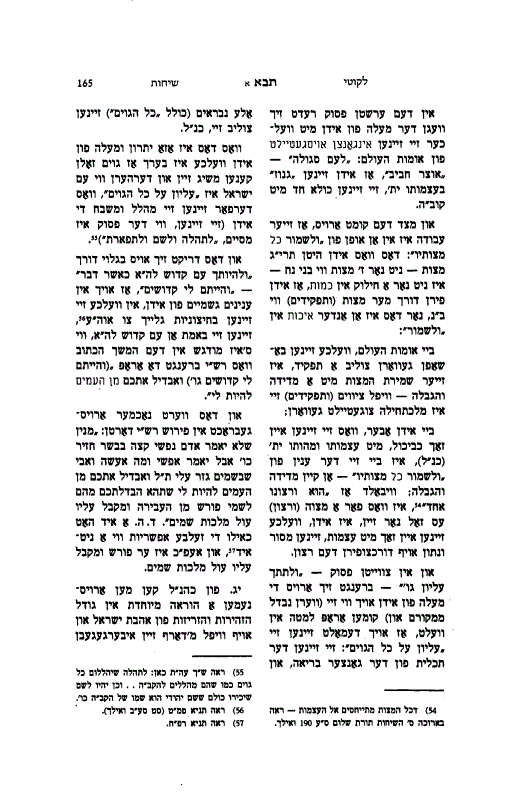
1. On the verse "And the L‑rd has declared you today to be His treasured people, as He promised you," Rashi comments on the words "as He promised you" and explains: "And you shall be to Me a treasure." Then, on the next verse, Rashi comments on the words "and to make you a holy nation, as He promised" and explains: "And you shall be holy to Me."
We need to understand: If Rashi does not need to quote from the verse what the "promise" is (since it is explicitly stated in the verse: "to be His treasured people"), then where is this "promise" mentioned earlier? Why does he quote it the second time? And if it is indeed necessary to quote what the "promise" is, then he should have quoted it the first time as well.
2. We also need to understand why Rashi interprets (in the second comment) that "as He promised" means "and you shall be holy to Me" from Parshas Kedoshim:
After "and you shall be to Me a treasure," which Rashi brings from Parshas Yisro, he continues there: "And you shall be to Me a kingdom of priests and a holy nation." So why does Rashi learn that the "as He promised" (in the second verse) refers to a different statement from the L‑rd ("and you shall be holy to Me"), and not to what is mentioned together with "and you shall be to Me a treasure" — as some Torah commentators indeed interpret?
Furthermore, according to these commentators, the continuation in the verse is straightforward: On the words "And you shall be to Me a kingdom of priests," which is stated in Parshas Yisro, Rashi interprets as "princes." Consequently, it follows that all the details here in the verses...
3. It could be suggested that the reason Rashi does not bring the verse "and a holy nation" regarding "and to make you a holy people, etc., as He promised" is because it would then be the same "as He promised," and the verse would not need to repeat "as He promised" again by "and to make you a holy people."
However, this explanation is strained, since there is an interruption with "and to observe all His commandments."
Furthermore, according to this, the verse requires clarification: Why does the verse refer to a different statement, and therefore repeat "as He promised," and not the "holy nation" from Parshas Yisro, which follows "and you shall be to Me a treasure"?
We also need to understand: The verse Rashi brings is at the end of Parshas Kedoshim — and we already find earlier the expression: "You shall be holy" (at the beginning of Parshas Kedoshim) and even earlier "and you shall sanctify yourselves and be holy" (at the end of Parshas Shemini). Why does Rashi bring the later verse?
It is difficult to answer that since the verse (in our Parsha) states "and to make you a holy people to the L‑rd your G‑d," therefore he brings a verse where it is also explicitly stated "and you shall be holy to Me," unlike the other aforementioned verses where the expression is simply "holy," and it is not emphasized that the holiness is "to Me" —
because according to this, Rashi should have also quoted from the verse here the words "to the L‑rd your G‑d."
Since Rashi only quotes "and to make you a holy people as He promised" (and omits the words "to the L‑rd your G‑d" which are between them — and he does not even hint at them with "etc."), it is evident that the "as He promised" refers to "and to make you a holy people" and does not intend to emphasize the detail of "to the L‑rd your G‑d."
4. The explanation could be as follows:
At first glance, the verse is not straightforward: "and to make you a holy people, etc." is essentially the same as "to be His treasured people," both describing how the "people of Israel" are distinguished from all other nations: "a treasured people" — "a holy people" —
they should have been stated together, one immediately following the other.
From the fact that "and to make you a holy people" is in a different verse, and at its conclusion —
after it interrupts with "and to observe all His commandments," which speaks about the action of the Jews due to the commandment (and not a matter of description and distinction in relation to all the nations), it is understood that "a treasured people" and "a holy people" here are two entirely separate matters.
Therefore, one cannot interpret "and to make you a holy people, etc., as He promised" as referring to the "holy nation" mentioned in Parshas Yisro, because there it is a matter that comes in continuation and in the same context as "and you shall be to Me a treasured people from among all the nations."
5. The difference between "and to make you a holy people" and "and you shall be to Me a treasured people from among all the nations" is derived by Rashi from the fact that in the first verse it states "as He promised you," whereas with "and to make you a holy people" it states "as He promised" (without the word "you").
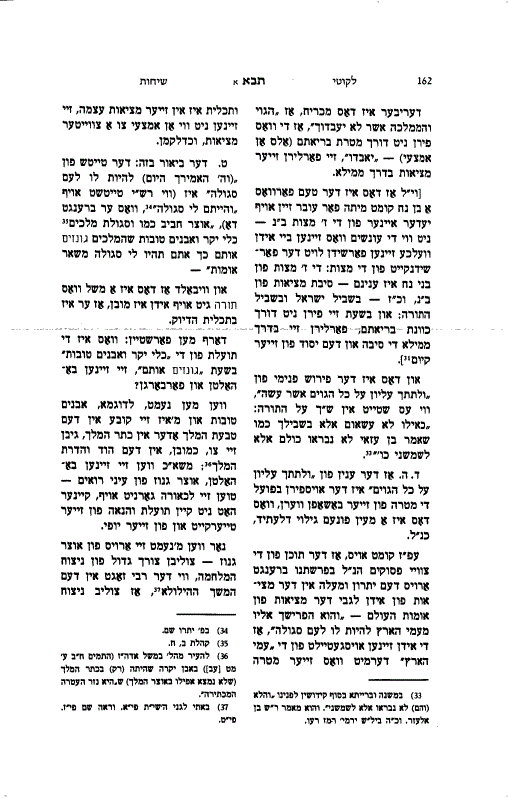
The explanation is as follows: Rashi has already explained earlier in Parshas Vayeitzei: "I spoke to you — for your sake and about you, what I promised to Abraham regarding his descendants, I promised to you, etc. And so, all instances of 'to me,' 'to you,' 'to him,' and 'to them' that are adjacent to the word 'spoke' serve as expressions of 'about.'"
From this, it is understood in our case that the interpretation of "as He promised you" does not mean "as He spoke to you," to the Jews [especially since according to this, one could ask: what is it teaching us? The entire Torah was spoken to the Jews!], but rather "for your sake and about you," "as He spoke concerning you" — a promise, a guarantee for you, "about you."
And this is the continuation of the verse: "And the L‑rd has declared you today to be His treasured people," which means that "He has separated you to Himself from the peoples of the earth to be His treasured people," this was accomplished "as He promised you" — as the Almighty had promised, spoken concerning the Jews.
Therefore, Rashi explains that "as He promised you" refers to the statement "and you shall be to Me a treasured people," where the "statement" was concerning the Jews.
In the second verse, "and to make you a holy people, etc., as He promised," where it does not say "you," it is understood that "as He promised" does not refer to the statement of the Almighty concerning the Jews, a promise about what will be with you, but rather in its simple sense, as He spoke (and commanded) (and therefore — to the Jews), which means a command for an action by the Jews.
4. Therefore, it is understood that this does not refer to the statement "And you shall be to Me a kingdom of priests and a holy nation," which is similar to the statement "And you shall be to Me a treasured people" — "for your sake and about you," a statement from the Almighty regarding (His action with) the Jews. Rather, it is a statement from the Almighty, a command for "to make you a holy people."
Thus, Rashi says that this refers to the verse "And you shall be holy to Me," which is the Almighty's command that the Jews should be holy.
For this reason, Rashi also quotes here the beginning of the phrase "and to make you (a holy people)" — not as it is stated earlier "to be to Him a treasured people" — because from this change in language (to make you — emphasizing the holiness from the Jews themselves), it is understood that being a holy people is not solely an action from the Almighty (as in the previous verse), but rather the content of the Jews' action due to the command.
5. However, there is the question, as mentioned earlier: A command for holiness is already found earlier "You shall be holy" and even earlier "And you shall sanctify yourselves and be holy"?
Therefore, Rashi explicitly quotes (not merely hints with "etc.") from the verse also "(and to make you) a holy people": The verses here aim to highlight the distinctiveness of the Jews as a "people," as the beginning of the previous verse states "And the L‑rd has declared you today (and He has separated you to Himself from the peoples of the earth) to be to Him a treasured people." And also, the command for holiness in our parsha is not for each Jew as an individual, but for the entire people, that they should be a "holy people."
Therefore, it is fitting to say that this is the statement "And you shall be holy to Me" from the end of Parshas Kedoshim, where the command is (also) for such holiness that distinguishes them as a people from all nations, as the verse continues "And you shall be holy to Me, for I, the L‑rd, am holy, and I have separated you from the peoples to be Mine."
In contrast, the verse at the end of Parshas Shemini "And you shall sanctify yourselves and be holy," and similarly "You shall be holy" at the beginning of Parshas Kedoshim, do not emphasize that these are commands for the holiness of the entire nation of Israel and their separation from all nations, but rather commands to each Jew as an individual, like the other commandments of the Torah.
6. We still need to understand (in the inner dimensions of the matters): Indeed, it is true that…
6. Indeed, it is true that "to be a holy people" refers to the holiness which is the content of the Jews' actions, due to the commandment, unlike "to be to Him a treasured people," which is accomplished by the Almighty. However, what is the connection of "to be a holy people" to the matter of "to set you high above all nations," which is in the same verse at its beginning?
Seemingly, "to be a holy people" is more related to "and to keep all His commandments" (which is mentioned in the previous verse), since there it speaks about the virtue of the Jews in their fulfillment of the commandments "and to keep all His commandments," whereas "to set you high above all nations" is a significance and virtue granted by the Almighty (similar to "to be to Him a treasured people").
This will be understood by prefacing with what is stated in the current haftarah.
Therefore, it necessitates that "the nation and the kingdom that will not serve you" — those who do not fulfill the purpose of their creation (as a means) — "will perish," they lose their existence automatically.
[It is worth examining why a Ben Noach is liable to death for transgressing any one of the seven Noahide laws — unlike the punishments for Jews, which vary according to the different commandments: the seven Noahide laws are the reason for the existence of a Ben Noach, and all this is for the sake of Israel and for the sake of the Torah; and when they do not fulfill the intent of their creation, they automatically lose the reason and foundation of their existence.]
And this is the inner explanation of "to set you high above all nations which He has made," as it is stated in the Shach on the Torah: "as if they were not created except for your sake, as Ben Azzai said, 'they were not created except to serve me.'"
That is, the matter of "to set you high above all nations" is the actualization of the purpose for which they were created, which is a semblance of the future revelation, as mentioned above.
Accordingly, it turns out that the content of these two verses in our parsha highlights the superiority and virtue in the existence of the Jews compared to the existence of the nations of the world — "and He has separated you to Himself from the peoples of the earth to be to Him a treasured people," that the Jews are distinguished from the "peoples of the earth" in that their purpose and goal is in their very existence, they are not like a means to another existence, as will be explained.
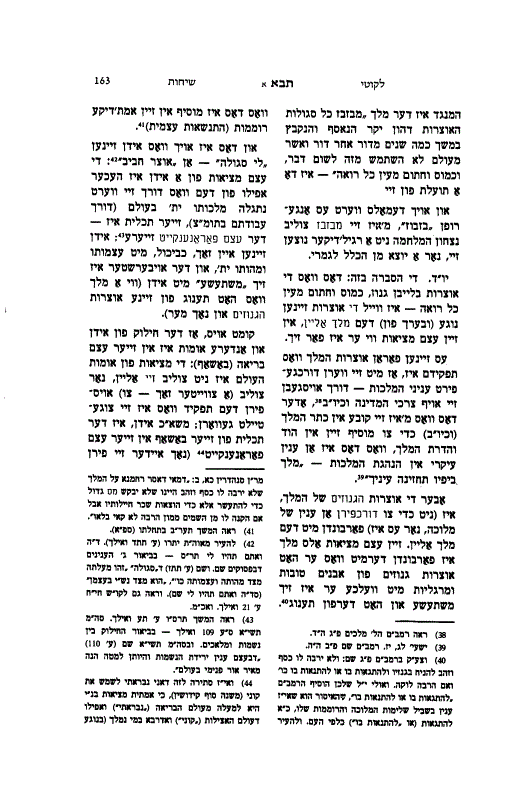
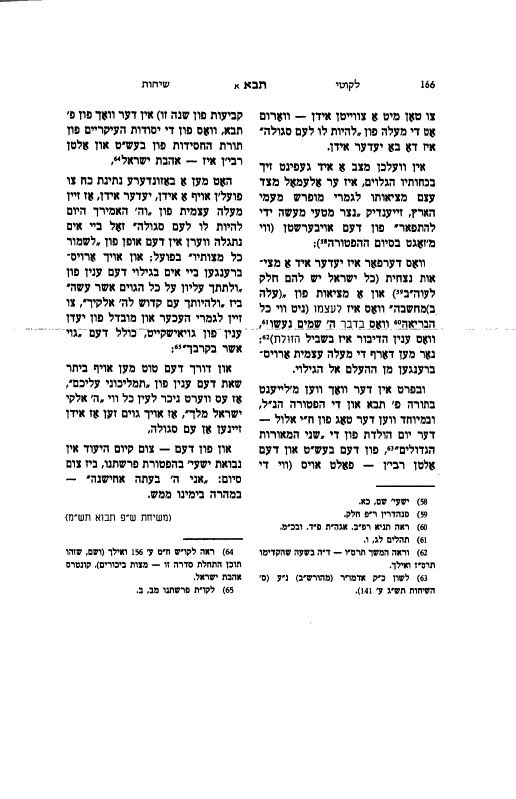
9. The explanation in this: The meaning of "(and the L‑rd has declared you today) to be to Him a treasured people" is, "a beloved treasure like the treasure of kings," precious vessels and gems that kings store away, so too you will be a treasure to Me from among the other nations."
And since this is a parable that the Torah gives about the Jews, it is understood that it is with utmost precision.
We must understand: What is the benefit of these "precious vessels and gems" when "they are stored away," hidden and concealed?
10. When one takes, for example, precious stones and sets them in the king's ring or in the king's crown, they obviously add to the splendor and majesty of the king. However, when they are hidden away, a concealed treasure from the eyes of onlookers, they seemingly serve no purpose; no one benefits or derives pleasure from their value and beauty.
Only when they are taken out from the hidden treasure — due to a great need, such as for the victory of a war, as the Rebbe explains in the maamar "Basi LeGani" — does the king "spend" all the precious treasures that have been gathered and accumulated over many years, from generation to generation, which have never been used for anything, and are sealed and hidden from every eye. There is then a benefit from them.
Even then, it is called "spending," as they are expended for the victory of the war, not for a regular use, but for an entirely exceptional purpose.
11. The explanation in this: The reason these treasures remain hidden, sealed, and concealed from every eye is because they are relevant (and in relation to) the king himself, in his very essence as he is for himself.
There are treasures of the king whose purpose is to carry out matters of the kingdom — by spending them on the needs of the state and the like, or those that are set in the king's crown (and the like) to add to the splendor and majesty of the king, which is a primary matter in the conduct of the kingdom — "Your eyes shall see the king in his beauty."
However, the hidden treasures of the king are not for the purpose of carrying out a matter of kingship, but are connected with the king himself. His very essence as a king is connected with having hidden treasures of precious stones and gems with which he delights and derives pleasure.
This also explains why the Jews are "a treasured people" — a "beloved treasure": The very existence of a Jew is higher even than the revelation of His kingship in the world through their service in Torah and mitzvos. Their purpose is their very existence; Jews are, so to speak, one with His essence and being, and G‑d "delights" in the Jews (like a king who derives pleasure from his hidden treasures, and even more so).
7. It emerges that the distinction between Jews and other nations lies in their very creation. The existence of the nations of the world is not for their own sake, but rather to fulfill a designated role assigned to them. In contrast, the purpose of the creation of Jews is in their very existence itself (even before they fulfill their role in the world).
And this is the meaning of "And the L‑rd has distinguished you today — He has set you apart from the nations of the earth — to be His treasured people," indicating that Jews are entirely distinct from the nations of the earth because they are a "treasured people," a "beloved treasure," as mentioned earlier.
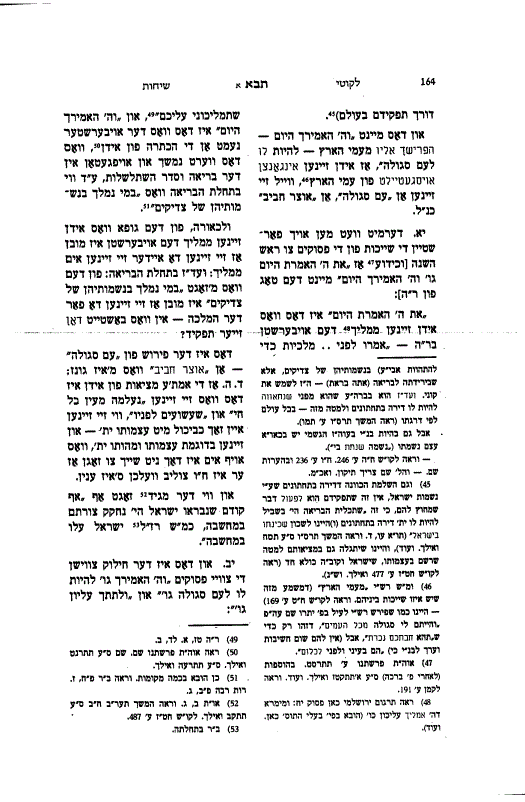
11. This also helps us understand the connection of these verses to Rosh Hashanah. It is well known that "You have distinguished the L‑rd today" refers to the day of Rosh Hashanah:
"You have distinguished the L‑rd today" is about Jews crowning the Almighty on Rosh Hashanah — "Say before Me... kingship in order to..."
11. "That you crown Me as your king," and "And the L‑rd has distinguished you today" refers to the acceptance of this coronation by G‑d from the Jews. This is drawn down and accomplished within creation and the order of Hishtalshelus, similar to the beginning of creation where "With whom did He consult? With the souls of the righteous."
Seemingly, from the very fact that Jews crown the Almighty, it is understood that they exist before they crown Him. Even at the beginning of creation, from the statement "With whom did He consult? With the souls of the righteous," it is clear that they exist prior to the coronation. What then is their role?
This is the meaning of "a treasured people" — a "beloved treasure" that is hidden; that is, the true existence of Jews is that they are "hidden from the eyes of all living" and "a delight before Him," as they are, so to speak, one with His essence and being. They are similar to His essence and being, upon which it is not applicable to say that He exists for any reason.
As the Maggid says, "Even before the Jews were created, their form was engraved in thought," as our sages say, "Israel arose in thought."
12. This is the distinction between the two verses "And the L‑rd has distinguished you to be His treasured people" and "to set you high above all nations":
In the first verse, it speaks of the virtue of Jews by which they are entirely distinct from the nations of the world: "a treasured people" — a "beloved treasure," that Jews are "hidden" within His essence, they are entirely one with the Holy One, blessed be He.
From this, it follows that their service is in the manner of "to observe all His commandments": the fact that Jews observe 613 mitzvos — not just the seven mitzvos like the children of Noah — is not merely a quantitative difference, that Jews perform more mitzvos (and tasks) than the children of Noah, but it is a different quality in "to observe":
For the nations of the world, who were created for a purpose, their observance of mitzvos is with measure and limitation — as many commandments (and tasks) as were initially assigned to them;
But for Jews, who are, so to speak, one with His essence and being (as mentioned above), their observance of "to observe all His commandments" is without measure and limitation; since "He and His will are one," whatever mitzvah (and will) it may be, Jews, who are one with the essence, are devoted and given to fulfill that will.
And in the second verse — "to set you high above all nations" — it expresses the virtue of Jews even as they (are separated from their source and) descend below into the world, that even then they are "high above all nations": they are the purpose of the entire creation, and all creatures (including "all nations") exist for their sake, as mentioned above.
9. This is a unique advantage and virtue of the Jewish people, which is such that even the nations can perceive and recognize how the Jewish people are "high above all nations." Therefore, they praise and extol the Jews (as the verse concludes, "for praise, for a name, and for glory").
This is openly expressed through "and to be a holy people to the L‑rd your G‑d, as He has spoken" — "and you shall be holy to Me," indicating that even in the physical matters of Jews, in which they externally resemble the nations of the world, they are truly a holy people to the L‑rd. This is emphasized in the continuation of the verse that Rashi brings here ("and you shall be holy to Me, etc.") "and I have separated you from the nations to be Mine."
This is further brought out in Rashi's explanation there: "From where do we know that a person should not say, 'I am disgusted by pork, etc.' but rather, 'I desire it, but what can I do, my Father in Heaven has decreed upon me'? Therefore, it says, 'and I have separated you from the nations to be Mine,' that your separation from them should be for My sake, abstaining from sin and accepting upon oneself the yoke of the Kingdom of Heaven." This means that a Jew has, as it were, the same possibilities as a non-Jew, and yet he abstains and accepts upon himself the yoke of the Kingdom of Heaven.
13. From the above, we can derive a special lesson in the importance of caution and zeal in the love of Israel and how dedicated one must be to bring out this intrinsic quality from concealment to revelation.
Especially in the week when we read in the Torah the portion of Ki Tavo and the aforementioned haftarah, and particularly when the day of the 18th of Elul — the birthday of the "two great luminaries," the Baal Shem Tov and the Alter Rebbe — falls out (as it does this year) in the week of the portion of Ki Tavo. One of the main foundations of the teachings of Chassidus from the Baal Shem Tov and the Alter Rebbe is the love of Israel.
We have a special empowerment to influence a Jew, every Jew, so that his intrinsic quality of "and the L‑rd has chosen you today to be His treasured people" should be revealed in him in the manner of "to observe all His commandments" in actuality.