Likkutei Sichos Vol. 19 – Ha'azinu 2
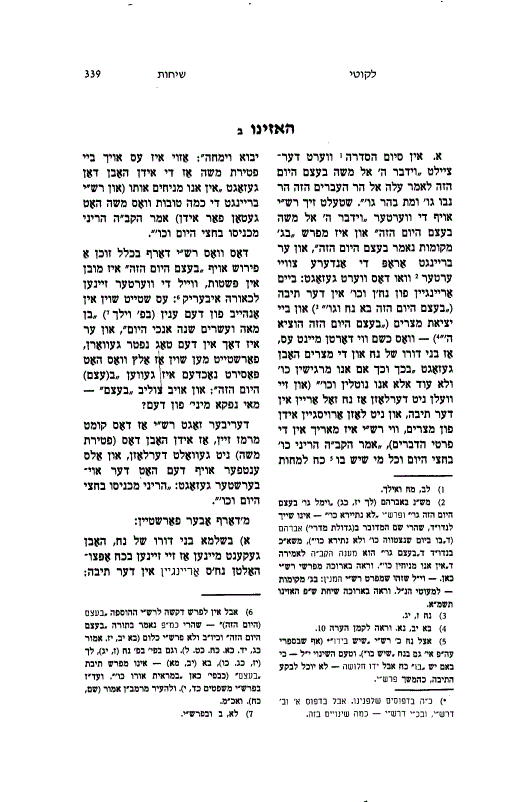
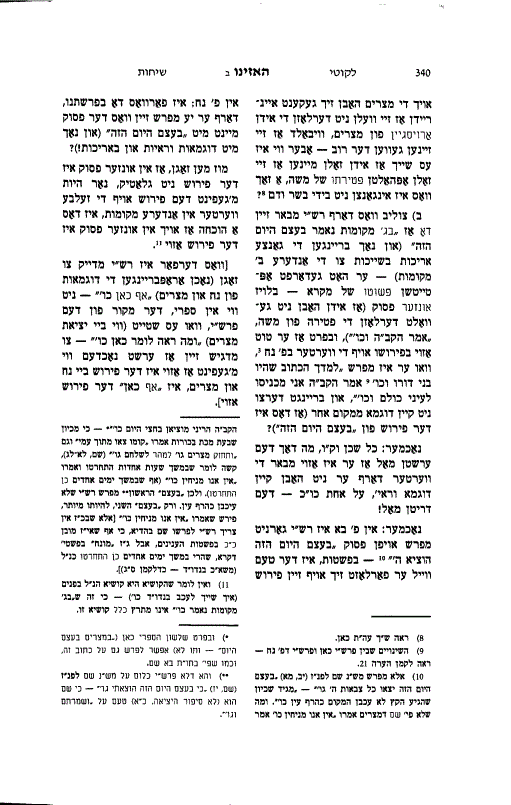
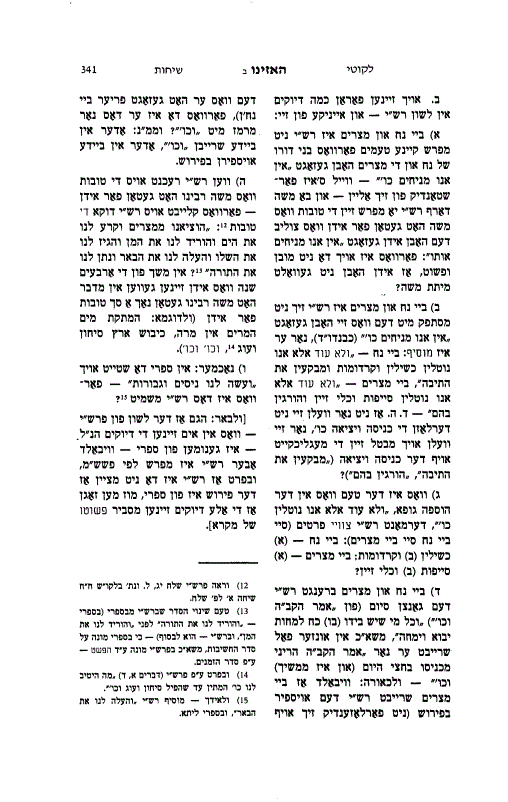
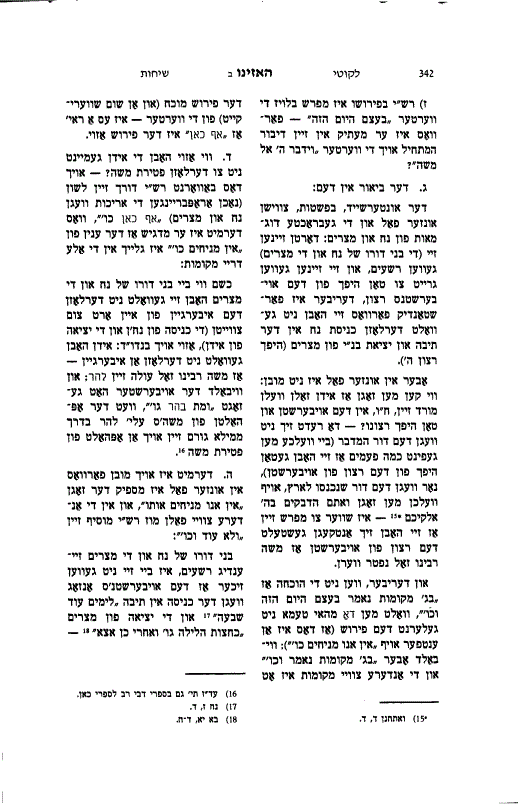
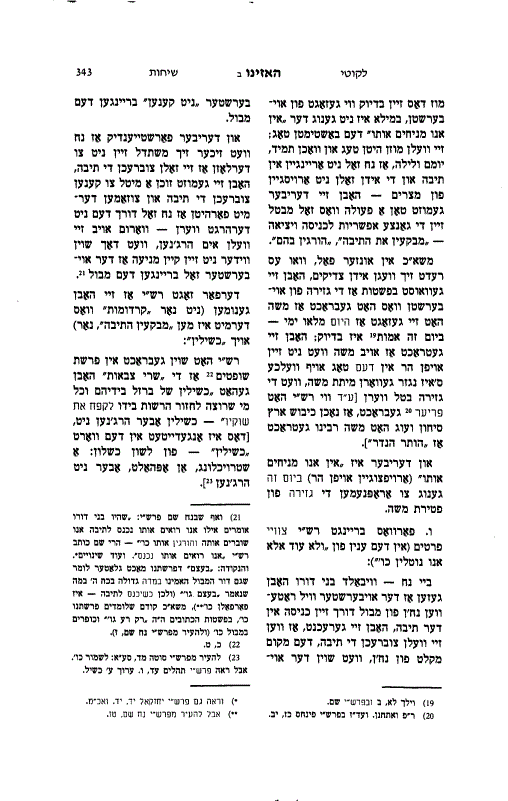
7. Rashi, in his commentary, explains only the words "on this very day" — so why does he also include in his introductory words "And G‑d spoke to Moses"?
3. The explanation for this is as follows:
The simple difference between our case and the examples brought from Noah and Egypt is that there, they (the generation of Noah and the Egyptians) were wicked, and they were ready to act contrary to the will of the Almighty. Therefore, it is understandable why they did not want to allow Noah to enter the ark and the Israelites to leave Egypt (against the will of G‑d).
However, in our case, it is not understood: How can one say that the Jews would want to rebel, G‑d forbid, against the Almighty and act contrary to His will? Here, we are not speaking about the generation of the wilderness (where we find several times that they acted contrary to the will of the Almighty), but about the generation that entered the land, about whom it is said, "But you who cleave to the L‑rd your G‑d" — it is difficult to interpret that they opposed the will of the Almighty that Moses our teacher should pass away.
Therefore, if not for the proof that "in three places it is said 'on this very day' etc.," we would not have learned this interpretation (that this is a response to "we will not allow it etc."); however, since "in three places it is said etc." and in the other two places this interpretation is proven (and without any difficulty) from the words — it is evidence that "also here" the interpretation is the same.
4. How did the Jews intend not to allow the passing of Moses? — Rashi also clarifies this through his wording (after bringing the lengthy explanation about Noah and Egypt) "also here etc.," which emphasizes that the matter of "we will not allow it etc." is the same in all three places:
Just as in the generation of Noah and the Egyptians, they wanted to prevent the transition from one place to another (the entry of Noah and the exit of the Jews), so too in our case: the Jews wanted to prevent a transition — that Moses our teacher should ascend the mountain; and since the Almighty said "and you shall die on the mountain," preventing Moses' ascent to the mountain would naturally also cause a delay in Moses' passing.
5. This also explains why in our case it is sufficient to say "we will not allow him," while in the other two cases Rashi needs to add "and not only etc.":
The generation of Noah and the Egyptians, being wicked, were not certain about the Almighty's command regarding the entry into the ark "for yet seven days" and the exit from Egypt "at about midnight and afterwards I will go out" —
6. Since it must be precise as stated by the Almighty, it is not enough for them to say "we will not allow him" on the designated day; they would have to guard constantly, day and night, to ensure that Noah does not enter the ark and the Jews do not leave Egypt. Therefore, they had to take an action that would nullify the entire possibility of entry and exit — "they would break the ark," "they would kill them."
However, in our case, where it concerns righteous Jews, they simply knew that the decree from the Almighty, which led Moses to tell them "today my days are complete — on this day I will die," is precise. They thought that if Moses would not be on the mountain on the day decreed for his death, the decree would be nullified [similar to what Rashi previously brought, that after the conquest of the land of Sihon and Og, Moses thought that the vow was annulled].
Therefore, by saying "we will not allow him" (to ascend the mountain) on this day, it was sufficient to remove the decree of Moses' passing.
7. Why does Rashi bring two details (in the matter of "and not only that, but we will take etc."):
In the case of Noah — since the people of his generation saw that the Almighty wanted to save Noah from the flood through his entry into the ark, they reckoned that if they would break the ark, Noah's place of refuge, then the Almighty would no longer be able to bring the flood.
And therefore, understanding that Noah would surely strive to prevent them from breaking the ark, they had to find a means to break the ark and at the same time ensure that Noah would not be killed in the process — because if they would kill him, there would again be no hindrance for the Almighty to bring the flood.
Therefore, Rashi says that they took (not only axes with which they could break the ark, but also) a "keshilon":
Rashi has already brought in Parshas Shoftim that the officers of the army had a "keshilon of iron in their hands, and anyone who wished to return had permission to strike their legs" — but a "keshilon" does not kill, [this is indicated in the word "keshilon" — from the language of stumbling, an impediment, but not killing].
8. Similarly, in our case, they prepared themselves with "keshilon" to prevent Noah from hindering them in their attempt to break the ark.
And likewise with the Egyptians: The Egyptians knew that as soon as they would attempt to kill the Jews, G‑d forbid, a war would immediately break out from the side of the Jews. Therefore, they armed themselves not only with "swords" (weapons of killing) but also with "weapons" in general, including defensive weapons.
9. However, it still remains difficult: How could the Jews have wanted to take action to prevent the passing of Moses — after all, this is contrary to the will of G‑d?
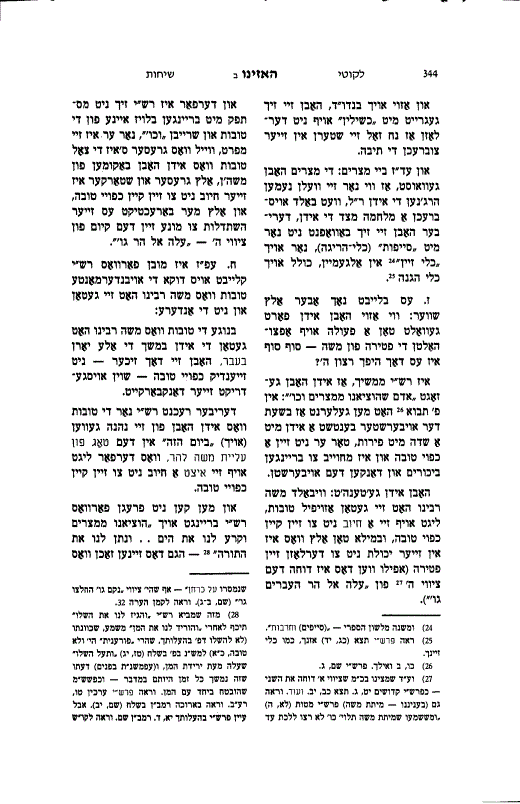
Rashi continues, explaining that the Jews said, "A man who took us out of Egypt, etc.": In Parshas Tavo, we learned that when the Almighty blesses a Jew with a field of produce, he must not be ungrateful and is obligated to bring the first fruits and thank the Almighty.
The Jews argued: Since Moses our teacher did so many favors for them, they were obligated not to be ungrateful, and therefore they did everything within their power to prevent his passing (even when this would override the command of G‑d to "ascend the mountain of Avarim, etc.").
And therefore, Rashi does not suffice with mentioning just one of the favors and writes "etc.," but he specifies them, because the greater the number of favors the Jews received from Moses, the greater and stronger their obligation not to be ungrateful, and the more justified their efforts to prevent the fulfillment of G‑d's command — "ascend the mountain, etc."
10. Based on this, we understand why Rashi specifically chooses the aforementioned favors that Moses did for them and not others:
Regarding the favors that Moses did for the Jews throughout the previous years, they certainly — not being ungrateful — had already expressed their gratitude.
Therefore, Rashi only counts the favors from which the Jews benefited (also) "on this day," the day of Moses' ascent to the mountain, for which they now had an obligation not to be ungrateful.
And one cannot ask why Rashi also brings "He took us out of Egypt and split the sea for us... and gave us the Torah" — even though these are matters that...
11. These actions were done in the past (even more so in relation to the generation of the desert) because these favors have a continuous relevance (similar to a "continuous effect") to all Jews of all generations and times. Regarding the Exodus from Egypt, it has already been taught earlier that "when your son asks you tomorrow, etc." — where "tomorrow" means "tomorrow that is after a time" (without limitation) — "and you shall say to your son, etc., and He took us out from there, etc."; and similarly, the giving of the Torah was not limited to that generation alone, but for all Jews throughout all generations.
on the day of Moses' ascent to the mountain, unlike the general "miracles and mighty deeds," whose benefit was in the past.)
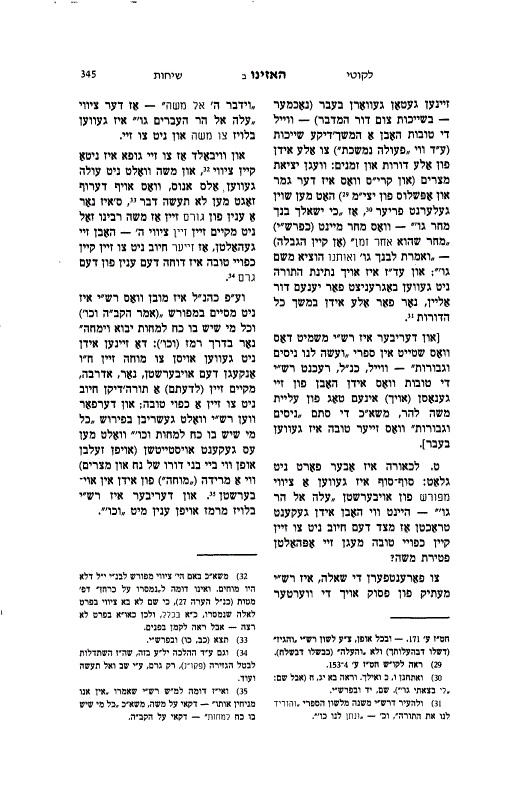
12. However, this is still not entirely smooth: After all, there was an explicit command from the Almighty, "ascend the mountain, etc." — so how could the Jews think that due to the obligation not to be ungrateful, they could prevent Moses' passing?
To answer this question, Rashi also quotes from the verse the words "And the L‑rd spoke to Moses" — indicating that the command "ascend the mountain of Avarim, etc." was directed only to Moses and not to them.
And since there was no command to them specifically, and Moses would not ascend as one compelled, for which it is said "do not do a thing," it was merely a matter of causing Moses not to fulfill his command from G‑d — they held that their obligation not to be ungrateful overrides the matter of causing.
Based on the above, it is understood why Rashi does not explicitly conclude with "(G‑d said, etc.) and anyone who has the power to protest should come and protest," but rather hints at it (with "etc."): Here, the Jews were not intending to protest, G‑d forbid, against the Almighty, but rather, on the contrary, to fulfill (in their view) a Torah obligation not to be ungrateful. Therefore, if Rashi had written explicitly "anyone who has the power to protest, etc.," it could have been interpreted (in the same manner as with the generation of Noah and the Egyptians) as a rebellion ("protest") of the Jews against the Almighty. Hence, Rashi only hints at the matter with "etc."
10. To further clarify: Ultimately, there was a command from the Almighty (at least) to Moses that he should ascend the mountain. So how did the Jews intend to prevent him from fulfilling a command of G‑d?
The explanation is: The Jews interpreted that the very fact that "And the L‑rd spoke to Moses" (specifically) and also set a condition (after "ascend the mountain") was not only that it could be "against their will" as in the war with Midian, but "here He opened a door for him and informed him that the matter depends on him" (to prevent the "ascend") — especially since Moses would be considered compelled — as in the decree concerning the sin of the Golden Calf.
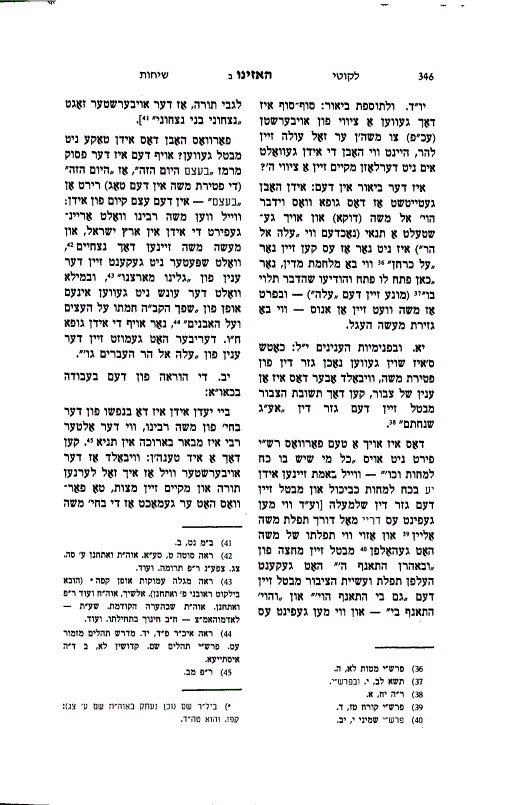
11. In the inner dimension of the matter, it can be said: Although the decree of Moses' passing had already been issued, since this was a matter concerning the community, the repentance of the community could annul the decree "even if it has been sealed."
This is also a reason why Rashi does not explicitly state "anyone who has the power to protest, etc." — because, in truth, the Jews indeed had the power to protest, as it were, and annul the decree from above [similar to how it is found three times through Moses' prayer alone and just as Moses' prayer helped annul half of "And G‑d was angry with Aaron," the prayer and action of the community could have helped annul the "And G‑d was angry with me" and "And the L‑rd was angry with me" — as it is found regarding the Torah, that the Almighty says "My children have triumphed over Me"].
Why did the Jews not actually annul it? The verse hints at this with "on this very day," indicating that "this day" (the passing of Moses on that day) touches the very essence — the core existence of the Jews: because if Moses our teacher had brought the Jews into the Land of Israel, and Moses' actions are eternal, then later there could not have been the matter of "we were exiled from our land," and consequently, the punishment would not have been in the manner of "He poured out His wrath on wood and stones," but on the Jews themselves, G‑d forbid. Therefore, there had to be the matter of "ascend the mountain of Avarim, etc."
12. The lesson from this in the service of each individual:
Within every Jew's soul is an aspect of Moses our teacher, as the Alter Rebbe explains at length in Tanya. A Jew might argue: Since the Almighty wants me to study Torah and fulfill mitzvos, why did He make it so that the aspect of Moses within my soul should be concealed, to the point that one might think it is completely hidden, G‑d forbid, and only the animal soul is felt in revelation?
13. The answer to this is that it is for the benefit of a Jew, because specifically through this, it becomes "on this very day": Only when there is effort — when a Jew toils to overcome the concealment and hiddenness that exists within him and around him in the world at large — does the "essence" of a Jew become expressed. And then, one sees how the entire concealment and hiddenness was merely a preparation for the subsequent elevation: the redemption through the aspect of Moses within his soul, and from a personal redemption to the general redemption, for "Moses is the first redeemer and he is the final redeemer."
(From the talk of Shabbos Parshas Haazinu 5727)