
Likkutei Sichos Vol. 19 – Chag HaSukkos 1
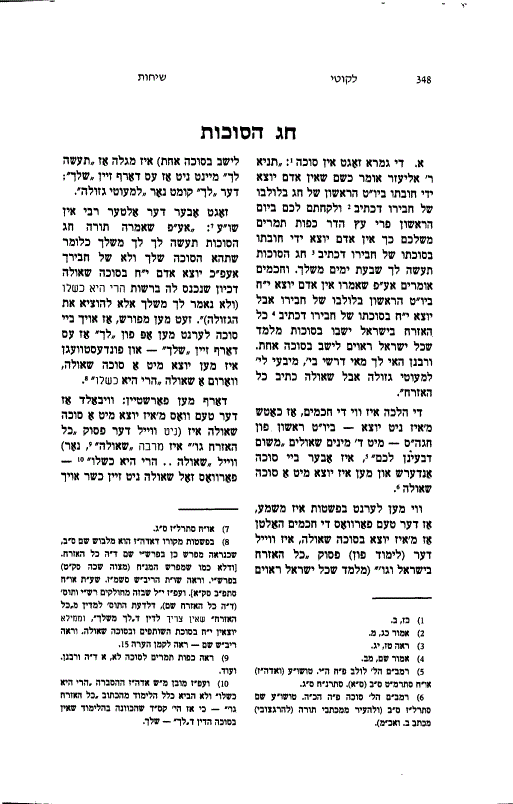
1. The Gemara in Sukkah states: "It was taught: Rabbi Eliezer says, just as one cannot fulfill his obligation on the first day of the festival with his fellow's lulav, as it is written, 'And you shall take for yourselves on the first day the fruit of a beautiful tree, branches of palm trees' — it must be yours — so too, one cannot fulfill his obligation with his fellow's sukkah, as it is written, 'The festival of Sukkot you shall make for yourself for seven days' — it must be yours. However, the Sages say, although they said one cannot fulfill his obligation on the first day with his fellow's lulav, one can fulfill his obligation with his fellow's sukkah, as it is written, 'All the citizens of Israel shall dwell in booths,' teaching that all of Israel are fit to dwell in one sukkah. And the Rabbis, what do they derive from 'for yourself'? It is needed to exclude a stolen sukkah, but a borrowed one is included in 'all the citizens.'"
The halacha follows the Sages, that although one does not fulfill the obligation on the first day of the festival of Sukkot with borrowed four species, because it requires 'for yourselves', it is different with a sukkah, and one fulfills the obligation with a borrowed sukkah.
As it is simply understood, it seems that the reason the Sages hold that one fulfills the obligation with a borrowed sukkah is because the verse 'All the citizens of Israel...' teaches that all of Israel are fit to dwell in one sukkah, revealing that 'you shall make for yourself' does not mean it must be 'yours'; rather, 'for yourself' only excludes a stolen sukkah.
However, the Alter Rebbe states in Shulchan Aruch: "Although the Torah says, 'The festival of Sukkot you shall make for yourself,' meaning it should be your own and not your fellow's, nevertheless, one fulfills the obligation with a borrowed sukkah, because once he enters it with permission, it is as if it is his own (and 'for yourself' only excludes a stolen sukkah)." It is clear that even regarding a sukkah, we learn from 'for yourself' that it must be 'yours' — yet one fulfills the obligation with a borrowed sukkah because a borrowed sukkah is considered as if it is his own.
We need to understand: Since the reason one fulfills the obligation with a borrowed sukkah is not because the verse 'All the citizens...' includes 'borrowed', but because a borrowed sukkah is considered as if it is his own — why should a borrowed lulav not be valid for the same reason, that a borrowed lulav is considered as if it is his own?
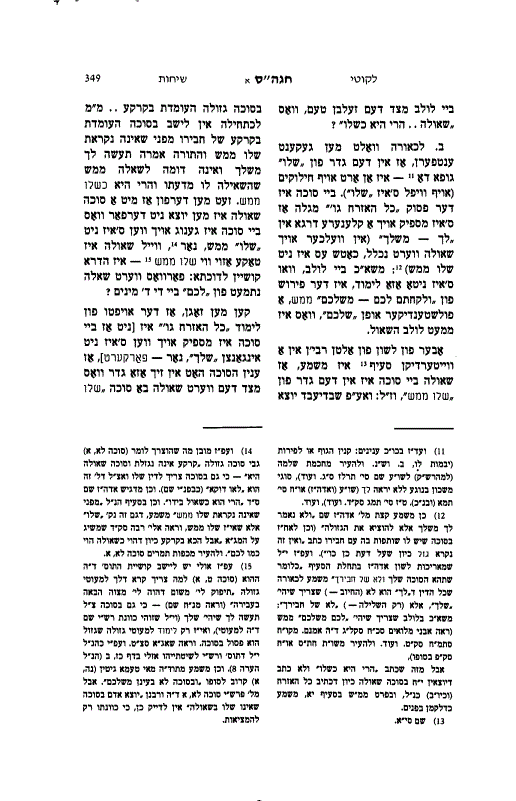
2. At first glance, one might answer that within the concept of "yours" itself, there is room for distinctions (regarding how much it is "his"). In the case of a sukkah, the verse "All the citizens..." reveals that a lesser degree of "yours" is sufficient (in which a borrowed sukkah is also included, even though it is not truly his own). However, with a lulav, where there is no such teaching, the meaning of "and you shall take for yourselves" is truly "from your own," which excludes a borrowed lulav.
However, from the wording of the Alter Rebbe in a subsequent section, it is implied that a borrowed sukkah is within the category of "truly his own." His words are: "And although, after the fact, one fulfills the obligation...
In a stolen sukkah that stands on the ground... nevertheless, initially, one should not sit in a sukkah that stands on someone else's ground because it is not truly called his own, and the Torah says, 'You shall make for yourself from your own,' and it is not similar to a true borrowing where it was lent to him willingly, and it is truly like his own." From this, we see that with a borrowed sukkah, one fulfills the obligation not because, with a sukkah, it is sufficient even if it is not "truly his own," but rather because a borrowed sukkah is indeed like his own. Therefore, the question returns: Why is borrowing excluded from "yours" regarding the four species?
One could say that the effect of the teaching "All the citizens..." is not that with a sukkah it is sufficient even if it is not entirely "yours," but rather — on the contrary — that the concept of the sukkah has within it such a definition that, because of this, a borrowed sukkah is considered "his own."
3. The explanation in simple terms is as follows: Since one is required to make the sukkah just like his permanent dwelling throughout the year, which is the entire definition of the festival sukkah (as opposed to the lulav, where "yours" is merely a condition), the borrowing of the sukkah is in a manner that it is truly "his own," "with this intention it was lent to him."
4. We can add and sweeten this explanation in the inner dimensions: From the verse "All the citizens of Israel shall dwell in booths," we learn that "all of Israel are fit to sit in one sukkah." Due to the elevation of the sukkah, all Jews become united into one entity, to the extent that "all of Israel are fit to sit in one sukkah." For this reason, a borrowed sukkah is also considered "truly his own."
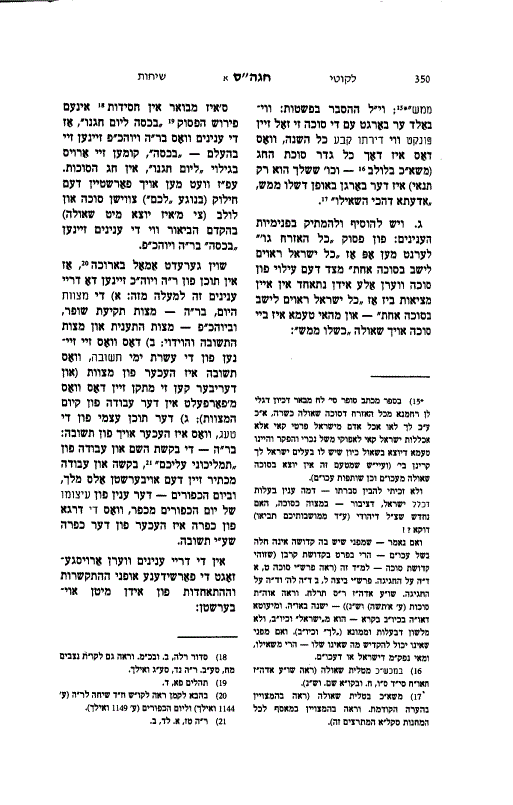
5. It is explained in Chassidus regarding the interpretation of the verse "In the cover of the day of our festival," that the matters which are concealed on Rosh Hashanah and Yom Kippur — "in the cover" — are revealed on "the day of our festival," during the festival of Sukkos. Based on this, we can also understand the difference (regarding "yours") between sukkah and lulav (whether one fulfills the obligation with a borrowed one) by first explaining how the matters are "in the cover" on Rosh Hashanah and Yom Kippur.
6. It has been discussed at length elsewhere that on Rosh Hashanah and Yom Kippur, there are three levels, each higher than the previous: a) The mitzvos of the day, on Rosh Hashanah — the mitzvah of sounding the shofar, and on Yom Kippur — the mitzvah of fasting and the mitzvah of repentance and confession; b) The fact that they are part of the Ten Days of Repentance, where repentance is higher than mitzvos (and therefore can rectify what was missed in the service of fulfilling the mitzvos); c) The essential content of the days, which is even higher than repentance: on Rosh Hashanah — the request and service of "Crown Me as King," the request and service of coronating the Almighty as King, and on Yom Kippur — the concept of the essence of the day itself atoning, which is a level of atonement higher than that achieved through repentance.
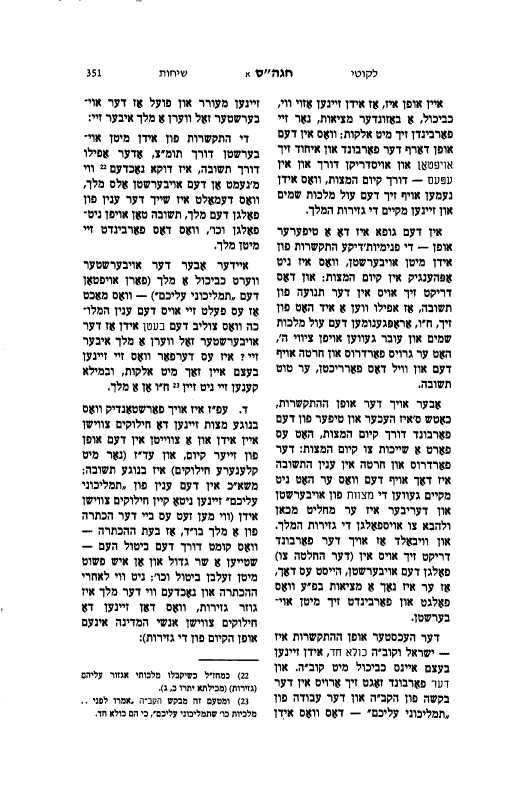
In these three aspects, the different ways of connection and unification of Jews with the Almighty are expressed:
One way is that Jews are, as it were, a separate entity, but they connect with G‑dliness; in this manner, the connection and unity must be achieved and expressed through something — through the fulfillment of the mitzvos, where Jews accept upon themselves the yoke of the Kingdom of Heaven and fulfill the decrees of the King.
Within this itself, there is a deeper way — the inner connection of Jews with the Almighty, which is not dependent on the fulfillment of mitzvos; this is expressed in the movement of repentance, that even when a Jew has, G‑d forbid, removed the yoke of the Kingdom of Heaven from himself and transgressed the command of G‑d, he feels great remorse and regret for this and wishes to rectify it, he repents.
However, even this way of connection, although it is higher and deeper than the connection through the fulfillment of mitzvos, still has a relation to the fulfillment of mitzvos: the remorse and regret in the matter of repentance is because he did not fulfill the mitzvos of the Almighty, and therefore he resolves from now on to follow the decrees of the King. And since this connection is also expressed in (the resolution to) follow the Almighty, it means that he is still an independent entity that follows and connects with the Almighty.
The highest way of connection is — "Israel and the Holy One, blessed be He, are entirely one," Jews are essentially one, as it were, with the Holy One, blessed be He. And this connection is expressed in the request of the Holy One, blessed be He, and the service of "Crown Me as King" — that Jews awaken and cause the Almighty to become a King over them:
The connection of Jews with the Almighty through Torah and mitzvos, or even through repentance, is specifically after they accept the Almighty as King, for then the matter of following the King, repenting for not following, etc., is relevant, which connects them with the King.
5. Before the Almighty becomes, as it were, a King (prior to the fulfillment of "Crown Me as King"), what necessitates the concept of kingship, which prompts Jews to request that the Almighty become a King over them? It is because they are essentially one with G‑dliness, and therefore they cannot, G‑d forbid, exist without a King.
6. Based on this, it is also understood why, regarding mitzvos, there are differences between one Jew and another in the manner of their fulfillment. Similarly (though with smaller differences) is the case with repentance. However, in the matter of "Crown Me as King," there are no differences among Jews (as seen in the coronation of a king in the flesh, where during the coronation — which comes through the nullification of the people — a great minister and a simple person stand with the same nullification, etc.; unlike after the coronation and once the king issues decrees, where there are differences among the people of the state in the manner of fulfilling the decrees).
The fulfillment of mitzvos, since their quality of connection is such that Jews, as they feel themselves as separate entities, connect with the Almighty, therefore the fulfillment of mitzvos and acceptance of the yoke of Heaven is for each individual according to their unique manner and level as an independent entity.
In the service of repentance, which comes from a deeper connection that is not achieved through the actual fulfillment of mitzvos, there is not such a distinction between one Jew and another. Nevertheless, there are also differences in this, because ultimately it is repentance for (and relative to) sins, or repentance to its root and source — in all of this, each individual is connected with one of the three festivals of the month of Tishrei: Rosh Hashanah, Yom Kippur, and the festival of Sukkos.
Rosh Hashanah openly represents that it is the "head" of the year — it is the time of the coronation of the King; and as the Rosh Saadia Gaon writes, the "primary matter" in "(the mitzvah of the day with) the shofar" is that "we crown the Creator over us."
On Yom Kippur, it is openly the day of repentance, the day of "end and forgiveness and pardon" for transgressing the commandments of the King. Moreover, even the aspect of "the essence of the day," which expresses the essential connection between Jews and the Almighty that is higher than the connection through repentance — is still in the aspect of "atonement," as its name implies: Yom Kippurim.
The festival of Sukkos is the time when Jews are openly engaged in the fulfillment of mitzvos: the sukkah, taking the four species, etc. — they are "occupied with mitzvos" (from immediately after Yom Kippur), as its name implies: the festival of Sukkos.
7. Since all matters that are (on Rosh Hashanah and Yom Kippur) "concealed" come down in revelation on the day of our festival, the festival of Sukkos, it is understood that although the essence of Sukkos is engagement in mitzvos, nevertheless,
8. Just as on Rosh Hashanah (and Yom Kippur), the essential aspect of the day and the aspect of repentance are present, as hinted in the words of our Sages, "the ten days between Rosh Hashanah and Yom Kippur," meaning Rosh Hashanah and Yom Kippur are part of the Ten Days of Repentance. Yet, they themselves are above the aspect of repentance that is present during these ten days. Additionally, there is the third aspect — the mitzvah of the day.
Similarly, we find in the verse regarding Sukkos: the verse describes the festival — "On the fifteenth day of this seventh month is the festival of Sukkos, seven days for the L‑rd," "You shall celebrate the festival of Sukkos for seven days" — and likewise, regarding the mitzvah of dwelling in the sukkah, it states, "You shall dwell in sukkahs for seven days" (without indicating that these are special days in and of themselves). From this, we understand that the essential aspect of Sukkos is the mitzvah of sukkah.
Concerning the taking of the four species, the law is "And you shall take for yourselves on the first day the fruit of a beautiful tree, etc." — that on the first day of the festival of Sukkos, one should fulfill the mitzvah of taking the four species. From this, it is evident that the mitzvah of the four species is not the essential aspect of the first day of Sukkos, the festival.
After the mitzvah of taking the four species, the verse continues, "And you shall rejoice before the L‑rd your G‑d for seven days" — the mitzvah of rejoicing during the festival of the L‑rd.
Based on the above (section 5), it is understood that the essential unity of the Jewish people with the Almighty in the manner of "all is one" (expressed in "Crown Me over you" from Rosh Hashanah) is revealed in the essential aspect of the sukkah. The connection through repentance (which is the main aspect of Yom Kippur) is openly expressed in the mitzvah of the lulav. The connection between the Jewish people and the Almighty through the fulfillment of mitzvos is revealed in the mitzvah of rejoicing during Sukkos.
7. The explanation for this is as follows: As mentioned earlier, in the concept of "Crown Me over you," there are no distinctions between one Jew and another. This idea is revealed during Sukkos in the mitzvah of sukkah, as "all of Israel are fit to sit in one sukkah" — meaning that all Jews, without any distinctions, are suited to dwell together in one and the same sukkah.
Regarding the lulav, it is stated in the Midrash on the verse "And you shall take for yourselves on the first day" — "With whom does the verse speak? With Israel and the nations of the world, whom the Holy One, blessed be He, judges on Yom Kippur, etc., and we do not know who has triumphed, etc. The Holy One, blessed be He, said: Take your lulavim in your hands so that everyone will know that you have been vindicated in judgment." This means that the atonement of Yom Kippur becomes apparent and revealed during Sukkos in the mitzvah of taking the four species.
And the mitzvah of the rejoicing of the festival, which is a joy of mitzvah, is the revelation of the connection of the Jews to the Almighty through the fulfillment of mitzvos, which elicits a movement of joy among the Jews — they rejoice with the mitzvos of G‑d.
8. Based on the above, we can understand the difference mentioned earlier between sukkah and lulav:
Since the sukkah is the "revelation" of "Crown Me over you," where Jews are one entity with the Almighty, it is understood, as mentioned above, that there are no distinctions between one Jew and another in this regard. This means that the fact that "all of Israel are fit to sit in one sukkah" signifies that, due to the elevation of the sukkah, Jews stand in an essential unity, not like two who unite, but as if all Jews are initially "all one," a single essence.
Therefore, the law is that a borrowed sukkah "is considered as his own," and even more so, it is "truly as his own" — because since a sukkah unites all Jews into one entity, one cannot separate one Jew from another and say that the sukkah is not "his" but someone else's — rather, it is his just as it is the other's.
[However, if someone steals a sukkah from another, he thereby opposes and contradicts the unity of the sukkah — by taking it from the other, he creates a separation in the unity of the sukkah between him and the one from whom it was stolen — it can no longer be called "his."]
9. This is, however, only regarding the sukkah. In contrast, the four species, although they also express the unity of the Jews — as they bind together all four types of Jews (as is known) — this unity is in a manner that they remain distinct types even after they are all bound together:
10. Since the mitzvah of the four species reveals the atonement of Yom Kippur, just as in the matter of atonement there are distinctions between one Jew and another (because although the essential point of atonement and teshuvah is beyond division, the actual atonement is achieved in each person according to their own situation), similarly, the unity of the four species is such that each one remains in its own category.
Therefore, regarding the four species, one cannot say that borrowed species are "as his own" — because in this, he remains a separate entity from the other.
Based on this, it is understood why regarding the sukkah it states "for you" (in singular form), whereas for the four species, the law of "yours" is derived from "and you shall take for yourselves" (in plural form): In the case of the sukkah, all Jews are like one entity "in one body" — and to one body, one speaks in the singular form; whereas regarding the four species, where each one remains a separate entity (they are merely bound together), they are a plural — "for yourselves."
Nevertheless, in the four species, there is still the aspect of unity — they are bound and connected together.
Following this comes the third aspect of the festival of Sukkos, the mitzvah of joy, which expresses the connection to the Almighty through mitzvos; and therefore, there are indeed distinctions among the types of Jews — "Chassidim and men of action would dance" and "all the people, men and women, would come to see and hear."