Likkutei Sichos Vol. 19 – Rosh Hashanah
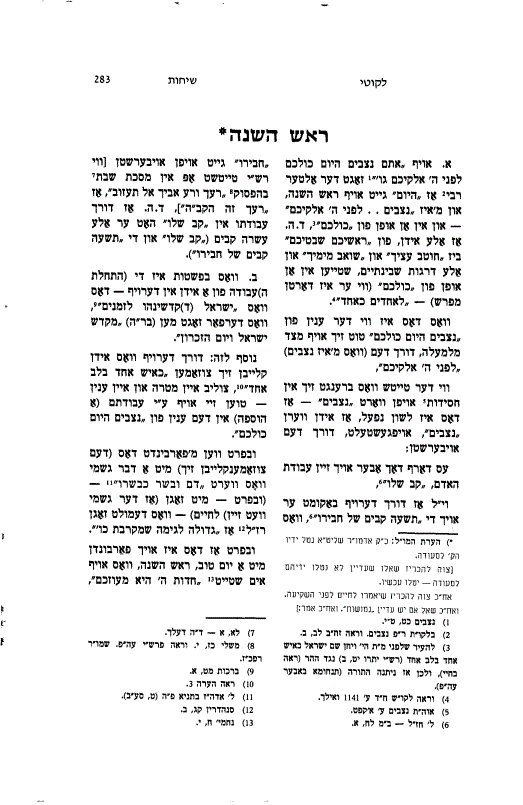
1. On the verse "You are standing today, all of you, before the L‑rd your G‑d," the Alter Rebbe explains that "today" refers to Rosh Hashanah. The phrase "you are standing... before the L‑rd your G‑d" indicates a state of "all of you," meaning that all Jews, from "the heads of your tribes" to "your woodcutters" and "your water drawers," and all levels in between, stand in a manner of "all of you" (as he explains there) — united as one.
This concept of "standing today, all of you" is initiated from Above, through the act of standing "before the L‑rd your G‑d." As Chassidus explains regarding the word "standing" (nitzavim), it is in the passive form, indicating that the Jews are made to stand, established, by the Almighty.
However, there must also be the service of man, his own effort (kav shelo), because through this, he also receives the "nine measures of his fellow." Here, "his fellow" refers to the Almighty, as Rashi explains in Tractate Shabbat on the verse "Do not forsake your friend and the friend of your father," that "your friend" is the Holy One, blessed be He. Thus, through his service in "his own measure," he attains all ten measures ("his own measure" and the "nine measures of his fellow").
2. The initial service of a Jew in this regard is the fact that "Israel sanctifies the times," which is why we say on Rosh Hashanah, "Who sanctifies Israel and the Day of Remembrance."
Additionally, by gathering together "as one person with one heart," for a single purpose and a single matter, they achieve through their service an enhancement in the concept of "standing today, all of you."
Especially when this gathering is connected with a physical matter that becomes "flesh and blood like his own flesh" — particularly by saying (that the physical will be) "to life" — as our Sages say, "Great is drinking, for it brings people closer."
And especially since this is also connected with a Yom Tov, Rosh Hashanah, about which it is written, "The joy of the L‑rd is your strength," and at that time, there should be "drink sweet beverages" in addition to "eat rich foods."
Moreover, since this is a Rosh Hashanah of a Hakhel year, which begins from Rosh Hashanah of that year, as the verse states, "At the end of seven years" there should be Hakhel, which begins "at the end of seven years" from Rosh Hashanah.
Especially according to what Chassidus explains on the verse "In the concealment of the day of our festival," that the matters of "our festival," the festival of Sukkot, are already present on Rosh Hashanah in a concealed manner.
It is worth investigating whether the concept of Hakhel, which occurs during "our festival," is also present on Rosh Hashanah in a concealed manner.
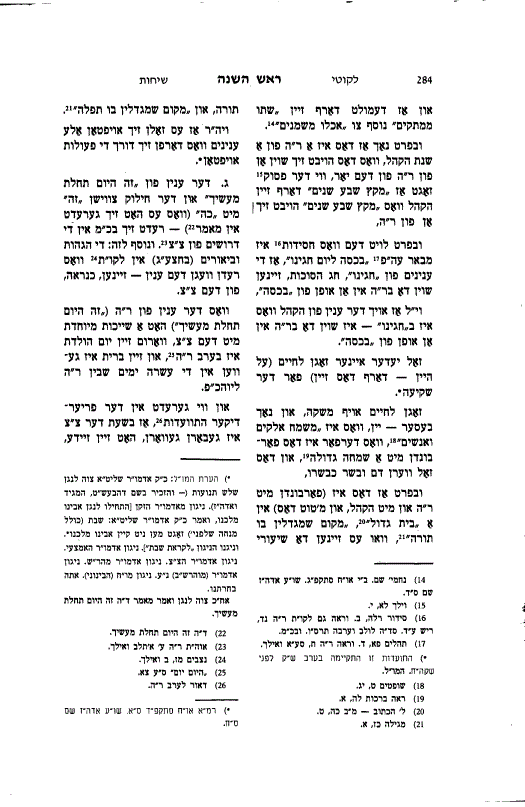
2. Everyone should say "L'chaim" (on wine — this should be done) before sunset.
To say "L'chaim" on a beverage, and even better — on wine, which "gladdens G‑d and men," and therefore is associated with great joy, and this should become flesh and blood like his own flesh.
Especially since this is (connected with Rosh Hashanah and with Hakhel, and it is done) in a "great house," "a place where Torah is nurtured," where there are Torah lessons, and "a place where prayer is nurtured."
May it be G‑d's will that all matters that need to be accomplished through these actions should be fulfilled.
3. The concept of "This day is the beginning of Your works" and the distinction between "this" and "thus" (as discussed in the maamar) is spoken about in many places in the discourses of the Tzemach Tzedek. In addition to this, the glosses and explanations (in the middle of the page) in Likkutei Torah that discuss this concept are apparently from the Tzemach Tzedek.
The matter of Rosh Hashanah ("This day is the beginning of Your works") has a special connection with the Tzemach Tzedek, because his birthday is on the eve of Rosh Hashanah, and his bris was during the Ten Days of Repentance between Rosh Hashanah and Yom Kippur.
As discussed in the previous farbrengen, when the Tzemach Tzedek was born, his grandfather, the Alter Rebbe, said a teaching on "They administer an oath to him to be righteous, etc.".
The concept of "They administer an oath to him to be righteous" is connected with the birth (of the Tzemach Tzedek) — because "They administer an oath to him to be righteous" is given to a Jewish child before he is born and comes into the world.
4. This (the birth of the Tzemach Tzedek and that at that time "They administer an oath to him, etc.") is also particularly connected with Rosh Hashanah:
For Rosh Hashanah was the creation of Adam, the first man, which is analogous to the descent of the soul into the body and the birth of (every person, and especially of) every Jew — because "You are called Adam."
And as the Mishnah states, every person is a "complete world," just like Adam, who was "created alone," and even more so: in order for us to know now that every Jew is a "complete world," "therefore man was created alone" thousands of years ago!
This further emphasizes the connection between the creation of Adam (on Rosh Hashanah) and the birth of every Jew.
5. Since every year on Rosh Hashanah, "they are remembered and done" — the events that occurred on the first Rosh Hashanah are repeated, including the creation of Adam on Rosh Hashanah — it is understood that Rosh Hashanah each year is the birth of every Jew.
One could say that the Torah's statement "They administer an oath to him, etc." on the eve of Rosh Hashanah also hints at this: since on Rosh Hashanah itself is the birth of every Jew (analogous to the creation of Adam), the "They administer an oath to him, etc." must occur before the child enters the world, on the eve of Rosh Hashanah.
[Even though the first time (at the creation of Adam) there were several hours on that day (of Rosh Hashanah) itself before the creation of Adam, as the Gemara in Sanhedrin details how the creation of man unfolded during the hours of the day.]
6. In this year's calendar, there is an additional emphasis on the "they are remembered and done" of Rosh Hashanah (and the creation of Adam):
The first creation of Adam (Rosh Hashanah) occurred on the sixth day of the week. However, there is a rule that "Rosh Hashanah does not fall on Sunday, Wednesday, or Friday," as the Rambam notes, and according to the opinion of Rav Saadia Gaon, this is from the Torah. This means that Rosh Hashanah cannot occur on the sixth day of the week as it did the first time.
The only possibility for the sixth day to be Rosh Hashanah is as in this year's calendar, where the second day of Rosh Hashanah is on the sixth day of the week.
And even though this is the second day of Rosh Hashanah, both days of Rosh Hashanah are considered a "long day." Thus, in this year's calendar, Rosh Hashanah falls on the day of Adam's creation as it was the first time — on the sixth day of the week.
And the sixth day of the week itself, the time of Adam's creation, is at the end of the "long day" (which is on the second day of Rosh Hashanah) — similar to how it was the first time, when Adam's creation was at the end of the day of Rosh Hashanah.
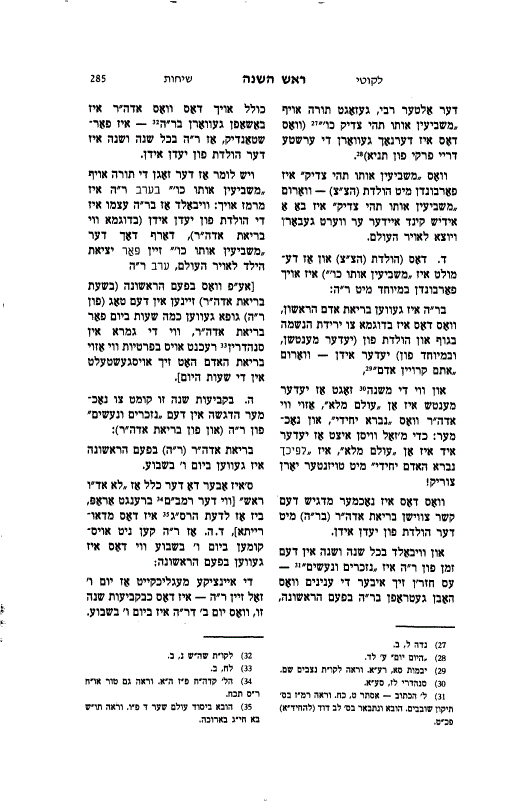
7. Here is the place to note regarding the fact that Rosh Hashanah is two days,
[which is not only outside of the Land of Israel but also in the Land of Israel, where this emphasizes the concept of "(You are standing today) all of you": all other festivals have a difference between Jews outside the Land and in the Land of Israel, where outside the Land they observe a second day of Yom Tov, unlike in the Land of Israel; however, Rosh Hashanah is observed by all Jews for two days, both in the Land of Israel and outside the Land, where the majority of Jews are, until our righteous Mashiach will bring them to the Land of Israel].
There are those who seek a source for this (that Rosh Hashanah is also two days in the Land of Israel) and when it began,
8. We find an explicit verse in the Written Torah:
In Nehemiah [whom the Alter Rebbe refers to in his Shulchan Aruch (in the laws of Rosh Hashanah) as "Ezra"], chapter 8, following the account of what occurred "on the first day of the seventh month," on the day of Rosh Hashanah — it is stated that the Jews were instructed, "Eat rich foods and drink sweet beverages and send portions to those who have nothing prepared, for this day is holy to our L‑rd. Do not be sad, for the joy of the L‑rd is your strength." And afterwards, it is stated that the Jews indeed did so in practice, "And all the people went to eat and drink and to send portions and to make great joy, etc." — it then states, "And on the second day, etc."
Commentators interpret that "on the second day" means (not the day following Rosh Hashanah, but) "on the second day of Rosh Hashanah,"
and it is explained (from the words of our Sages) the reason for this, that there were two days of Rosh Hashanah at that time, because in the days of Ezra, the month of Elul was extended.
9. The aforementioned from Nehemiah, that on (the first day of) Rosh Hashanah, "all the people went to eat, etc., and to make great joy" — can be connected
to what my revered father-in-law, the Rebbe, writes in Sefer HaMaamarim 5703 at the beginning, that we see in the earthly kingdom that when a king is crowned, "the coronation comes with great joy, etc.",
and since "the earthly kingdom is a reflection of the heavenly kingdom," the coronation of the King in the heavenly kingdom — when we crown the Almighty on Rosh Hashanah — is also with great joy.
10. A parenthetical note:
Regarding the statement that since "the earthly kingdom is a reflection of the heavenly kingdom," just as in the earthly kingdom the coronation of the king is with great joy, so too in the heavenly kingdom — there arises the question:
It is not necessary, G‑d forbid, to say that matters above are as they are below — so how can we say that since in the earthly kingdom the coronation of the king is with great joy, the coronation of the King in the heavenly kingdom is also in this manner?!
Similarly, the question arises concerning many parables brought in the sayings of our Sages about the Almighty, "To what is this matter comparable? To a king of flesh and blood," and the like — how can we say that a matter is in a certain way above, with the Almighty, because it is so below?!
This question also pertains to the parable brought by the Maggid, that just as with a father below, the image of the son is engraved in his thought, so too it is above.
11. Above, the souls of Israel are engraved in the thought of the Almighty [with the distinction that in the analogy of a father who is flesh and blood, "one who never had a son cannot say that the image of the son he will have later is engraved in his thought... but with the L‑rd... even before the Israelites were created, their form was engraved in thought... for with Him, past and future are one"].
9. The explanation of this is:
It is not that because a matter is a certain way below, therefore it is so above. Rather, the opposite: from seeing how a matter is below, we know — this is evidence — how the matter is above.
Furthermore: because the matter is so above, it "descends from its essence" and becomes so below. Therefore, if one wants to know how a matter is above, one should look at how the matter is below, and from this, one gains knowledge of how it is above.
This applies to all the analogies. — In the words of the verse, "From my flesh I shall see G‑d," because one desires that one's matters should not only be in a manner of faith but also in a manner of vision (and knowledge), as the Rambam's precise language is "to know" (not "to believe"), as discussed many times.
[This is also the explanation of what the Tzemach Tzedek brings in Sefer HaMitzvos of the Alter Rebbe: How is it possible to command faith in G‑d, when faith is (the foundation and) the preface of all mitzvos and commandments?
He explains there that in addition to the command being on the details of faith — the main point is: the command is (not only "to believe" but also) "to know that there is a First Being"].
Therefore, one needs analogies from below in this world to understand with knowledge how matters are above — "From my flesh I shall see G‑d."
Similarly, the human below: he is "I will liken myself to the Most High," and therefore one can know from a king here below how it is, so to speak, with the King of kings, the Holy One, blessed be He, and from a father here below, how it is, so to speak, with our Father in heaven.
Similarly, regarding what is stated in Sefer HaMaamarim 5703, that from seeing that the coronation of the king in the earthly kingdom is "with great joy," we know that so too is the coronation of the King in the heavenly kingdom.
Thus concludes the parenthetical note.
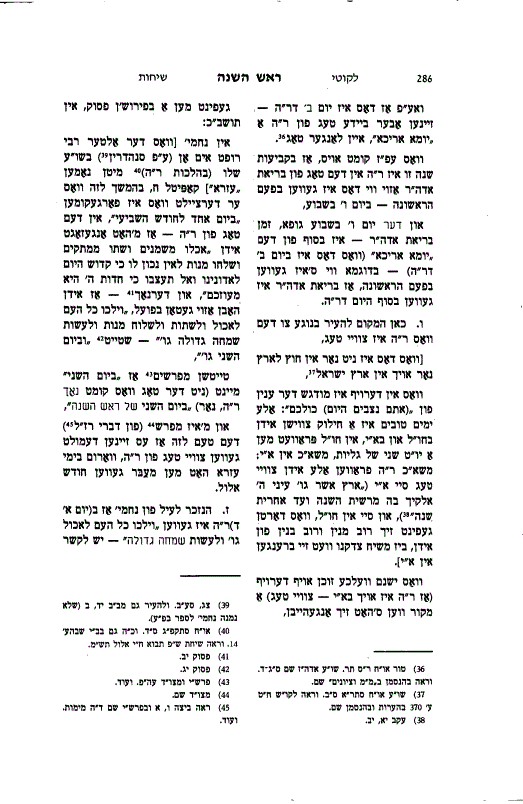
10. As mentioned earlier (section 7), in continuation to what is stated in Nehemiah that on the first day of Rosh Hashanah, "all the people went to eat... and to make great joy," the verse states that afterward there was a second day of Rosh Hashanah.
The verse tells what happened then (on the second day of Rosh Hashanah):
"And on the second day, the heads of the fathers of all the people, the priests, and the Levites gathered to Ezra the scribe to understand the words of the Torah, and they found written in the Torah that the L‑rd had commanded by Moses that the children of Israel should dwell in booths during the festival in the seventh month."
And Ezra then instructed them, "that they should proclaim and pass the word in all their cities and in Jerusalem, saying, 'Go out to the mountain and bring olive branches, and branches of oil trees, and myrtle branches, and palm branches, and branches of thick trees, to make booths, as it is written.'"
11. The expression "Go out to the mountain" is similar to the language found in Haggai, where it states, "In the sixth month (the month of Elul), on the first day of the month," the L‑rd said (in astonishment), "This people say, 'The time has not come, the time for the L‑rd's house to be built,'" and subsequently, He instructed, "Go up to the mountain and bring wood and build the house" (as discussed in the gathering on Rosh Chodesh Elul).
The difference between them is: here it says "Go out to the mountain," whereas there it says "Go up to the mountain." The explanation is simple: In Haggai, it speaks of the situation before the Temple was built, and they needed to go and build the Beis HaMikdash. This is an ascent from a state of before the Temple was built to a state of building the Temple, hence the expression "Go up to the mountain." In contrast, in Nehemiah, it speaks of a situation where the Beis HaMikdash already exists (as he states in the subsequent verses), and therefore it says, "Go out to the mountain."
Even though on that day, the second day of Rosh Hashanah, the Jews had not yet fulfilled the mitzvah of sukkah in practice, since they had already decided that they would fulfill what Ezra told them, "Go out to the mountain," the principle of "a good thought, the Holy One, blessed be He, joins it to an action" applies. Therefore, at the time of the good thought, it is already assured that it will come down into actual deed.
Furthermore:
Regarding the verse "And the children of Israel went and did as the L‑rd commanded Moses and Aaron" concerning the Passover offering, Rashi asks, "Did they already do it? Was it not said to them from the beginning of the month?" He answers, "Rather, since they accepted it upon themselves, the scripture considers it as if they had done it," even though the verse states "and they did" without a "like" (as if).
From this, it is also understood concerning the decision of the Jews then, on the second day of Rosh Hashanah, regarding the mitzvah of sukkah, that even then it is considered as if they had already done it in practice.
12. The verse then tells how the Jews fulfilled the mitzvah of sukkah in practice: "And the people went out and brought and made themselves booths, each on his roof, and in their courtyards, and in the courtyards of the house of G‑d, and in the street of the Water Gate, and in the street of the Gate of Ephraim," and "there was very great joy," and (as it says earlier in the verse) it was such great joy that from the days of Joshua the son of Nun, there had not been such joy.
In connection with the verse "and they made themselves booths, each on his roof, and in their courtyards, and in the courtyards of the house of G‑d," it is stated in the responsa of the Geonim that they were asked whether one needs to make a sukkah (also) in a synagogue.
Initially, the assumption is that it is not necessary, because a sukkah must be (as you dwell) similar to your dwelling, and therefore one should make a sukkah only in one's own residence, unlike in a synagogue.
However, the responsa continues that indeed one should make a sukkah in a synagogue for guests [and as it says there, in Baghdad (where several Geonim lived), they made sukkahs in their synagogues], and it also brings there that this was the case in the Temple from the verse in Nehemiah where it states that "they made themselves booths... in the courtyards of the house of G‑d."
And then it concludes in the responsa, "And so is the custom of Israel" — that this is the custom of Israel.
12. From all the above (from what is recounted in Nehemiah, and from the responsa of the Geonim with the details therein), one can derive several hints, etc. — but it requires further investigation because, for now, I have not found it in the books.
One of them: On the second day of Rosh Hashanah, one should prepare for the festival of Sukkot and resolve to perform the matters that need to be done during Sukkot, to the extent of "very great joy."
[Especially according to what is explained in Chassidus, that on Rosh Hashanah, the matters of "our festival," Sukkot, are present in a concealed manner (as mentioned above in section 2)].
Regarding practical application:
Just as was discussed in previous farbrengens, and in the years before that, regarding the matter of "sending portions to those for whom nothing is prepared," which should be done concerning Rosh Hashanah —
Similarly, one should do so concerning Sukkot — providing all the needs for those who require them so that they can celebrate Sukkot with joy, up to and including "very great joy."
And similarly, one should act concerning the days in between (between Rosh Hashanah and Sukkot), so that they are days filled with joy, and "very great joy,"
which is accomplished for all Jews also by providing them, if they lack, everything they need to be in joy and gladness of heart,
until one reaches "everlasting joy upon their heads," which is connected with the true and complete redemption through our righteous Moshiach,
who will "build the Temple in its place," and then "gather the dispersed of Israel,"
and may it be His will — in a manner of "assemble the people, the men, the women, and the children, and your stranger that is within your gates" in the year which is a year of Hakhel, the year 5741, which is approaching us for good and blessing.
And even before that, may we be "inscribed and sealed immediately for life" in the book of the completely righteous, for "your people are all righteous" — that it should be a good and sweet year, with visible and revealed good, and below ten handbreadths,
and very soon in our days, indeed.
(Sicha of the second day of Rosh Hashanah, Erev Shabbat, 5741)
1. In the haftarah of the first day of Rosh Hashanah (the beginning of the Book of Samuel), it is recounted about Chana, the wife of Elkanah, whose content is that initially "Chana had no children," and afterwards, through her prayer (while in Shiloh at the Mishkan), she was blessed with a son — Shmuel the prophet.
The purpose of reading the haftarah on festivals, as with all haftarahs, is similar to the reading of the Torah, from the term "instruction" — so that a Jew should derive from it a lesson in the service of a Jew on that Shabbat and on that festival.
And so it is in our case: Although the reason for saying this haftarah on Rosh Hashanah is because "Chana was remembered on Rosh Hashanah," the haftarah contains several lessons in the service of a Jew on Rosh Hashanah (and also several lessons in general);
2. Since the "service" that led to Chana's remembrance — which is the main point of the haftarah (in its connection to Rosh Hashanah) — was her prayer (in Shiloh), it is reasonable to say that the primary lesson from this haftarah regarding the service of a Jew on Rosh Hashanah is found in Chana's prayer. This is especially true according to the opinion brought in the Shaloh, that Chana's prayer also took place on Rosh Hashanah.
3. We will understand this by first explaining the story of Chana's prayer, where initially Eli the Kohen mistook her for a "drunken woman" because her prayer was "speaking in her heart," and therefore he rebuked her, saying, "How long will you be drunk?" Chana responded, "No, my lord, I am a woman of sorrowful spirit; I have poured out my soul before the L‑rd," and so on.
At first glance, this is puzzling:
a) How could Eli the Kohen make such a mistake — from one extreme to the other! Instead of recognizing that she was praying with an outpouring of the soul, he thought she was "drunk"?
b) Even if we could find an explanation for how Eli made this mistake, it is still not clear why this story is recounted in the Torah. After all, the Torah does not even speak negatively about an impure animal, how much more so, to differentiate, about Eli the Kohen!
c) Since "he thought she was drunk," why did Eli wait to rebuke her until she finished her prayer? He should have immediately interrupted her and ensured she was removed from the House of the L‑rd.
4. From all this, it is evident that Eli did not consider her to be drunk in the literal sense, but rather "drunk" in the context of prayer. This means: Since Chana's prayer was in a manner of "she prayed much," it was an excessive prayer beyond the norm, which is not desirable (especially when one stands before the L‑rd in the House of the L‑rd, as will be explained later).
5. Chana's response to this was, "I have poured out my soul before the L‑rd," indicating that when "she prayed much" is connected with an outpouring of the soul, it is not a matter of "drunkenness" in prayer. On the contrary, it is a higher level of prayer.
This also explains the connection between Chana's prayer and Rosh Hashanah. The argument and exchange between Eli the Kohen and Chana regarding the manner of prayer in the House of the L‑rd provides insight into the general content of Chana's prayer and several prayers on Rosh Hashanah, as will be explained.
6. Regarding the prayers of Rosh Hashanah, we find two opposite aspects:
Rosh Hashanah is the Day of Judgment for all the needs of a person, both spiritual and physical. As it is written, "For it is a statute for Israel, a judgment for the G‑d of Jacob." The "statute for Israel" refers to the judgment concerning physical sustenance, as in "Give me my allotted bread," which includes all material needs. The "judgment for the G‑d of Jacob" refers to the judgment concerning spiritual matters, such as how much G‑dliness will be revealed in the soul. Therefore, in the prayers of Rosh Hashanah, we ask for children, life, and sustenance, as well as success in spiritual matters.
On the other hand, it is known that the essence of the service (which primarily takes place in prayer) on Rosh Hashanah is to crown the Almighty as King. In the words of our Sages, "Make Me King over you," as we say in the Rosh Hashanah prayers, "Reign over the entire world in Your glory," "King over all the earth," and more. The crowning of the King and the acceptance of His kingship is specifically through the ultimate state of self-nullification, where one completely submits to the King, to the point of feeling no personal desires. This self-nullification evokes the King to "accept" the coronation.
These matters are seemingly contradictory: when one stands in a state of complete self-nullification to the King, one is not in a position to think about (or request) personal needs, which is only relevant when one has personal desires. This is true even concerning spiritual needs, and certainly regarding material requests, which are the primary focus of the judgment on Rosh Hashanah, as explained in the glosses of the Maimonides.
As is known from the Tikkunei Zohar, those who pray on "the Days of Atonement" for "sustenance, forgiveness, atonement, and life, inscribe us for life," are likened to dogs that bark "Give, give," because they think about themselves and not about the Shechinah.
4. On the other hand, these requests (for human needs) were incorporated into the prayer text by our Sages, who explain that this is a time of favor for the fulfillment of requests, etc. From this, it is understood that the requests must not be solely due to accepting the yoke of Heaven—since the Almighty commanded a Jew to ask for his needs on Rosh Hashanah, he does so merely to fulfill the divine will—but rather in a manner where he has a desire and feeling for the requested needs.
That is, on one hand, one must want and intend (in this part of the prayer) that the Almighty should grant him his needs, which requires feeling one's own existence (and sensing what he lacks); and at the same time, he must be absorbed in fulfilling the "Make Me King over you," which demands complete self-nullification, negating one's own existence.
5. Seemingly, one could ask the same question regarding the prayers of the entire year:
During the Shemoneh Esrei prayer, the one praying is like one standing before the King, and when standing before a king, one must not display any gesture of personal existence [as we find in the Gemara, that even "a gesture with a hand before the king" is something for which one deserves the opposite of life]; and at the same time, the twelve middle blessings, which are requests for one's needs, have been established in the prayer text for every Jew.
However, there is a significant difference between the prayer of Rosh Hashanah and the prayers of the entire year:
Throughout the year, after the coronation of Rosh Hashanah, the Almighty is, so to speak, like a "king" who governs a country. Therefore, the nullification of the citizens to the king is in a manner where it is acknowledged that there is the existence and needs, etc., of the citizens, with whom the king governs; it is only that when one stands directly before the king, it must be evident that the entire existence of the country is not independent but is subjugated to the king.
However, when one must first crown the (Almighty as) king, when He is still exalted and removed from the conduct of kingship, a greater, deeper nullification is required, a complete nullification in which nothing is heard except for the king alone—thus raising the question: how can one, in such a state, request from the king regarding personal needs?
6. The explanation of this is:
6. When a Jew prays for his needs on Rosh Hashanah, the request should not be for his own benefit, in order to have an abundance in matters of this world (or even an abundance in spiritual matters). Rather, it should be a continuation of the service of "Crown Me as your King":
In order to fulfill "Reign over the entire world in Your glory," so that throughout the entire world the kingship of the Holy One, blessed be He, will be evident, this is achieved through a Jew engaging in worldly matters and making them a dwelling place for His Divine presence.
Since every Jew has sparks of holiness that are connected to his soul and which he (specifically) must refine—these sparks are clothed in the physical things that G‑d has designated for his portion and his service—therefore, the Jew asks G‑d to bestow upon him these things (needs), so that through them he can fulfill the part of "Reign over the entire world" that pertains to him.
It turns out that even in the request for one's needs on Rosh Hashanah, there is no involvement of a sense of personal existence, because he asks for them only for the sake of the Almighty. On the contrary, this comes precisely from the ultimate nullification in which one stands during the service of crowning the king; because since the refinement of the sparks is connected and related to the essence of the soul—
Just as the intention of "The Holy One, blessed be He, desired to have a dwelling place in the lower realms" (which is accomplished through the service of refining) is rooted in His essence, so too with Jews (who carry out this intention in practice), the service is connected with the essence of their soul.
In the essence of the soul, there is no concept of personal desires; it is "bound and united with You... a singularity to unite You"—it is understood that the request for one's needs (in order to fulfill the higher intention) is connected with the nullification of the essence of the soul (which is revealed in the service of "Crown Me as your King").
7. Seemingly, one could ask: The request for one's needs on Rosh Hashanah was established by our Sages in the prayer text for every Jew, in every situation in which he finds himself—and it is known to each person in his soul that when he asks for his physical (and spiritual) needs, it is not only to fulfill the Almighty's intention, but also because he finds himself in distress, literally, and he wants the Almighty to fulfill his (the person's) needs from His full, open, and generous hand. On the contrary, this is the essence of the mitzvah, as explicitly stated in the blessings of the prayer, and this is the virtue and effect of prayer—that the sick should be healed, the rain should fall, etc.
8. It would be understandable if one were asked not to think at all about their physical needs during the Rosh Hashanah prayers, and instead focus entirely on the concept of "Crown Me as your King"—to effect within oneself the acceptance of His sovereignty. In such a case, there would be no question, because during this time of "the luminary drawing close to the spark," every Jew is capable of awakening with a natural inclination to draw closer to the Almighty, and consequently, to forget about their own needs, desiring only to be with the "King."
However, how can it be demanded of every Jew to simultaneously hold both ends: to think about their own needs and desire that the Almighty fulfill them, and yet, within this, not allow any personal feelings or ulterior motives to interfere, but be entirely for the sake of the Almighty?
9. This can be understood according to the interpretation of the Baal Shem Tov on the verse "Hungry and thirsty, their soul within them faints"—that the body's hunger and thirst for food or drink stem from the fact that "their soul within them faints"—the soul desires to refine the sparks of holiness within the food and drink (because these sparks are connected to him, and he specifically needs to rectify them).
This means that although a person feels only their natural hunger to eat from the body's perspective, it is truly the "hunger" of their soul for the sparks of holiness in the food that belong to them.
Similarly, in our matter: when a Jew prays on Rosh Hashanah with supplications, etc., that the Almighty should grant them their physical and spiritual needs, it is (even though externally it is because matters of children, life, and sustenance are important to him, and his existence, however) the truth and inner aspect of the soul's outpouring—the "hunger" of the soul to fulfill the higher intention of making the physical things a dwelling place for Him.
On the contrary: the very fact that we see Jews being aroused when saying "Unesaneh Tokef... who will rest, etc." from the depths of their hearts, even more than the arousal when saying "Reign over the entire world in Your glory," etc., is proof that this is also the truth of the matter.
For although the revealed reason for this is because, being a soul in a body, matters of this world are closer to him and affect him more than spiritual matters—the inner reason for this is because the intention of His essence is specifically in the lower realms (as mentioned above in section 6), and therefore it also affects a Jew in the essence of their soul;
And therefore, they become aroused, etc., in these requests specifically, which internally is the essential strength of the essence of the soul to fulfill the higher intention of making the world a dwelling place for Him.
10. This is also the reason for the practice of reciting the Haftorah of the prayer of Chana on Rosh Hashanah, along with the words of Eli the Kohen, "How long will you be drunk?"
11. Eli's argument was that when one stands "before the L‑rd"—"before the Holy of Holies"—nothing should matter except that one is "before the L‑rd." There is no place then for requests concerning material matters, and even not for a request such as "give Your maidservant a male child," especially not in a manner of "she prayed much." This is a state of "drunkenness" from her good but personal desires (as indicated by "give Your maidservant"); her desire is so strong that she does not realize where she is, that she stands "before the L‑rd."
To this, Chana replied, "I have poured out my soul before the L‑rd": Not only is her prayer for a male child not a matter of "drunkenness," G‑d forbid, in personal desires, but on the contrary—it is an outpouring of the essence of the soul, which is specifically connected to the state of standing "before the L‑rd," as it is stated, "Seek My face, Your face, L‑rd, I will seek," which has no personal desire; her entire being is "embraced and attached to You."
This also explains why she immediately vowed in her request that if "You will give Your maidservant a male child," then "I will give him to the L‑rd all the days of his life": His entire life will be (not personal, but) dedicated to the L‑rd; because her request for a male child is not for her own sake, but solely for the sake of the L‑rd, which is perceived in her inner soul.
12. From this, every Jew receives a directive in their service of G‑d during their prayer on Rosh Hashanah:
It is not enough that the inner essence of a Jew is as it should be; rather, the inner essence must be revealed. Therefore, when a Jew stands on Rosh Hashanah to pray to the L‑rd for their material needs, or even for spiritual ones, there is the aspect of "Eli the Kohen" within their soul, which argues: "How long will you be drunk?" Why think now about matters of this world and personal needs at such a time of coronating the King!
13. Nevertheless, one must pray for these matters, for on the contrary—this itself evokes the response of Chana. In every Jew, even when they are momentarily thinking about their needs for their own sake, the inner aspect of the request is an expression of "I have poured out my soul before the L‑rd," a pouring out of the inner soul, which is "embraced and attached to You," united with His essence.
Just as Chana's response completely answered Eli's claim, to the extent that Eli agreed with her and even gave her his blessing (and assurance) in this matter, saying, "May the G‑d of Israel grant your request that you have asked of Him," so too does the Almighty fulfill the request of every Jew for a good and sweet year, in the literal sense—with visible and revealed goodness, in children, life, and sustenance (and in all of them) abundantly.
(From the talk of the second day of Rosh Hashanah, 5736)
1. Regarding the portions of Nitzavim and Vayeilech, the Rabeinu Saadia Gaon says: "Among them (the fifty-three portions of the Torah) is a portion that is divided into two and is read on two Shabbosim if necessary, and it is 'You are standing' which is divided with 'And Moshe went.'
From the precise language "a portion that is divided into two"—not like he says regarding the other portions that are combined, "eight of them sometimes join together two by two and are read on four Shabbosim"—it is proven that Nitzavim and Vayeilech are essentially one portion, only sometimes divided into two (unlike the other "eight" combined portions, which are essentially two separate portions, only sometimes read together on one Shabbos).
[This is also implied by the sign
2. Since each Torah portion has a general theme (which distinguishes it from all other portions), it is understood that Nitzavim and Vayeilech share a single general theme. This means that not only do they contain a certain common point which allows them to be combined (similar to all the portions that are combined), but more so: both contain one and the same primary concept.
Nevertheless, from the fact that sometimes Parshas Vayeilech is read on a separate Shabbos, it is evident that despite both portions sharing a single theme, there is still a difference in how the concept is expressed in each of the two portions. Furthermore, since Parshas Vayeilech follows Parshas Nitzavim, it must be said that Vayeilech contains an advantage (in this concept) over Nitzavim, to the extent of an incomparable advantage (which is why it is sometimes read on a separate Shabbos).
2. Parshas Nitzavim is always read before Rosh Hashanah, and as the Alter Rebbe explains, the connection of "You are standing today, all of you, etc." to Rosh Hashanah (as will be explained in section 3); whereas Parshas Vayeilech, when it is separated from Nitzavim, is read on the Shabbos after Rosh Hashanah and before Yom Kippur. This is proof that the content of Parshas Vayeilech is also related to Yom Kippur.
Therefore, the explanation of the two aforementioned points regarding Nitzavim and Vayeilech [(a) that they have one theme and (b) that together with this, Parshas Vayeilech has an advantage over Parshas Nitzavim] will be understood according to the explanation that also in the matter of Rosh Hashanah and Yom Kippur, these two points exist:
Rosh Hashanah and Yom Kippur are one matter — one continuum, to the extent that Yom Kippur is referred to as Rosh Hashanah; however, Yom Kippur has an advantage over Rosh Hashanah — "On Rosh Hashanah it is written and on the fast of Yom Kippur it is sealed," meaning that Yom Kippur is the completion and seal of Rosh Hashanah.
3. This is also reflected in halacha: Yom Kippur is referred to as Rosh Hashanah (also) because it is the Rosh Hashanah for the Jubilee year. The law is that the release of slaves to freedom during the Jubilee occurs in such a manner that "from Rosh Hashanah until Yom Kippur, the slaves would not return to their homes nor serve their masters... Once Yom Kippur arrived... the slaves would return to their homes."
We see two points in this: the concept of liberation is one point; however, this very point is divided into two times — the beginning of the release (they do not serve) is on Rosh Hashanah, and the completion of the release, which is the main aspect, is on Yom Kippur.
4. The connection of "You are standing today, all of you, etc." to Rosh Hashanah is explained by the Alter Rebbe: Rosh Hashanah is the time of "Crown Me as your King." And how is the "And He became King in Jeshurun" accomplished — "when the heads of the people are gathered together," when "all are gathered together to be united as one," which is the unity of the Jewish people. This is the general content of "You are standing today, all of you, before the L‑rd your G‑d, your heads, your tribes, and the stranger who draws your water" — that despite the different levels that exist among Jews, they all stand "all of you — as one — before the L‑rd your G‑d."
This concept — the unity of the Jewish people — is also the encompassing point of Parshas Vayeilech: the parsha begins with "And Moshe went... to all of Israel" — the precise wording "all of Israel" emphasizes that it is one journey and speech to all Jews equally; and also at the end of the parsha, it is stated, "And Moshe spoke in the ears of all the congregation of Israel the words of this song..." — to the entire congregation of Israel as one.
4. Furthermore, the mitzvos in this parsha — Hakhel and the writing of a Sefer Torah — emphasize the unity of the Jewish people. The mitzvah of "Hakhel the people" encompasses all Jews equally, without distinction — "the men, the women, the children, and your stranger" (such unity is not found in any other mitzvah). Therefore, it is called "Hakhel" because the concept of "Kahal" signifies that those gathered are not just a collection of many individuals, but they are united into one new entity — "Kahal".
This resolves a question regarding the matter of "Hakhel" — where the Torah reading must be done by the king. Seemingly, learning Torah with all Jews is something that pertains to the Sanhedrin, so the Torah reading at Hakhel should have been done by the head of the Sanhedrin or the Av Beis Din.
However, the explanation is as follows: In Torah, there are two aspects:
a) The study of Torah, where understanding and comprehension are essential — in this, there are distinctions between "your heads, your tribes, etc." and the other categories up to "the drawer of your water";
b) The reading of the Torah, where the reading of the Torah, in the Written Torah, is not necessarily connected with understanding and comprehension, but it pertains to all Jews equally without distinctions.
Since at Hakhel all Jews are united into one entity, it is understood that at that time, the aspect of Torah that is relevant is the one in which all Jews are equal — the reading of the Chumash; and furthermore, in the words of the Rambam: it is "as on the day it was given at Sinai" (where the event at Mount Sinai encompassed all Jews equally).
Therefore, "he should see himself as if he is now commanded in it and hears it from the mouth of the Almighty."
This aspect of Torah is specifically related to the king because the submission of the entire people to the king is not due to understanding and comprehension, but their very essence (and everything they have) belongs to the king; through this, he unites them into one entity, as he is "the heart of the entire congregation of Israel."
For this reason, he is the one who reads the Torah — he reveals to the Jews the aspect of Torah that is beyond comprehension and is equal for the entire congregation of Israel.
5. The second mitzvah in Parshas Vayeilech is also not an aspect of Torah study, but rather the writing of a Sefer Torah. This emphasizes the connection of Jews to the Torah, which is equal for all, similar to what was mentioned above regarding the reading of the Torah during Hakhel.
6. The difference between Nitzavim and Vayeilech in the matter of the unity of the Jewish people (which