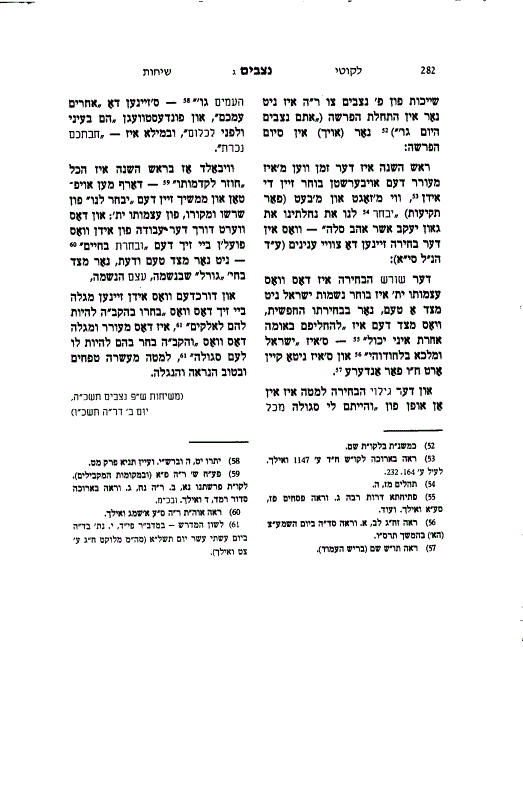
Likkutei Sichos Vol. 19 – Nitzavim 3
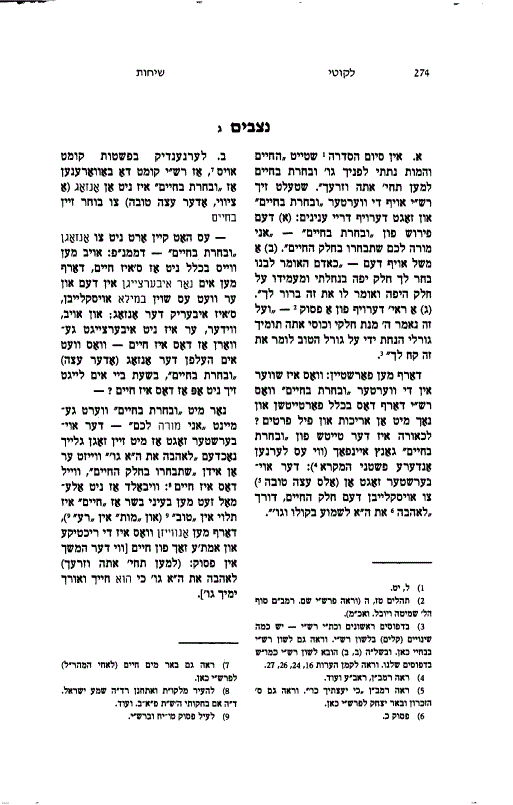
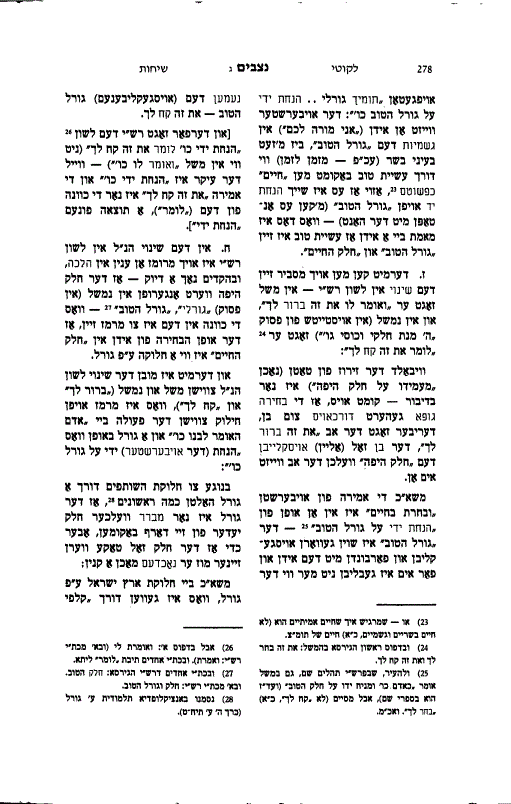
1. At the conclusion of the parsha, it states, "I have set before you life and death... and you shall choose life, so that you and your offspring will live." Rashi comments on the words "and you shall choose life" and provides three explanations: (a) The interpretation of "and you shall choose life" is "I instruct you to choose the portion of life." (b) A parable for this: like a person who says to his son, "Choose a good portion in my inheritance," and he places him on the good portion and says to him, "Choose this for yourself." (c) A proof from a verse: "The L‑rd is my allotted portion and my cup; You support my lot. You have placed my hand on the good lot, saying, 'Take this for yourself.'"
We need to understand: What is difficult about the words "and you shall choose life" that Rashi needs to explain them at all, and with such length and detail? Seemingly, the meaning of "and you shall choose life" is quite simple (as other commentators on the peshat of the text explain): The A-lmighty is advising (as good advice) to choose the portion of life, through loving the L‑rd your G‑d, listening to His voice, etc.
2. When learning it simply, it appears that Rashi is warning that "and you shall choose life" is not a command (an instruction or good advice) to choose life. There is no need to command "and you shall choose life" — because logically: if one does not know at all that it is life, he only needs to be convinced of it, and he will naturally choose it, so the command is superfluous; and if, on the other hand, he is not convinced that this is life, how will the command (or advice) "and you shall choose life" help him, when he does not perceive it as life?
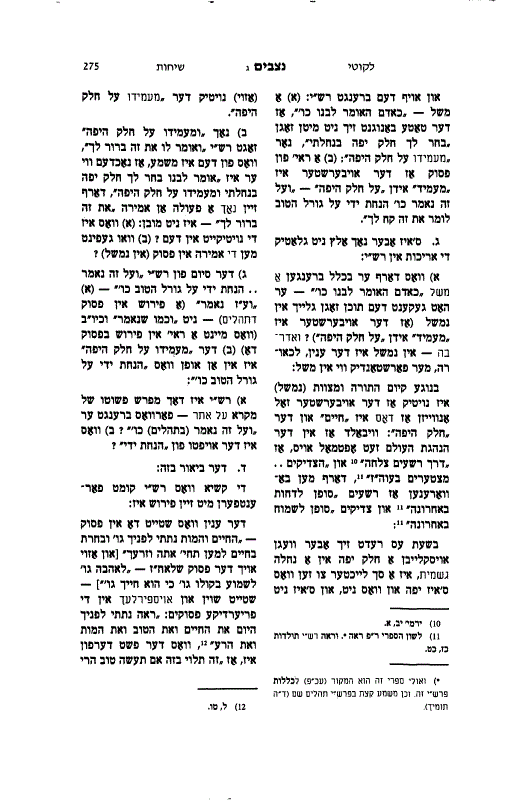
Rather, with "and you shall choose life," it means "I instruct you" — the A-lmighty is saying that with His statement immediately following, "to love the L‑rd your G‑d, etc.," He shows the Jew "that you should choose the portion of life," because this is life. Since not always can one see with physical eyes that "life" depends on "good" (and "death" on "evil"), it is necessary to indicate what is the correct and true aspect of life [as the continuation of the verse states: (so that you and your offspring will live) to love the L‑rd your G‑d, etc., for He is your life and the length of your days, etc.].
And for this, Rashi brings: (a) A parable — "like a person who says to his son, etc.," where the father does not suffice with saying, "Choose a good portion in my inheritance," but rather "places him on the good portion"; (b) A proof from a verse that the A-lmighty "places" the Jews "on the good portion" — "and for this it is said, 'You have placed my hand on the good lot, saying, 'Take this for yourself.''"
3. However, the length in Rashi is still not smooth:
1. Why does Rashi need to bring a parable, "like a person who says to his son, etc."? He could have conveyed the content directly in the nimshal (that the A-lmighty "places" the Jews "on the good portion"). On the contrary, in the nimshal, the matter seems more understandable than in the parable:
Regarding the observance of Torah and mitzvos (nimshal), it is necessary for the A-lmighty to indicate that it is necessary to "place him on the good portion."
2. After "places him on the good portion," Rashi says, "and tells him, 'Take this for yourself,'" which implies that after he says to his son, "Choose a good portion in my inheritance," and places him on the good portion, there must be an additional action with the statement "Take this for yourself." It is not understood: (a) What is the necessity for this? (b) Where is this statement found in the verse (in the nimshal)?
3. The conclusion of Rashi, "And for this it is said, 'You have placed my hand on the good lot, etc.'" — (a) "And for this it is said" — not "And as it is said" or similar (which would imply a proof in the explanation of the verse here). (b) The "places him on the good portion" is in a manner of "You have placed my hand on the good lot, etc.":
(a) Rashi is a commentator on the simple meaning of the text on the spot — why does he bring "And for this it is said, etc."? (b) What is the purpose of "You have placed my hand"?
4. The explanation of this:
The question Rashi comes to answer with his commentary is:
The matter stated here in the verse — "I have placed before you life and death, etc., and you shall choose life so that you and your offspring will live" [and similarly the verse that follows — "to love, etc., to listen to His voice, etc., for He is your life, etc."] — is already stated explicitly in the previous verses: "See, I have placed before you today life and good, and death and evil," whose simple meaning is that this depends on that: if you do good, you have life, and if you do evil, you have death. And as the verse subsequently explains, "that I command you today to love, etc., and you shall live and multiply, etc., and if your heart turns away, etc., I declare to you, etc."
Why does the verse repeat it here again?
Therefore, Rashi learns that the novelty in the content of the verse here is emphasized in the words "and you shall choose life" (which do not appear earlier).
What is the novelty? Rashi brings a parable — "like a person who says to his son, etc., and places him on the good portion and tells him, 'Take this for yourself,'" which helps us understand that there is a parable where even after "places him on the good portion," a statement "Take this for yourself" is required (as will be explained):
And similarly in our matter: the "I instruct you to choose the portion of life" from our verse is like the "tells him" that comes after "places him on the good portion" — after the Torah explains in the previous verses that "if you do good, you have life," there must first be an instruction "and you shall choose life."
5. From what we find (in the parable), that after giving a "good portion" (in his inheritance), one must first "place" him "on the good portion," it is understood that this is about an inheritance where it is difficult to know (from the outset).
6. From an external perspective, it might not be immediately clear which is the "good portion" in it — and therefore the giver must "place him on the good portion."
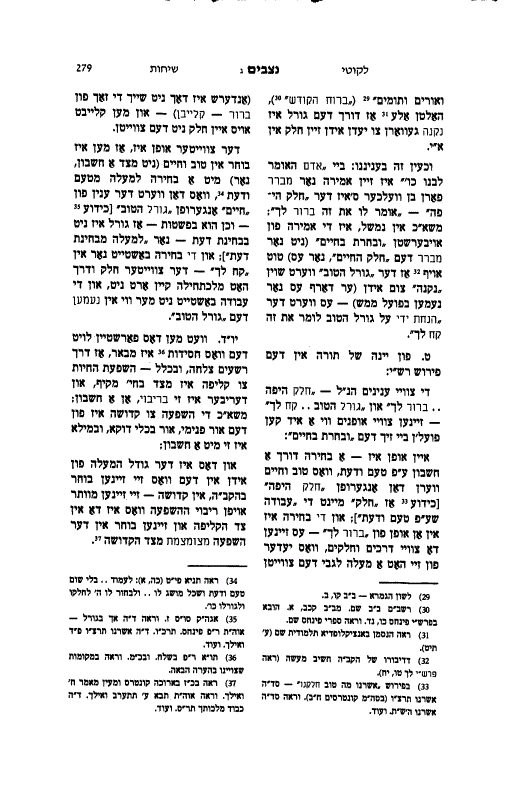
This can also explain the precision in the parable, "like a person who says to his son, etc." (and not "to his friend"): The certainty of the recipient that the giver is placing him on the good portion is connected with two things — (a) the giver clearly knows what the good portion is; (b) the giver genuinely desires the recipient's benefit with all his heart and is therefore willing to give him the good portion of his inheritance. These two certainties are emphasized in the parable: (a) The portion is "my inheritance" — belonging to the giver, and therefore he has a clear understanding of it; (b) he gives it "to his son," as a father is (more than anyone else) willing to give his son the good portion of his inheritance.
Similarly, in the analogy concerning the relationship between the Almighty and the Jewish people: In order for Jews to internalize that "life" and "good" are "interdependent" — even though with physical eyes it is not always visible — they are told to contemplate two things: (a) The world is "My inheritance" — from the Almighty, the Creator and Ruler of the universe, and therefore He knows what the true path of "life" is. (b) Jews are "children... to the L‑rd your G‑d."
Since they can be certain that the Almighty seeks only their benefit.
However, since one does not see the "good portion" with physical eyes and relies on the word of the giver, it is understood that the giver does not suffice with "placing him on the good portion," but rather he again urges the recipient and tells him once more to take the good portion; and this is what he adds — "and tells him, 'Take this for yourself.'"
Similarly, in our matter, even after explaining to the Jews that "life" and "good" are "interdependent," and they are placed on the good portion, a special urging is still required from Above: "And you shall choose life, so that you and your offspring will live," so that Jews will completely rely on the Almighty and choose the "portion of life."
7. However, one might ask — seemingly the parable is not similar to the analogy:
In the parable, it is understood how the urging "Take this for yourself" affects the son, because
In the case of the son, he does not have an absolute knowledge of the quality of the inheritance from his father — to know what is the good portion of the inheritance. Therefore, it is sufficient for him to accept the assurance and urging of the giving father.
However, in the analogy, not only is it that one does not (always) see the "placing him on the good portion" ("if you do good, you will have life") in a physical sense (to the extent that it can sometimes mean "life" in the World to Come), but furthermore: with physical eyes, one sometimes sees the opposite, that "the way of the wicked prospers" and "the lips of a strange woman drip honey" — the pleasure of worldly delights is felt with the physical senses, and the fact that "its end is bitter as wormwood" is only something he believes or (at most) understands intellectually.
So how can the urging, which the Almighty states (through Moses) in His Torah "And you shall choose life," effectively influence a person to abandon matters of physical life and instead choose the good and life of Torah and mitzvos?
On this, Rashi continues — "And concerning this, it is said, 'The L‑rd is my allotted portion and my cup; You support my lot. You have placed my hand on the good lot, saying, Take this for yourself.'"
"And you shall choose life" is not merely a statement, but through it, it is also accomplished "You support my lot... You have placed my hand on the good lot": the Almighty shows the Jews ("I instruct you") in a physical sense the "good lot," to the extent that one sees with physical eyes (at least from time to time) how through doing good, one receives "life" in the literal sense, so that it is possible to place one's hand on the "good lot" (to tap it with the hand) — which affirms for a Jew that doing good is his "good lot" and "portion of life."
7. This can also explain the change in Rashi's wording — in the parable, he says "and tells him, 'Take this for yourself,'" and in the analogy (in the interpretation of the verse "The L‑rd is my allotted portion and my cup") he says "saying, 'Take this for yourself.'"
Since the urging from the father (after "placing him on the good portion") is only verbal — it follows that the choice itself entirely belongs to the son. Therefore, the father says, "Take this for yourself," so that the son will (on his own) choose the "good portion" which the father points out to him.
However, the statement from the Almighty "And you shall choose life" is in the manner of "You have placed my hand on the good lot" — the "good lot" has already been chosen and connected with the Jew, and for him, nothing remains but to take the (chosen) good lot — "Take this for yourself."
8. Therefore, Rashi uses the wording "You have placed my hand, etc., saying, 'Take this for yourself'" (not as in the parable "and tells him, etc.") — because the main point is "You have placed my hand, etc." and the statement "Take this for yourself" is merely the intention of this ("saying"), a result of the "You have placed my hand."
The above change in Rashi's wording also hints at a matter in halacha, and to preface with another precision — that the beautiful portion is referred to in the analogy (in the verse) as "my lot," "the good lot" — the intention of which is to hint that the manner of choice for Jews in the "portion of life" is like a division by lot.
This clarifies the above-mentioned change in wording between the parable and the analogy ("clarify for yourself" and "take for yourself"), which hints at the difference between the action in "a man who tells his son, etc." and a lot in the manner of "You have placed (the Almighty) my hand on the lot, etc.":
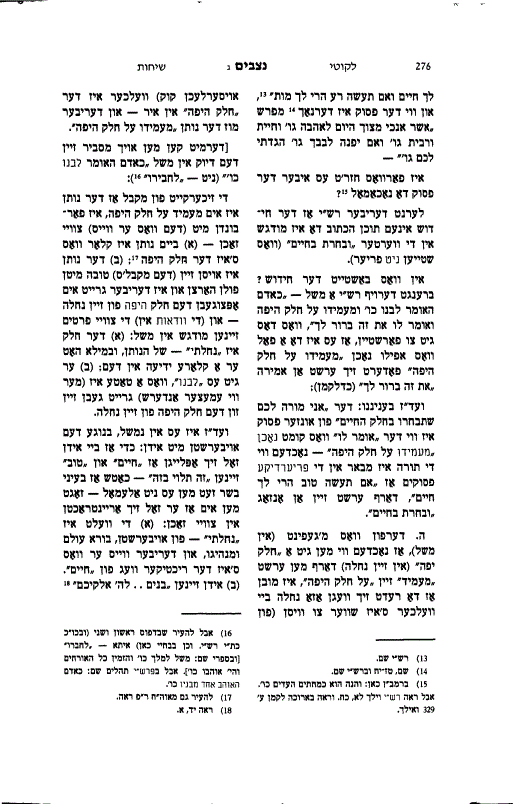
Regarding the division of partners through a lot, several Rishonim hold that the lot only clarifies which portion each of them should receive, but for the portion to actually become theirs, they must subsequently perform an acquisition.
However, in the division of the Land of Israel by lot, which was done through "lots and the Urim and Thummim," all agree that through the lot, each Jew acquired his portion in the Land of Israel.
Similarly, in our matter: in "a man who tells his son, etc.," his statement only clarifies for the son which is the "beautiful portion" — he tells him, "This clarify for yourself"; whereas in the analogy, the statement from the Almighty "And you shall choose life" not only clarifies the "portion of life," but it also effects that the "good lot" is already acquired by the Jew (he only needs to take it in actual practice) — it becomes the placing of my hand on the good lot, saying, "Take this for yourself."
9. From the wine of Torah in this explanation of Rashi:
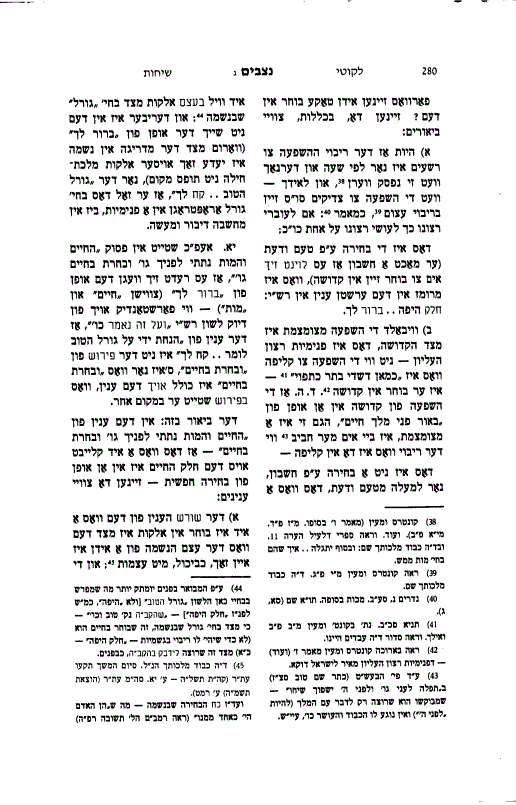
The two aforementioned concepts — the "beautiful portion... clarify for yourself" and the "good lot... take for yourself" — are two ways in which a Jew can achieve within himself the "And you shall choose life."
The first way is through a choice based on reason and understanding (otherwise, the concept of clarification — choosing — is not applicable), where one selects one portion and not the other.
The second way is that one chooses good and life (not based on calculation, but) with a choice beyond reason and understanding, which then makes the concept of "life" called the "good lot" [as is known — and it is simple — that a lot is not within the realm of understanding, but "beyond the realm of understanding"]; and the choice consists only of "take for yourself" — the other portion and path have no place from the outset, and the work consists of no more than taking the "good lot."
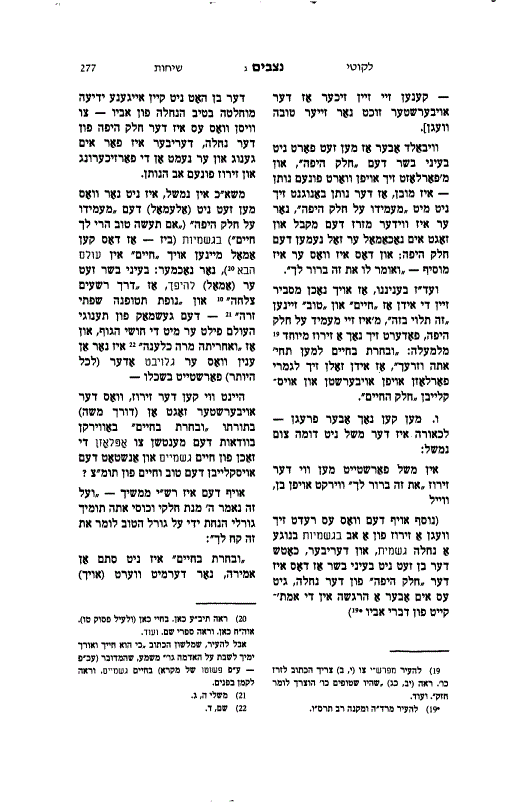
10. This can be understood according to what Chassidus explains, that the way of the wicked prospers, and in general — the flow of vitality to the klipah is from the aspect of makif, and therefore it is abundant, without calculation; whereas the flow to holiness is from the inner light, light within a vessel specifically, and therefore it is with calculation:
11. And this is the great virtue of the Jews in that they choose in the Holy One, blessed be He, in holiness — they forgo the abundant influence that exists on the side of the klipah and choose the limited influence from the side of holiness.
Why do Jews indeed choose this? There are, in general, two explanations:
1) Since the abundant influence to the wicked is only temporary and will eventually cease, whereas the influence to the righteous will ultimately be exceedingly abundant, as the saying goes: "If for those who transgress His will it is so, how much more so for those who fulfill His will." This is the choice based on reason and understanding (he calculates that it is worthwhile for him to choose holiness), which is hinted at in the first concept in Rashi: "the good portion... clarify for yourself."
2) Since the limited influence is from the side of holiness, which is the inner will of the Supreme — unlike the influence to the klipah, which is "as one who throws it behind his back" — he chooses holiness. That is, the influence from holiness is in a manner of "in the light of the king's countenance is life," and although it is limited, it is more cherished by him than the abundance that exists in klipah. This is not a choice based on calculation, but beyond reason and understanding, because a Jew inherently desires G‑dliness from the aspect of the "lot within the soul"; and therefore, in this, the manner of "clarify for yourself" is not applicable (because from the level of the soul, anything outside of G‑dliness does not take up space at all), but rather the "good lot... take for yourself," so that he should bring this aspect of the lot into an inner dimension, even into thought, speech, and action.
12. Nevertheless, the verse states, "I have set before you life and death... and you shall choose life," which speaks of the manner of "clarify for yourself" (between "life" and "death") — as is also understood from the precise wording of Rashi, "and on this it is said," that the concept of "I have placed My hand on the good lot to say... take for yourself" is not the explanation of "and you shall choose life," but rather that "and you shall choose life" also includes this concept, which is explicitly stated elsewhere.
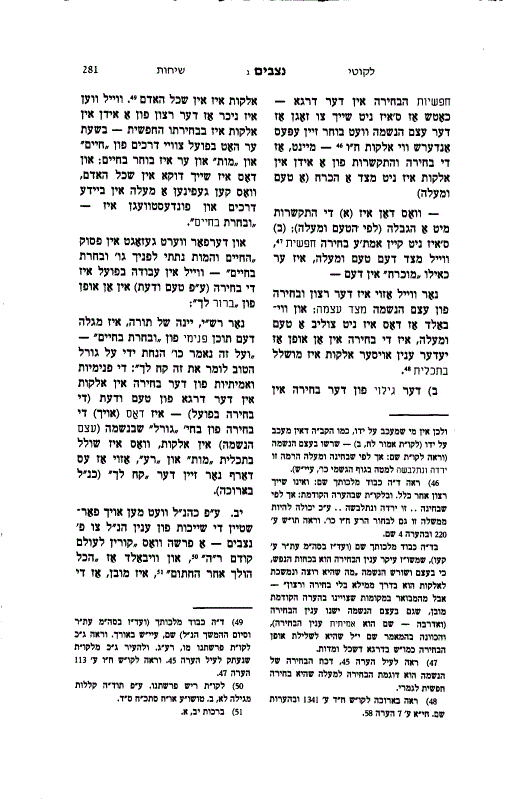
13. The explanation in this matter: Regarding the concept of "I have set before you life and death... and you shall choose life" — the fact that a Jew chooses the portion of life is in a manner of free choice — there are two aspects:
a) The root of the matter that a Jew chooses G‑dliness is because the essence of a Jew's soul is one with the Essence, as it were; and the freedom of choice at this level — although it is not applicable to say that the essence of the soul would choose anything other than G‑dliness, G‑d forbid — means that the choice and connection of a Jew to G‑dliness is not due to necessity (a reason or advantage).
— For then (a) the connection would be limited (according to reason and advantage); (b) it would not be a true free choice, because from the perspective of reason and advantage, he is as if "compelled" in this —
but because this is the will and choice of the essence of the soul from itself; and since this is not due to a reason or advantage, the choice is in a manner that anything outside of G‑dliness is completely negated.
b) The revelation of this choice in G‑dliness is in the intellect of man. For when is it evident that a Jew's desire is G‑dliness in his free choice? When he actually has two paths of "life" and "death" and he chooses life; and this is relevant specifically in the intellect of man, which can find an advantage in both paths, and nevertheless — "and you shall choose life."
And therefore, it is stated in the verse "I have set before you life and death... and you shall choose life" — because in actual service, the choice (according to reason and understanding) is in a manner of "clarify for yourself";
11. Only Rashi, the wine of Torah, reveals the inner content of "and you shall choose life" — "and regarding this it is said... I have placed My hand on the good lot, saying, 'Take this for yourself'": The inner and true choice in G‑dliness at the level of reason and understanding (the actual choice) is also the choice of the aspect of "lot" in the soul (the essence of the soul) in G‑dliness, which completely negates "death" and "evil," so that there only needs to be the "take for yourself" (as explained at length above).
12. Based on the above, we can also understand the connection of this matter to the portion of Nitzavim — a portion that is "always read before Rosh Hashanah," and since "everything follows the conclusion," it is understood that the connection of the portion of Nitzavim to Rosh Hashanah is not only in the beginning of the portion ("You are standing today...") but also in the conclusion of the portion:
Rosh Hashanah is the time when we awaken the Almighty to choose the Jewish people, as we say and request (before the sounding of the shofar), "He will choose for us our inheritance, the pride of Jacob whom He loved forever" — and in this choice, there are two aspects (as mentioned above in section 11):
The root of the choice is that His essence chooses the souls of Israel not because of any reason, but in His free choice, which is why "I cannot exchange them for another nation" — it is "Israel and the King alone," and there is no place, G‑d forbid, for others.
And the revelation of the choice below is in the manner of "and you shall be to Me a treasured nation from all the peoples" — there are others with you, and nevertheless, they are considered nothing before Me, and therefore — your dearness is evident.
Since on Rosh Hashanah "everything returns to its original state" — we must achieve and draw down the "He will choose for us" from its root and source, from His essence; and this is accomplished through the service of the Jews who effect within themselves the "and you shall choose life" — not only from the perspective of reason and understanding, but from the aspect of "lot" in the soul, the essence of the soul.
And through this, that the Jews reveal within themselves that they have chosen the Holy One, blessed be He, to be their G‑d, this arouses and reveals that the Holy One, blessed be He, has chosen them to be His treasured nation, below ten handbreadths and with visible and revealed good.
(From the talks of the portion of Nitzavim 5725, Monday of the week of the portion of Nitzavim 5726)