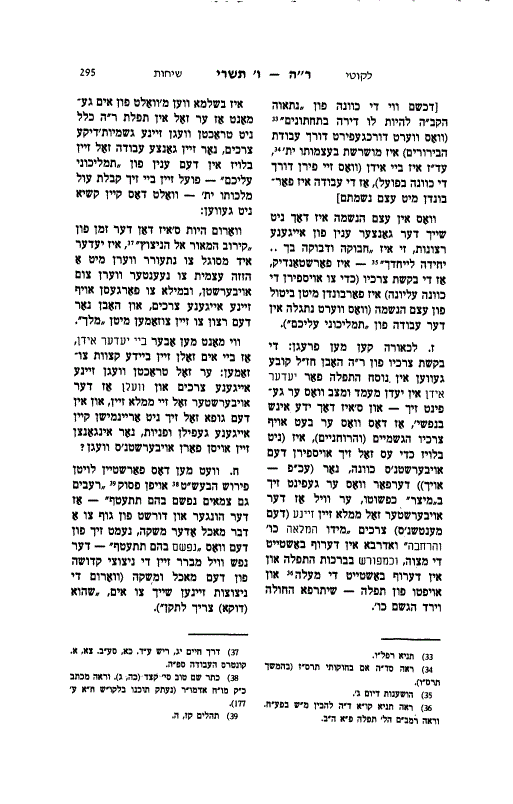
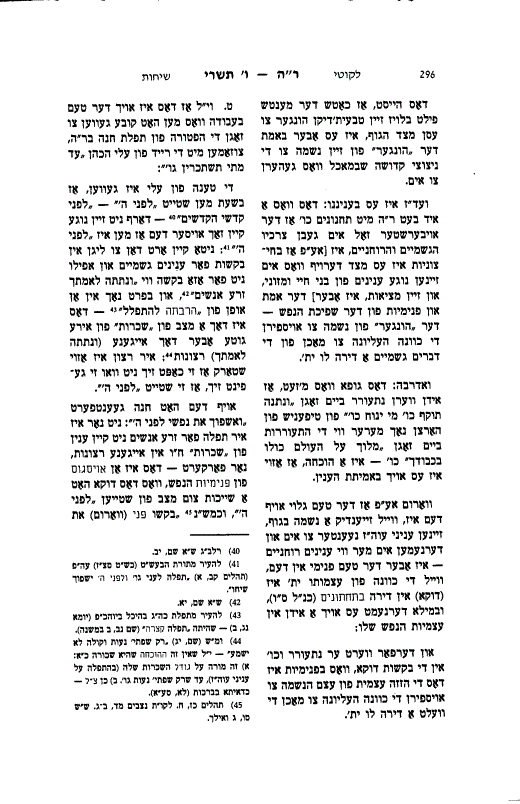
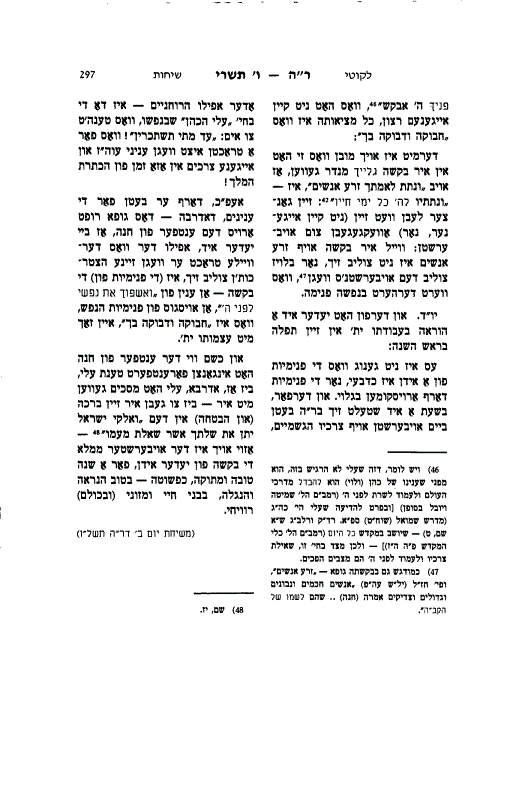
Likkutei Sichos Vol. 19 – Rosh Hashanah / Vav Tishrei
1. This concept will be understood in light of the difference between Rosh Hashanah and Yom Kippur regarding the theme of "Crown Me as your King." As mentioned, Rosh Hashanah and Yom Kippur share a common point — the "Crown Me as your King" of Rosh Hashanah unfolds throughout the Ten Days of Repentance, reaching its completion and culmination on Yom Kippur (hence, we say "the Holy King" throughout the Ten Days of Repentance). However, the distinction between them is as follows:
On Rosh Hashanah, the "Crown Me as your King" is accomplished at its root and primary source — at that time, we awaken the delight and will of His Essence in kingship, and the Jewish people have the power to effect this because they are rooted in His Essence. During the Ten Days of Repentance, the building of the Sefirah of Malchus (Kingship) is accomplished, culminating on Yom Kippur, when the building of Malchus is complete, and the concept of "Crown Me as your King" then shines in a revealed manner below.
Since the "Crown Me as your King" is achieved "when the heads of the people gather" — through the unity of the Jewish people — it is understood that corresponding to the aforementioned difference between Rosh Hashanah and Yom Kippur regarding "Crown Me as your King," there is also a difference between them concerning the unity of all Jews:
The unity of all Jews on Rosh Hashanah is primarily as their unity is above — in their root and source; whereas on Yom Kippur, this unity is revealed below.
This also explains the incomparable superiority of Yom Kippur over Rosh Hashanah:
The unity of all Jewish souls in their root and source is not in a manner of complete novelty and achievement, because there, initially, there is no place for division and differences in levels — like a circle "that has no beginning or end."
The true achievement of unity is when one creates unity from division, when unity is achieved where there are differences in levels and separation — and specifically, the unity from division expresses the true simple unity above, because it is precisely from the simple unity…
6. The aforementioned difference in the unity of Jews between Rosh Hashanah and Yom Kippur is also reflected in their relationship to the concept of teshuvah (repentance):
On Rosh Hashanah, we do not recite confessions or the like; in the prayers of Rosh Hashanah, there is no mention (through confession) of sins, nor even of forgiveness and atonement. In contrast, Yom Kippur is the "Day of Forgiveness and Atonement," and we recite confessions, etc. The reason for this difference can be explained as follows:
The service of Rosh Hashanah is the return from the essence of the soul as it is rooted in the Essence, even higher than the root of Torah and mitzvos. From this level, there is initially no place for sins. Therefore, it is also not relevant to speak of forgiveness and atonement, not even about the elevation of "sins becoming merits," etc. At this time, there is the free choice of the Essence in the souls of Israel, which arouses the pleasure and will in "Crown Me as your King."
However, on Yom Kippur, the root and essence of the soul is revealed below, in the place where sins are relevant, etc. — and there, the "essence of the day of Yom Kippur atones," due to the connection of the essence of the soul with G‑dliness that is revealed on Yom Kippur. This revelation brings about atonement and forgiveness for sins, etc.
This also provides an explanation and sweetening of why specifically on the "night of Yom Kippur, it is customary that before praying, we permit all transgressors":
7. On Rosh Hashanah, one can elevate themselves above the place where "transgressors" and transgressions have an impact. However, at that time, it is not relevant to pray with them or to connect and unite with them in their current state as "transgressors" here below.
Specifically on Yom Kippur, we reach the true state of "they all become one group" — that even Jews who are still, for the time being, in the state of "transgressors" become united with all Jews, and we pray with them "as one group."
8. Because the unity on Yom Kippur extends to Jews as they are below, it is therefore expressed not only in matters of the soul but also in matters of the body:
In the five afflictions of Yom Kippur, there is no distinction between one Jew and another. In the fulfillment of a positive mitzvah, which involves action and performance, there are differences in the manner and level of fulfillment between great tzadikim and simple people, etc. However, in the matter of affliction and abstention — in the "not," in the absence — there is no difference between one Jew and another.
Similarly, in the inner dimensions: the "to sustain them in famine" — the "life-force" that comes from the essence itself — is equal for everyone.
9. However, the service of Rosh Hashanah, although it stems from the essence of the soul, which is beyond division, is only during the time of the service itself (such as prayer, etc.). But after the prayer, when one departs from the service and engages in "eat the fat and drink the sweet," the eating and drinking are different for each individual.
8. This also highlights the incomparable advantage of Parshas Vayelech over Parshas Nitzavim:
In Parshas Nitzavim, the discussion is about the unity of all Jews (from "your heads, your tribes" to "your woodcutters and water drawers") as it comes from the fact that they are "standing today before the L‑rd your G‑d," which means that they all elevate to their source above ("before the L‑rd your G‑d").
However, Parshas Vayelech speaks about the unity as it is revealed among Jews below, as they stand in their own levels. This is the intention of the verse "And Moses went and spoke to all of Israel" — Moses, in his level, went and was drawn to all Jews as they stand in their level. Yet, on the other hand, it is the same going and drawing to all of Israel equally, because
This is the connection of the essence of the soul above with the soul as it is below.
Similarly, in the matter of Hakhel: On one hand, our Sages say that "men come to learn, women come to listen, children... to give reward to those who bring them," which indicates that the unity of Hakhel allows for differences in levels (unlike the unity of Rosh Hashanah as mentioned above). However, specifically in this manner of Hakhel (with the aforementioned differences in levels), the king stands and reads the Torah — the reading of the Torah by the king encompasses the entire congregation of Israel equally. This calls forth and draws the simple unity of all Jews (the congregation) into the place of differences in levels as mentioned above.
Until he concludes in the parsha, "And Moses spoke in the ears of all the congregation of Israel until their completion" — the inner meaning of this is that "until their completion" refers to the perfection and wholeness of the Jews.
9. The speech of Moses "in the ears of all the congregation of Israel" is not only directed to their essence of the soul above, but it descends and affects completeness and perfection in their revealed faculties, reaching all their limbs and sinews.
10. The lesson from all the above regarding practical application:
The Ten Days of Repentance are an auspicious time to increase in love for a fellow Jew. When the "gathering of the heads of the people" is not complete — when there is a lack in unity with all Jews, regardless of their situation — this is not merely a deficiency in a detail, but it affects the general matter of "crown Me over you" concerning the entirety of the Jewish people.
And since one must prepare for Yom Kippur, the love for every Jew should not only be in a manner where one overlooks another's faults — seeing only the good in them and therefore loving them and uniting with them — but even when one sees the faults in another, they should still express love for them without calculation. This love should manifest in great involvement and extraordinary effort to help the other nullify their faults.
And through engaging in the campaign of "Ahavas Yisrael" during these days, one merits the revelation of "crown Me over you," receiving a good and sweet inscription and seal on Yom Kippur, for a good and sweet year, both materially and spiritually, in visible and revealed good.
(From the sichah of Shabbos Parshas Vayelech, 5732)
1. In the verse "And Moses called to Joshua and said to him, 'Be strong and courageous, for you shall come with this people to the land which the L‑rd has sworn to give them, and you shall cause them to inherit it,'" Rashi comments on the words "for you shall come with this people" by explaining: "For you shall come with this people" — Moses said to Joshua, "The elders of the generation will be with you; everything according to their opinion and counsel." But the Holy One, blessed be He, said to Joshua, "For you shall bring the children of Israel to the land which I have sworn to give them; you shall bring them even against their will, etc." (as will be explained in section 4).
What is difficult in the verse that compels Rashi to bring the language of the Targum and the entire length of his explanation?
Commentators say that Rashi comes to resolve the contradiction between the two verses — in the language of the Gemara: "It is written, 'for you shall come with this people...'"
2. The Gemara's answer is that here (in "for you shall come") it refers to what Moses said to Joshua ("The elders of the generation will be with you, etc."), while there it recounts what the Holy One, blessed be He, said to Joshua ("You shall bring them even against their will, etc.").
However, it is difficult to simply learn this in Rashi because:
a) If this were the case, Rashi should have begun his commentary with "And later it says, 'for you shall bring, etc.,'" similar to how he writes in other places.
b) Rashi should have only brought the word "תבוא" ("you shall come") in the heading of his commentary (or "תבוא את העם" — "you shall come with the people"). Why does he quote all the words "כי אתה תבוא את העם הזה" ("for you shall come with this people")?
c) Most importantly, before learning the subsequent verse "for you shall bring, etc.," there is no difficulty. Rashi should have addressed (not our verse, but) the verse "for you shall bring, etc.," where the contradiction arises.
3. The explanation is: By quoting in the heading of his commentary also the words "כי אתה תבוא גו'" ("for you shall come, etc."), Rashi emphasizes that the words "you shall come with this people" serve as a reason for what is stated earlier in the verse — "be strong and courageous."
This raises a question: How is "you shall come with this people" a reason for "be strong and courageous"?
[One could forcefully say that this follows from earlier, where Moses strengthens all the Jews, so that when entering the Land of Israel, they should not fear "these nations" — "be strong and courageous, do not fear them." Similarly, when instructing Joshua that he will enter the Land of Israel (just like all the Jews), Moses strengthens him so that he should not fear these nations.
However, this interpretation is very forced: From the verse, it is implied that this is a special encouragement that pertains only to Joshua himself.]
And due to this difficulty, one might have thought (at least with difficulty) to interpret that the meaning of "תבוא" here is "תביא" — you will bring them into the Land of Israel, and therefore he needs encouragement.
Similar to what is stated earlier in Deuteronomy: "Strengthen him, for he shall cause Israel to inherit it."
7. To negate this interpretation, Rashi quotes the language of the Targum, indicating that the simple meaning of "you shall come with this people" is "you will enter with this nation" — that Joshua will enter with the Jews, and the word "תבוא" is not to be taken out of its simple meaning.
However, the question remains: What is the reason for "you shall come with this people" in relation to "be strong and courageous"? Rashi continues, "Moses said to Joshua, 'The elders of the generation will be with you, etc.'" From the fact that it states "you shall come with this people" — the people of Israel (who stood before Moses), led by "your heads, your tribes, your elders" — it is certain that the elders "will be with you"; therefore, you have nothing to fear from "and you shall cause them to inherit it," because they will assist you.
8. The reason Joshua needs strengthening is because "and you shall cause them to inherit it," and "you shall come with this people" is part of this strengthening (that "the elders of the generation will be with you").
9. However, we need to understand the continuation of Rashi's words, "The elders of the generation will be with you, all according to their opinion and counsel":
From the fact that Rashi does not suffice with "the elders of the generation will be with you" and adds "all according to their opinion and counsel," it is understood that the elders will not only help him, but everything will be done according to their opinion and counsel; that is, not only will Joshua not have the sole opinion, but on the contrary, the elders will have the entire opinion.
This is puzzling:
a) From where does Rashi derive this in the simple meaning of the text?
b) Furthermore, in the Gemara, the phrase is "you and the elders of the generation with them," meaning Joshua with the elders; and Rashi changes this to "all according to their opinion and counsel"?
c) How can it be said that Moses gave the elders the entire opinion, when Moses himself asked G‑d (in Parshas Pinchas) "May the L‑rd appoint a man over the congregation" and he appointed Joshua "with a generous eye, more and more than he was commanded... with both hands" as the leader of the Jews; and in this very verse it states "and you shall cause them to inherit it," that Joshua will cause the Jews to inherit the Land of Israel — how does Rashi now interpret Moses' words as "all according to their opinion and counsel"?
4. Rashi further states: "But the Holy One, blessed be He, said to Joshua, 'For you shall bring the children of Israel to the land which I swore to them; you shall bring them against their will. Everything depends on you. Take a stick and strike them on the head. One leader for a generation, not two leaders for a generation.'
This is not understood:
a) As mentioned earlier, Rashi only explains what is difficult in the verse at hand. What is difficult in this verse that necessitates Rashi to bring down 'But the Holy One, blessed be He, said, etc.' (the explanation in the subsequent verse 'For you shall bring, etc.')?
b) From the detailed language of Rashi — 'you shall bring them against their will, everything depends on you, take a stick and strike them on the head' — it is clear that not only did the Holy One, blessed be He, negate the conduct of 'everything according to their opinion and counsel' (meaning the elders should not have the entire opinion); and not only should they not remain equal to Joshua, or at least as advisors to him — but furthermore: the elders should not have any opinion at all; Joshua should not consider or even consult with them ('take a stick and strike them on the head').
This is not understood: It is true that since 'one leader for a generation, not two leaders for a generation,' Joshua is the sole 'leader' and guide of the Jews; but from where is it necessary that the elders should not assist him? Even Moses himself had the 'seventy elders' who 'shall bear the burden of the people with you, and you shall not bear it alone'; from which it is derived that such conduct is not contrary to the principle of 'one leader for a generation, not two leaders for a generation' (since ultimately Moses was the 'leader' and ruler) — so where does Rashi find the necessity that for Joshua, even such conduct is negated?
c) What does the conclusion of Rashi's statement 'one leader for a generation, not two leaders for a generation' add to the explanation of the verse?
4. What is the meaning of the phrase "and not two leaders for a generation"? Since Rashi is coming to negate the elders: (a) he should have said "and not many (or similar) leaders for a generation," (b) and on the other hand: how do we actually know that "and not two leaders for a generation" — perhaps it specifically means "and not seventy (and one)," but "two" could be acceptable? Especially since we find: "He is Aaron and Moses, to whom the L‑rd said, 'Bring the children of Israel out of the land of Egypt by their hosts'?"
5. The explanation of all this:
The term "the people (this)" is not a term of praise for the Jews. It follows that with the words "you shall come with the people," the verse means that Joshua will also be together with the least of the Israelites; on the other hand, from the fact that it says "this people," it is understood that the verse refers to the entire nation, including, and certainly, those who stand at the head, the elders as mentioned above.
Therefore, Rashi learns that the verse intends to convey two things:
a) From the fact that it says "this people" — this (indicating with a finger) people, and it is obvious that the elders — it is derived that the "elders of the generation will be with you."
b) From the emphasis of the verse on "the people," it is learned that Joshua will be united ("you — with") also with the least of the Jews. How is this possible? — Rashi explains "everything according to their opinion and counsel": the elders will have the entire opinion, and consequently, Joshua is equal in this (opinion and counsel) with the rest of the people.
6. How does this idea of "everything according to their opinion and counsel" align with the fact that Moses appointed Joshua as the leader of the Jews, as stated in Parshas Pinchas — Rashi clarifies this in his commentary there:
On "who shall go out before them," Rashi explains: "Not like the kings of the nations who sit in their homes and send their armies to war, etc.," meaning Moses requested for the Jews a king who would lead them into battle. Moses had also already instructed that Joshua would inherit (the land of Israel) to the Israelites — the division of the land (which follows the conquest of the land, in war). However, it is not mentioned that Moses requested a leader who would take upon himself "the burden of the people," the leadership in their internal matters.
What will happen with these matters? — For the five-year-old learning the text, there is no question: just as with Moses himself, the seventy elders helped with "the burden of the people," Moses assumed they would continue to do so (on their own). In contrast, a king to lead into battle can only be one person, and for this, Moses requested "a man over the congregation" and he appointed Joshua.
7. Therefore, there is no contradiction between Moses' earlier request for "a man over the congregation" and his statement here of "everything according to their opinion and counsel." This is because he immediately clarified: "You shall cause them to inherit" — this task is solely "yours," and "the L‑rd, He is the one who goes" — which refers to war — is "before you, He will be with you, etc." The "everything" is an exception to the aforementioned, the "burden of the people" [and this also adds to the "be strong and courageous," as he would not need to worry at all about the "burden of the people," as this would be handled by the elders].
However, this is not entirely straightforward, because for the five-year-old learning the text, it seems that Joshua took over the leadership from Moses in all aspects — not just concerning war (and division). Especially since G‑d commanded Moses not only to appoint Joshua but also to "bestow some of your majesty upon him so that the entire congregation of the children of Israel will listen." And G‑d said, "Command him, for Israel are troublesome and stubborn, etc." From all this, it implies that Joshua also took over the "burden of the people."
One might have to answer with difficulty that since it was (only) according to the "opinion and counsel" of the elders, but the actual implementation was done by Joshua, it is also considered leadership.
Rashi dismisses this difficulty and continues by explaining that the phrase "you shall bring this people" — that the elders of the generation will be with you, everything according to their opinion and counsel — is only what Moses said. But the Holy One, blessed be He, said to Joshua, "For you shall bring them against their will, etc." — that he would also lead with the "burden of the people."
8. In addition to the difference that here it says "you shall bring" and there "you shall cause to inherit," there is another difference between the two verses: here it says "this people," and there it says "the children of Israel." "The children of Israel" is a term of distinction for the Jews (unlike "this people," as mentioned above in section 5).
9. From the fact that the verse changes from earlier, where it says "the children of Israel" in the context of "you shall bring," Rashi derives that this adds another dimension: not only will Joshua lead with the "burden of the people" from the general community of Israel, but he will also have authority over the distinguished individuals among the Jews, the elders.
Therefore, not only is it that "you shall bring them against their will, everything depends on you" — unlike with Moses, where the elders shared with him the "burden of the people" — but everything will depend on Joshua. Moreover, "take a staff and strike them on their heads": Joshua's authority ("staff") extends over the elders just as it does over all other Jews; the elders will not have any opinion or counsel in the "burden of the people."
10. According to this, it turns out that Joshua's leadership is the exact opposite of Moses' leadership: with Moses, the elders assisted with the "burden of the people," while with Joshua, they had no say at all. This is not straightforward: after all, Joshua was the servant of Moses, who "did not depart from the tent," and "the face of Moses was like the sun, and the face of Joshua like the moon," whose light is from the light of the sun. How is it that his leadership should be contrary to that of his teacher, Moses?
On this, Rashi continues, "One leader for a generation and not two leaders for a generation" — with this, Rashi hints (not only at the authority over the elders but also) at Moses himself:
During Moses' lifetime, Joshua was the servant of Moses and completely devoted to Moses and his leadership. However, when the time comes for Joshua to become the leader, there is no longer a place for the path and leadership of Moses. In Joshua's time, one must conduct oneself according to Joshua's nature — because if Joshua were to lead like Moses, it would result in "two leaders": Joshua and Moses.
And since "one leader for a generation and not two leaders for a generation," Joshua's leadership is different from Moses' leadership: Moses delegated (through "and you shall bestow") part of the "burden of the people" to the elders, but Joshua does not need to rely on them.
— And the fact that during the Exodus it was "Aaron and Moses" (as mentioned above in section 4) is because there it was not a matter of "a leader for a generation," but rather to carry out a mission (precisely in its details) of bringing "the children of Israel out of the land of Egypt."
11. From the wine of Torah in Rashi:
It is stated in Chassidus that in Joshua there are two levels: a) as he is a servant (and receives from) Moses. b) as he is on his own (after the passing of Moses), at which point he is in the aspect of a youth and smallness.
12. However, there is a distinct advantage specifically in the aspect of being a "youth and smallness" — as it is written, "For Israel is a youth (and precisely because of this) and I love him." This is because specifically in the state of being a youth and smallness, there exists a greater level of self-nullification and acceptance of the yoke of the Kingdom of Heaven than in the service that comes from greatness (in intellect and heart). Therefore, it is specifically in this state that the "and I love him" from the Essence of G‑d is found.
This is the difference between the two verses: "You shall come with this people" refers to Joshua receiving from Moses, and from the perspective of Moses' level, the matter of the elders (those who have acquired wisdom) is relevant, which is a service according to reason and understanding. However, "You shall bring the children of Israel" are the words of G‑d to Joshua, from the perspective of Joshua's advantage of self-nullification — "For Israel is a youth and I love him" — and from this self-nullification beyond reason and understanding, there is no need to rely on those who have acquired wisdom.
It can be suggested that this is also hinted at in the difference between the letters of "תבוא" (you shall come) and "תביא" (you shall bring) — "תבוא" is with a vav, and "תביא" with a yud:
The "vav" indicates a drawing down from above to below — which is an extension outside of the "essence," and therefore with measurement and limitation; in service, this is the service according to reason and understanding, where one must rely on the "elders" who ensure that the extension comes to the appropriate place.
The "yud," which is merely a point, indicates self-nullification, and from this service, there is no need to rely on the "elders." On the contrary, through the yud, the aspect of self-nullification is also accomplished in the elders, "you shall bring them against their will... take a staff and strike it upon their heads."
11. From the practical directives regarding Rashi's interpretation:
When it is demanded in our times that everyone must dedicate time to spreading Torah and Judaism (in general, and...
12. Particularly in the context of the well-known Ten Mitzvah Campaigns, and that all of this must be permeated with "your wellsprings shall spread outward" — there are those who argue that in previous generations, such conduct did not exist. In earlier generations, there was no such emphasis on Ahavas Yisrael (love for a fellow Jew). Since until recent years, when the Rebbe, my father-in-law, came to America, this conduct was not present — how can it be that we should begin to introduce "new" forms of service?
To this, the response is "One leader for a generation and not two leaders for a generation": It may indeed be that in previous generations, there was no need for such a form of service, but in our generation, it is necessary.
And as an example from the saying (and directive) of our Sages, "When they came to Babylon (and similarly — to Babylon in time), they found a valley and built a fence there."
And the Rebbe, the leader, says that in our times it is essential to be involved in spreading the wellsprings outward. Furthermore, in the famous letter of the Baal Shem Tov — that in this depends the coming of Moshiach —
one must conduct oneself according to the path of the "leader" and guide of the generation,
so that everyone in this generation must engage in this service, and through this, "the master will come, the king Moshiach," very soon.
(From the talks of Shabbos Parshas Nitzavim, 5730, Shabbos Parshas Haazinu, 5731)
14. Rashi's comment "when it was completed in its entirety" is understood: to prevent the misunderstanding (since the verse narrates how Moses wrote it and gave it) that Moses only wrote the Torah up to that portion and not beyond, and gave an incomplete Torah. Therefore, Rashi states that he gave it "when it was completed in its entirety."
This also explains why Rashi includes the word "and he gave it" in his commentary, rather than simply stating "and Moses wrote it, in its entirety." From the word "and he wrote" alone, there is no necessity to say that it was "in its entirety." However, since the verse states "and he gave it," it compels us to say that "and he wrote" means "in its entirety," because Moses would not give an unfinished Torah.
However, the conclusion of Rashi's commentary, "he gave it to the sons of his tribe," is not understood. Seemingly, he is repeating what is already stated in the verse itself — "and he gave it to the priests, the sons of Levi, who carry the Ark of the Covenant of the L‑rd."
If Rashi's intention is to clarify that "priests" here means (not only priests, but) "the sons of his tribe" — the tribe of Levi in general — it is again difficult: the phrase "the priests, the sons of Levi" appears earlier, as mentioned, and there it means (not the tribe of Levi in general, but) specifically the priests, as the verse continues "for the L‑rd has chosen them to serve Him and to bless in His name, and by their word shall every dispute and every plague be decided" (which refers specifically to the priests). Similarly, the phrase "the priests, the Levites" appears several times in the Torah, and everywhere it means only priests, as Rashi explains the first time: "the priests, the Levites — the priests who come from the tribe of Levi."
So from where does Rashi derive here that "and he gave it to the priests, the sons of Levi" means "to the sons of his tribe" — the entire tribe of Levi?
Even though the verse itself concludes "who carry the Ark of the Covenant of the L‑rd," and those who carried the Ark were the Levites, it can be explained (as the Chizkuni does) that it refers to the priests who prepared the Ark so that the Levites could carry it, and they are the ones who "shall place them" (the sons of Kehat) to their tasks, as stated at the end of Parshas Bamidbar. And although this explanation is not straightforward, it is still closer to the simple meaning of the text than interpreting "the priests, the sons of Levi" to mean not only priests but the entire tribe of Levi.
Especially since one cannot interpret "who carry the Ark of the Covenant of the L‑rd" as the entire tribe of Levi, because only the sons of Kehat carried the Ark.
15. The explanation of this is:
15. Here too (as in the other verses), Rashi learns that "and he gave it to the priests, the sons of Levi" means that the actual giving was only to the priests. However, this raises a question: Moshe Rabbeinu gave the Torah scroll (as the verse concludes) also "to all the elders of Israel," representing all the tribes of Israel, since the elders were their representatives. Therefore, since the giving of the Torah scroll was to all the tribes of Israel, how can it be said that it was only given to the priests, excluding the tribe of Levi?
Therefore, Rashi emphasizes in his commentary: "He gave it to the sons of his tribe," meaning that when Moshe Rabbeinu gave the Torah scroll to the priests, it was intended as a giving "to the sons of his tribe," because the priests represented the entire tribe of Levi, just as all the elders of Israel took it on behalf of all the tribes of Israel.
This is also why the verse adds "(the priests) the sons of Levi," because the Torah scroll was given to them not as priests per se, but because they are "the priests, the sons of Levi," from the tribe of Levi. Being the priests, the "princes" of the tribe of Levi, they are similar to the elders of the tribes of Israel — the representatives of the entire tribe.
Although generally the priests are distinct from the tribe of Levi, forming a separate camp (the Divine Presence) for themselves, the explanation here, according to the simple meaning of the text, is not that they were entirely separated from the tribe of Levi, but that in addition to their status as Levites, they also have the status of priesthood.
From the proofs for this:
a) Rashi brings at the beginning of Parshas Behaaloscha: "Why was the section of the Menorah juxtaposed to the section of the princes? Because when Aharon saw the dedication of the princes... that he and his tribe were not with them, the Holy One, blessed be He, said to him: 'By your life, yours is greater than theirs, for you will light and prepare the lamps.'" From this, it is evident that although the matter of lighting and preparing the lamps pertains only to Aharon (priesthood), it is nevertheless a participation of the entire tribe — the very fact that it alleviated the distress of "neither he nor his tribe..."
2. After the dispute of Korach, G‑d said to Moshe: "Take from them a staff, one staff for each father's house, twelve staffs in total, and write Aharon's name on the staff of Levi, for there is one staff..." As Rashi explains: "For there is one staff — although I have divided them into two families, the family of the priesthood separately and the Levites separately, nevertheless, they are one tribe."
4. According to this, it is understandable — also in the context of halachic teaching — that with the words "(the priests) the sons of Levi," the verse (at the end of Parshas Shoftim) includes those with blemishes (as mentioned earlier in section 1):
Just as those with blemishes, although they are priests and even eat from the most sacred offerings — which their consumption atones — are nevertheless considered "outsiders" in relation to unblemished priests, as it is stated in the Jerusalem Talmud: "He is an outsider, he is blemished," so too are the sons of Levi, although they are "one tribe" with the priests, considered as "outsiders" in relation to the priests. And from this example, "the sons of Levi" includes those with blemishes.
Similarly, in our case: the giving of the Torah scroll to the priests was not due to their (sanctity of the) priesthood alone, but as "priests, the sons of Levi" — as priests who also encompass the aspect of the Levite (even though this includes the aspect of "outsiderness" in relation to the priestly part of them).
5. However, it is still not entirely straightforward: since the priests are indeed separated from the Levites — to the extent that they had a separate camp for themselves — why were they not given the Torah scroll as priests in their own right, and not just as "princes" of the Levites?
This question also applies to the two aforementioned matters — (a) the lighting and preparation of the lamps, which is in place of the "dedication of the Mishkan and the altar," and (b) the staff in the dispute of Korach — why were the priests not separated from the Levites in these instances?
On the contrary: in all three matters, it would seemingly be more logical to distinguish the priests from the tribe of Levi:
1. In our case, even though it is stated regarding the entire tribe of Levi, "They shall teach Your ordinances to Jacob and Your Torah to Israel," meaning that they all must teach Torah to the Jewish people, nevertheless, the priests have a distinct role in this. Specifically about them, it is written, "And you shall come to the priests... and they shall declare to you... according to the Torah which they shall teach you," and "by their word shall every dispute and every plague be decided" (which is not found regarding the Levites in general). Therefore, they should have been given the Torah scroll separately, not together with the Levites.
2. The mitzvah of lighting and preparing the lamps pertains only to the priests, as Rashi explains: "that you light and prepare the lamps," and the Levites are prohibited from this just like all the tribes of Israel. Consequently, there should have been a different participation for the Levites in the dedication of the altar.
3. The argument of Korach, "Why do you exalt yourselves over the congregation of the L‑rd," was not directed at the tribe of Levi — Korach himself was a Levite — but specifically at the priesthood itself, as he says, "and you seek the priesthood as well." The staffs were meant "as a sign" that "they shall no longer complain against the priesthood" — it would have been fitting for the priests to have a staff for themselves.
6. The explanation in the inner dimension of these matters is as follows:
Although both the priests and the Levites were elevated from all Jews to serve the Almighty and to be separated from worldly matters, there is a distinction between them: a priest is not allowed to become impure (and therefore cannot leave the Land of Israel), whereas a Levite does not have this prohibition. This means that a priest is entirely separated from matters that are contrary to holiness and purity; impurity cannot exist within him. In contrast, for a Levite, impurity is not inherently forbidden. However, when he must perform the service of the Levites, he must purify himself.
Similarly, in the levels of "priesthood" and "Levi" that exist within every Jew: the aspect of "priest" is the level in the soul where impurity does not exist (or affect); whereas the aspect of "Levi" is the level where impurity can indeed touch, and the service from this level is to nullify (immersion — the letters of nullification) the impurity.
7. In other words, as expressed in the language of the Tanya (chapter 44): The state (service) of a priest is that of "transformation" (התהפכא), where there is no evil, similar to delicacies "from pleasant and sweet foods." Levites, on the other hand, represent "subjugation" (אתכפיא), where one breaks and nullifies the evil, akin to delicacies "from sharp or sour foods, but they are well-seasoned and prepared, etc."
According to this, it is understood why in the three aforementioned matters, the priests were not distinguished from the Levites. This is because the intention and purpose of these three matters are to characterize and rectify an undesirable aspect, which is connected (not with the aspect of the priest, who has no connection with evil, but) specifically with the aspect of the Levite. Therefore, even among the priests themselves, it was not due to the virtue of their priesthood, but because of the aspect of the Levite within them.
8. The explanation:
a) In our case: The giving of the Torah scroll was not merely for the sake of studying Torah, but primarily to prevent an undesirable conduct, which is why he had the...