Likkutei Sichos Vol. 19 – Nitzavim 2
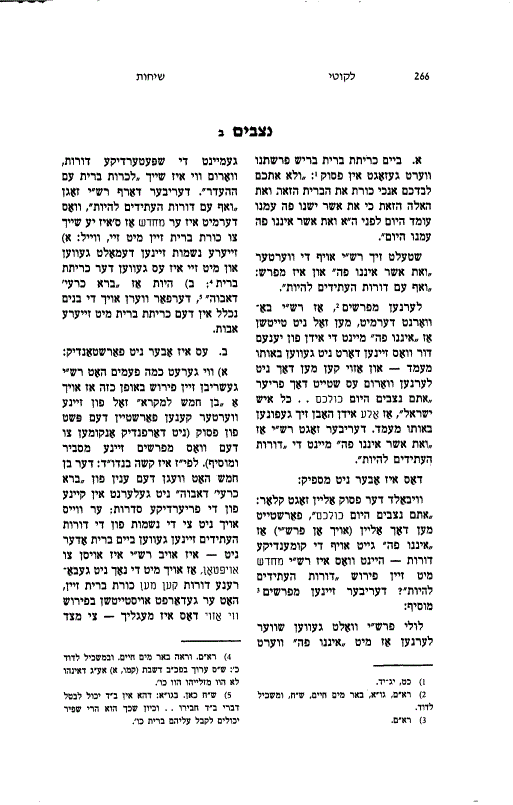
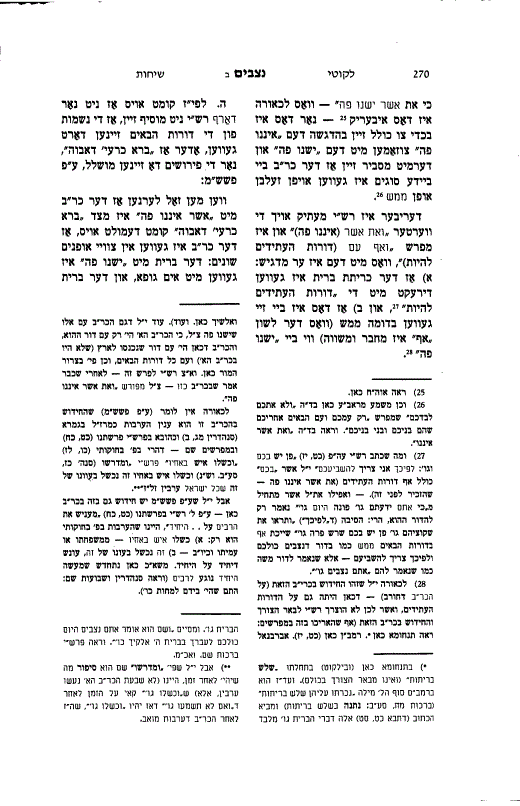
1. At the covenant established at the beginning of our parsha, it is stated in the verse: "And not with you alone do I make this covenant and this oath, but with those who are here with us standing today before the L‑rd our G‑d and with those who are not here with us today."
Rashi comments on the words "and with those who are not here" and explains: "Even with future generations."
Commentators explain that Rashi is cautioning against interpreting "those who are not here" as referring to the Jews of that generation who were not present at that event. This cannot be the case because it is stated earlier, "You are standing today, all of you... every man of Israel," indicating that all Jews were present at that event. Therefore, Rashi says that "those who are not here" refers to the "future generations."
However, this explanation is not sufficient:
Since the verse itself clearly states, "You are standing today, all of you," it is understood that "those who are not here" refers to future generations. What then is Rashi adding with his explanation "future generations"? Therefore, commentators add:
Without Rashi's commentary, it would be difficult to understand how "those who are not here" could refer to future generations, because how is it possible to make a covenant with those who are absent? Therefore, Rashi needs to say "even with future generations," indicating that it is indeed possible to make a covenant with them because: a) their souls were present at that time, and it was with them that the covenant was made; b) since "a child is the leg of the father," the children are also included in the covenant made with their fathers.
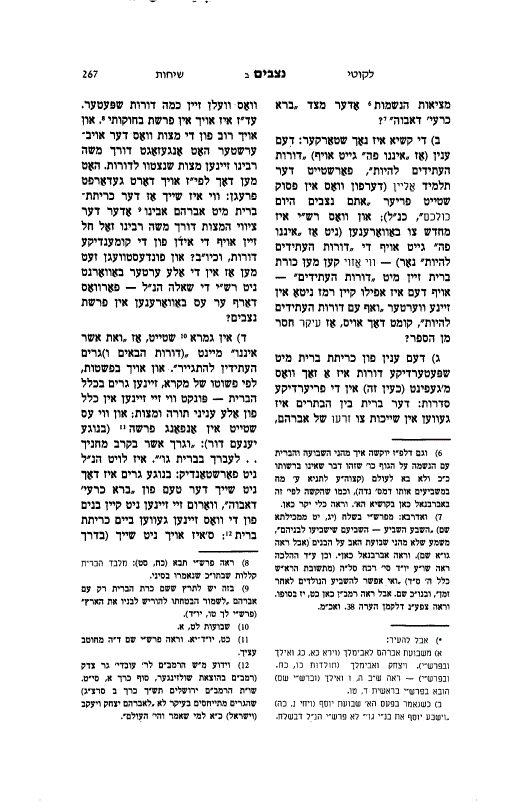
2. However, this is not understood: a) As discussed several times, Rashi wrote his commentary in such a way that even a "five-year-old learning Chumash" could understand the simple meaning of the verse from his words (without needing the explanations and additions of the commentators). According to this, it is difficult in our case: the five-year-old has not learned about the concept of "a child is the leg of the father" in any of the previous sections; he also does not know whether the souls of future generations were present at the covenant or not. So if Rashi intends to convey that it is possible to make a covenant with the unborn generations, he should have explicitly explained how this is possible — whether due to the presence of the souls or due to "a child is the leg of the father."
2. The question becomes even stronger: The concept that "those who are not here" refers to "future generations" is something the student understands on his own (from what is stated earlier in the verse "You are standing today, all of you," as mentioned above). What Rashi innovates is to clarify how it is possible to make a covenant with future generations. However, there is not even a hint of this in his words regarding "future generations," which implies that the main point is missing from the text.
3. The idea of making a covenant with future generations is something that we find (similarly) in previous sections: The Covenant Between the Parts was made in relation to the descendants of Abraham. Similarly, in Parshas Bechukosai, and also most of the mitzvos that the L‑rd commanded through Moshe Rabbeinu are mitzvos commanded for generations. According to this, we should also have asked there: How is it possible that the covenant with Abraham Avinu or the commandment of the mitzvos through Moshe Rabbeinu should apply to the Jews of future generations, and the like? Yet, we see that in all these places, Rashi does not address this question — why does he need to address it in Parshas Nitzavim?
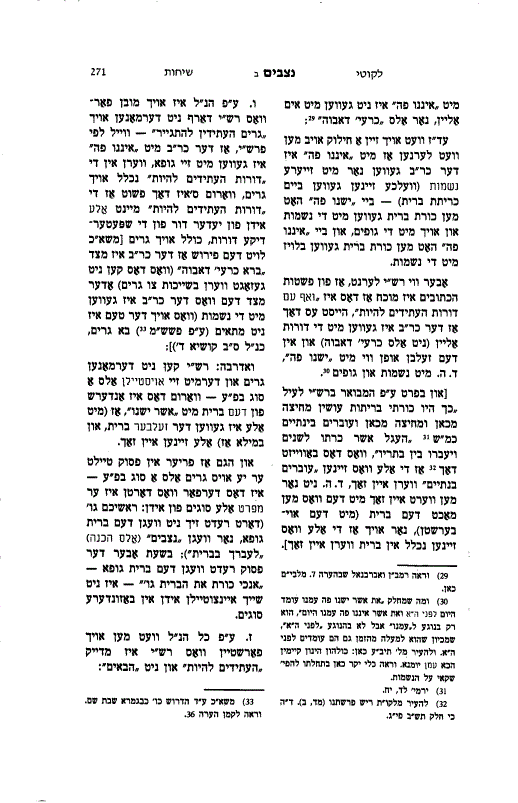
4. In the Gemara, it states that "those who are not here" refers to "future generations and converts who will convert." And also, in the simple meaning of the text, converts are included in the covenant — just as they are included in all matters of Torah and mitzvos; as it is stated at the beginning of the parsha (regarding that generation): "and the stranger who is in your camp... to enter into the covenant, etc." According to the above, it is not understood: Regarding converts, the reason of "a child is the leg of the father" does not apply, because they are not children of those who were present at the covenant; it is also not applicable (in the way of
5. The simple explanation for why their souls were present at the time of the covenant is because, for a child learning the text, it is understood that when a convert converts, they receive a new soul. The question remains: How was a covenant made with "future converts"?
6. On the other hand, since logically it is clear that the covenant was also made with future converts, why does Rashi only mention "future generations" and change from the Gemara by omitting converts (especially since regarding converts, it is a greater novelty, as they do not have the two aforementioned reasons)?
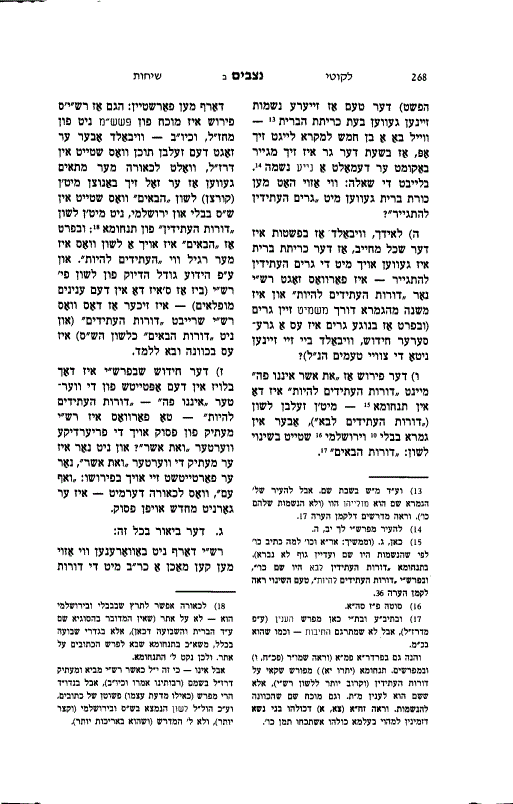
The interpretation that "those who are not here" refers to "future generations" is found in the Tanchuma with the same wording, but in the Babylonian and Jerusalem Talmuds, the wording is different: "future generations."
We need to understand: Although Rashi's explanation is derived from the simple meaning of the text and not from the sages, since he conveys the same content found in the sages, it would seemingly be more fitting for him to use the (shorter) wording "future generations" as found in the Babylonian and Jerusalem Talmuds, rather than the wording "future generations to be" from the Tanchuma. Especially since "future generations" is also a more common expression than "future generations to be." And given the well-known precision of Rashi's language (to the extent that there are wondrous matters in it), it is certain that Rashi's choice of "future generations to be" is intentional and meant to teach something.
7. The novelty in Rashi's commentary is only in the interpretation of the words "those who are not here" as "future generations to be." So why does Rashi also quote the preceding words from the verse "and also those who"? And not only does he quote the words "and also those who," but he also interprets them according to his explanation: "and even them," which seemingly does not add anything new to the verse.
3. The explanation of all this:
4. Rashi does not need to explain how a covenant can be made with future generations, because it is self-evident: the covenant was made by the Almighty, as explicitly stated in the verse, "which the L‑rd your G‑d makes with you today." Everyone understands that the Almighty can make a covenant with future generations as well.
[And the fact that it is written in Moses' speech, "I make this covenant," does not mean that the covenant was between the Jews and Moses; the covenant was between the Almighty and the Jews (including Moses), and when Moses says "I make," it means that Moses prepared for the making of the covenant.]
[It can be said that just as a covenant in general is connected with an action — as Rashi says, "they make a partition here and a partition there and pass between them" — so too, in this covenant, there was an action, and this action was performed by Moses.]
And this is so straightforward that Rashi does not even need to clarify that there is no contradiction between the earlier statement "the L‑rd your G‑d makes with you" and the later statement "I make."
And this is also the simple reason why Rashi does not need to explain how the Almighty told Moses the mitzvos for all generations and how the Covenant Between the Parts (with Abraham our forefather) applies to later generations. For the five-year-old learning scripture understands simply that the Almighty is not limited, G‑d forbid, and He can command for future generations as well. Therefore, this is not a question from the outset, as explained above.
5. What Rashi needs to explain with "and even with future generations to be" is not the essence of the matter that the covenant was also with future generations, but the manner in which the covenant was with "future generations to be":
5. From the wording "And not with you alone do I make this covenant and this oath, but with those who are here... and with those who are not here," it is understood that the covenant was not only to obligate future generations, but that the covenant was made directly with "those who are not here," in the same manner as with "those who are here."
Furthermore, this is necessitated by the fact that after the verse states "to establish you today as His people" regarding those who are "standing here, all of you," it repeats and reminds them again, "And not with you alone do I make this covenant..."
The phrase "with those who are here" — which seems superfluous — is included to emphasize the inclusion of "those who are not here" together with "those who are here," thereby explaining that the covenant with both groups was in exactly the same manner.
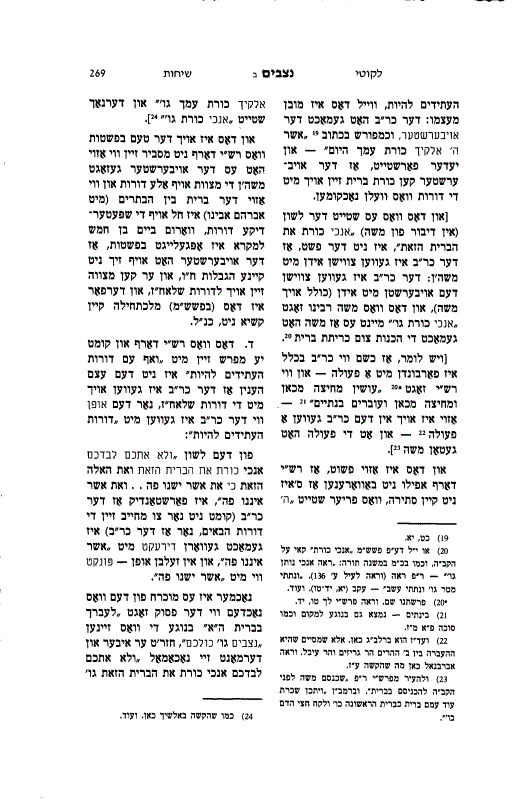
Therefore, Rashi also quotes the words "and with those (who are not here)" and explains "and even with," emphasizing: a) that the covenant was made directly with the "future generations to be," and b) that it was in exactly the same manner (as indicated by the word "even," which connects and equates) as with "those who are here."
6. According to this, it follows that Rashi does not need to add that the souls of future generations were present there, or that "a child is the foot of his father," as these interpretations are excluded according to the simple meaning of the text:
If we were to learn that the covenant with "those who are not here" was due to "a child is the foot of his father," it would imply that the covenant was in two different manners: the covenant with "those who are here" was with them directly, and the covenant...
6. According to the above, it is also understood why Rashi does not need to mention "future converts" — because according to Rashi's explanation, the covenant with "those who are not here" was made with them directly, and thus the "future generations to be" also include converts. It is obvious that "future generations to be" refers to all Jews of every subsequent generation, including converts. This is unlike the interpretation that the covenant was due to "a child is the foot of his father" (which cannot be said regarding converts) or that the covenant was with the souls (which is also not suitable according to the simple meaning of the text concerning converts, as explained in section 2, question 4).
On the contrary: Rashi cannot mention converts and thereby distinguish them as a separate category — because this would differ from the covenant with "those who are here," where (with all it was the same covenant, and therefore) all are one entity.
And although earlier in the verse, converts are indeed distinguished as a separate category — this is because there, it specifies all categories of Jews: "your heads, etc." (there it does not speak about the covenant itself, but about "standing" (as preparation) "to pass into the covenant"); however, when the verse speaks about the covenant itself — "I make this covenant, etc." — it is not appropriate to divide Jews into separate categories.
7. Based on all the above, we can also understand why Rashi is precise in using "future generations to be" and not "those who will come":
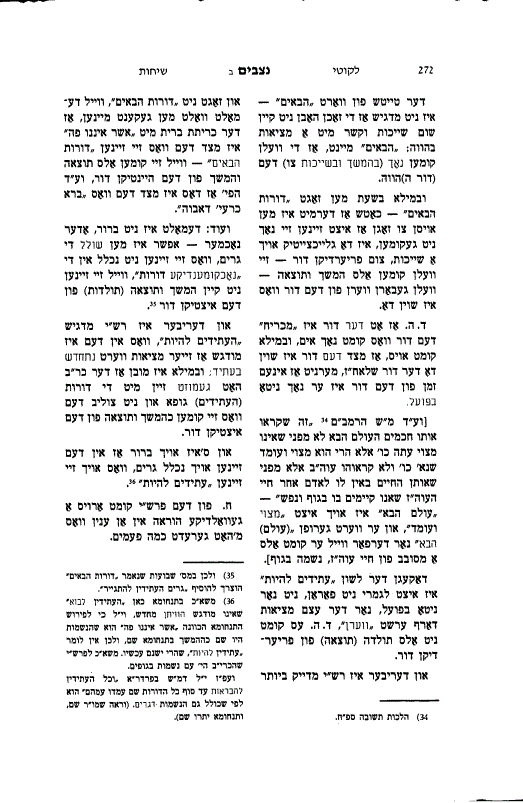
7. The meaning of the word "הבאים" (those who are coming) does not emphasize that these matters have no connection or relation to a current existence; rather, "הבאים" means that they will come after (in continuation and relation to) the present generation.
Therefore, when we say "future generations," although this implies that they have not yet arrived, there is simultaneously a connection to the previous generation — they will come as a continuation and result — they will be born from the generation that already exists.
This means that this generation "necessitates" the generation that follows it, and consequently, from the perspective of this generation, the subsequent generation already exists, even though in the time of this generation it is not yet present in actuality.
[Similar to what Rambam writes: "That which the sages called the World to Come is not because it does not exist now, but rather it exists and stands, as it is said... They called it the World to Come only because those lives come to a person after the life of this world in which we exist with body and soul" — the World to Come also currently "exists and stands," and it is called "the World to Come" only because it comes as a result of the life of this world, a soul in a body.]
In contrast, the term "עתידים להיות" (destined to be) indicates that it is not present at all now, not only not in actuality, but the very existence must first "become," meaning it does not come as a result of the previous generation.
Therefore, Rashi is very precise and does not say "future generations," because then it might be understood that the covenant with "those who are not here" is because they are "future generations" — since they come as a result and continuation of the current generation, similar to the interpretation that this is because "a child is the foot of his father."
Furthermore, in that case, it would not be clear, or even more so, it might exclude converts, who are not included in the "future generations," because they are not a continuation and result (offspring) of the current generation.
Therefore, Rashi emphasizes "destined to be," which highlights that their existence is renewed in the future; consequently, it is understood that the covenant had to be with the generations themselves (destined to be) and not because they come as a continuation and result of the current generation.
It is also clear that this includes converts, who are also "destined to be."
8. From this Rashi, we derive a powerful lesson in a matter that has been discussed many times.
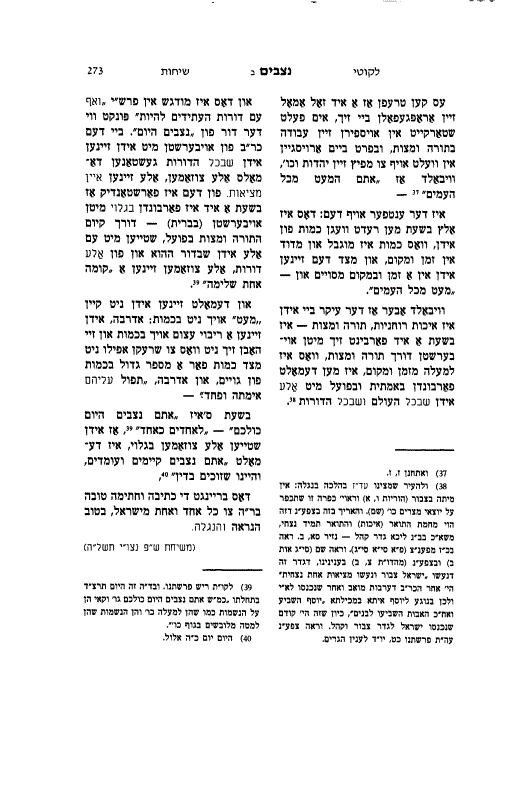
9. The answer to this is: This is all when speaking about the quantity of Jews, which is limited and measured in time and space, and because of this, Jews are in a specific time and place and are "the fewest of all peoples."
However, since the primary aspect of Jews is their spiritual quality, Torah and mitzvos — when a Jew connects with the Almighty through Torah and mitzvos, which transcend time and space, they are then truly and actually connected with all Jews throughout the world and across all generations.
This is emphasized in Rashi's commentary "and even with the generations destined to be," just like the generation of "standing today." At the covenant made by the Almighty with the Jews, Jews from all generations stood together at that time, all as one entity. From this, it is understood that when a Jew is openly connected with the Almighty (in the covenant) — through the actual observance of Torah and mitzvos, all Jews of that generation and from all generations stand with them, all together as "one complete stature."
And then, Jews are not "few" even in quantity; on the contrary, Jews are a vast multitude even in quantity, and they have nothing to fear, not even quantitatively from a large number of non-Jews. On the contrary, "fear and dread shall fall upon them."
When it is "You are standing today, all of you" — "united as one," when Jews stand all together openly, then "You are standing firm and established, and thus victorious in judgment,"
This brings the blessing of a good inscription and sealing on Rosh Hashanah for each and every Jew, with visible and revealed good.