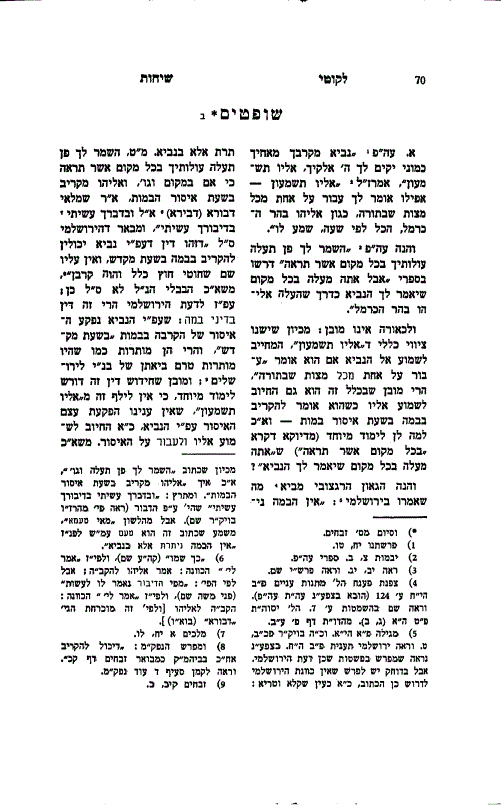
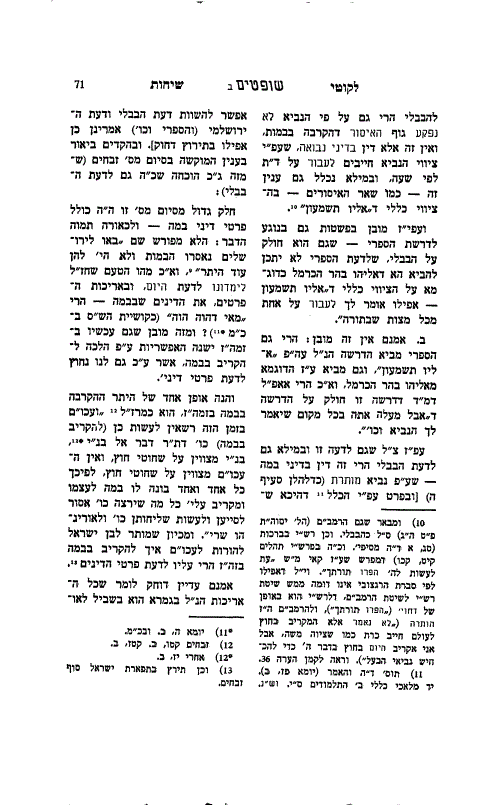
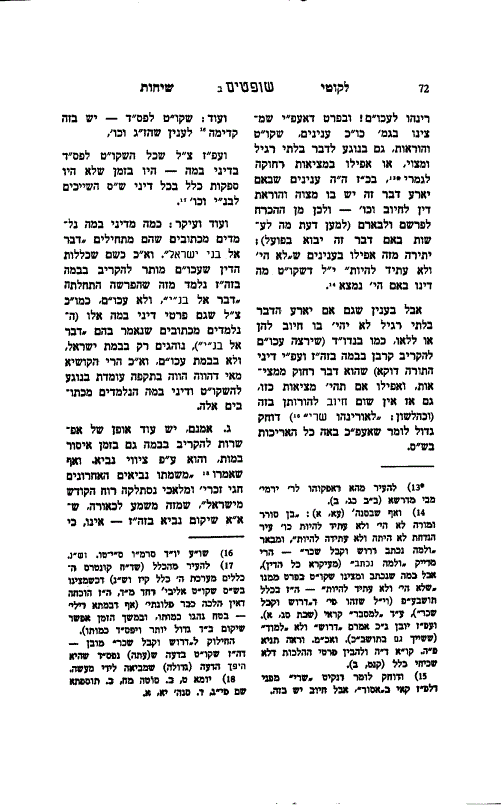
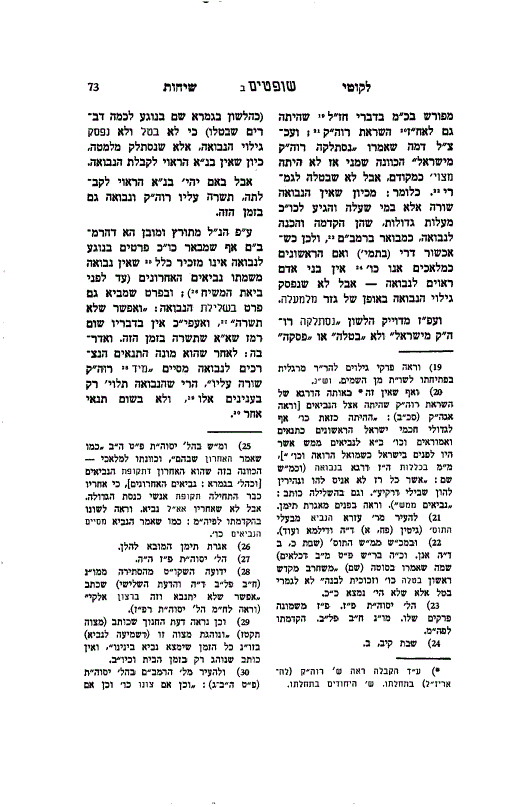
On the verse (Devarim 18:15), “To him you shall listen,” our Sages derive (Yevamos 90b and Sifri): “Even if he tells you to transgress one of the mitzvos of the Torah, as Eliyahu did at Mount Carmel, provided that it is only temporary, listen to him.”
And on the verse (Devarim 12:13), “Beware lest you offer your burnt-offerings in any place that you see,” our Sages derive in the Sifri: “But you may offer in any place that the prophet tells you, just as Eliyahu offered on Mount Carmel.”
We must understand why an additional teaching is necessary specifically regarding the laws of a bamah, after the Torah has already taught through “to him you shall listen” that a prophet may temporarily override a Torah commandment.
The explanation can be understood by first noting that at the conclusion of Maseches Zevachim there is an extensive discussion of the laws of a bamah.
This itself requires explanation. These laws are not presently applicable, so seemingly, “What happened, happened”—why discuss them at such length?
The explanation is that the laws of a bamah can have practical relevance even now, in a case where a prophet would come and command that a sacrifice be offered on a bamah.
Although such a situation is extremely unusual, and one might argue that if a prophet were to come, he could also temporarily alter the particular laws governing a bamah, it may be explained that this itself is part of the laws of a bamah: a prophet has the authority to permit a bamah even during a period when bamot are generally forbidden. Once he does so, all the regular laws of a bamah become applicable.
Since this possibility is itself part of the halachic framework of bamah, the Gemara discusses even the detailed laws that are not ordinarily relevant at present.
This also explains the need for the two separate sources mentioned above.
The first source, “to him you shall listen,” teaches the general rule that a prophet may temporarily override a commandment of the Torah.
The second source, stated specifically in the laws of bamah, teaches that this is also a law within the institution of bamah itself: when a prophet commands the use of a bamah during a period in which bamot are prohibited, the bamah becomes permitted, and the laws governing a bamah apply to it.
Now, an obligatory sacrifice cannot ordinarily be offered on a bamah.
The reason is that the sanctity of a bamah does not have the power to affect the person who stands outside the bamah, just as its sanctity does not have the power to draw down holiness into the place itself in the same manner as the Beis HaMikdash.
A bamah established by the command of a prophet, however, possesses an advantage over an ordinary bamah. In such a case there is a prophetic command to bring the offering, and by bringing it on the bamah one is fulfilling that command—an obligation—through the bamah.
This also explains the connection between the beginning and the end of Maseches Zevachim.
At the beginning of the tractate we are taught: “All sacrifices that were slaughtered not for their designated purpose are valid, but they do not fulfill the owners’ obligation.”
The holiness of such sacrifices does not fully affect the person who brought them, and therefore they do not discharge his personal obligation.
This deficiency is highlighted by the conclusion of the tractate: even a bamah established through the command of a prophet—and certainly an offering brought in the Beis HaMikdash—can draw its holiness down upon the person himself.