
.
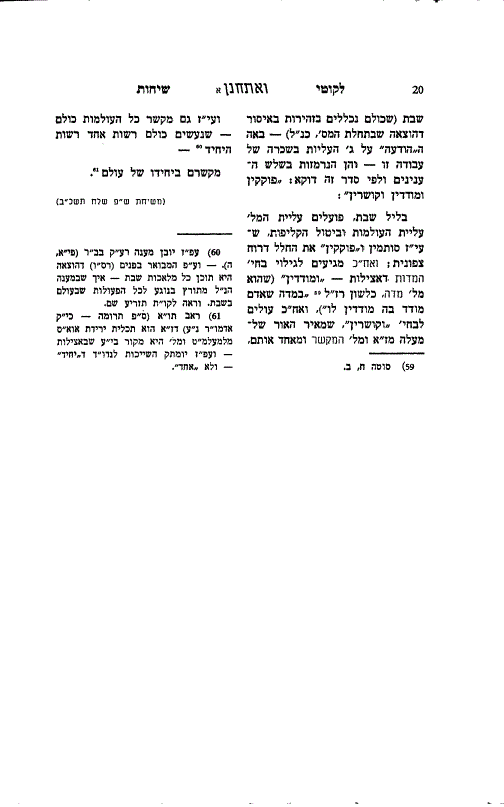
“Measuring” is a greater novelty than “tying.” Although measuring is prohibited only because it is a weekday activity and constitutes a degradation of Shabbos, the act itself is nevertheless forbidden for that reason. With tying, however, the act itself is not inherently forbidden, because without the intention that the knot remain permanent, it is not considered a genuine connection and union at all.
At the conclusion of Tractate Shabbos, the Gemara states:
“From their words we learned that one may seal an opening, measure, and tie on Shabbos.”
The order of these laws requires explanation. Sealing an opening is clearly the greatest novelty, since it closely resembles the prohibited labor of building, and it is therefore mentioned first. Seemingly, however, tying, which closely resembles a Torah-prohibited labor and is not considered such a labor only because there was no intention that it remain permanent, should be a greater novelty than measuring, which is prohibited merely as a weekday activity and as a degradation of Shabbos. Why, then, is tying mentioned last?
This can be understood by first considering the law that lifting an object without placing it down is not prohibited by the Torah. At first glance, it would appear to be comparable to half of the prohibited measure, which is itself forbidden by the Torah. Lifting without placing down, however, is not considered half of a prohibited measure. Half of a prohibited measure lacks only the necessary quantity of the prohibition, whereas lifting without placing down lacks an essential element of the very nature of the prohibited labor.
The same can be said regarding tying. A knot that is not intended to be permanent is not half of the prohibited labor. Rather, because the necessary intention is lacking, the act does not possess the essential quality of the labor of tying.
Accordingly, however, it must be understood why we do not find that lifting without placing down was permitted for the sake of a mitzvah, just as a nonpermanent knot was permitted for the sake of a mitzvah.
The explanation is that the essential nature of the labor of tying is to connect and unite two things. Consequently, when the intention that the connection remain permanent is lacking, something is lacking in the essence of the knot itself. The act is therefore not inherently forbidden. Its rabbinic prohibition exists only because it resembles a Torah prohibition, not because performing it may lead the person to violate a Torah prohibition. It was therefore permitted for the sake of a mitzvah.
Lifting, by contrast, is itself one component of the prohibited labor of carrying. It lacks only the other component, namely, placing the object down. Its rabbinic prohibition is therefore based on the concern that the person may come to complete the Torah-prohibited labor. For this reason, it was not permitted even for the sake of a mitzvah.
Based on this, it can be said that measuring is a greater novelty than tying. Although measuring is prohibited only because it is a weekday activity and constitutes a degradation of Shabbos, the act itself is nevertheless forbidden because of that degradation. With tying, however, the act itself is not inherently forbidden, because, as explained above, without the intention that the knot remain permanent, it is not considered a true connection and union at all.
On the inner dimension of Torah, these three activities correspond to the three stages of Shabbos:
First, “sealing an opening” corresponds to Friday night. At that time, Malchus ascends from the worlds of Beriah, Yetzirah, and Asiyah to Atzilus, and “all judgments depart from her.” This is the meaning of “sealing an opening”: sealing the opening on the northern side, which is the source from which the forces of kelipah receive nurture.
Second, “measuring” corresponds to the daytime of Shabbos, when Malchus ascends to Ze’eir Anpin. This is alluded to by the word “measuring,” מודדין, which is related to the word middos, the Divine attributes.
Third, “tying” corresponds to Ra’ava D’Ra’avin, the most sublime time of Shabbos afternoon. At that time, Malchus ascends to a level above Ze’eir Anpin and Malchus, a level that binds and unites Ze’eir Anpin with Malchus. This is the inner meaning of “tying.”