


Likkutei Sichos Vol. 4 – Nitzavim – The Unity of the Jewish People
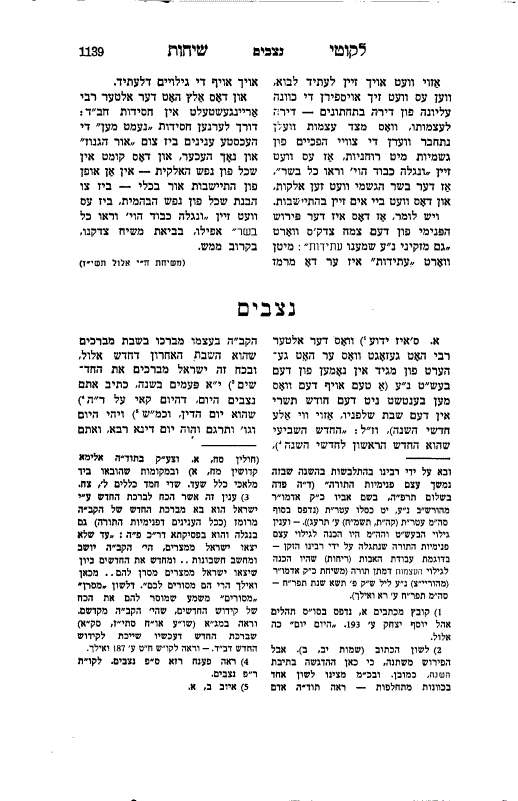
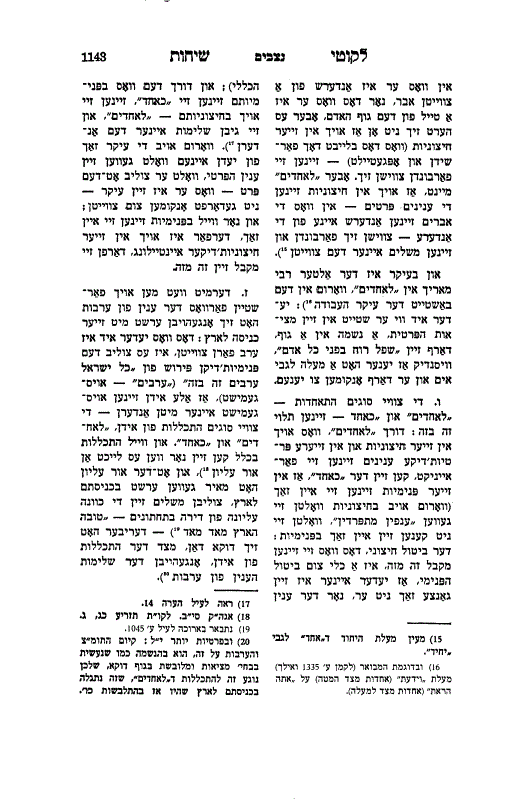
1. It is well known what the Alter Rebbe said, which he heard from the Maggid in the name of the Baal Shem Tov, of blessed memory. This is an explanation for why we do not bless the month of Tishrei on the Shabbat before it, as we do for all other months of the year. The Baal Shem Tov's words are as follows: "The seventh month, which is the first of the months of the year, the Holy One, blessed be He, blesses it Himself on the Shabbat Mevarchim, which is the last Shabbat of the month of Elul. With this power, the Jewish people bless the months eleven times a year. It is written, 'You are standing today,' and 'today' refers to Rosh Hashanah, which is the Day of Judgment, as it is written, 'And it was on the day,' and the Targum translates it as 'And it was the great day of judgment.' And 'You are standing' means you are established and standing, which means that they merit in judgment. On the Shabbat before Rosh Hashanah, which is the last Shabbat of the month of Elul, we read the portion 'You are standing.' This is the blessing of the Holy One, blessed be He, on the Shabbat Mevarchim of the 'seventh month,' which is the 'satiated' and the 'satiating' month, with abundant goodness for all Israel for the entire year."
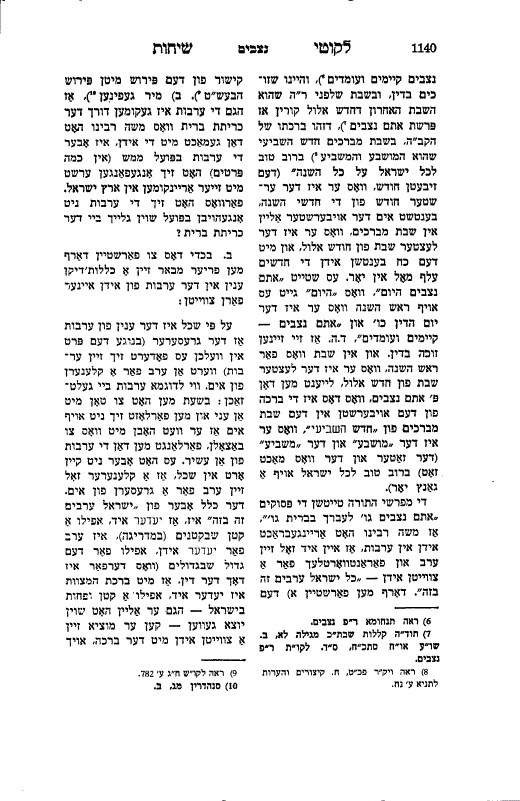
The commentators on the Torah explain the verses "You are standing... to pass into the covenant..." as indicating that Moses brought the Jews into mutual responsibility, where one Jew is responsible for another — "All Israel are guarantors for one another." We need to understand: a) the connection between this interpretation and the interpretation of the Baal Shem Tov. b) We find that although the mutual responsibility came through the covenant that Moses made with the Jews, the actual mutual responsibility (in several details) only began when they entered the Land of Israel. Why did the mutual responsibility not begin in practice immediately with the covenant?
2. To understand this, we must first explain a general concept regarding the mutual responsibility of Jews for one another:
2. According to reason, the concept of mutual responsibility (areivus) is that the greater one (in the aspect where responsibility is required) becomes a guarantor for someone lesser than himself. For example, in financial matters: when dealing with a poor person and there is no reliance on him having the means to pay, the guarantee of a wealthy person is required. However, it does not make sense for a lesser person to be a guarantor for someone greater than himself. Yet, the general principle of "All Israel are guarantors for one another" is that every Jew, even the smallest of the small, is a guarantor for every Jew, even for the greatest of the great. This is why the law states that with the blessings of the mitzvos, every Jew, even a minor and insignificant one in Israel — although he has already fulfilled his obligation — can fulfill the obligation for another Jew with the blessing, even when the other is much greater than him, as it is stated "All Israel are guarantors for one another."
3. Regarding the verse "You are standing... all of you," the Alter Rebbe says that all Jews are "one complete body" (a single complete entity). Just as in the human body there is a certain advantage in the feet over the head and there is no completeness in the head without the feet, so too in the "body" of all Israel: even the Jew from the lower category, "your woodcutters and your water drawers," has an advantage over the Jews from the category of "your heads," and they must rely on the "woodcutters and water drawers" and are not complete without them.
According to this, we can understand how "All Israel are guarantors for one another," because every Jew is a head and is superior, in a certain aspect, and because of this aspect, all Israel need his responsibility.
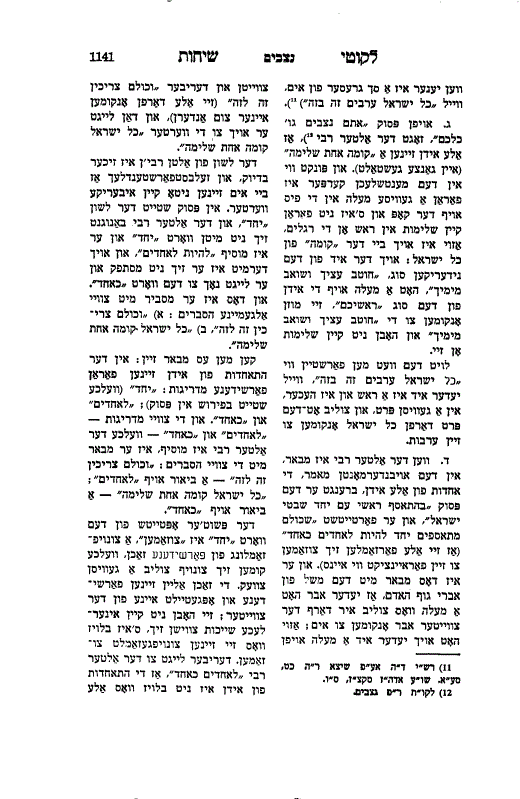
4. When the Alter Rebbe explains, in the aforementioned teaching, the unity of all Jews, he brings the verse "When the heads of the people gather together, the tribes of Israel are united," and he interprets it as "that they all gather together to be united as one." He explains this with the analogy of the limbs of the human body, where each limb has an advantage that requires the other limb to rely on it; so too, each Jew has an advantage over the other, and therefore "they all need one another," and then he also adds the words "all Israel are one complete body."
The language of the Alter Rebbe is certainly precise, and it is self-evident that there are no superfluous words with him. In the verse, the term "together" is used, and the Alter Rebbe does not suffice with the word "together" and adds "to be united," and even with this, he is not satisfied and further adds the word "as one." He explains this with two general explanations: a) "and they all need one another," b) "all Israel are one complete body."
This can be explained: in the unity of Jews, there are different levels: "together" (which is explicitly stated in the verse); "to be united" and "as one." The two levels — "to be united" and "as one" — which the Alter Rebbe adds, he explains with the two explanations: "and they all need one another" — an explanation for "to be united"; "all Israel are one complete body" — an explanation for "as one."
3. The simple meaning of the word "together" is a gathering of different things that come together for a certain purpose. These things themselves are distinct and separate from one another; they have no intrinsic connection between them, it is merely that they are gathered together. Therefore, the Alter Rebbe adds "to be united as one," indicating that the unity of Jews is not merely that they come together and are bound in one group for a purpose, for "to do Your will with a complete heart," but they have an internal bond among themselves. Within this itself, there are two general levels: "to be united" and "as one."
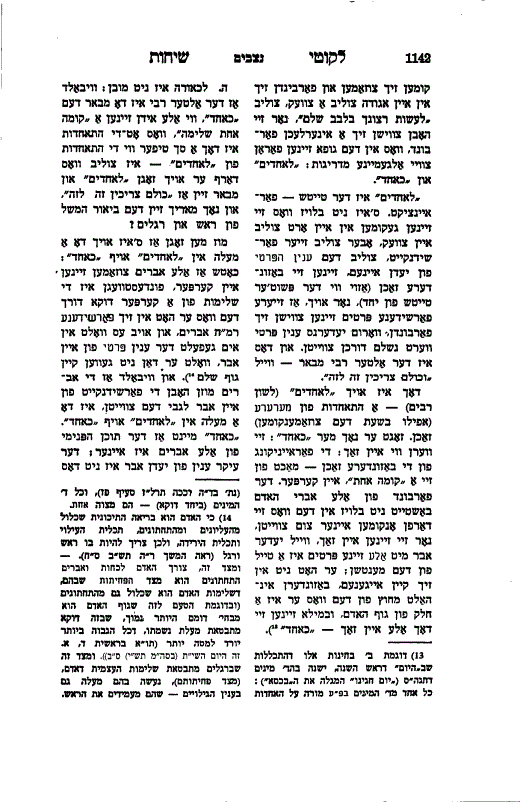
"To be united" means unified. It is not only that they have come to one place for one purpose, but due to their differences, due to the individual aspect of each one, they are separate entities (as in the simple meaning of "together"). However, their different aspects are interconnected, for each one's individual aspect is completed by the other. This is what the Alter Rebbe explains — because "and they all need one another."
Yet, "to be united" (in the plural form) is still a unity of multiple (even at the time of coming together) things. He says even more "as one": they become like one entity. The unification of the separate things makes them a "single stature," one body. The connection of all the limbs of a person is not only in that they need each other, but they are one entity, because each limb with all its details is a part of the person; it does not have its own, separate content outside of being a part of the human body, and consequently, they are all one entity — "as one."
5. At first glance, it is not understood: Since the Alter Rebbe is explaining "as one," where all Jews are a "complete single stature," which is a much deeper unity than the unity of "to be united" — why does he also need to say "to be united" and explain that "they all need one another," and further elaborate on the analogy of the head and feet?
5. We must say that there is also an advantage in "to be united" over "as one": Although all the limbs together form one body, the completeness of a body is specifically through having within it the various 248 limbs. If it were missing the specific aspect of one limb, it would not be a complete body. Since the limbs must have the distinction of one limb from another, there is an advantage in "to be united" over "as one." "As one" means that the inner content of all the limbs is one; the primary aspect of each limb is not what makes it different from another limb, but rather that it is a part of the human body. However, it does not negate the fact that even in their externality (which remains distinct and separate), they are connected to each other. But "to be united" means that even in their externality, the specific aspects in which the limbs differ from one another are interconnected and complement each other.
And primarily, the Alter Rebbe elaborates on "to be united" because this is where the main service lies: Every Jew, as he stands in his individual existence, a soul in a body, must be "humble in spirit before every person," knowing that the other has an advantage over him and he needs to rely on the other.
6. The two types of unity — "to be united" and "as one" — are interdependent: Through "to be united," where even in their externality and specific matters they are united, the "as one" can exist, where in their inner essence they are one thing. For if externally they were "separate branches," they could not be one thing internally. The external nullification, where they receive from one another, is a vessel for the internal nullification, where each one is not a complete entity on its own, but part of the general matter. And through their inner essence being "as one," they are also externally "to be united," and they provide completeness to one another. For if the primary aspect of each one were its individual matter, it would not need to rely on the other because of this detail, which is its main aspect. Only because internally they are one thing, therefore, even in their external division, they need to receive from one another.
7. This will also help us understand why the concept of mutual responsibility began only with their entry into the land: The reason every Jew is responsible for another is due to the inner interpretation of "all Israel are guarantors for one another" ("guarantors" — mixed together), that all Jews are mixed with one another — the two types of integration of Jews, "to be united" and "as one." And because integration in general can only occur when a supernal light shines, and this supernal light began to shine only upon their entry into the land, to complete the divine intention of a dwelling in the lower realms — "the land is very, very good" — therefore, it was specifically then, due to the integration of Jews, that the completeness of the concept of mutual responsibility began.
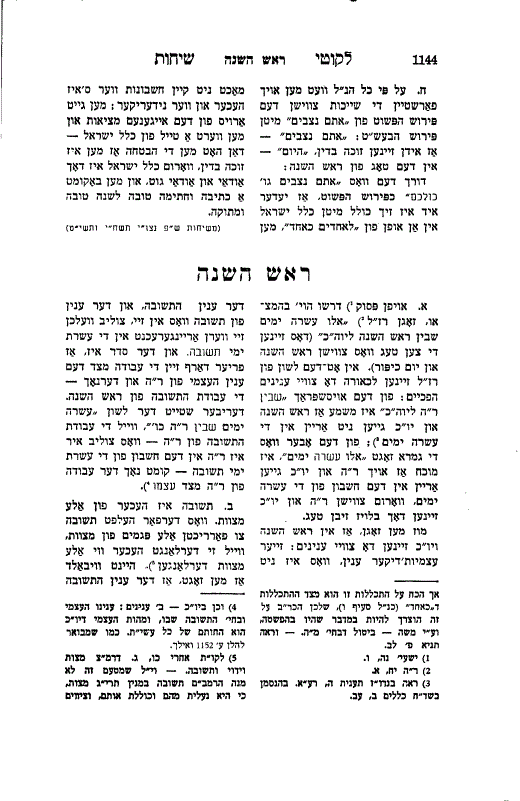
8. Based on all the above, we can also understand the connection between the simple interpretation of "Atem Nitzavim" and the interpretation of the Baal Shem Tov: "Atem Nitzavim" — that Jews are meritorious in judgment, "today" — on the day of Rosh Hashanah. Through "Atem Nitzavim... Kulchem" in its simple interpretation, where every Jew includes themselves with the entirety of Israel in a manner of "to be united as one," without making calculations of who is higher and who is lower; one steps out of their own existence and becomes a part of the collective of Israel — then there is the assurance that they are meritorious in judgment. For the collective of Israel is certainly and undoubtedly good, and they receive a good and sweet inscription and sealing for the new year.
9. The concept of "Atem Nitzavim" — standing firm — is connected to the idea of being meritorious in judgment on Rosh Hashanah. This is because when Jews unite as one, transcending individual differences and becoming part of the collective of Israel, they are assured of being meritorious. The collective of Israel is inherently good, and thus they receive a favorable judgment for the new year. This unity and collective merit are emphasized in the teachings of the Baal Shem Tov, who interprets "Atem Nitzavim" as a sign of being meritorious on Rosh Hashanah.
10. Furthermore, the idea of unity among Jews is not just a spiritual concept but also has practical implications. The unity and integration of Jews, especially upon entering the land of Israel, is what completes the divine intention of creating a dwelling place for G‑d in the lower realms. This unity is what allows for the fulfillment of the mitzvos and the mutual responsibility that Jews have for one another. It is through this collective responsibility and unity that the Jewish people can achieve their ultimate purpose and merit a good and sweet year.