Likkutei Sichos Vol. 1 – Vayera
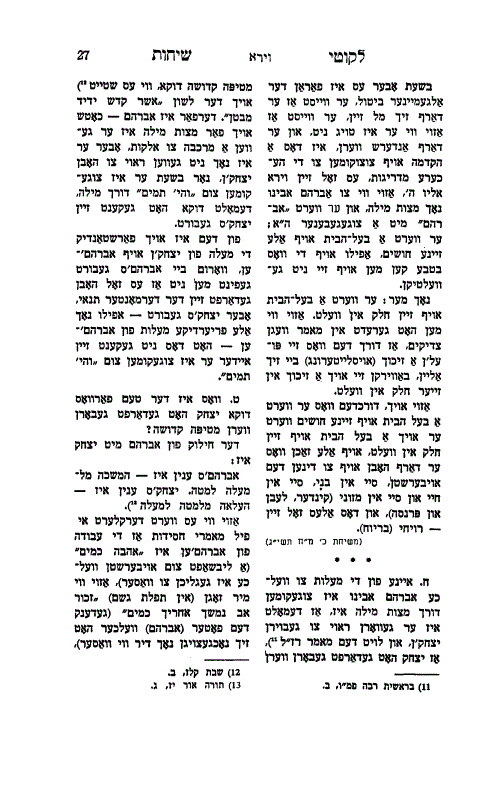
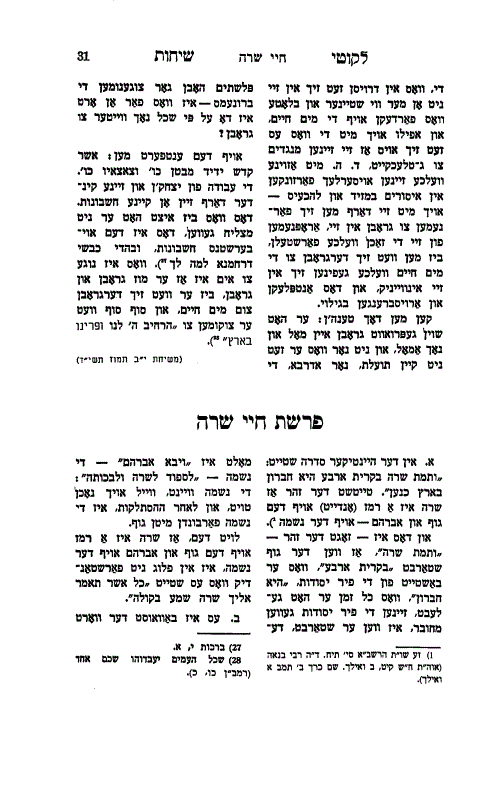
1. Today is the 20th of Cheshvan, the birthday of the Rebbe, Rabbi Sholom DovBer (the Rebbe Rashab), of blessed memory, the father of my father-in-law. I will recount a story that I have told before:
The Rebbe Rashab would enter his grandfather, the Tzemach Tzedek, every 20th of Cheshvan, his birthday, to ask for a blessing. It is possible that this was also the custom among the other grandchildren of the Tzemach Tzedek.
Once, when the Rebbe Rashab entered (he was then four or five years old, as he was born in the year 5621 and the Tzemach Tzedek passed away in Nissan 5626), he began to cry. The Tzemach Tzedek asked him, "Why are you crying?" He replied that he had learned in Chumash (or heard it retold) that G‑d appeared to Avraham Avinu (it was Parshas Vayeira), and he cried because G‑d had not appeared to him.
The Tzemach Tzedek answered him: "When a Jew (in another version: a Jewish tzadik) decides at the age of ninety-nine that he needs to circumcise himself, he is worthy that G‑d should appear to him." This answer satisfied the child, and he stopped crying.
2. Although this story with the Rebbe Rashab occurred when he was still a child before his Bar Mitzvah, and even before he reached the age of education, we must still learn from this story. Since the Rebbe Rashab told this story to his grandson, the Rebbe, and the Rebbe retold it so that it would be conveyed to the world, it is proof that the story speaks to us as well. We can learn two things from it, both from the question and the answer.
3. From the Rebbe's crying over the fact that G‑d did not appear to him, we can learn that every Jew, regardless of their situation, even if they have not reached the age of education, meaning they do not have much understanding, and they cannot even receive influence from another,
3. Even if a person is considered a grown-up in years, in a spiritual sense, he might still be like a child who has not reached the age of education. As the Rebbe, the Previous Rebbe, said, Jewish years are not counted according to the passport. On the passport, a person might be an old Jew, but in his true, spiritual years, in his fulfillment of Torah and mitzvos, he might be like a small child playing under the table. Such a person can also demand, and demand with strength—which is the essence of crying, an expression that is beyond understanding, beyond intellect, which cannot tolerate it anymore, and from the "mochah d'mochin" (the essence of the intellect) come tears—that G‑d should appear to him, just as He appeared to Avraham Avinu.
4. Furthermore, he can demand that G‑d should appear to him just as He appeared to Avraham Avinu after he fulfilled the mitzvah of circumcision, at which point "the L‑rd appeared to him." We also find the revelation of the name Havayah to Avraham, but it is similar to the revelation—"v'esgali"—which occurred after the mitzvah of circumcision, which is much higher. When G‑d revealed Himself to Avraham after the mitzvah of circumcision, he was already called Avraham with an added "hei." The Gemara states that at that point, Avraham became a master over the five organs: eyes, ears, and the head of the body—organs over which, by nature, a person has no control. Previously, he was called Avram, without the "hei," and he was a master only over what a person can naturally control. But afterward, through what he accomplished with his own strength—as much as one can achieve with one's own power—he was granted from above control over matters that one cannot naturally master.
Therefore, it is understood that the revelation to Avraham Avinu after the mitzvah of circumcision was much higher than before. Nevertheless, every Jew—even one who is "not reached the age of education" in spirituality—can also demand that G‑d should appear to him as He appeared to Avraham when he had already reached the level after the mitzvah of circumcision.
5. From the Tzemach Tzedek's answer, that the revelation to Avraham occurred because he knew he needed to circumcise himself, we can learn: Indeed, every Jew can demand that G‑d should appear to him. However, it requires a precondition: he must know that he needs to circumcise himself. This means that regardless of all the virtues he possesses in actuality or at least potentially,
in potential, every Jew can reach the highest levels, as discussed earlier and as it is stated, "Every Jew is obligated to say: When will my actions reach the actions of my forefathers, Avraham, Yitzchak, and Yaakov?" From the fact that Avraham is mentioned together with Yitzchak and Yaakov, it is also an indication that this refers to Avraham in the state he was in after the mitzvah of circumcision. Nevertheless, one must know that he needs to circumcise himself.
6. Furthermore, even those who possess these virtues in actuality, such as the righteous who have mastery over the organs that by nature one cannot control—like Avraham Avinu—they too must know that they need to circumcise themselves.
It is known the story with the Rebbe (Rashab) of blessed memory, that once he complained that he could not hear in one ear. When they began to investigate the reason, it was discovered that on Shabbos, when he was delivering a discourse in Chassidus, there was talking in another room, and this disturbed him from saying the discourse. Since he felt the responsibility that his matter was to influence through Chassidus, and the talking disturbed him, he removed the sense of hearing from the ear that was on the side of that room. This is what is stated in a discourse that the righteous have taken away their sight or hearing when it disturbed the G‑dly soul, for the righteous are masters over the senses that by nature one does not control.
However, even those who are on such a high level must know that they need to circumcise themselves.
7. The reason for this is because even if there is only the slightest spiritual foreskin, it can, after many descents, manifest in lowly matters. This is the precision in the Tzemach Tzedek's wording, that a Jew, a righteous person at ninety-nine years, knows that he needs to circumcise himself. At one hundred years—that is, when he has refined all ten faculties, each faculty as it consists of ten—then he no longer has anything to fear, for he no longer has any connection to worldly matters, as it is stated, "At one hundred, it is as if he has died and passed away and is nullified from the world."
8. The Mishnah states, "At thirteen, one is obligated in mitzvos," etc. However, what is the indication that at one hundred years, he is "as if he has died and passed away and is nullified from the world"? The explanation is that when he has already refined all ten faculties—and specifically in detail, each one as it consists of ten—he is a "son of one hundred," and he is "as if he has passed away and is nullified from the world." He no longer has any connection to worldly matters and has nothing to fear, as if he no longer has an evil inclination.
However, when he is ninety-nine years old, he still lacks something in the refinement of all ten faculties in detail. At that point, he needs to circumcise himself, because through the multitude of descents—
We do not mean the multitude of descents in the sense that a person finds himself in one world and the descent is in another world. Rather, since a person is both prior to and after the act of creation, within him there can be a multitude of descents—
it can descend to lowly matters.
When there is, however, the general nullification, he knows that he needs to circumcise himself. He knows that as he is, he is not fitting, and he needs to become different. This is a preparation to reach higher levels, so that "G‑d appeared to him," just as to Abraham our forefather after the mitzvah of circumcision, and he becomes "Abraham" with an added "hei"; he becomes a master over all his senses, even those that by nature one cannot control.
Furthermore, he becomes a master over his portion in the world. As discussed in the discourse regarding the righteous, through refining themselves, they also bring about a refinement in their portion of the world.
Similarly, by becoming a master over his senses, he also becomes a master over his portion in the world, over all matters he needs to serve the Almighty, whether in children, life, or sustenance, and all of this should be with abundance.
(From a talk on the 20th of Menachem Av, 5713)
8. One of the advantages that Abraham our forefather achieved through the mitzvah of circumcision is that he then became worthy to father Isaac. According to the saying of our sages, Isaac needed to be born from a holy drop, as it is also stated in the expression "who sanctified the beloved from the womb." Therefore, although Abraham was a chariot to G‑dliness even before the mitzvah of circumcision, he was not yet worthy to have Isaac. Only when he reached "and be perfect" through circumcision could Isaac's birth occur.
9. From this, we also understand the superiority of Isaac over Abraham. For at Abraham's birth, we do not find that the aforementioned condition was necessary. However, Isaac's birth, even after all of Abraham's previous virtues, could not occur until he reached the state of "and be perfect."
10. What is the reason that specifically Isaac needed to be born from a holy drop?
The difference between Abraham and Isaac is as follows:
Abraham's role is to draw down from above to below, while Isaac's role is to elevate from below to above.
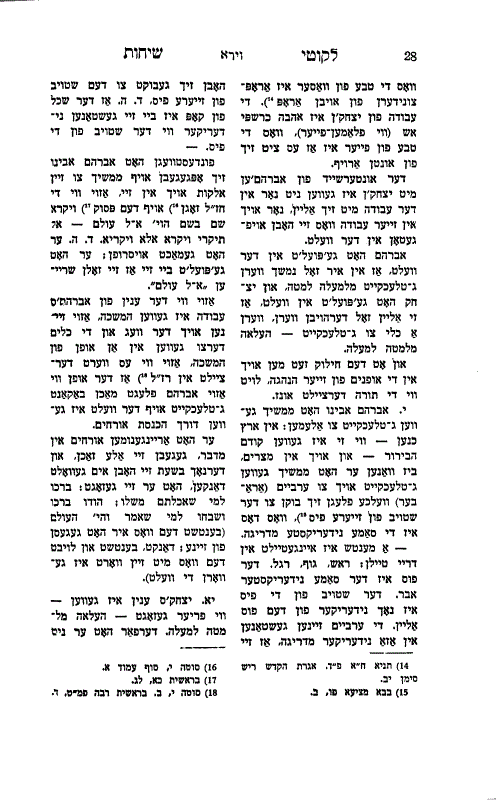
As explained in many Chassidic discourses, Abraham's service is "love like water" (a love for the Almighty compared to water), as we say (in the prayer for rain), "Remember the father who was drawn after You like water" (referring to Abraham, who followed G‑d like water). The nature of water is to flow downward from above. In contrast, Isaac's service is "love like fiery flames," where the nature of fire is to ascend from below to above.
The distinction between Abraham and Isaac was not only in their personal service but also in the work they accomplished in the world.
Abraham influenced the world so that G‑dliness would be drawn into it from above to below, while Isaac worked so that the world itself would be elevated and become a vessel for G‑dliness — an elevation from below to above.
This difference is also evident in the ways they conducted themselves, as the Torah narrates to us.
11. Abraham our forefather drew down G‑dliness to everyone: in the land of Canaan — as it was before its refinement — and also in Egypt. He extended G‑dliness even to the Arabs, who would bow to the dust of their feet, which is the lowest level.
A person is divided into three parts: head, body, and foot. The foot is the lowest part. The dust of the feet is even lower than the foot itself. The Arabs were on such a low level that they bowed to the dust of their feet, meaning their intellect was lower than the dust of their feet.
Nevertheless, Abraham our forefather dedicated himself to drawing down G‑dliness even to them, as our sages say regarding the verse "And he called there in the name of the L‑rd, the G‑d of the world" — do not read "and he called" but "and he made others call," meaning he caused them to proclaim "G‑d of the world."
Since Abraham's service was about drawing down, the method and tools for this were also in a manner of drawing down, as it is recounted in our sages that the way Abraham made G‑dliness known in the world was through hospitality.
He welcomed guests in the desert, provided them with all their needs, and then, when they wanted to thank him, he would say to them: "Bless the One from Whose food you have eaten; give thanks, bless, and praise the One Who spoke and the world came into being."
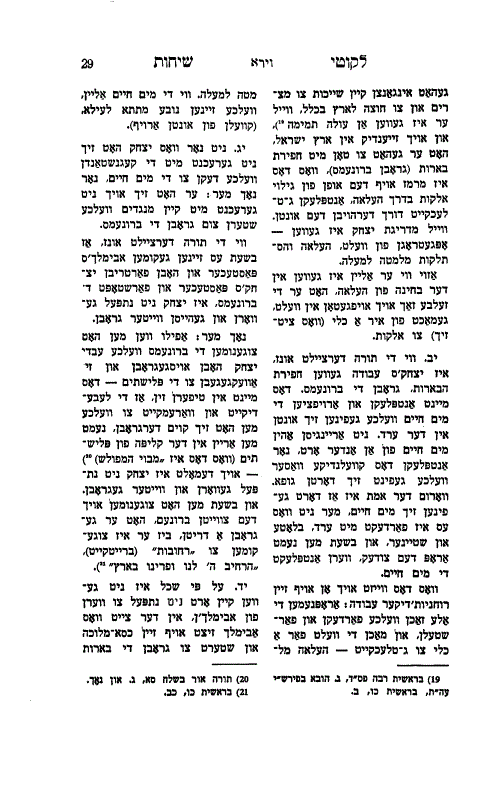
12. Isaac's approach, as mentioned earlier, was the elevation from below to above. Therefore, he had no connection whatsoever to Egypt or to outside the Land of Israel in general, because he was a "perfect burnt offering." Even while in the Land of Israel, his focus was on digging wells, which symbolizes the manner of revealing G‑dliness through elevation, uncovering G‑dliness by uplifting the lower realm. Isaac's level was detached from the world, characterized by elevation and withdrawal from below to above. Just as he himself was in the state of elevation, he accomplished the same in the world, making it a vessel that draws towards G‑dliness.
13. As the Torah tells us, Isaac's service was digging wells. This means uncovering and drawing up the living waters that are found beneath the earth. It is not about pouring living waters from another place, but revealing the bubbling water that is already there. The truth is that living waters are present there, only covered by earth, mud, and stones. When the covering is removed, the living waters are revealed. This also indicates his spiritual service: removing all things that conceal and obscure, and making the world a vessel for G‑dliness — elevation from below to above, like the living waters themselves, which spring forth from below to above.
14. Not only did Isaac disregard the obstacles that covered the living waters, but even more so: he was not deterred by opponents who hindered the digging of the wells. As the Torah narrates, when Abimelech's shepherds came and drove away Isaac's shepherds and stopped up the wells, Isaac was not disheartened and continued to dig. Furthermore, even when the wells that Isaac's servants had dug were taken and given to the Philistines — which, in a deeper sense, means that the vitality and warmth that had just been reached were being absorbed into the "shell" of the Philistines (which is an "open passageway") — even then, Isaac was not disheartened and continued to dig. And when the second well was also taken, he dug a third one, until he reached "Rehoboth" (broad spaces), "For now the L‑rd has made room for us, and we shall be fruitful in the land."
15. According to reason, there was no place to be affected by Abimelech, even when Abimelech sat on his royal throne and obstructed the digging of the wells of holiness. And the wells that were dug with the greatest effort were taken by Abimelech for himself. However, Isaac did not consider any rational calculations; he knew that his task was to reveal the living waters, and he performed this work with mesiras nefesh (self-sacrifice).
The service of making the world a vessel for G‑dliness reaches the true infinity (the true boundlessness) of the Infinite One, blessed be He, because through this, the ultimate purpose is fulfilled. As it states, the reason for calling him by the name Isaac — "G‑d has made laughter for me." This purification and refinement of the matters that conceal and derive from the name Elokim, which in gematria equals "nature," specifically evokes the laughter and delight above.
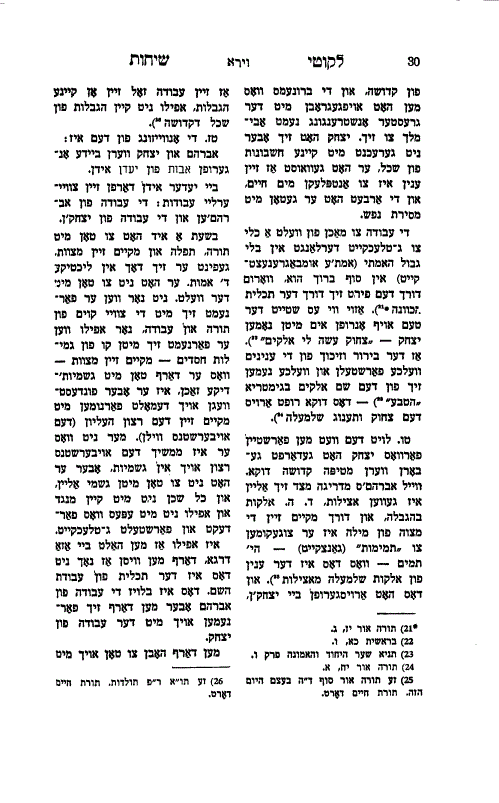
16. According to this, we will understand why Isaac had to be born from a drop of holiness specifically. For Abraham's level by itself was Atzilus, meaning G‑dliness with limitation, and by fulfilling the mitzvah of circumcision, he reached "perfection" — he was perfect — which is the concept of G‑dliness above Atzilus, and this evoked in Isaac that his service should be without any limitations, not even the limitations of holy intellect.
17. The instruction from this is: Abraham and Isaac are both called fathers of every Jew. Every Jew must have two types of service: the service of Abraham and the service of Isaac. When a Jew is involved with Torah, prayer, and fulfilling mitzvos, he finds himself in a bright four cubits. He does not deal with the world. Not only when he engages in the dual fulfillment of Torah and service, but even when he is involved in the act of kindness — fulfilling mitzvos — which he must do with physical things, he is nevertheless also then occupied with fulfilling the Supreme Will (the will of the Most High). More than that, he draws down the Supreme Will also into the physical, but he does not deal with the physical itself, and certainly not with any opposition, and not even with anything that covers and conceals G‑dliness. Even when one reaches such a level, one must know that this is not yet the ultimate purpose of serving G‑d. This is only the service of Abraham, but one must also engage in the service of Isaac.
One must also deal with...