Likkutei Sichos Vol. 34 – Ki Savo 2
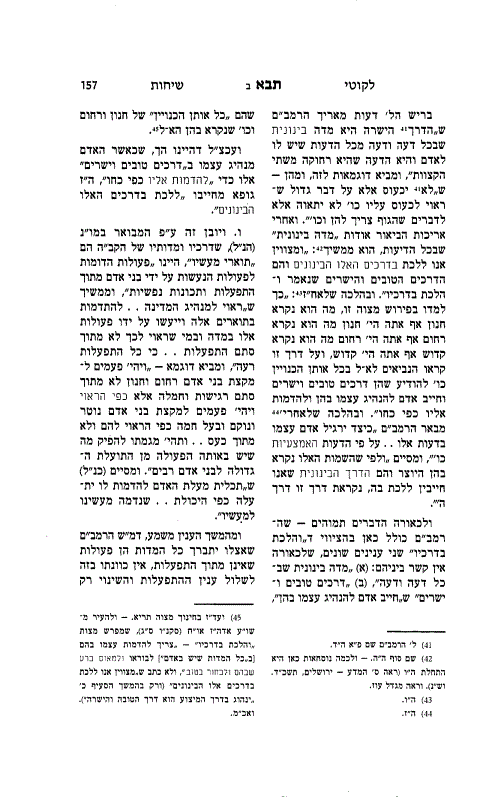
1. The Rambam writes in Sefer HaMitzvos: "The eighth mitzvah is that we are commanded to emulate Him, may He be exalted, to the best of our ability. This is what is meant by the commandment 'And you shall walk in His ways.' This commandment is repeated in the phrase 'to walk in all His ways.' It is explained that just as the Holy One, blessed be He, is called gracious, so too should you be gracious; just as the Holy One, blessed be He, is called merciful, so too should you be merciful; just as the Holy One, blessed be He, is called pious, so too should you be pious [and this is the language of the Sifri]. This concept is repeated in another form with the phrase 'After the L‑rd your G‑d you shall walk,' which is explained to mean emulating His good deeds and the noble attributes with which the Almighty is described, etc."
In the responsa of Rabbi Avraham, the son of the Rambam, it is mentioned that he was asked, "Isn't this mitzvah inclusive of all the mitzvos, as is evident from the verses that repeat this concept, such as 'in all the way which the L‑rd your G‑d has commanded you, you shall walk,' and similarly 'if you keep all this commandment [to perform it] which I command you today, etc., to walk in His ways all the days,' and also 'And now, Israel, what does the L‑rd your G‑d ask of you?' Our teacher, of blessed memory, has already stated [in his principles at the beginning of Sefer HaMitzvos] in the fourth principle that it is not appropriate to count the commandments that are inclusive of all the mitzvos."
[It is worth adding an explanation that all the mitzvos are called the "ways" of the Holy One, blessed be He, not only because He commanded us to follow them, but because they are the ways in which He, may He be exalted, conducts Himself. As our sages said regarding the verse 'He declares His words to Jacob, etc.,' that the Holy One, blessed be He, fulfills, as it were, all the mitzvos, "what He does, He tells Israel to do and observe". Therefore, all the mitzvos are the "ways" of the Omnipresent. This is also explicitly stated in the Zohar on the verse "For the ways of the L‑rd are right," that the entire Torah is "the paths of the Holy One, blessed be He"].
Rabbi Avraham, the son of the Rambam, responded to this by saying that "a fundamental principle in our religion is that we do not rely solely on the plain meaning of the text [alone, as the 'Karaites' do], but on what the text and the tradition together indicate. Even if the plain meaning of this verse would definitely indicate that it refers to the fulfillment of all the mitzvos, nevertheless, we are obligated to believe that it is a specific mitzvah because the tradition explains regarding it what is meant by gracious, etc. This is not an inclusive mitzvah according to what the tradition has clarified," as he further explains in the continuation of his response, the necessity for this also from
the language of the verse, that "after it says 'if you keep the commandments of the L‑rd your G‑d,' which includes all the mitzvos, it adds and says 'and you shall walk in His ways,' regarding which one might have thought it is not as obligatory as the mitzvos, since the mitzvos are practical, and 'walking in His ways' are matters dependent on attributes, as the tradition explains what is meant by gracious. The general principle is that from the addition of 'and you shall walk in His ways' to the condition of the mitzvos in general, it becomes clear that the intention is for something other than the explicitly stated mitzvos at the beginning."
In other words, "and you shall walk in His ways" is not an inclusive commandment, because according to the "tradition," the verse does not speak of fulfilling all the mitzvos, but only refers to "matters dependent on attributes," such as graciousness, mercy, and the like.
2. There is room to discuss this: if "His ways" in this verse refers only to "matters dependent on attributes," then there is no novelty in this mitzvah — because the conduct of being merciful and gracious, and the like, is included in the mitzvah of "Love your neighbor as yourself," as the Rambam writes, "He commanded us to have compassion, mercy, charity, and kindness, and this is what is meant by 'Love your neighbor as yourself.'" In the language of the Rambam in the fourth principle (mentioned above), "He did not command to do anything other than what we already know."
The Rambam also writes regarding "visiting the sick, comforting mourners, and burying the dead [that these actions are 'the attributes of the Holy One, blessed be He,' as it is stated in the tractate Sotah in the explanation of the verse 'After the L‑rd your G‑d you shall walk,' 'follow the attributes of the Holy One, blessed be He, just as He clothes the naked, etc.']
3. It might initially seem that the intention of Rabbi Avraham, the son of the Rambam, when he wrote "the mitzvos are practical, and 'you shall walk in His ways' are matters dependent on attributes," is that the commandment of "you shall walk in His ways" is not about actual conduct in practice, such as mercy, but rather about the feeling in the heart. This would be the novelty of this commandment, something not known from elsewhere.
However, this is not a sufficient explanation, because:
a) From the straightforward language of the Rambam (both in the Book of Mitzvos and in the Mishneh Torah), it is implied that the commandment "Love your neighbor as yourself" includes not only conduct in a manner of friendship towards one's fellow, but also the literal meaning of "love" — the feeling of love in the heart. When a person feels love in their heart, it naturally arouses feelings of mercy, etc., towards their fellow.
b) The phrase "you shall walk in His ways" indicates an aspect of action, actual conduct, and not (only) a feeling in the heart. This is evident from the straightforward language of the Sages mentioned above: "You too should clothe the naked, visit the sick, etc." As the Rambam concludes in the Book of Mitzvos here, "this matter is repeated... to emulate His good actions, etc."
[As explained elsewhere, it can be said that this is the difference between the two sayings of the Sages on this matter — (a) "Follow the attributes of the Holy One, blessed be He" (in accordance with the language of the verse "After the L‑rd your G‑d you shall walk," "you shall walk in His ways," "to walk in all His ways"), (b) "Cleave to His ways" (as in the verse "and to Him you shall cleave," "to cleave to Him") — that walking in His ways and attributes is actual conduct according to the attributes of the Holy One, blessed be He, while cleaving to His attributes is the feeling in the heart (as the simple meaning of cleaving, which is a matter of feeling)].
This is also proven from the words of the Rambam in the Guide for the Perplexed, where he states that "the ultimate perfection of man is to emulate Him, may He be exalted, to the extent possible [which is the commandment of 'you shall walk in His ways,' as he writes in the Book of Mitzvos here], meaning that we should make our actions resemble His actions... they said, just as He is gracious, so you should be gracious; just as He is merciful, so you should be merciful" — the emphasis here is "that we should make our actions resemble His actions," and as he explains there at length, that the ways of the Holy One, blessed be He, which are His attributes, "are descriptions of His actions," that "He performs actions similar to those performed by us as a result of attributes, meaning psychological traits, not that He, may He be exalted, possesses psychological traits," and this is the ultimate perfection in human conduct, that "these actions should be performed by him in measure and with those who are worthy of it, not out of mere emotional excitement... every emotional excitement is bad." See there at length.
4. Therefore, it seems that the novelty in the commandment of "you shall walk in His ways," "besides what we already know," is explained in the words of the Rambam himself, who emphasizes "He commanded us to emulate Him, may He be exalted, to the extent possible," meaning that "you shall walk in His ways" is not a commandment obligating a person to conduct (in practice) with mercy and graciousness, etc., but rather it is a commandment about emulation — "to emulate Him, may He be exalted, to the extent possible," where the conduct of mercy and graciousness is intended and aimed at emulating the Creator.
Thus, this commandment is one of the duties of the heart, where the intention of a person in their conduct of mercy and graciousness, etc., should be (not only because reason dictates that one should behave in these ways because they are good and upright behaviors, but) in order "to emulate Him, may He be exalted." Since these ways are the ways of the Holy One, blessed be He, therefore, one emulates Him, as the precise language of our Sages states, "Just as He is... so too you..." indicating that the entire intention of a person in this conduct is to emulate the Creator.
This does not contradict what was explained earlier that "you shall walk in His ways" is not a commandment about the emotion in the heart, but about the actual walking (and doing) in His ways — because the explanation does not negate the actual walking (on the contrary, as mentioned above), but rather in this case, the emphasis is on the intention and content of walking in the ways of the Holy One, blessed be He, which is solely "to emulate Him, may He be exalted," matters of the heart and the intention of the person, that their walking in these ways is only because they are "His ways" of the Holy One, blessed be He.
This simply resolves the reason why "you shall walk in His ways" is not a general commandment — because of the novelty in the intention of walking in these ways, "to emulate Him, may He be exalted."
5. It can be said that according to this, there is also a practical implication — and to preface with the words of the Rambam in the Mishneh Torah, in his explanation of the commandment "you shall walk in His ways":
At the beginning of the Laws of De'ot, the Rambam elaborates that "the straight path is the middle measure in every trait and trait from all the traits a person has, and it is the trait that is distant from both extremes," and he provides examples of this, among them — "one should not become angry except over a great matter that is worthy of anger, etc., one should only desire things that the body needs, etc." After elaborating on the "middle measure" in all traits, he continues: "And we are commanded to walk in these intermediate paths, and they are the good and upright paths, as it is said, 'and you shall walk in His ways.'" In the following law, he states: "Thus they taught in the explanation of this commandment, just as He is called gracious, so too you be gracious; just as He is called merciful, so too you be merciful; just as He is called holy, so too you be holy. And in this manner, the prophets called G‑d by all these appellations, etc., to make known that they are good and upright paths, and a person is obligated to conduct himself in them and to emulate Him to the extent of his ability." In the subsequent law, the Rambam explains "how a person should accustom himself to these traits... according to the intermediate traits, etc.," and concludes "and since these names are those by which the Creator is called, and they are the middle path that we are obligated to walk in, this path is called the way of G‑d."
At first glance, the Rambam's words are puzzling — as he includes in the commandment of "you shall walk in His ways" two different matters that seemingly have no connection: (a) "the middle measure in every trait and trait," (b) "good and upright paths" that "a person is obligated to conduct himself in," which are "all those appellations" of gracious and merciful, etc., by which G‑d is called.
It must be said that they are one and the same, that when a person conducts himself in these "good and upright paths" in order "to emulate Him to the extent of his ability," this itself obligates him "to walk in these intermediate paths."
6. This can be understood based on what is explained in the Guide for the Perplexed (as mentioned above), that the ways and attributes of the Holy One, blessed be He, are "descriptions of His actions," meaning "actions similar to those performed by humans as a result of emotional excitement and psychological traits," and he continues that "it is fitting for the leader of the state... to emulate these descriptions and perform these actions in measure and with those who are worthy of it, not out of mere emotional excitement... for every emotional excitement is bad," and he provides an example — "there will be times when for some people he will be merciful and gracious not out of mere sensitivity and compassion but as is fitting, and there will be times when for some people he will be vengeful and wrathful as is fitting for them, not out of anger... and his aim will be to achieve the great benefit that this action brings to many people." And he concludes (as mentioned above) that "the ultimate perfection of a person is to emulate Him, may He be exalted, to the extent possible... that we should make our actions resemble His actions."
7. From the continuation of the matter, it is implied that when Rambam writes that for Him, blessed be He, all the attributes are actions not stemming from emotional excitement, his intention is not to negate the concept of excitement and change only because it is not possible for Him (as he writes there, "not out of excitement and not out of change... they are done by Him, blessed be He, not from any addition to Himself at all"), but rather because this pertains to the essence of the actions of the attributes. Since these actions come from Him, blessed be He, not out of excitement, therefore they are truly good and upright paths, where each attribute is in the manner it should be performed.
This is the continuation of Rambam's words, that after explaining the essence of the attributes for Him, blessed be He, he continues that it is fitting for a person to conduct himself in this way, that "the ultimate perfection of a person is to emulate Him, may He be exalted, to the extent possible... that we should make our actions resemble His actions... just as He is gracious, so too should you be gracious, etc." When a person emulates his Creator, and his conduct in attributes is like the conduct of the Holy One, blessed be He, according to His attributes, then his attributes will be "as is fitting," and the required benefit from that attribute will be achieved.
Accordingly, we can understand the connection between the two matters in the Mishneh Torah — the "intermediate path in every trait" and the commandment "to emulate Him to the extent of one's ability" by a person conducting himself in good and upright ways according to all those descriptions by which G‑d is called. Conduct according to the "extremes" (in every trait) generally stems from emotional excitement (of the heart), which does not allow for opposite conduct, and lacks the discernment of the mind to decide whether in this situation it is appropriate to act this way or not — and therefore it leads a person to "extremes." But when a person conducts himself in these attributes to "emulate Him to the extent of his ability," and consequently his conduct in these attributes is not (only) from the excitement of the heart, but from intention and alignment with the truth of these attributes (as they are with Him, blessed be He), he holds to the intermediate path in every trait, as Rambam writes in the Guide for the Perplexed, "as is fitting," and consequently, at times the conduct is in a manner of mercy and at times with some people, etc.
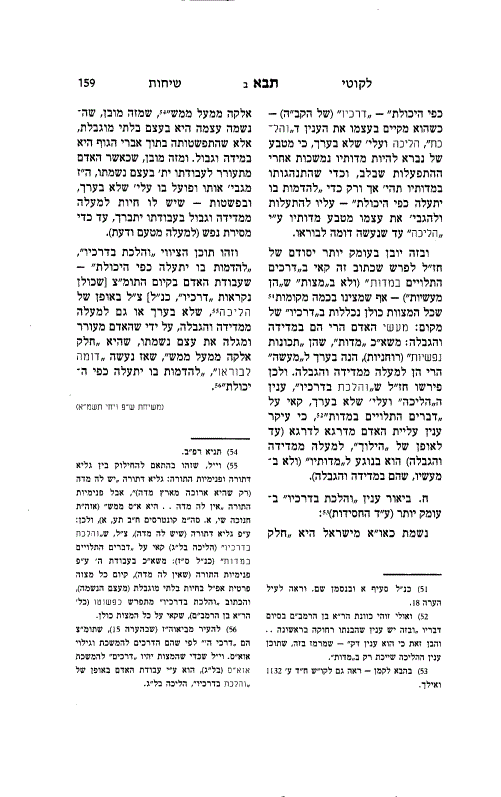
Based on what was explained above, that the point of innovation in the commandment "and you shall walk in His ways" is — "to emulate Him, may He be exalted, to the extent possible," we can also explain the precision of the wording of the verse "and you shall walk in His ways," specifically walking:
"Walking" implies — an ascent from one level to another (as it is written, "they go from strength to strength"), and primarily — an ascent to a level that is incomparably higher than the previous level.
[This is the reason why angels are called by the name "standing," as it is written, "and I will give you places to walk among these standing ones," "because they stand all their days in one level" — which at first glance is not understood: it is explained in many places that angels always ascend from one elevation to another, and this is their song, etc., so what is the meaning of "they stand all their days in one level"? It is explained that the ascents of the angels are gradual ascents, from one level to another that have a relative value to each other, and therefore, even though they ascend from strength to strength, they have not completely moved from their first place and their first level (since even the highest level has a value to the lowest level), and it is as if "they stand all their days in one level"].
This is the (inner) explanation of "and you shall walk in His ways" — that the two details in the verse [(a) and you shall walk (b) in His ways] are dependent on each other: when can a person reach "to emulate Him, may He be exalted, to the extent possible" — "His ways" (of the Holy One, blessed be He) — when he fulfills within himself the matter of "and you shall walk," walking and ascending beyond measure, because it is the nature of a created being that his attributes follow the excitement of the heart, and in order for his conduct in his attributes to be solely to "emulate Him, may He be exalted, to the extent possible" — he must elevate and uplift himself from the nature of his attributes through "walking" until he becomes similar to his Creator.
7. This provides a deeper understanding of the foundation of our Sages in interpreting that this verse refers to "ways dependent on attributes" (and not on "mitzvos" which "are practical") — even though we find in several places that all the mitzvos are included in the "ways" of the Omnipresent: Human actions are measured and limited; however, "attributes," which are "spiritual qualities," are, in relation to "action," beyond measurement and limitation. Therefore, our Sages interpreted that "and you shall walk in His ways," the concept of "walking" and ascent beyond measure, refers to "matters dependent on attributes," because the primary concept of a person's ascent from level to level (up to the manner of "walking," beyond measurement and limitation) pertains to his "attributes" (and not his actions, which are measured and limited).
8. A deeper explanation of "and you shall walk in His ways" (according to Chassidus):
The soul of every Jew is "a part of G‑d above, truly," from which it is understood that the soul itself is essentially unlimited, but its extension within the body is with measure and limit. From this, it is understood that when a person is aroused to serve the Blessed One with the essence of his soul, it elevates him and causes an ascent beyond measure, and simply — he has vitality beyond measurement and limit in his service of the Blessed One, to the extent of mesiras nefesh (beyond reason and understanding).
This is the essence of the commandment "and you shall walk in His ways," "to emulate Him, may He be exalted, to the extent possible" — that a person's service in fulfilling the Torah and mitzvos [all of which are called "His ways," as mentioned above] should be in a manner of walking, beyond measure or even beyond measurement and limitation, by the person arousing and revealing the essence of his soul, which is "a part of G‑d above, truly," and then he becomes "similar to his Creator," "to emulate Him, may He be exalted, to the extent possible."