Likkutei Sichos Vol. 34 – Ki Savo 1
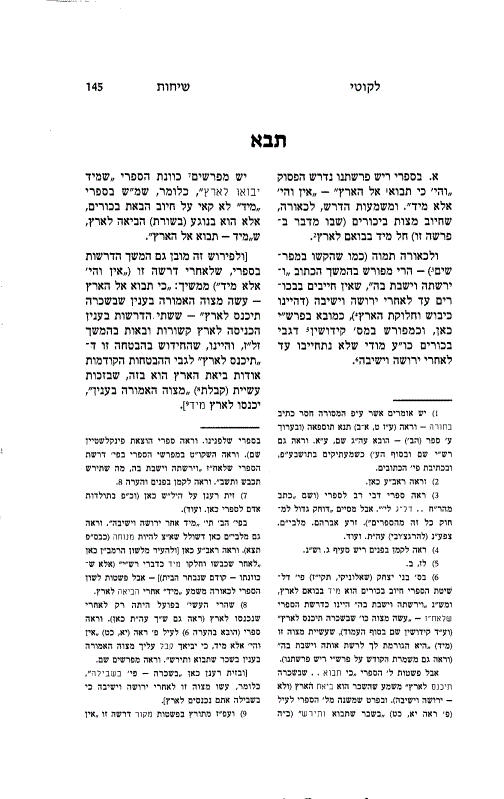
1. In the Sifrei at the beginning of our parsha, the verse "And it shall be when you come into the land" is expounded as "there is no 'and it shall be' except immediately." The implication of this drash, seemingly, is that the obligation of the mitzvah of Bikkurim (which is discussed in this parsha) takes effect immediately upon their arrival in the land.
This is puzzling (as the commentators have questioned) — for it is explicitly stated later in the verse "and you shall possess it and dwell in it," indicating that the obligation of Bikkurim does not apply until after possession and settlement (that is, the conquest and division of the land), as Rashi explains here, and as is clearly stated in Tractate Kiddushin that regarding Bikkurim, everyone agrees they were not obligated until after possession and settlement.
Some commentators explain the intention of the Sifrei as "that they will immediately come to the land," meaning that the "immediately" mentioned in the Sifrei does not refer to the obligation of bringing Bikkurim, but rather to the (news of the) entry into the land, that "immediately — you will come into the land."
[According to this explanation, the continuation of the drashot in the Sifrei is also understood, where after this drasha ("there is no 'and it shall be' except immediately"), it continues: "when you come into the land — perform the mitzvah mentioned in the matter, for in its merit you will enter the land" — both drashot concerning the entry into the land are connected and follow one another, meaning that the novelty in this promise of "you will enter the land" compared to previous promises about coming to the land is that in the merit of performing (accepting) "the mitzvah mentioned in the matter," they will enter the land immediately].
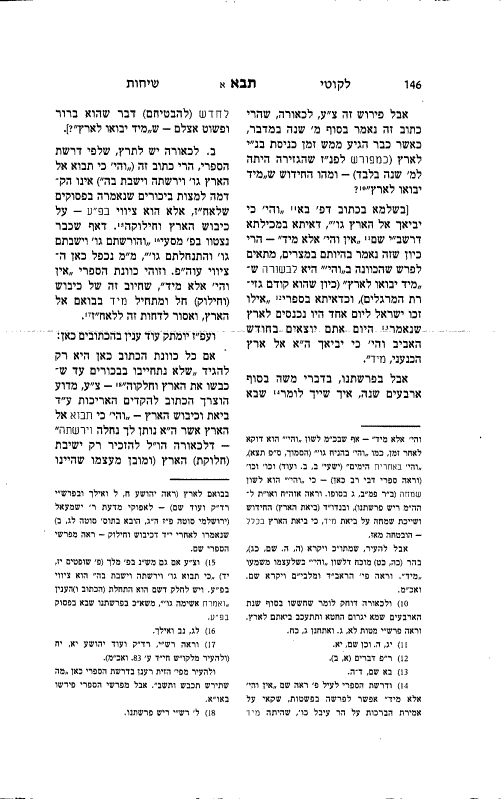
However, this explanation is seemingly difficult, for this verse was stated at the end of the forty years in the desert, when the time for the entry of the Children of Israel into the land had already truly arrived (as is explicitly stated earlier that the decree was only for forty years) — so what is the novelty that "they will immediately come to the land"?
[It is understandable in the verse in Parshas Bo "And it shall be when the L‑rd brings you to the land," where it is stated in the Mechilta of Rabbi Shimon bar Yochai there "there is no 'and it shall be' except immediately" — since this was said while they were in Egypt, it is fitting to interpret that the intention of "and it shall be" is the news that "they will immediately come to the land" (since it was before the decree of the spies), as it is stated in the Sifrei "if Israel had merited for one day, they would have entered the land, as it says 'today you are going out in the month of Aviv and it shall be when the L‑rd brings you to the land of the Canaanite, immediately."
But in our parsha, in the words of Moshe at the end of the forty years, how is it possible to say that he came to innovate (to assure them) something that is clear and obvious to them — that "they will immediately come to the land"?].
2. Seemingly, it can be resolved that according to the drasha of the Sifrei, this verse ("And it shall be when you come into the land... and you shall possess it and dwell in it") is not an introduction to the mitzvah of Bikkurim stated in the subsequent verses, but rather a commandment in its own right — concerning the conquest and division of the land. Even though they were already commanded in Parshas Masei "and you shall dispossess... and dwell... and you shall inherit," nevertheless, the commandment is repeated here once more. And this is the intention of the Sifrei "there is no 'and it shall be' except immediately," that this obligation of conquest (and division) takes effect and begins immediately upon their arrival in the land, and it is forbidden to postpone it for later.
Accordingly, another aspect in these verses is clarified:
If the entire intention of the verse here is only to state "that they were not obligated in Bikkurim until they conquered and divided the land" — it is puzzling why the verse needed to preface with the lengthy description of coming and conquering the land — "And it shall be when you come into the land which the L‑rd your G‑d gives you as an inheritance and you possess it" — seemingly, it should have only mentioned the settlement (division) of the land (and it is understood by itself that this is after coming and conquering); similar to what is stated earlier in Parshas Re'eh "and you shall cross the Jordan and dwell in the land...", and there it does not mention about (coming and) conquering the land, and similarly at the end of the previous parsha — "and it shall be when the L‑rd your G‑d gives you rest from all your enemies around...".
According to the above, it is simply resolved, because the conquest and division of the land in this verse are not (only) a condition for the mitzvah of Bikkurim, but a commandment in its own right concerning the conquest and division, "and you shall possess it and dwell in it."
2. This does not contradict the words of the Gemara, which teaches that they were not obligated in Bikkurim until after inheritance and settlement. This is derived from the juxtaposition and order of the commandments — from the fact that the verse repeats the commandment of conquering and dividing the land here, before the commandment of Bikkurim, we learn that they are not obligated in Bikkurim until after fulfilling the commandment of conquering and dividing the land.
However, it is difficult to interpret the Sifri in this way, because from its language in the subsequent teaching, "perform the commandment stated in the matter," it implies that in this verse itself there is no commandment (only a matter), and the commandment is (only) "stated in the matter" (in the verses that follow), the commandment of Bikkurim.
3. We can explain this as follows:
Regarding the statement "when you come... and you possess it and dwell in it" — that the obligation does not apply until "after inheritance and settlement" — this can be interpreted in two ways:
a) After the inheritance and settlement of all Israel, as explicitly stated in Rashi on the Talmud that "after inheritance and settlement" means after fourteen years of conquest and division.
b) Each individual, as soon as he conquers (acquires) his portion, becomes obligated in this commandment.
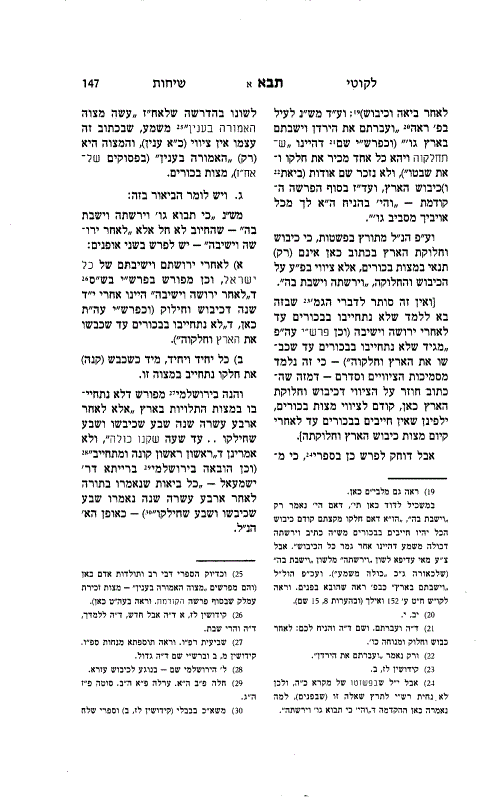
Now, the Yerushalmi explicitly states that they were not obligated in the commandments dependent on the land "until after fourteen years, seven of conquest and seven of division... until they acquired it all," and we do not say that "each one acquires and becomes obligated" (as also brought in the Yerushalmi, the Baraita of Rabbi Yishmael — "all the arrivals mentioned in the Torah were said after fourteen years, seven of conquest and seven of division") — as in the first manner mentioned above.
According to this, we can explain the opinion and intention of the Sifri here that "there is no 'and it shall be' except immediately" — according to the Sifri, the verse innovates that the commandment of Bikkurim (unlike many commandments dependent on the land) does not begin at the end of the fourteen years of conquest and division of all Israel, but each individual becomes obligated in Bikkurim immediately after he conquers his portion (his inheritance and settlement).
[This clarifies the language of the Tanna of the school of Rabbi Yishmael, "since arrivals are mentioned in the Torah generally, and the verse specified in one of them after inheritance and settlement, etc.," that is, "regarding the king, as it is written, when you come to the land... and you possess it and dwell in it, and you say, I will set a king over me." At first glance, it is not understood — for also in Bikkurim "the verse specified... after inheritance and settlement", so what is the meaning of the words of the Tanna of the school of Rabbi Yishmael "the verse specified in one of them"?]
According to the above explanation of the Sifri, we can say that the Tanna of Rabbi Yishmael and the Sifri's teaching align, that the commandment of Bikkurim is different from other commandments dependent on the land (which they were obligated in only after fourteen years of conquest and division), for the Torah placed its obligation on each individual "immediately" (when he recognizes his portion), and the innovation is that "the verse specified (only) in one of them (regarding the king) after inheritance and settlement (conquest and division), etc."]
4. However, this explanation is not sufficient to clarify the language of the Sifri, because from the straightforward language "and it shall be when you come, there is no 'and it shall be' except immediately" it implies that immediately upon their arrival in the land they were obligated in Bikkurim, whereas according to the above explanation, that the obligation falls on each one immediately when he recognizes his portion, it turns out that the obligation does not fall until after seven years of conquest and the beginning of the years of division (when he is able to recognize his portion).
We can explain this as follows:
From what was explained above regarding the opinion of the Sifri, that the condition of "inheritance and settlement" in Bikkurim is a law concerning each individual, that as soon as he recognizes his portion he becomes obligated in Bikkurim, unlike other commandments dependent on the land which they were not obligated in "until they acquired it all" — the intention is not that the distinction is only between the law of individual obligation and the law dependent on the community, but that this is a fundamental difference in the very nature of this condition of "inheritance and settlement":
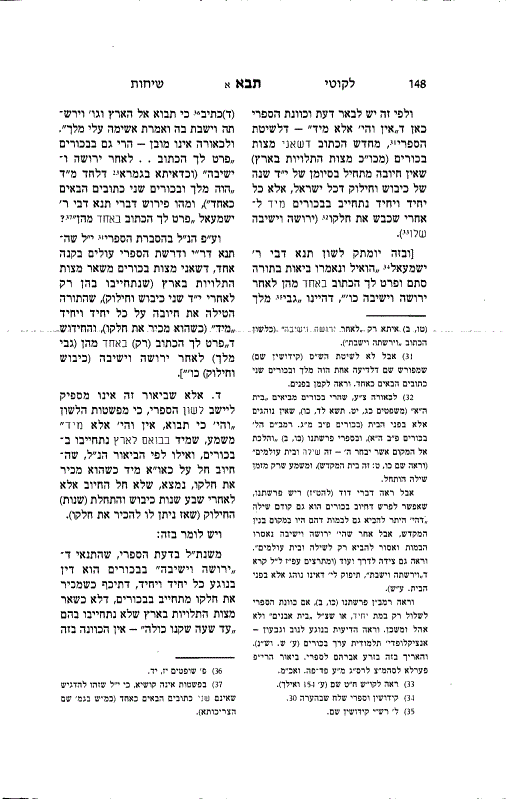
4. In most (almost all) mitzvos dependent on the land, the obligation is contingent upon the conquest and division of the land. The conquest and division are what cause the obligation in these land-dependent mitzvos (either because until then the complete sanctity of the land, which effects the obligation of these mitzvos, is lacking, or because the obligation of land-dependent mitzvos is contingent upon the acquisition of the entire land).
However, regarding Bikkurim, the obligation is dependent solely on entering the land, and the condition of "and you shall inherit it and dwell in it" (does not cause the obligation, but) merely removes the obstacle of "a lion crouching upon it," because the actual fulfillment of this mitzvah is only possible when the field is his and in his possession — as it says, "I have brought the first of the fruit of the ground that You have given me, O L‑rd" — meaning after his inheritance and settlement, when he has a defined portion in the land.
This is the intention of the Sifri, "and it shall be when you come — there is no 'and it shall be' except immediately," for from the verse "and it shall be when you come," we learn that the obligation of Bikkurim falls immediately upon their arrival in the land, similar to the mitzvah of Challah, which they were obligated in immediately "when you come into the land" [but regarding Challah, which is separated from the dough, it can be fulfilled "immediately" upon their actual arrival in the land, as soon as he has dough, whereas with Bikkurim, which must be from "the first of the fruit of the ground that You have given me, O L‑rd," it cannot be fulfilled in practice until after "and you shall inherit it and dwell in it," when the owner of the field recognizes the land — his portion in the land].
5. Furthermore, it can be said — according to the Sifri's view, it was possible to actually fulfill the mitzvah of Bikkurim "immediately" (upon their arrival in the land), at the beginning of the conquest.
For it is stated in the Sifri, that what Moshe said to Yisro, "and it shall be, if you go with us... we will do good to you," means that his descendants would be given "the fertile land of Jericho" (until the Temple would be built), "and they (the descendants of Yisro) would eat it for four hundred and forty years" (the number of years from the beginning of Israel's entry into the land until the building of the Temple). Thus, "the fertile land of Jericho" was promised to the children of Israel, and they did good to Yisro and gave it to him (his descendants) in practice immediately upon entering the land, with the conquest of Jericho.
One might inquire — what is the law regarding "the fertile land of Jericho," which was not subject to the mitzvah of division (i.e., the lottery, "but by lot shall the land be divided"), as from the outset at the time of conquest, it was a defined portion for the descendants of Yisro — when did it become obligated in Bikkurim?
According to the Talmudic view, etc., that they are not obligated in Bikkurim until after fourteen years of conquest and division (because it must be "until they acquired it all," and we do not say "each one acquires and becomes obligated"), this is also true for "the fertile land of Jericho" (even though it was not included in the division of the land after the seven years of conquest).
But based on what was explained above regarding the Sifri's view, that the obligation of Bikkurim is dependent on entering the land, and the condition of "inheritance and settlement" in Bikkurim is only so that the Bikkurim will be from "the first of the fruit of the ground that You have given me, O L‑rd," it is reasonable to say that in this case (the fertile land of Jericho), which was already a defined portion for the descendants of Yisro, they became obligated in Bikkurim immediately upon conquering and settling there.
Accordingly, it turns out that the Sifri's words "there is no 'and it shall be' except immediately" are to be taken literally, that immediately upon their arrival in the land, there was an obligation of Bikkurim, because the (beginning of the) conquest of the land was — the conquest of Jericho, and its "fertile land" was given immediately to the descendants of Yisro, and they became obligated in Bikkurim immediately.
6. Our sages stated a general principle regarding disputes in the Torah, that "these and those are the words of the living G‑d." It has been explained many times that this means not only that all opinions are part of our Torah regarding their study, but furthermore, that each opinion has a place in the actual conduct of a person. For the fact that the law is decided according to one opinion is regarding the conduct in practice in the simplest sense, but regarding (the mitzvos that are "in place" — similar to prayers that are in place of sacrifices, and regarding) the spiritual aspect of the mitzvos, there is room for all opinions.
6. Similarly, in our discussion regarding the mitzvah of Bikkurim, whether its obligation began only after fourteen years of conquest and division, or "immediately" upon their arrival in the land, there is a lesson and guidance for a person's conduct and actions.
This is similar to our case — in the mitzvah of Challah in its literal sense, which is the first (of your dough) like Bikkurim.
The explanation is as follows:
The essence of the mitzvah of Bikkurim is the praise and thanks of the one bringing the Bikkurim to the Holy One, blessed be He, for the goodness bestowed upon him, "And the L‑rd brought us out of Egypt... and brought us to this place and gave us this land... I have brought... which You have given me, O L‑rd," which necessitates — "(he brings) and recites," as "reciting" is part of the mitzvah from the Torah.
Based on this, we can say that the two opinions regarding the beginning of the obligation of Bikkurim correspond to two types of gratitude to the Holy One, blessed be He, that must be expressed every day:
a) The gratitude immediately at the beginning of the day, for "immediately upon awakening" from sleep (even before washing hands), a person says "I offer thanks before You... for restoring my soul..."
b) The gratitude during prayer — starting with the gratitude at the beginning of the prayer — "Give thanks to the L‑rd, call upon His name..." and then several times throughout the prayer, including in the Amidah prayer — "We give thanks to You," until the conclusion of the prayer, and until its very end (in the custom that is now accepted and practiced by all Israel) — the recitation of the verse "But the righteous shall give thanks to Your name..."
These are two modes of gratitude:
The first gratitude, which a person fulfills — is said immediately upon awakening from sleep, and does not come through contemplation and intellectual conclusion about the greatness and immense goodness done to him by the restoration of his soul — for he has just now, immediately awakened from his sleep, and has not even washed his hands (especially since initially a person should not contemplate Torah while still lying in bed before washing hands, etc.), and is not yet capable of intellectual contemplation — rather, this gratitude is primarily a result of the simple faith implanted in the heart of every Jew, who in his pure faith recognizes that his awakening from sleep each day is because the Holy One, blessed be He, Himself returns his soul to him. Therefore, the straightforward law is "when he awakens at the end of his sleep, he blesses while still on his bed, 'My G‑d, the soul You have given me... I offer thanks before You...'" — he gives thanks verbally for the goodness done to him by the restoration of his soul.
In contrast, the gratitude during prayer comes through intellectual contemplation, etc., as with all matters of awakening during prayer, which come through contemplation — as the Mishnah and Shulchan Aruch rule that before prayer, a person must contemplate "and think of the exaltedness of the Almighty and the lowliness of man," and similarly matters of contemplation, etc., during prayer — as a result of which he gives thanks to G‑d.
This is the distinction between the two aforementioned opinions (regarding the obligation of Bikkurim from the Torah):
According to the Sifri, that "there is no 'and it shall be' except immediately" — the gratitude of Bikkurim is akin to the gratitude of "Modeh Ani" that is said "immediately upon awakening from sleep," and similarly, the gratitude of Bikkurim should be "immediately" upon the entry of Israel into the land;
In contrast, according to the Talmud, etc., that they were not obligated in Bikkurim until after fourteen years of conquest and division, the gratitude of Bikkurim is akin to the gratitude during and at the conclusion of prayer — "But the righteous shall give thanks to Your name" — after all matters of contemplation during and before prayer, when the gratitude to G‑d is with deep recognition of His kindness, and it is in the utmost perfection — and similarly with Bikkurim, that only after the completion of the conquest and division of the entire land, the gratitude to G‑d for the giving of the land, etc., is with fruits that are in the utmost praise, a state of utmost perfection.
7. Parshas Tavo includes and is read in several years (and in this year — 5747) on the day of the 18th of Elul, the birthday of the Baal Shem Tov — the founder of general Chassidus, and the birthday of the Alter Rebbe — the founder of Chabad Chassidus.
8. It can be said that the two aforementioned opinions, which correspond to the two types of gratitude as previously explained, are hinted at in the two types of influence that the Baal Shem Tov and the Alter Rebbe had on the Jewish people:
The primary emphasis of the teachings of general Chassidus (of the Baal Shem Tov) is to awaken the power of faith within the Jewish people. As recounted in the talks of our Rebbeim, the Baal Shem Tov endeavored and engaged with Jewish children to educate them in saying "Yehei Shmei Rabba" and similar expressions, as well as with simple people to bring them to say "Blessed be G‑d" and the like. All of this serves to awaken and reveal within them the power of faith — akin to the general gratitude of "Modeh Ani" at the beginning of the day, and similarly, the gratitude "immediately" upon entering the land.
The emphasis of the Alter Rebbe in the teachings of Chabad Chassidus is that every Jew is obligated to intellectually comprehend, understand, and know matters of the greatness of G‑d to the best of their ability (as elaborated in the teachings of Chabad Chassidus in a manner that each individual can understand according to their level), and not to suffice with faith alone.
This corresponds to the gratitude that comes "after inheritance and settlement" — a term implying settling. For when a person contemplates with their intellect on the greatness of G‑d, it causes the faith to become established and settled within them, reaching the perfection of "inheritance and settlement" — the conquest and division of the entire land. Within the person, this means that the faith penetrates all the faculties of their soul, resulting in gratitude to G‑d in the utmost perfection — "But the righteous shall give thanks to Your name; the upright shall dwell in Your presence" (in a manner of settlement and permanence).