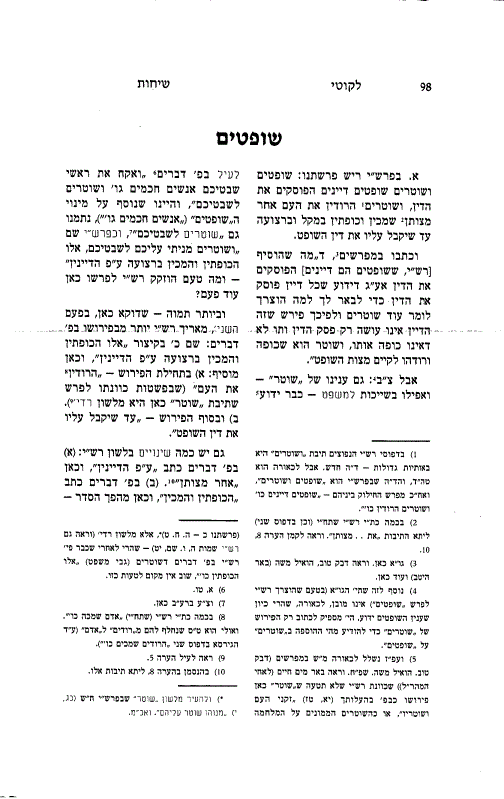
In the beginning of our parsha, Rashi comments: "Judges and officers: Judges are those who decide the law, and officers are those who enforce the people's compliance with their rulings, using sticks and straps until they accept the judge's decision."
The commentators explain that Rashi adds that "judges are those who decide the law" even though it is known that every judge decides the law, to clarify why it was necessary to also mention officers. Therefore, he explains that the judge only issues the ruling and does not enforce it, while the officer enforces and compels compliance with the judge's command.
However, this requires clarification: the role of an "officer"—even in relation to law—was already known earlier in Parshas Devarim, where it states, "And I took the heads of your tribes, wise men, etc., and officers for your tribes." This means that in addition to appointing "judges" ("wise men, etc."), "officers for your tribes" were also appointed. Rashi explains there, "And I appointed officers over you for your tribes, these are the ones who bind and strike with a strap according to the judges." Why then does Rashi need to explain it again here?
It is even more puzzling that specifically here, in the second instance, Rashi elaborates more than in his explanation in Parshas Devarim. There, he briefly states, "These are the ones who bind and strike with a strap according to the judges," while here he adds: a) at the beginning of the explanation, "those who enforce the people" (which simply means to explain that the word "officer" here is from the language of enforcement), and b) at the end of the explanation, "until they accept the judge's decision."
There are also several changes in Rashi's wording: (a) In Parshas Devarim, he writes "according to the judges," while here it is "after their command." (b) In Parshas Devarim, he writes "those who bind and strike," whereas here the order is reversed—"those who strike and bind." (c) In Parshas Devarim, he only mentions "with a strap," while here he adds "with a stick and a strap."
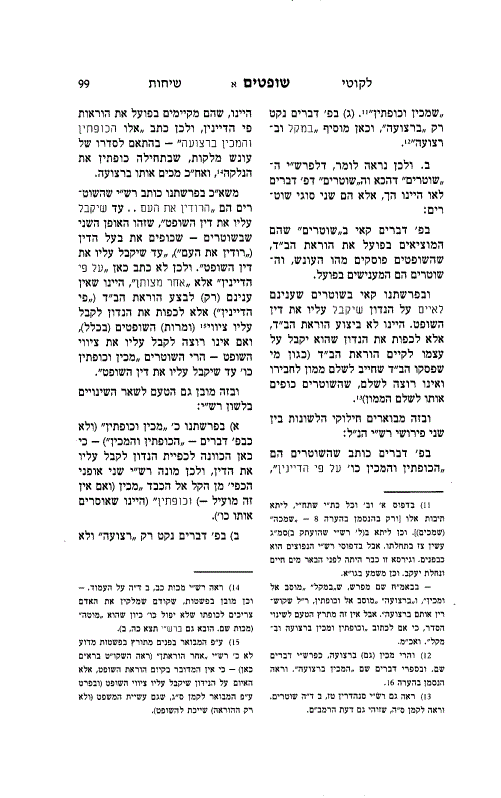
Therefore, it seems appropriate to say that according to Rashi, the "officers" here and the "officers" in Parshas Devarim are not the same, but rather two types of officers:
In Parshas Devarim, the "officers" are those who carry out the court's directive in practice. The judges decide what the punishment is, and the officers are the ones who actually administer the punishment.
In our parsha, the officers are those whose role is to threaten the litigant to accept the judge's decision. That is, not to execute the court's directive, but to compel the litigant to accept upon themselves to fulfill the court's directive (for example, if the court ruled that one must pay money to another and they refuse to pay, the officers compel them to pay).
This explains the differences in Rashi's language between the two explanations:
In Parshas Devarim, he writes that the officers are "those who bind and strike, etc., according to the judges," meaning they carry out the judges' directives in practice. Therefore, he writes "those who bind and strike with a strap"—in accordance with the order of the punishment of lashes, where first the one being lashed is bound, and then they are struck with a strap.
In contrast, in our parsha, Rashi writes that the officers are "those who enforce the people... until they accept the judge's decision," which is the second type of officer—those who compel the litigant ("enforce the people") "until they accept the judge's decision." Therefore, he does not write "according to the judges" but "after their command," meaning their role is not (only) to execute the court's directive ("according to the judges") but to compel the litigant to accept the command (and authority) of the judges (in general). If they do not want to accept the judge's command, the officers "strike and bind, etc., until they accept the judge's decision."
This also explains the reason for the other changes in Rashi's wording:
a) In our parsha, he writes "strike and bind" because here the intention is to compel the litigant to accept the decision. Therefore, Rashi lists the two methods of compulsion from light to severe: "strike (and if this does not help—) and bind" (meaning they are restrained, etc.).
The term "stick" is used because the punishment of lashes involves a strap and not a beating with a stick. However, in our parsha, where the intention is for the officers to "enforce the people" so that they fear the judge and accept the judge's ruling, sometimes a stick is also necessary. In fact, Rashi places "stick" first because it is a sign of "enforcement."
Based on the above, we need to understand the necessity (in the plain meaning of the text) for two types of officers: those described in Parshas Devarim as "those who bind, etc., according to the judges" and the officers in our parsha who "enforce the people... until they accept the judge's decision."
We can explain this as follows:
A "judge" in the Torah (in the simple sense) is not only one who decides the law but also one who carries out the law in practice, as explicitly stated earlier at the end of Parshas Balak, where Moshe said, "Let each of you kill his men." Rashi explains there, "Let each of the judges of Israel kill two, etc." Similarly, regarding the punishment of lashes, it is stated in the verse, "the judge shall cause him to lie down and be beaten, etc."
Based on this, it is understood that we cannot interpret "officers" here as those who carry out the sentence in practice because this is included in the commandment of "Judges... you shall appoint."
This is not similar to "and officers for your tribes" in Parshas Devarim, where Rashi explains that there was a separate appointment for "those who bind and strike... according to the judges" because in that verse, the judges are not called "judges" (rather, as it says, "I took the heads of your tribes, wise and known men, and made them heads over you, leaders of thousands, etc."), and it is understood that what is stated afterward, "and officers for your tribes," can be interpreted as those who carry out the judges' instructions in practice (and both are called "judges" — and all are included in what is stated in the subsequent verse, "And I commanded your judges at that time, etc., and you shall judge righteously, etc.").
However, in our parsha, where it says, "Judges and officers you shall appoint for yourself," it is clear that the "officers" are not included in the "judges."
Therefore, Rashi explains here that the intention is for those "who enforce the people after the judges' command... until they accept the judge's decision" — these enforcers are not related to the essence of the judgment (neither to the instruction nor to the execution of the judgment in practice), but rather to the enforcement of the people to fear the judges and accept their rulings, as explained at length above.
However, further clarification is needed — on the other hand:
Since it is possible to interpret "officers" as "those who enforce the people," how does Rashi know to interpret in Parshas Devarim that "officers" there means "those who bind and strike... according to the judges"? Especially since we find in several places (as mentioned above) that the judges themselves carry out the law in practice, how does Rashi know that there was a special appointment for such officers?
We can say that Rashi hints at the necessity for his interpretation with the extra wording there, "and officers — I appointed over you for your tribes, these are those who bind, etc.," for seemingly, the novelty in Rashi's explanation there is that the officers are a separate appointment (and not that the judges given "heads over you" are the officers), and it should have said, "and officers — I appointed for your tribes." What is his intention with the word "over you" — and it is obvious that the appointment is over the Children of Israel?
Rather, Rashi hints here at the necessity for his continuation of the explanation "these are those who bind, etc., according to the judges":
If the "officers" are "those who enforce the people... until they accept the judge's decision," then this appointment does not imply authority over the Children of Israel, but rather assistance to the judges [since it involves a litigant who does not comply, he needs officers to threaten the litigant to accept the judge's decision] — and if so, the verse should have said "and officers to assist your judges"?
Therefore, Rashi explains that the intention is for "those who bind and strike... according to the judges" — based on this, it is understood that this is an appointment over the Children of Israel ("over you"), as they are two parts of the appointment of judges (over the Children of Israel): a) wise men, etc. — who instruct the Children of Israel in the law, b) the officers who carry out and execute the law in practice.
It is necessary to explain why, in the days of Moshe Rabbeinu, we do not find that "officers" were appointed to compel the people to accept the judge's decision. This is because, in the simple sense, during Moshe's time, when judges were appointed, there was no need for this, as the Children of Israel feared the judges and did not require officers to threaten them, etc. However, in our parsha, which is a commandment for future generations, in any situation that may arise, there is a commandment to appoint "officers" — "those who enforce the people... until they accept the judge's decision" (to be ready if the situation demands coercive leadership).
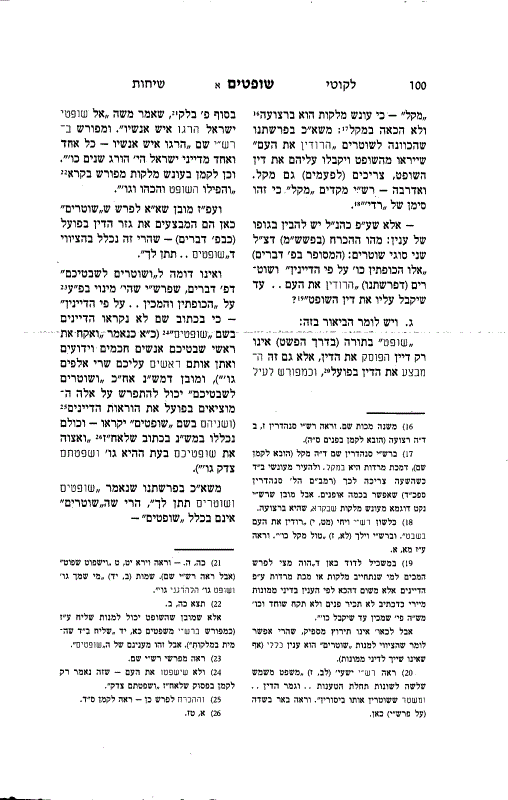
Based on the above, we can explain the Gemara's discussion in Tractate Sanhedrin:
"And these are the laws" that you shall place before them — it should have said "that you shall teach them." Rather... these are the tools of the judges. When Rav Huna would go out to judgment, he would say, "Bring me the tools of my trade: a staff, a strap, a shofar, and a sandal." And I commanded your judges at that time, said Rabbi Yochanan, to be diligent with the staff and strap.
This requires explanation — why did Rabbi Yochanan mention only the "staff and strap" and omit the other tools of the judges mentioned earlier — "shofar and sandal"?
Regarding the "sandal," which is for chalitzah, it can be explained that it is not related to instilling fear in the community. However, it is not understood why he omitted the "shofar."
Based on what was explained earlier, it can be said that the two sayings in the Gemara refer to two different matters:
The interpretation of "the tools of the judges" refers to the tools necessary for the actions of the court: a sandal for chalitzah — specifically in court, "a strap for lashes, a staff for disciplinary lashes, etc., a shofar for excommunication and banishment";
However, the statement "to be diligent with the staff and strap" refers to the officers, whose role is to instill fear in the community, and therefore, the "shofar" for excommunication and banishment is not mentioned here, as these are not the actions of the officers, but of the judges.
[Similarly, this is also the opinion of the Rambam, that the role of the "officers" (in our parsha) is to ensure that the people accept the law, and he writes: "These officers are those with a staff and strap, and they stand before the judges, going around in the markets and streets and on the shops to regulate prices, etc., and to correct (or to fix) any wrongdoing... and anyone they see doing wrong, they bring to the court, and they judge him according to his wickedness" — thus, these officers are not those who execute the judges' rulings, but they are "those with a staff and strap... who go around in the markets and streets" to correct the conduct of the people and bring "wrongdoing" before the court (and the court "judges him according to his wickedness").]
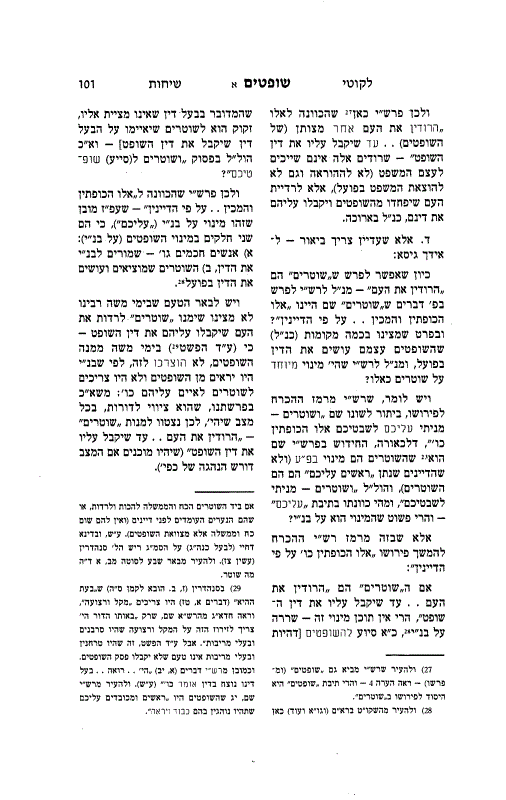
In this way, another question regarding the commandment to appoint "judges and officers" is easily resolved:
All those who count the commandments count the appointment of judges and officers as one commandment, even though, seemingly, they are two separate actions, the appointment of judges and the appointment of officers (as emphasized in the language of the Baraita, "From where do we know that judges are appointed for Israel? The verse states, 'You shall appoint judges.' From where do we know that officers are appointed for Israel? The verse states, 'You shall appoint officers'") — and why are they not counted as two commandments?
Some explain that judges and officers are interdependent, and therefore they are counted as one commandment, and they bring proof from what is said in the Sifrei, "If there are officers, there are judges; if there are no officers, there are no judges," and in the Tanchuma, "If there is no officer, there is no judge. How so? When a person is obligated by the court to another, if there is no officer to enforce it, once he leaves the judge, the judge has no power to do anything unless he hands him over to the officer," and it turns out that "through both together, the judgment is completed."
However, it is difficult to explain this way, for in practical law, it is not mentioned in the Rambam that judges and officers are interdependent, and simply, even if it is not possible (for whatever reason) to appoint officers, there is still an obligation to appoint judges.
Simply, the intention of the Sifrei (and the Tanchuma) is not to establish a legal ruling that "if there are no officers, there are no judges," but rather to highlight the practical benefit: without officers, it is possible that the matter of justice will not be actualized. However, in practice, there is an obligation to appoint judges even without officers, and it is possible for the matter of justice to be actualized even without the (threat of) officers. Moreover, and primarily, there is a need and necessity for "judges" to instruct in all matters of the Torah (most of which are not related to punishment, etc.).
Seemingly, this can be explained based on the words of the Rambam (regarding tekhelet and white, which are counted as one commandment, even though they do not invalidate each other) "that even parts that do not invalidate each other can sometimes be one commandment when they are one matter" — and indeed, in our case (as the aforementioned commentators say), "certainly judges and officers are one matter."
However, there is still room for discussion, because the aforementioned principle in the Rambam is not stated and applicable everywhere, as the commentators have elaborated in questioning it. Among them is the case of the tefillin of the arm and the head, which are counted as two commandments, and "surely the tefillin should be considered more of one matter (than tekhelet and white)" — and they answered that in tefillin, they are "two actions" (two wearings), and also "their arrangement and form are not the same, but there is much difference, and above all, their location is different, these on the head and these on the arm."
Based on this, also in our case — the appointment of judges and the appointment of officers are "two actions," and in their content, "there is much difference" — and the question returns to its place: why are they not counted as two commandments?
Based on what was explained earlier regarding the role of the officers, the matter is simply resolved:
If the role of the officers is to uphold and execute the rulings of the judges in practice, and "judges" refers only to those who instruct and rule on the law — it turns out that the matter of justice is divided (in the Torah) into two distinct parts — the instruction of the law (by the judges), and the execution of the ruling (by the officers); then there is room to count the appointment of officers as a separate commandment, because although they are one matter (justice), they are "two actions," two appointments (as mentioned above in section 4);
But according to the above, where the role of the judges includes (not only instruction but also) the execution of the law, and the entire role of the officers is merely to assist the judges, for if the judge cannot bring his judgment to fruition, then he must use "those with stick and arm" to compel the litigant "to accept the judgment" — it is clear why the appointment of officers is not counted as a separate commandment, because (a) it is a detail in the matter of bringing the judgment to fruition by the judges. (b) And primarily: it is not an essential matter at all to the content of the matter of justice, for it is possible to bring the judgment to light (even in practice) without officers.
The lesson of Torah in Rashi's commentary:
The words of the Shach on the Torah are well-known, that "You shall appoint judges and officers in all your gates" also refers to the "gates of the body," the eyes and ears, etc., "to teach a person that he should have a ruler and governor over each of these limbs, etc."
Simply, the distinction between "judges" and "officers" in this matter is that the appointment of "judges" (dayanim) is fulfilled through the study of the laws of the Torah, to know what actions should be done and those which should not be done; and the appointment of "officers" is fulfilled through the actual observance of the laws of the Torah in practice.
But based on what was explained above, it is understood that even matters of "action" are included in the appointment of "judges" themselves (just as "judges" in the simple sense have the role of also bringing their judgment to fruition, as mentioned above). The reason can be said to be that "the purpose of wisdom is repentance and good deeds," and if the study does not lead to action, there is a deficiency (not only in action but) also in the study itself, as explained elsewhere.
According to this interpretation, the role of the "officers" is when a person's evil inclination overpowers him, and there is a need to subdue it so that it does not disturb him from Torah and service. In such a case, one needs an "officer" — to incite his good inclination against his evil inclination, and "to strike it" (with words), saying to it, "You are evil, wicked, loathsome, abominable, and vile," etc., through which the dominance of the evil inclination is nullified.
Based on this, we can understand the language of the promise, "And I will restore your judges as at first," etc. — and "officers" are not mentioned — because then the evil will be nullified, and there will be no need for "officers," only "judges" — the study of Torah and the observance of mitzvos, as they will "go from strength to strength" in holiness itself.