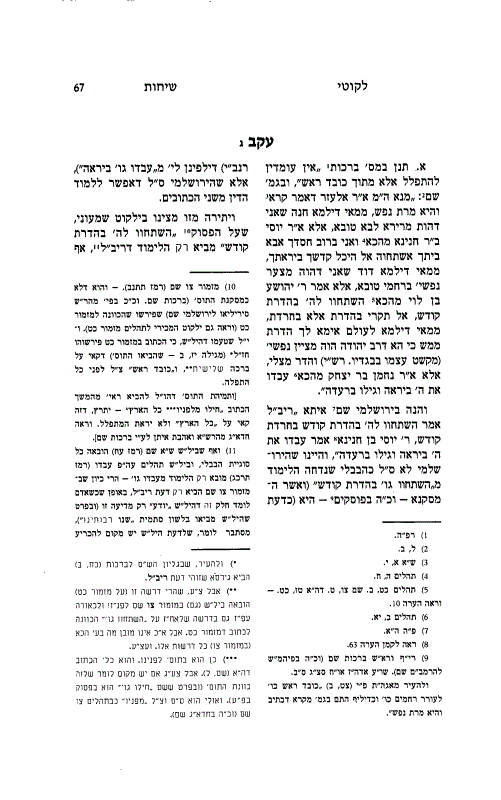
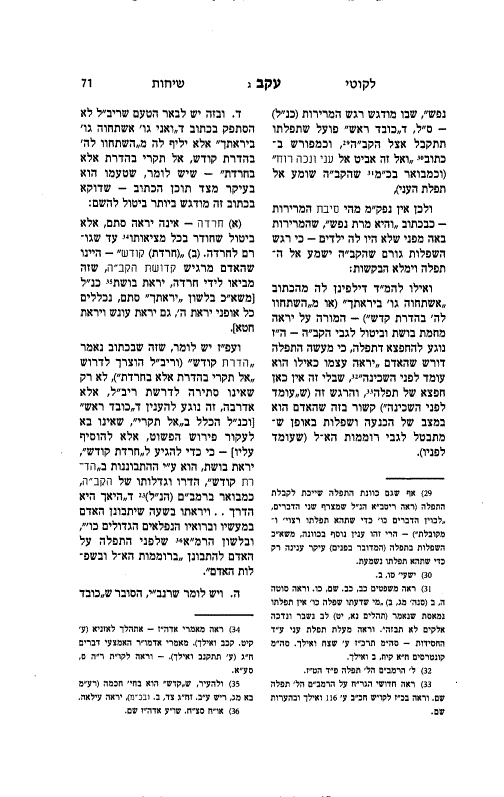
The Mishnah in Tractate Berachos states, "One should not stand to pray except with a serious demeanor." The Gemara there asks, "From where do we know this?" Rabbi Elazar says, "For it is written, 'And she was bitter of soul.'" The Gemara questions, "Perhaps Chana is different because her heart was very bitter?" Rabbi Yossi bar Chanina says, "From here: 'But as for me, in the abundance of Your lovingkindness, I will come into Your house; in fear of You, I will worship toward Your holy temple.'" The Gemara questions, "Perhaps David is different because he would afflict himself with much mercy?" Rabbi Yehoshua ben Levi says, "From here: 'Worship the L‑rd in the beauty of holiness.' Do not read 'beauty' (הדרת) but 'fear' (חרדת)." The Gemara questions, "Perhaps it indeed means beauty, as Rav Yehuda would adorn himself with his garments and then pray?" Rabbi Nachman bar Yitzchak says, "From here: 'Serve the L‑rd with fear, and rejoice with trembling.'"
In the Jerusalem Talmud, it states, "Rabbi Yehoshua ben Levi said, 'Worship the L‑rd in the beauty of holiness' means 'in the fear of holiness.' Rabbi Yossi ben Chanina said, 'Serve the L‑rd with fear, and rejoice with trembling.'" This indicates that the Jerusalem Talmud does not agree with the Babylonian Talmud, which dismisses the interpretation of "Worship the L‑rd in the beauty of holiness" (and the conclusion, as is the ruling in halachic authorities, follows Rabbi Nachman bar Yitzchak that we derive it from "Serve the L‑rd with fear"). Instead, the Jerusalem Talmud holds that it is possible to learn the law from both verses.
Furthermore, we find in the Yalkut Shimoni that on the verse "Worship the L‑rd in the beauty of holiness," it only brings the teaching of Rabbi Yehoshua ben Levi, even though it could be said simply that it did not bring the other teachings because this is the Midrash on this verse.
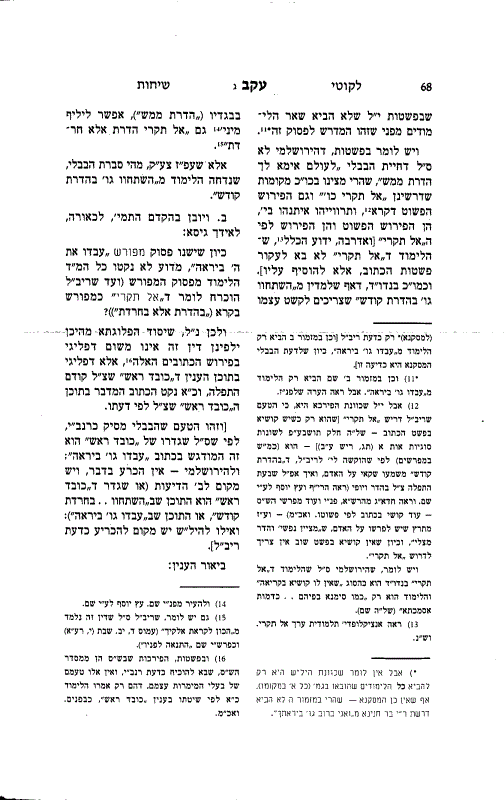
It can be explained simply that the Jerusalem Talmud does not accept the dismissal of the Babylonian Talmud, "Perhaps it indeed means beauty," because we find in many places that we interpret "Do not read...," and also the simple meaning of the verse, and both are present in it, both the simple meaning and the interpretation according to "Do not read." [On the contrary, it is known that the rule is that the teaching of "Do not read" does not come to uproot the simple meaning of the text, but to add to it.] Similarly, in our case, even though we learn from "Worship the L‑rd in the beauty of holiness" that one should adorn oneself with garments ("indeed beauty"), it is also possible to derive from it "Do not read beauty but fear."
However, based on this, the question arises: What is the reasoning of the Babylonian Talmud, which dismisses the interpretation of "Worship the L‑rd in the beauty of holiness"?
This will be understood by first addressing the apparent question from the other side:
Since there is an explicit verse, "Serve the L‑rd with fear," why did not all the sages derive the teaching from this explicit verse (to the extent that Rabbi Yehoshua ben Levi was compelled to say "Do not read" as explicitly stated in the verse ("beauty but fear"))?
Therefore, it seems to me that the basis of the dispute about from where we derive this law is not because they disagree on the interpretation of these verses, but because they disagree on the content of the concept of "serious demeanor" that should precede prayer, and each one chose the verse that speaks to the content of "serious demeanor" according to his opinion.
[This is the reason the Babylonian Talmud concludes like Rabbi Nachman bar Yitzchak, because it holds that the definition of "serious demeanor" is what is emphasized in the verse "Serve the L‑rd with fear"; whereas the Jerusalem Talmud does not see a definitive conclusion in the matter, and there is room for both opinions (either that the definition of "serious demeanor" is the content in "Worship... in the fear of holiness," or the content in "Serve the L‑rd with fear"); and according to the Yalkut Shimoni, there is room to conclude like the opinion of Rabbi Yehoshua ben Levi.]
Explanation of the matter:
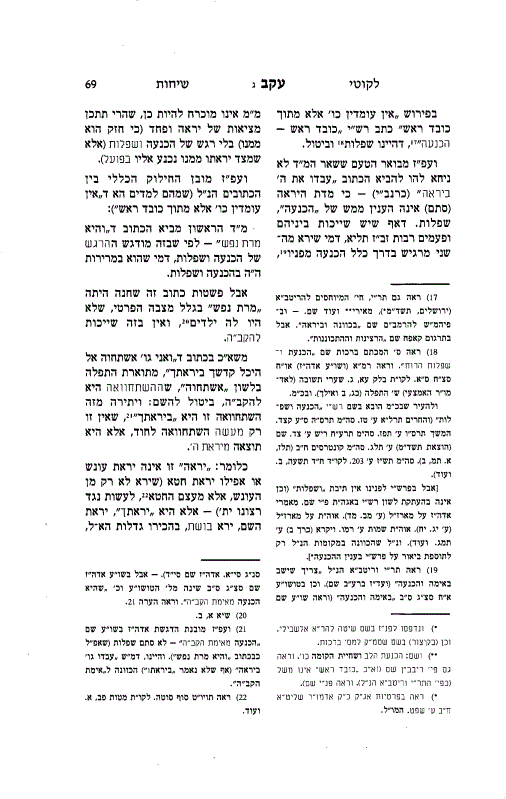
In the explanation of "One should not stand... except with a serious demeanor," Rashi writes, "Serious demeanor — submission," meaning humility and self-nullification.
Based on this, the reason is explained why the other sages were not satisfied to bring the verse "Serve the L‑rd with fear" (like Rabbi Nachman bar Yitzchak) — because the attribute of fear (in general) is not exactly the matter of "submission," humility. Although there is a connection between them and often they are dependent on each other, as one who fears another usually feels submission before him, nevertheless, it is not necessarily so, for there can be a situation of fear and dread (because he is stronger than him) without a feeling of submission and humility (but because of his fear of him, he submits to him in practice).
Based on this, the general distinction between the aforementioned verses (from which we learn that "One should not stand... except with a serious demeanor") is understood:
The first opinion brings the verse "and she was bitter of soul" because it emphasizes the feeling of submission and lowliness, as one who is in bitterness is in a state of submission and lowliness.
However, the simple meaning of this verse is that Chana was "bitter of soul" due to her personal situation, as she had no children, and this does not have a direct connection to the Holy One, blessed be He.
In contrast, in the verse "But I... will bow down toward Your holy temple in fear of You," the prayer is described with the term "I will bow down," which indicates bowing to G‑d, a nullification to G‑d; and furthermore, this bowing is "in fear of You," which is not merely the act of bowing alone, but it is a result of the fear of G‑d.
That is to say, this "fear" is not fear of punishment or even fear of sin (where one fears not only the punishment but the sin itself, acting against His will) — rather, it is "fear of You," fear of G‑d, a fear of shame, recognizing the greatness of G‑d.
In the words of the Rambam, "When one contemplates (the greatness of G‑d) etc., immediately he recoils backward and fears, knowing that he is a small, lowly, dark creature standing with a limited and meager understanding before the Omniscient One," "When a person contemplates these matters etc., he will fear and be humbled by his lowliness and insignificance etc., and he will find himself as a vessel full of shame and disgrace, empty and lacking." This is the concept of "serious demeanor" — submission (and lowliness) before G‑d.
[However, within this itself, Rabbi Yehoshua ben Levi adds the teaching from the verse "Bow... in the beauty of holiness" — because this emphasizes even more this level of fear and nullification, as will be explained in section four.]
But Rabbi Nachman bar Yitzchak holds that it is sufficient before prayer to have actual submission towards G‑d, which also comes through general fear (at whatever level it may be), and therefore he brings the verse "Serve the L‑rd with fear."
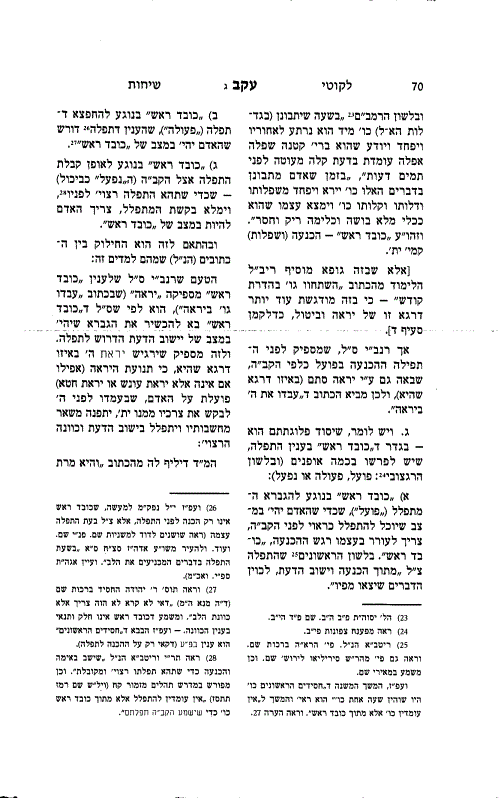
One can say that the foundation of their disagreement is regarding the nature of "serious demeanor" in the context of prayer, which can be interpreted in several ways (in the language of the Rogatchover: the actor, the action, or the recipient):
a) "Serious demeanor" concerning the person praying ("actor"), meaning that for a person to be in a state where he can pray properly before G‑d, he must awaken within himself a feeling of submission, "serious demeanor." In the words of the early commentators, prayer must be "with submission and settled mind, to direct the words that come from his mouth."
b) "Serious demeanor" concerning the object of prayer ("action"), meaning that the matter of prayer requires that a person be in a state of "serious demeanor."
c) "Serious demeanor" concerning the acceptance of the prayer by G‑d (the "recipient," so to speak) — that for the prayer to be desirable before Him, and for Him to fulfill the request of the one praying, the person must be in a state of "serious demeanor."
Accordingly, this is the difference between the verses (mentioned above) from which this is learned:
The reason Rabbi Nachman bar Yitzchak holds that for "serious demeanor," "fear" (as in the verse "Serve the L‑rd with fear") is sufficient is because he believes that "serious demeanor" is meant to prepare the person to be in a state of settled mind necessary for prayer. For this, it is sufficient to feel fear of G‑d at any level, because the movement of fear (even if it is only fear of punishment or fear of sin) affects the person, so that when he stands before G‑d to request his needs from Him, he will be free from other thoughts and will pray with the desired focus and intention.
The opinion that derives it from the verse "and she was bitter of soul," where the feeling of bitterness is emphasized (as mentioned above) — holds that "serious demeanor" causes the prayer to be accepted by G‑d, as explicitly stated in the verse "But to this one will I look, to the poor and contrite in spirit" (and as explained in various places that G‑d listens to the prayer of the poor),
and therefore it does not matter what the cause of the bitterness is — as in the verse "and she was bitter of soul," where the bitterness came because she had no children — because the feeling of lowliness causes G‑d to listen to the prayer and fulfill the requests;
According to the opinion that derives it from the verse "I will bow down... in Your fear" (or from "Bow down to the L‑rd in the beauty of holiness"), which indicates fear due to shame and nullification before the Holy One, blessed be He, this pertains to the essence of prayer. The act of prayer requires that a person "see himself as if he is standing before the Divine Presence," for without this, there is no essence of prayer. This feeling (of "standing before the Divine Presence") is connected to the person being in a state of submission and lowliness, in a manner that he nullifies himself before the exaltedness of G‑d (before whom he stands).
We can explain the reason why Rabbi Yehoshua ben Levi did not suffice with the verse "And I... will bow down... in Your fear" but instead derived it from "Bow down to the L‑rd in the beauty of holiness, do not read 'beauty' but 'trembling'" — it can be said that his reason is primarily due to the content of the verse — that specifically in this verse, the nullification to G‑d is most emphasized:
(a) Trembling is not just any fear, but a nullification that penetrates his entire being to the point that it causes trembling. (b) "(Trembling) of holiness" — meaning that the person feels the holiness of the Holy One, blessed be He, which brings him to trembling, a fear of shame as mentioned above [unlike the term "Your fear" alone, which includes all forms of fear of G‑d, even fear of punishment and fear of sin].
Based on this, we can say that the fact that the verse states "the beauty of holiness" (and Rabbi Yehoshua ben Levi needed to interpret "do not read 'beauty' but 'trembling'") is not only not a contradiction to Rabbi Yehoshua ben Levi's interpretation, but on the contrary, it pertains to the concept of "serious demeanor" [as mentioned above, the rule of "do not read" does not come to uproot the simple meaning, but to add to it] — because to reach "trembling of holiness," a fear of shame, is through contemplation of "the beauty of holiness," the splendor and greatness of the Holy One, blessed be He, as explained in the Rambam (mentioned above) regarding "how is the way... and His fear when a person contemplates His wondrous and great deeds, etc.," and in the words of the Rema that before prayer, a person should contemplate "the exaltedness of G‑d and the lowliness of man."
We can say that Rabbi Nachman bar Yitzchak, who holds that "serious demeanor" is a matter of fear (in general), and Rabbi Yehoshua ben Levi, who holds that it refers to a fear of shame, complete nullification ("trembling of holiness") — follow their respective approaches:
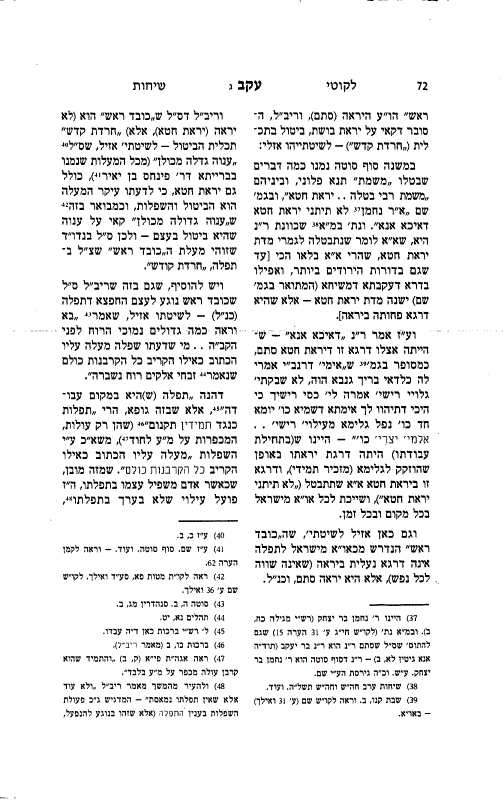
In the Mishnah at the end of Sotah, several things are listed that ceased "from the death of" a certain Tanna, among them "from the death of Rabbi, fear of sin ceased," and in the Gemara there, Rabbi Nachman says, "Do not teach 'fear of sin' because I am here." It is explained elsewhere that Rabbi Nachman's intention is that it cannot be said that the attribute of fear of sin was completely nullified, for it is impossible without it [even in the lowest generations, and even in the generation of the footsteps of the Messiah, the attribute of fear of sin exists — but it is a lower level of fear].
And regarding this, Rabbi Nachman said "because I am here" — that he possessed this level of simple fear of sin, as the Gemara recounts that "the mother of Rabbi Nachman bar Yitzchak was told by astrologers that her son would be a thief, so she did not allow him to uncover his head and said to him, 'Cover your head so that the fear of Heaven will be upon you, etc.' One day, his head covering fell off... and his inclination overpowered him, etc." — meaning that (at the beginning of his service) his level of fear was such that he needed a constant reminder, and this level of fear of sin cannot be nullified ("do not teach 'fear of sin'"), and it is relevant to every Jew in every place and time.
And here too, he follows his approach, that the "serious demeanor" required from every Jew for prayer is not a high level of fear (which is not accessible to everyone), but rather it is simple fear, as mentioned above.
And Rabbi Yehoshua ben Levi, who holds that "serious demeanor" is (not fear (fear of sin), but) "trembling of holiness," complete nullification — follows his approach, as he holds that "humility is greater than all" (of the virtues listed in the Baraita of Rabbi Pinchas ben Yair), including fear of sin, because in his view, the main virtue is nullification and lowliness, as explained that "humility is greater than all" refers to humility that is intrinsic nullification — therefore, he holds in our case that this is the virtue of the "serious demeanor" that should be in prayer, "trembling of holiness."
Additionally, we can add that even in Rabbi Yehoshua ben Levi's view, where "serious demeanor" pertains to the very essence of prayer (as mentioned above), he follows his own approach. He said, "Come and see how great are those of humble spirit before the Holy One, blessed be He... One who is humble is considered by Scripture as if he offered all the sacrifices, as it is stated, 'The sacrifices of G‑d are a broken spirit.'"
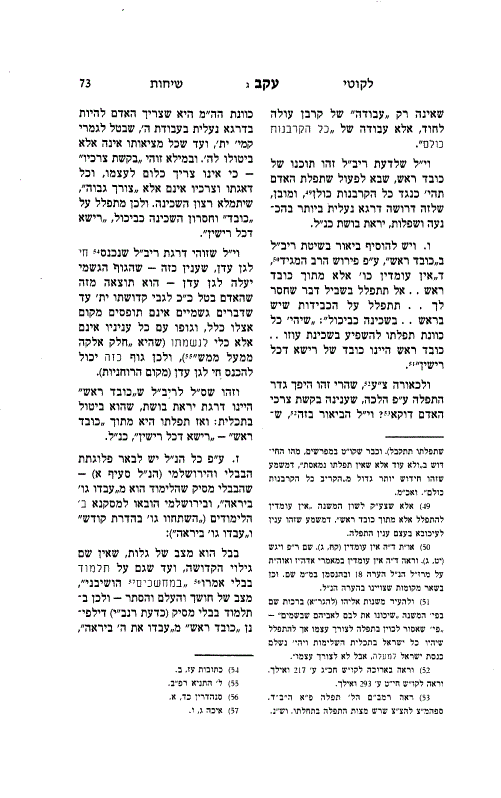
For "prayer is in place of service," yet within this, "the prayers were instituted corresponding to the daily offerings" (which are only burnt offerings that atone for positive commandments alone). However, through humility, "Scripture considers it as if he offered all the sacrifices." From this, it is understood that when a person humbles himself in his prayer, it elevates his prayer to an incomparable level, not just as the "service" of a burnt offering alone, but as the service of "all the sacrifices."
It can be said that according to Rabbi Yehoshua ben Levi, this is the essence of "serious demeanor," which aims to make a person's prayer correspond to all the sacrifices. It is understood that for this, a very high level of submission and humility is required, a fear of shame as mentioned above.
We can further explain Rabbi Yehoshua ben Levi's view on "serious demeanor" based on the interpretation of the Maggid, who explains, "One should not stand... except with serious demeanor... Do not pray for something you lack... Pray for the heaviness in the head... in the Shechinah, as it were"; "that the entire intention of his prayer should be to influence His glorious Shechinah... 'serious demeanor' means the seriousness of the 'head of all heads.'"
At first glance, this seems to contradict the legal definition of prayer, which is specifically about requesting one's needs. However, it can be explained that the Maggid's intention is that a person should be on a high level in the service of G‑d, completely nullified before Him, to the extent that his entire existence is only his nullification to G‑d. Consequently, this is his "request for needs" — because he needs nothing for himself, and all his concerns and needs are only for the "higher need," that the will of the Shechinah be fulfilled. Therefore, he prays for the "heaviness" and deficiency of the Shechinah, as it were, "the head of all heads."
It can be said that this is the level of Rabbi Yehoshua ben Levi, who entered Gan Eden alive. Such a phenomenon — that the physical body ascends to Gan Eden — results from a person being so nullified to His holiness that physical matters hold no significance for him at all, and his body with all its matters is merely a vessel for his soul (which is "a part of G‑d above, truly"). Therefore, such a body can enter Gan Eden alive (a place of spirituality).
This is why Rabbi Yehoshua ben Levi holds that "serious demeanor" is the level of fear of shame, which is complete nullification; and then his prayer is with "serious demeanor" — "the head of all heads," as mentioned above.
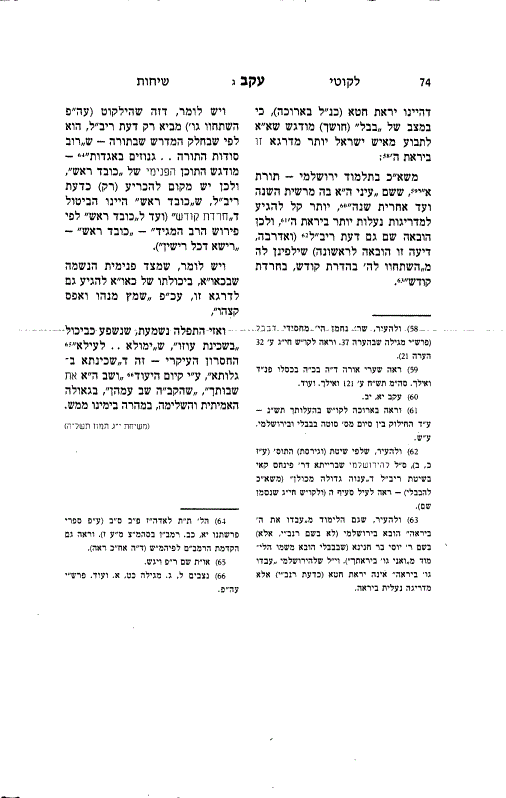
Based on all the above, we can explain the dispute between the Babylonian Talmud and the Jerusalem Talmud (mentioned in section A) — the Babylonian Talmud concludes that the teaching is from "Serve the L‑rd with fear," while the Jerusalem Talmud brings both teachings ("Bow down... in holy reverence" and "Serve the L‑rd with fear"):
Bavel is a state of exile, where there is no revelation of holiness, and even regarding the Babylonian Talmud, it is said, "He has placed me in darkness," a state of darkness and concealment. Therefore, in the Babylonian Talmud, it concludes (according to the view of Rabbi Nachman bar Yitzchak) that we learn "serious demeanor" from "Serve the L‑rd with fear," meaning fear of sin (as explained at length), because in the state of "Bavel" (darkness), it is emphasized that it is impossible to demand more from a Jew than this level of fear of sin.
However, in the Jerusalem Talmud — the Torah of the Land of Israel, where "the eyes of the L‑rd your G‑d are upon it from the beginning of the year to the end of the year," it is easier to reach higher levels of fear of G‑d. Therefore, it also brings the view of Rabbi Yehoshua ben Levi (and indeed, this view is brought first) that we learn it from "Bow down to the L‑rd in holy reverence, in trembling of holiness."
It can be said that the reason the Yalkut (on the verse "Bow down...") brings only the view of Rabbi Yehoshua ben Levi is because in the part of the Midrash in the Torah — where "most of the secrets of the Torah... are hidden in the Aggadot" — the inner content of "serious demeanor" is emphasized. Therefore, there is room to decide (only) according to the view of Rabbi Yehoshua ben Levi, that "serious demeanor" is the nullification of "trembling of holiness" (and up to "serious demeanor" according to the interpretation of the Maggid — "serious demeanor" — "the head of all heads").
It can be said that due to the inner essence of the soul within each individual, every person has the potential to reach even this level, at least "a trace of it and a mere glimpse of it."
Then, the prayer is heard, and it is as if "in His glorious presence," the primary deficiency — that of "the Shechinah in exile" — is fulfilled "above." This is achieved through the fulfillment of the promise "And the L‑rd your G‑d will return your captivity," meaning "that the Holy One, blessed be He, returns with them," in the true and complete redemption, speedily in our days, amen.