
Likkutei Sichos Vol. 30 – Vayigash 1
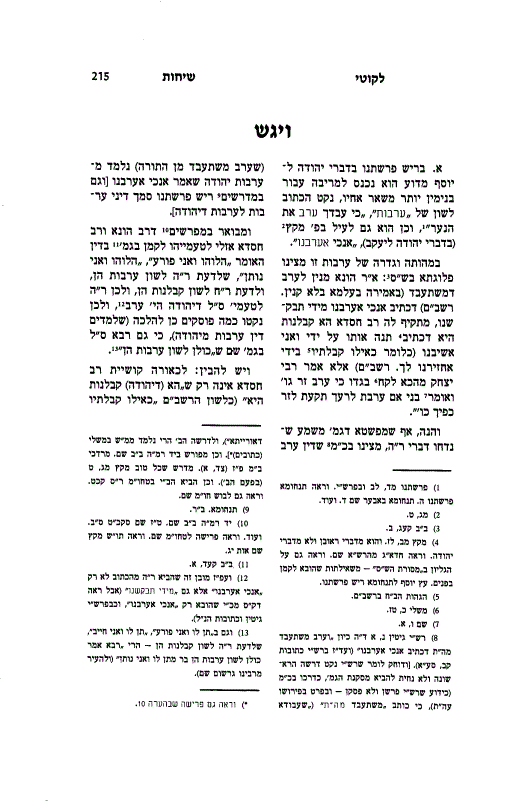
1. At the beginning of our parshah, in Yehudah’s words to Yosef regarding why he enters into a dispute on behalf of Binyamin more than the rest of his brothers, the Torah uses the language of “guarantor” (areivus): “For your servant became a guarantor for the lad.” Similarly, earlier in Parshas Mikeitz (in Yehudah’s words to Yaakov), it says, “I will be his guarantor.”
Regarding the nature and definition of this areivus (guaranteeship), we find a dispute in the Gemara: Rav Huna said, “From where do we know that a guarantor becomes obligated (through speech alone, without a formal act of acquisition — Rashbam)? As it is written, ‘I will be his guarantor; from my hand you may demand him.’” Rav Chisda challenged this: “That is a case of kablanus (an enhanced form of guarantee), as it is written, ‘Place him in my hands and I will return him to you’ (that is, as if I have received him into my hands, I will return him to you — Rashbam).” Rather, Rav Yitzchak said, “It is learned from here: ‘Take his garment, for he has become a guarantor for a stranger…’ and it says, ‘My son, if you have become a guarantor for your friend, if you have struck your hands for a stranger…’”
Now, even though the plain reading of the Gemara implies that Rav Huna’s words were rejected, we nevertheless find in many places that the law of areiv (that a guarantor becomes obligated by Torah law) is derived from Yehudah’s areivus, when he said, “I will be his guarantor.” [And also in the Midrashim at the beginning of our parshah, the laws of areivus are connected to Yehudah’s areivus.]
The commentaries explain that Rav Huna and Rav Chisda each follow their own reasoning later in the Gemara regarding one who says, “Lend him money and I will pay,” or “Lend him money and I will give [it to you].” According to Rav Huna, this is the language of areivus (guaranteeship), while according to Rav Chisda, it is the language of kablanus. Therefore, Rav Huna holds that Yehudah was an areiv (guarantor), and thus several halachic authorities rule accordingly (that the law of areivus is learned from Yehudah), since Rava also holds there in the Gemara that “all of them are the language of areivus.”
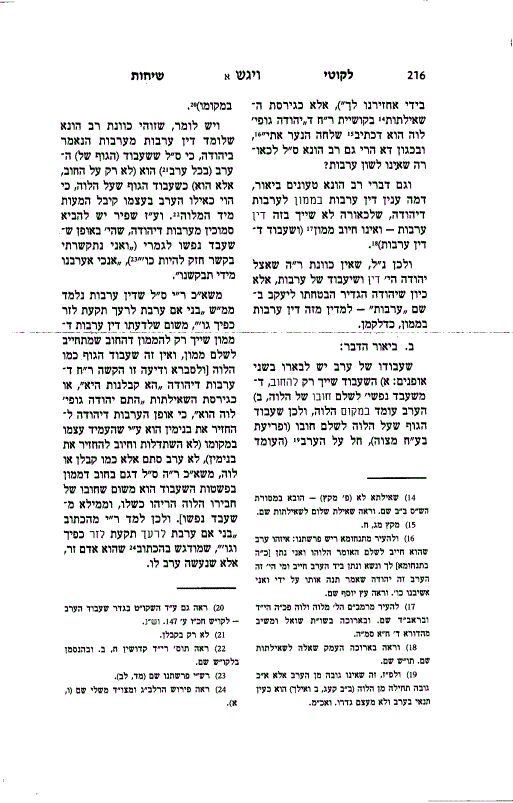
However, this needs to be understood: Seemingly, Rav Chisda’s objection is not only that “this (of Yehudah) is kablanus” (in the words of the Rashbam, “as if I have received him into my hands, I will return him to you”), but rather, as in the version of the She’iltos in Rav Chisda’s objection, “Yehudah himself was the borrower, as it is written, ‘Send the lad with me,’” and in such a case, even Rav Huna would seemingly agree that this is not the language of areivus.
Also, Rav Huna’s words require explanation: What is the connection between the law of areivus in monetary matters and Yehudah’s areivus, which seemingly does not involve the law of areivus—it is not a monetary obligation (nor the type of obligation found in the law of areivus)?
Therefore, it appears that Rav Huna’s intent is not that in Yehudah’s case there was an actual legal and binding areivus, but rather, since Yehudah defined his promise to Yaakov with the term “areivus,” we learn from this the law of areivus in monetary matters, as will be explained.
2. The explanation of the matter:
The obligation of a guarantor (areiv) can be explained in two ways: (a) The obligation applies only to the debt—the guarantor obligates himself to pay the borrower’s debt; (b) The guarantor stands in the place of the borrower, and therefore the personal obligation that rests upon the borrower to pay his debt (and the mitzvah to repay one’s creditor) now applies to the guarantor (who stands in his place).
It can be said that this is Rav Huna’s intent in deriving the law of areivus from the areivus stated regarding Yehudah, because he holds that the obligation (of the person) of the guarantor (in every case of areivus) is not only regarding the debt, but is like the personal obligation that rests upon the borrower, as if the guarantor himself received the money directly from the lender. For this, it is fitting to bring support from Yehudah’s areivus, which was in a manner that he completely obligated himself (“And I have bound myself with a strong bond to be…”)—“I will be his guarantor; from my hand you may demand him.”
Whereas Rav Yitzchak holds that the law of areivus is learned from the verse, “My son, if you have become a guarantor for your friend, if you have struck your hands for a stranger…,” because in his view, the law of areivus in monetary matters applies only to the money of the debt—the guarantor obligates himself to pay money, but it is not a personal obligation like the borrower’s. [According to this reasoning and view, Rav Chisda objected that Yehudah’s areivus “is kablanus,” or as in the version of the She’iltos, “there Yehudah himself was the borrower,” because Yehudah’s form of areivus to return Binyamin was by placing himself in Binyamin’s place—not merely an effort or obligation to return Binyamin, but not a simple areiv, rather like a kablan (an enhanced guarantor) or a borrower. Whereas Rav Huna holds that even in a simple monetary debt, the obligation is because his friend’s debt is considered as his own, and therefore he obligates himself.] Therefore, Rav Yitzchak learns from the verse, “My son, if you have become a guarantor for your friend, if you have struck your hands for a stranger…,” where the verse emphasizes that he is a stranger, but has become a guarantor for him.
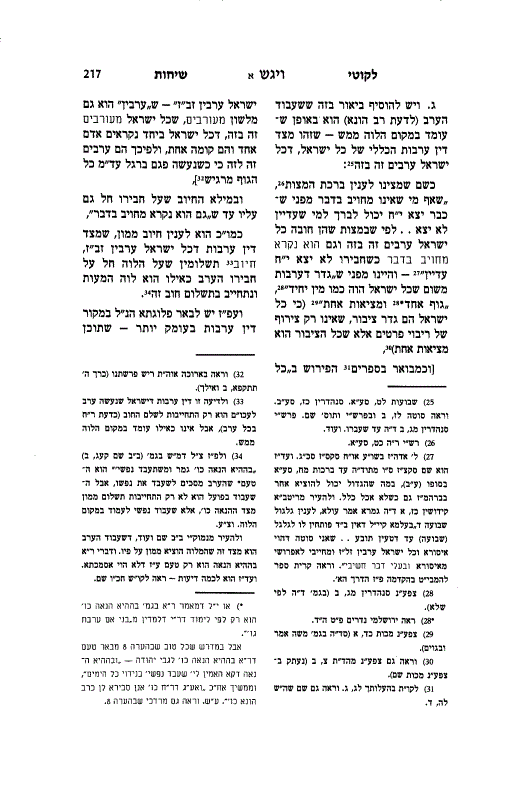
3. We can further explain this—that the obligation of the guarantor (according to Rav Huna) is in such a manner that he stands in the place of the borrower himself—by connecting it to the general law of areivus (mutual responsibility) among all Jews, that all Jews are guarantors for one another:
Just as we find regarding the blessing on mitzvos, that “even one who is not obligated in the matter because he has already fulfilled his obligation can recite the blessing for someone who has not yet fulfilled it… because in obligatory mitzvos, all Jews are guarantors for one another, and he too is considered obligated in the matter when his fellow has not yet fulfilled his obligation.” This is because “the concept of areivus is that all Jews are like a single entity,” “one body and one existence” (for all Jews together are a tzibbur—a congregation—which is not merely a collection of many individuals, but the entire congregation is a single entity).
[As is explained in the seforim, the meaning of “all Jews are areivim (guarantors) for one another” is that “areivim” also means “intermixed”—that all Jews are intermixed with one another, that all Jews together are called one person and are one structure, and therefore they are guarantors for one another, because when there is a blemish in the foot, for example, the entire body feels it.]
Accordingly, the obligation that rests on one’s fellow also rests upon him, to the extent that “he too is considered obligated in the matter.”
So too regarding monetary obligations: from the law of areivus that all Jews are guarantors for one another, the obligation of repayment that is upon the borrower also falls upon his fellow, the guarantor, as if he himself borrowed the money and became obligated to repay this debt.
Based on this, we can explain the above dispute regarding the source of the law of areivus on a deeper level—the essence of their disagreement is whether the concept of areivus in monetary matters is connected to and derived from the fact that all Jews are guarantors for one another.
The explanation is as follows:
The reason for this unity among Jews—that all Jews are intermixed with one another (and therefore are a single entity)—is because of their souls, whose root is “in the One G‑d” (which is why the law of tzibbur does not apply to Bnei Noach). In contrast, regarding their bodies, “the bodies are separate” [and as the Alter Rebbe explains, for this reason, “the fulfillment of the mitzvah ‘Love your fellow as yourself’ toward every Jewish soul, from the greatest to the smallest, is achieved by making one’s soul primary”].
And this is the point of dispute: whether the unity among Jews (that they are a single entity and “intermixed with one another”) applies only to matters of the soul (such as the fulfillment of positive commandments, or the obligation to rebuke and protest against sin, etc.), or whether this unity also extends to a person’s material possessions:
According to the first opinion, since the essence of the Jewish people is that they are “one nation on earth,” as the Alter Rebbe explains—that even in matters of “earth” (earthly and physical matters) they reveal the unity of G‑d—therefore, it is possible to reveal even in monetary matters the unity among Jews, that they are guarantors and intermixed with one another.
But according to the second opinion (which, from the plain flow of the Gemara, appears to be the conclusion)—“the Torah speaks according to the majority,” and for most Jews it is not possible for such unity (that would effect the concept of areivus, that all Jews are guarantors and intermixed with one another) to be revealed even in the material and monetary matters of another. Therefore, they hold that it is a law unto itself—that the guarantor obligates himself to pay his fellow’s debt.
4. Based on this, we can explain the (inner) reason why the law of areivus in monetary matters is derived (according to Rav Huna) specifically from the areivus of Yehudah—that is, Yehudah’s guarantee for Binyamin points to a unique kind of areivus, which is the result of the highest level of Jewish unity, and from this level, unity extends even to the discretionary (and material) matters of Jews.
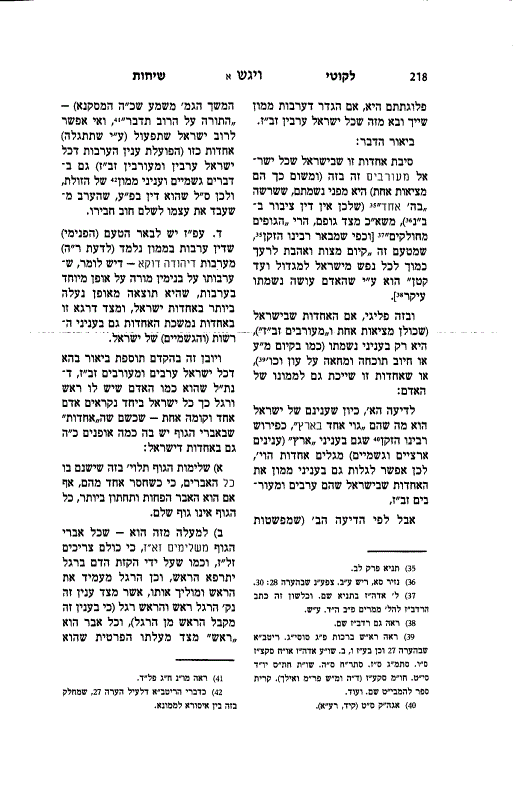
This can be understood by first adding an explanation to the idea that all Jews are guarantors and intermixed with one another. As mentioned above, it is like a person who has a head and a foot—so too, all Jews together are called one person and one structure. Just as the “unity” among the limbs of the body has several levels, so too is it with the unity of the Jewish people:
a) The completeness of the body depends on having all the limbs, for if even one is missing, even if it is the least and lowest limb, the entire body is not a complete body.
b) A higher level than this is that all the limbs of the body complete one another, for they all need each other. For example, through bloodletting in the foot, the head is healed; likewise, the foot supports the head and carries it. In this aspect, the foot can be called the head and the head the foot (for in this regard, the head receives from the foot), and every limb is a “head” in its own unique quality, in which it influences all the other limbs, to the point that “no beginning or end can be found among them.”
However, in these two ways, there still remains a distinction between the limbs. Not only in the first way, where the completeness of the body depends on having all 248 limbs—which is specifically when there are 248 distinct limbs, meaning that the body possesses all 248 unique qualities of each of the 248 limbs, and through all of them together, a “single complete stature” is formed—but even according to the second way, where the superiority of one limb over another is not so apparent, since they are all “heads,” nevertheless, the superiority of each limb is only in its unique quality, in that which distinguishes it from its fellow.
But the true unity in the stature of the body is when each limb feels that its main existence and purpose is not its individual characteristics, but in being a part of the human body as a whole. This aspect is present equally in all the limbs, for they are all equally part of this stature, and because of this, they are in complete unity.
So too is it with the unity of the Jewish people, that all Jews are guarantors and intermixed with one another, by virtue of being one complete stature. In this, there are also these three levels:
a) The completeness of the Jewish people is when all types are present, “from your heads, the leaders of your tribes…” to “your water drawer.”
b) Higher than this: each type among the Jewish people influences the others with its unique quality, in such a way that all Jews need each other and complete one another, until “no beginning or end can be found among them.”
c) The highest unity is that all Jews are part of the collective Jewish people. This is due to the “Jewish point” within every single Jew, which is truly equal in all, and this is the true meaning of “all Jews are guarantors and intermixed with one another”—there is no division at all (of head and foot), and all are like a single point.
5. It can be said that this is one of the reasons why specifically Yehudah was the guarantor for Binyamin:
Yehudah’s guarantee, that he bound himself “with a strong bond to be… in both worlds,” is a most profound areivus, which comes from the fact that all Jews are truly one essence, like a single point.
Therefore, this areivus was specifically with Yehudah, for Yehudah’s primary quality is kingship [Yehudah was the king among the tribes, and he was blessed, “The scepter shall not depart from Yehudah… until Shiloh comes,” and from him comes the kingship of the House of David, which is the “main kingship” among the Jewish people]. Through the concept of kingship, the true unity of the Jewish people is revealed—that they are a single point, beyond all division.
As explained elsewhere, the king not only includes all the people (being king over them), but through him, all the people become a single entity (and note the language of the Rashba: “the king is like the community, for the community and all Israel depend on him”), and because of this, there is no division among the Jewish people, and their entire existence is only the existence of the king.
6. According to the above, we can also understand the reason why the connection between the law of areivus in monetary matters and the general principle that all Jews are guarantors for one another is derived from the verse about Yehudah’s areivus for Binyamin:
The ability to draw down the concept of unity (which is rooted in the soul) even into a person’s material and discretionary matters comes from a deep sense of the true unity of the Jewish people—that all Jews are truly one—similar to the above regarding kingship: the power of kingship is not only over people, but over all things—even the inanimate, plant, and animal life within his kingdom are under his control and dominion.
Therefore, it is specifically from Yehudah’s areivus for Binyamin, in which the highest level of Jewish unity is revealed (as explained above, section 5), that we learn that the law of areivus in monetary matters is connected to the general principle that all Jews are guarantors for one another.
7. The Torah portion of Vayigash is always read close to the fast of the tenth of Teves, the day on which “the king of Babylon laid siege to Jerusalem and brought it into siege and distress.” According to what is explained in the Shelah, it is understood that there is a connection between them:
It has been explained elsewhere that “the king of Babylon laid siege to Jerusalem” was, in a sense, a preemptive healing before the blow (of exile). For the reason for the severity of the exile is the sin of baseless hatred, and the healing—the redemption from exile—comes through the opposite behavior: baseless love, to the point of complete unity among the Jewish people. This unity comes about naturally through a siege, when “no one goes out and no one comes in”—all those within the siege are always together in the city. Moreover, the nature of a siege is not only that none of the city’s inhabitants go out or come in, but this applies to all aspects of the city and all its possessions. The purpose of the siege is not (only) that the people inside the city cannot leave, but that they are unable to bring out or bring in the city’s needs—food, drink, weapons, etc.
That is, a siege on a city (especially a city that is surrounded by a wall of its own) makes all the things in the city and all that is in the city into something like a single entity.
This is the inner meaning of the siege on Jerusalem in particular—the city that is “joined together as one,” which unites all Israel. The Jewish people are, by nature, compelled to be united together in Jerusalem, they and all that belongs to them. [And if this would have led to true unity among the Jewish people, then seemingly, this would have been an actual preemptive healing before the blow, and the blow would have been nullified from the outset, and Nebuchadnezzar would not have been able to rule over them. And how much more so compared to the situation of “Ephraim is joined to idols”—when they were “joined,” even though they were “idols,” they would go out to war and be victorious.]
Therefore, the main avodah when we are in the time of exile, in the very final footsteps of Moshiach (ikvesa diMeshicha), is to strengthen and increase our efforts in the matter that “all Israel are guarantors for one another,” that they are mixed and united with one another—to strengthen and increase love of Israel and unity of Israel.
And it is obvious that this does not mean, G‑d forbid, to give up or even to make compromises, G‑d forbid, in matters of Torah and mitzvos. On the contrary, the fact that all Israel are guarantors for one another obligates every Jew to separate his fellow from prohibition and sin—“You shall surely rebuke your fellow… and you shall love your fellow as yourself” [following the conduct of Aharon the Kohen, the High Priest, who “loved peace and pursued peace, loved the creations and brought them close to Torah”—not, G‑d forbid, bringing the Torah down to the people, with compromises and concessions in the observance of Torah according to the spirit of the times and place, G‑d forbid].
And an increase and added effort and energy in love and unity of Israel will bring immediately, literally, the coming of our righteous Moshiach, as is explicit in the haftorah of our parshah, and the matter of Yehudah approaching Yosef will be fulfilled in its completeness, that the two trees (of Yehudah and Yosef) “will become one in your hand… and one king will be for them all,” for “My servant David will be king over them… a prince for them forever,” speedily in our days, literally.
(From a maamar and sicha of Shabbos Parshas Vayigash, 5732; sicha of Tu BiShvat, 5745)