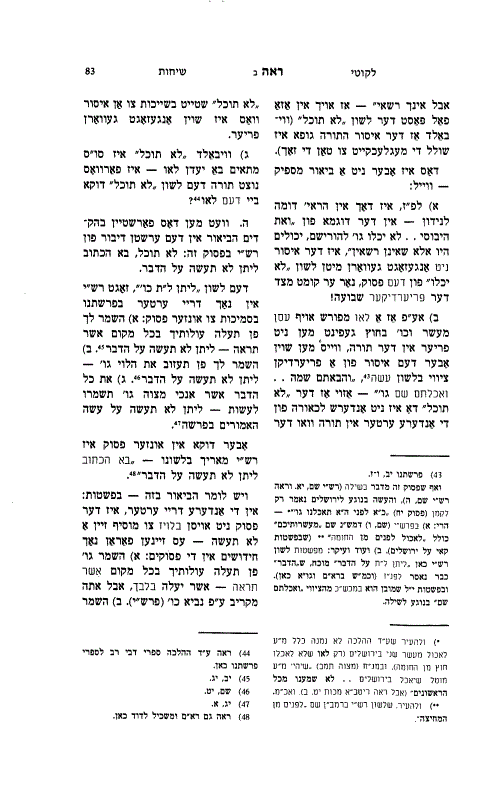
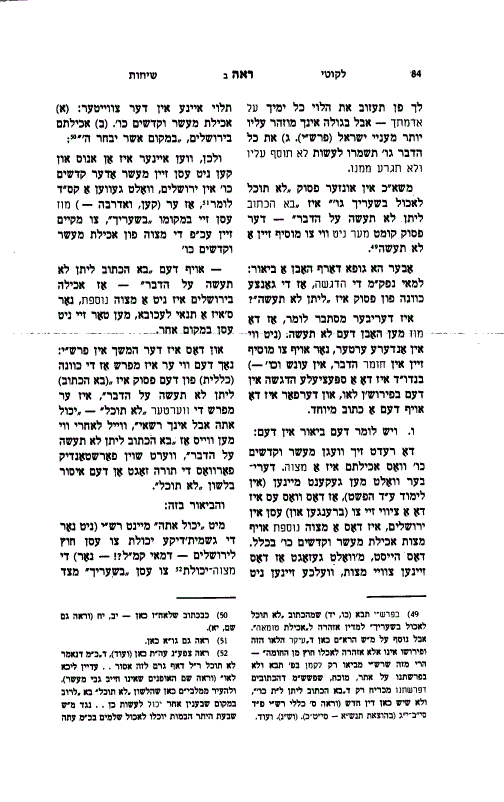
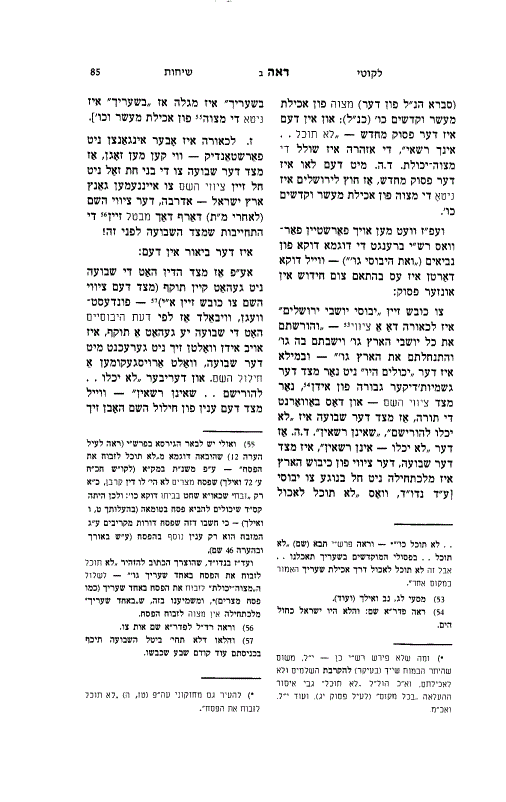
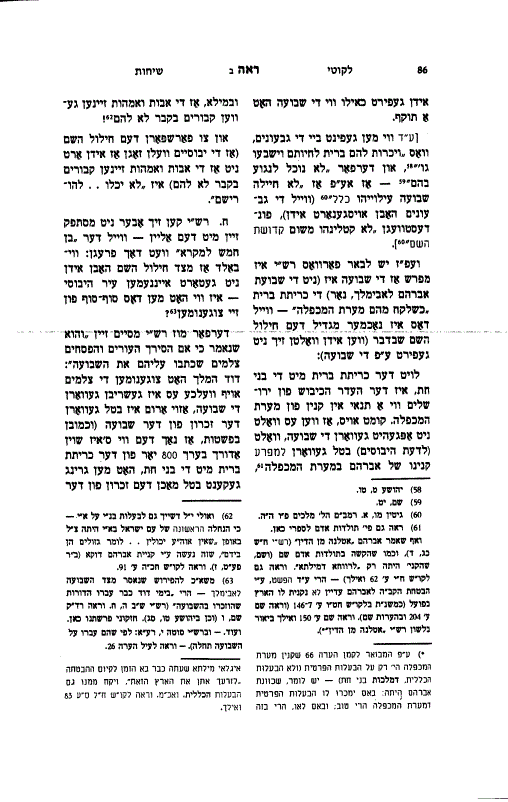
Whenever the Torah uses the expression “you cannot,” meaning “you are not permitted,” this generally follows an existing reason that the act is impossible—either because it is beyond the person’s ability or because it has already been prohibited.
In the present case, however, the Torah had not previously stated that one may not eat the tithe and the other sacred foods within one’s own gates. Rashi therefore introduces the novel explanation that here, too, “you cannot” means:
“You are capable of doing so, but you are not permitted.”
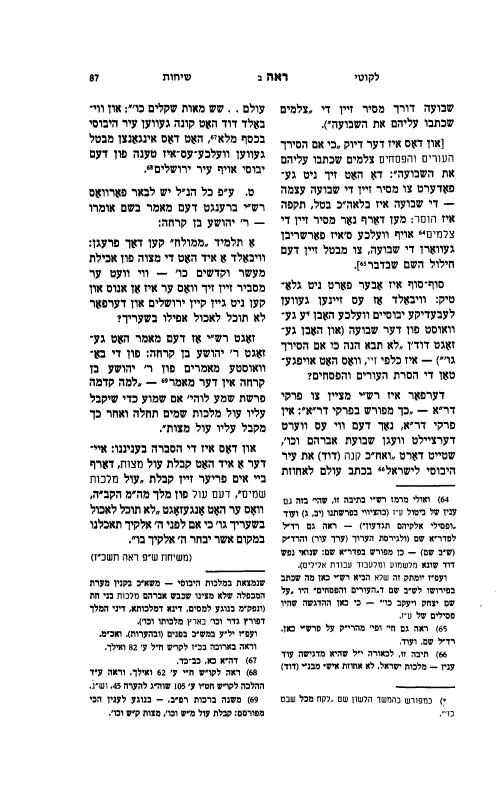
On the verse:
“You may not eat within your gates the tithe…”
(Devarim 12:17),
Rashi comments:
“You may not”—Scripture comes to impose a negative commandment upon the matter.
Rabbi Yehoshua ben Korchah says: “You are capable of doing so, but you are not permitted.” A similar expression is found in the verse: “The children of Yehudah could not dispossess the Yevusites who inhabited Jerusalem.” They were capable of doing so, but they were not permitted, because Avraham had made a covenant with them when he purchased the Cave of Machpelah from them.
They were not actually Yevusites, but Chittites. They were called Yevusites after the city, whose name was Yevus. This is explained in Pirkei DeRabbi Eliezer. This is the meaning of the words, “Unless you remove the blind and the lame”—images upon which the oath had been inscribed.
This requires explanation.
The expression “you cannot” appears many times in the Torah. Rashi himself explains in several places that it means that one does not have permission.
For example, regarding the verse:
“The people cannot ascend Mount Sinai,”
Rashi explains:
“They do not have permission.”
Why, then, specifically in our verse does Rashi cite the interpretation of Rabbi Yehoshua ben Korchah, who emphasizes:
“You are capable of doing so, but you are not permitted”?
Why does Rashi bring proof from a verse in the Prophets?
Also, why does he say that Avraham took the oath when he purchased the Cave of Machpelah—a detail not indicated in the plain meaning of Scripture—instead of referring to Avraham’s explicit oath to Avimelech?
The explanation is as follows:
In every other instance in which “you cannot” means “you are not permitted,” the lack of permission is added to some prior reason that the act cannot be done.
Sometimes the Torah itself establishes that it is legally impossible, as in:
“He may not give the firstborn status to the son of the beloved wife.”
Sometimes the act is beyond human capability, as in:
“For man cannot see Me and live.”
In other cases, a command prohibiting the act has already been stated, as with:
“You may not slaughter the Pesach offering.”
In our case, however, the Torah had not previously stated that the tithe and the other sacred foods may not be eaten within one’s own gates.
Rashi therefore teaches that even in this verse, the words “you cannot” may be interpreted to mean:
“You are capable of doing so, but you are not permitted.”
It is true that a positive commandment had already been stated regarding these foods:
“You shall bring them there…and you shall eat there.”
This can be understood by first examining Rashi’s initial explanation:
“Scripture comes to impose a negative commandment upon the matter.”
Rashi’s expression “Scripture comes” emphasizes that whenever the Torah adds a negative commandment to an existing positive commandment, the prohibition generally introduces an additional law beyond merely increasing the severity of the matter.
For example, regarding the verse:
“Beware lest you offer your burnt offerings in any place that you see,”
Rashi explains:
“To impose a negative commandment upon the matter.”
That prohibition also contains an additional qualification: one may offer a sacrifice outside the usual place only when instructed by a prophet.
In the present case, however, the negative commandment is needed not merely to increase the severity of the prohibition, but to establish explicitly that eating the sacred food outside Jerusalem is forbidden.
Eating the tithe is itself a mitzvah. A person might therefore think that if circumstances beyond his control prevent him from traveling to Jerusalem, he should fulfill the mitzvah by eating the tithe within his own gates.
The Torah must therefore emphasize that doing so is prohibited.
This is the meaning of Rabbi Yehoshua ben Korchah’s words:
“You are capable of doing so”—because eating sacred food is a mitzvah.
“But you are not permitted”—because the Torah has imposed a negative commandment forbidding its consumption outside Jerusalem.
This also explains the proof Rashi brings from the oath concerning the Yevusites.
There, too, the Jewish people had a mitzvah:
“You shall dispossess the inhabitants of the land.”
Nevertheless, because of the oath, they were not permitted to conquer Jerusalem.
Strictly according to Torah law, they may have been permitted to do so. From the perspective of the Yevusites, however, the conquest would have violated Avraham’s oath and would therefore have caused a desecration of Hashem’s Name.
Rashi specifically explains that Avraham gave the oath when purchasing the Cave of Machpelah. This emphasizes the severity of the potential desecration of Hashem’s Name. In the eyes of the Yevusites, conquering Jerusalem would retroactively invalidate the agreement through which Avraham acquired the Cave of Machpelah.
Approximately eight hundred years had passed since that oath. Once the images bearing the written reminder of the oath were removed, the oath was forgotten and the concern of desecrating Hashem’s Name ceased.
Although some people presumably still knew about the oath, Rashi cites Pirkei DeRabbi Eliezer as his source. There it is explained that David purchased Jerusalem with money. The concern of desecrating Hashem’s Name was therefore completely removed.
Rashi also records the name of the author of this teaching, Rabbi Yehoshua ben Korchah.
Rabbi Yehoshua ben Korchah is the Sage who taught:
“Why does the passage of Shema precede the passage of Vehayah im shamoa? So that a person should first accept upon himself the yoke of the Kingdom of Heaven, and afterward accept upon himself the yoke of the mitzvos.”
This teaching illuminates the lesson of our verse.
When a person is outside Jerusalem, he must first accept the yoke of the Kingdom of Heaven and refrain from eating the sacred food, even though eating sacred food in Jerusalem is itself a mitzvah.