
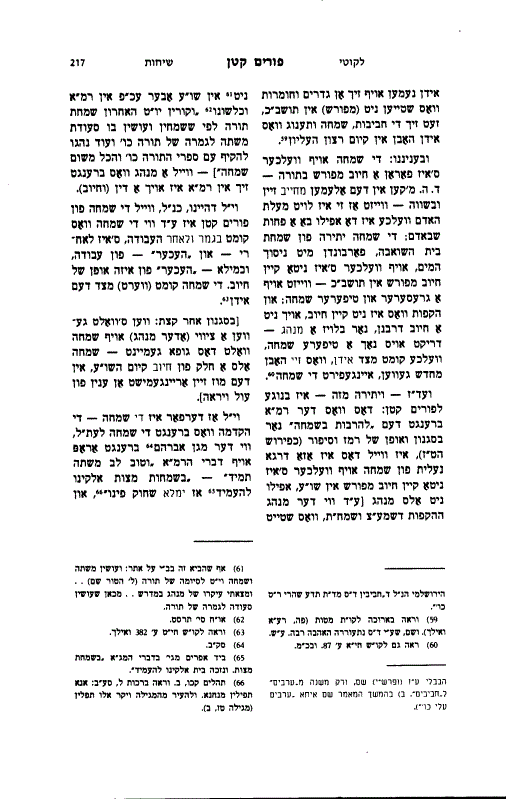

Purim Katan
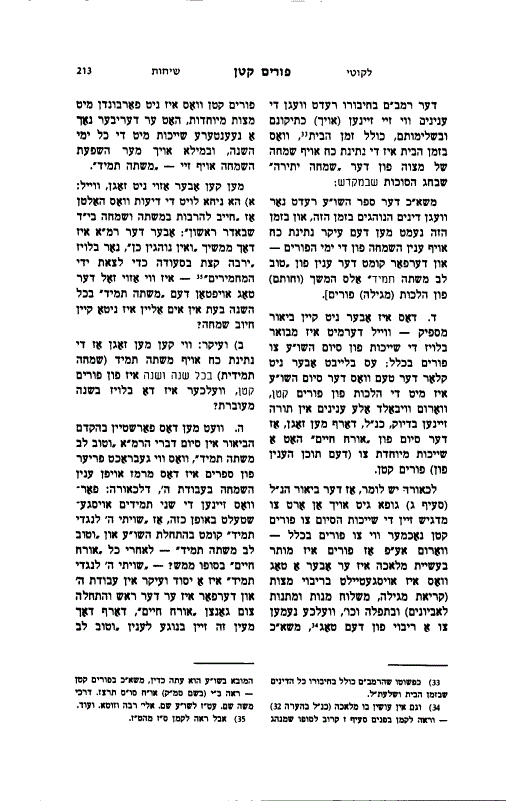
1. The Shulchan Aruch, Orach Chaim, concludes with the laws and rules of Purim (the Laws of Megillah), and its final siman1 deals with the laws of the fourteenth and fifteenth of Adar I.
The simple reason for this is that it follows the order of the year. The way the laws of the times and festivals of the year are set out in the Tur and the Shulchan Aruch, Orach Chaim, they begin with Rosh Chodesh, followed by Nissan (the Laws of Pesach), and so on, so the laws of Purim come at the end2.
The laws of the fourteenth and fifteenth of Adar I come at the conclusion (of the Laws of Megillah), after the laws of Purim, even though in a leap year itself they come before the laws of Purim of Adar II. This is because these laws do not apply every year, only in a leap year, and therefore the laws of Purim take precedence.
One may further say that the particular laws of the fourteenth and fifteenth of Adar I, and the law about fasting and eulogizing on those days3, are a consequence of the mitzvos and laws of Purim. That is, the laws and obligations of the fourteenth and fifteenth of Adar I are: "אין נופלים על פניהם ואין אומרים מזמור יענך ה׳ ביום צרה ואסורים בהספד ותענית" ("We do not fall on our faces [in Tachanun], we do not say the psalm 'May the L‑rd answer you on the day of distress,' and eulogizing and fasting are forbidden")4. These obligations are not tied to any special content of these days of the month in their own right. They come only as a result of the days of Purim (and of fulfilling the mitzvos of Purim5) in Adar II.
That is why they come after the laws and rules of the fourteenth and fifteenth of Adar (plain Adar). The laws in this siman come as a result and consequence6 of the main days of Purim7, which in this (leap) year fall in Adar II.
However, all matters of Torah are absolutely precise. This follows all the more so from the matters of the world, since everything in the world happens by Divine Providence and with precise intent. It is therefore understood that the laws of Purim stand at the conclusion of the laws of the section Orach Chaim, and that within them the conclusion is the laws of Purim Katan8, the fourteenth and fifteenth of Adar I, for a reason. It is not merely because that is how things come out in the order of the laws by their times, from earlier to later (or, within Adar itself, because of the principle of "the more frequent" and so on), so that they happen to come at the end of the section Orach Chaim. Rather, it is because (also) in this there is a special precision and intent:
The fact that these laws are the conclusion and seal of Orach Chaim expresses something about the order of a person's "אורח חיים" ("way of life"), since there is the rule that "הכל הולך אחר החתום" ("Everything follows the conclusion")9.
2. Seemingly, one could explain this by clarifying the content of the final words with which the Rema concludes Orach Chaim: "יש שחייב להרבות במשתה ושמחה בי״ד שבאדר ראשון ואין נוהגין כן, מ״מ ירבה קצת בסעודה כדי לצאת ידי המחמירים וטוב לב משתה תמיד" ("Some say that one is obligated to increase in feasting and joy on the fourteenth of Adar I, but the custom is not so. Nevertheless, one should increase his meal somewhat, in order to satisfy those who are stringent; 'and one who is of good heart10 has a constant feast'").
It is stated in sefarim11 that the Rema's "conclusion" is "similar to the opening" of Orach Chaim. The Rema opens with "שויתי ה׳ לנגדי תמיד" ("I have set the L‑rd before me constantly")12, and the conclusion and seal is "and one who is of good heart has a constant feast." The two times "constantly" correspond to the "שני תמידים כסדרן" ("two daily offerings in their order")13, "שנים ליום תמיד" ("two each day, constantly")14.
One of the explanations of this:
The section Orach Chaim consists of the mitzvos and laws that a person must fulfill day by day and throughout the whole day, from the time he rises from sleep in the morning until the time he lies down at night. It also contains the laws and mitzvos for the days of the entire year, in the order of the year.
These mitzvos and laws are generally tied to specific times during the day and night, or (during the year) to a specific time of year when one is obligated to fulfill them, and they have nothing to do with any other time of the year.
But the beginning of "Orach Chaim" (one may say, also of a person's way of life) and its conclusion are the "two constant offerings"14*. Their obligation is constant, at every moment of a person's life: throughout the entire year and throughout the entire day, every single day.
This is why they are arranged so that one "constant" comes as the head and beginning of "Orach Chaim" and the second "constant" as its conclusion and seal:
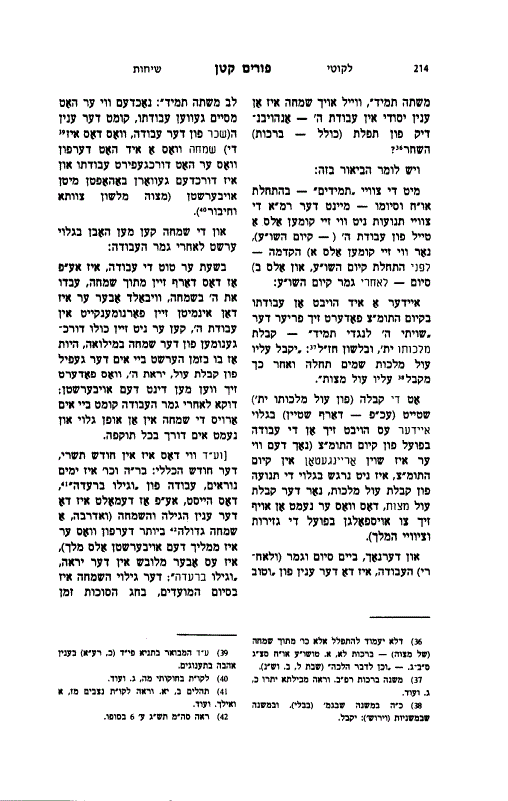
The beginning of the Shulchan Aruch, "I have set the L‑rd before me constantly," is the point of fear of G‑d, as the Rema elaborates and details15 (there): "כשישים האדם אל לבו שהמלך הגדול הקב״ה אשר מלא כל הארץ כבודו עומד עליו ורואה במעשיו כו׳ מיד יגיע אליו היראה וההכנעה בפחד הש״י ובושתו ממנו תמיד" ("When a person takes to heart that the great King, the Holy One, blessed be He, whose glory fills the whole earth, stands over him and sees his deeds... at once fear and submission will come to him, in awe of G‑d, may He be blessed, and he will feel shame before Him constantly"). The conclusion, "and one who is of good heart has a constant feast"18, is the matter of joy.
A person must have these two matters in the manner of "constantly," at all times. In every service16 that a Jew performs, he must feel fear and submission, and also joy in serving G‑d: "עבדו את ה׳ ביראה" ("Serve the L‑rd with fear"), "עבדו את ה׳ בשמחה" ("Serve the L‑rd with joy")17.
3. On this basis one can explain why Orach Chaim concludes with the laws of Purim (the Laws of Megillah):
It is known that for every type or special line in the service of G‑d there is a fixed day (time) in the year that is especially suited and fitting for that mode of service19. From that time one draws the strength for this matter and the influence on this service throughout the entire year.
The same applies to the line of joy. The strength for "and one who is of good heart has a constant feast," for joy in serving G‑d throughout the entire year, comes from the days of Purim. Purim is the time when one increases in (feasting and) joy to the greatest degree, more than on all the festivals and holidays of the year, as ruled in the Tur20 and the Shulchan Aruch21: "מצוה להרבות בסעודת פורים" ("It is a mitzvah to make the Purim feast abundant"), and22 "חייב אינש לבסומי בפוריא עד דלא ידע כו׳" ("A person is obligated to become intoxicated on Purim until he does not know, etc.").
This does not contradict what is explained in many places, that the festival of Sukkos, the Season of our Rejoicing, is23 the source of joy for the entire year
[as is known24, the general matters in the service of G‑d draw their strength from the general month, the month of Tishrei. Rosh Hashanah, the time of "תמליכוני עליכם" ("Make Me King over you")25, is the source from which one draws fear of Heaven for the whole year. Yom Kippur is the source for teshuvah. And from Sukkos, Shemini Atzeres and Simchas Torah, the Season of our Rejoicing, one draws the strength to do all matters of Torah and mitzvos throughout the year with joy],
and as alluded to in the Rambam26, that the joy of a mitzvah ("השמחה שישמח אדם בעשיית המצוה כו׳ עבודה גדולה היא כו׳", "The joy with which a person rejoices in doing the mitzvah... is a great service...") comes as a continuation of the "שמחה יתירה" ("extra joy")27 that took place in the Beis HaMikdash on the festival of Sukkos.
One may say this holds specifically in the time when the Beis HaMikdash stood, when all matters were in their proper order and complete. At that time one could draw vitality for the service of G‑d throughout the entire year from the festivals of the month of Tishrei (and that was enough), and accordingly, joy in serving G‑d was drawn from the "extra joy" that took place in the Beis HaMikdash on the festival of Sukkos.
In the time of exile, however, a time of concealment and hiddenness, the joy drawn from the festival of Sukkos is not enough to affect the service of an entire year28. As matters stand in the month of Tishrei, they are, by way of analogy, like the vitality of all the limbs while it is still in the head, where the vitality is too lofty to invest itself in the limbs of the body and give them life. Similarly in the thing being illustrated: in Tishrei the matters of the service of G‑d stand at a far higher29 level, too high to connect to the particular forms of service as they appear in a person's service throughout the entire year30.
There must therefore be a "closer" source of strength31 and influence, from a day and a level that is not in the general month, which influences the days of the year.
In our case, "good heart, constant feast," the constant joy throughout the days of the year, is drawn (one may say, also from the festival of Sukkos, by way of) the joy of the days of Purim. These are among the days of the year, and they became days of joy in exile (and because of exile). Moreover, they are days on which work is permitted (like the other ordinary days of the year)32. Therefore they can bring constant joy into every situation in which a Jew finds himself, even a weekday (exilic) condition and state.
[On this basis one can understand the difference in this regard between the Rambam's work and the Shulchan Aruch:
The Rambam in his work speaks of matters as they are (also) in their proper order and complete, including Temple times33. In Temple times the strength for the joy of a mitzvah comes from the "extra joy" of the festival of Sukkos in the Beis HaMikdash.
The Shulchan Aruch, however, speaks only of laws that apply in the present time, and in the present time the main strength for joy is drawn from the days of Purim. Therefore the matter of "good heart, constant feast" comes as a continuation (and seal) of the laws of Purim (the Laws of Megillah).]
4. This, however, is not a sufficient explanation. It explains only the connection of the conclusion of the Shulchan Aruch to Purim in general, but it leaves unclear why the Shulchan Aruch concludes with the laws of Purim Katan. Since all matters in Torah are precise, as mentioned, one must say that the conclusion of "Orach Chaim" has a special connection to (the content of) Purim Katan.
Seemingly, one could say that the above explanation (section 3) itself makes room to stress the connection of the conclusion to Purim Katan even more than to Purim in general. Although work is permitted on Purim, it is still a day set apart by many mitzvos (reading the Megillah, sending portions of food, and gifts to the poor) and by prayer and so on, which take up much of the day34. Purim Katan, by contrast, is not tied to any special mitzvos, so it has an even closer connection to all the days of the year, and consequently also more influence of joy upon them: "a constant feast"35.
However, one cannot say this, because:
a) This would work according to the opinions that hold that "one is obligated to increase in feasting and joy on the fourteenth of Adar I." But the Rema continues, "but the custom is not so," only "one should increase his meal somewhat, in order to satisfy those who are stringent." So how can this day bring about the "constant feast" for the entire year, when on the day itself there is no obligation of joy?
b) And mainly: how can one say that the strength for a constant feast (constant joy) every single year comes from Purim Katan, which occurs only in a leap year?
5. This will be understood by first explaining the conclusion of the Rema's words, "and one who is of good heart has a constant feast," which, as cited earlier from sefarim, alludes to joy in serving G‑d. For seemingly: why are the two "constants" arranged so that "I have set the L‑rd before me constantly" comes at the beginning of the Shulchan Aruch, while "and one who is of good heart has a constant feast" comes after the entire "Orach Chaim," at its very end? "I have set the L‑rd before me constantly" is a foundation and principle in the service of G‑d, and that is why it is the head and beginning of the entire "Orach Chaim." The same should apply to "and one who is of good heart has a constant feast," since joy too is a fundamental matter in the service of G‑d, starting from the morning prayer (including the blessings)36.
The explanation of this may be as follows:
By the two "constants," at the beginning of Orach Chaim and at its conclusion, the Rema does not mean the two movements as they come as part of the service of G‑d (that is, as part of fulfilling the Shulchan Aruch). He means them as they come a) as a preface, before one begins to fulfill the Shulchan Aruch, and b) as a conclusion, after one has finished fulfilling the Shulchan Aruch:
Before a Jew begins his service of fulfilling Torah and mitzvos, he first needs "I have set the L‑rd before me constantly," the acceptance of His kingship, may He be blessed. In the words of our Sages37: "יקבל עליו עול מלכות שמים תחלה ואחר כך מקבל38 עליו עול מצות" ("One should first accept upon himself the yoke of the Kingdom of Heaven, and afterwards accept upon himself the yoke of mitzvos").
This acceptance (of the yoke of His kingship) is present (or at least should be present) openly before the actual service of fulfilling Torah and mitzvos begins. (Once he is already engaged in fulfilling Torah and mitzvos, the movement of accepting the yoke of kingship is not openly felt. What is felt is the acceptance of the yoke of mitzvos: his taking upon himself to carry out in practice the decrees and commands of the King.)
Afterwards, at the conclusion and completion of the service (and after it), there comes "and one who is of good heart has a constant feast." After he has completed his service, there comes the (reward for the service, which is39 the) joy a Jew has from having carried out his service and thereby having become bonded with G‑d ("mitzvah" from the word "tzavsa," connection and bonding40).
This joy can be felt openly only after the service is completed:
While he is doing the service, it must indeed be done with joy, "Serve the L‑rd with joy." But since he is then in the midst of his engagement in the service of G‑d, he cannot be wholly permeated by the joy in its fullness, because at that time the feeling that dominates him is the acceptance of the yoke, fear of G‑d, which is required when serving G‑d. Only after completing the service does the joy emerge in him openly and permeate him with all its strength.
[It is similar to how things are in the month of Tishrei, the general month. Rosh Hashanah and Yom Kippur are the Days of Awe, a service of "וגילו ברעדה" ("rejoice with trembling")41. That is, although there is rejoicing and joy then (and on the contrary, very great joy42, from crowning G‑d as King), it is enclothed in fear: "rejoice with trembling." The revelation of joy comes at the conclusion of the festivals, on the festival of Sukkos, the Season of our Rejoicing, and mainly at its very conclusion, on Simchas Torah.
The same applies in our case: the revelation of joy comes after the service is completed, at the very conclusion of "Orach Chaim".]
6. This is the difference between how joy is discussed in the Rambam and how it is discussed in the Rema:
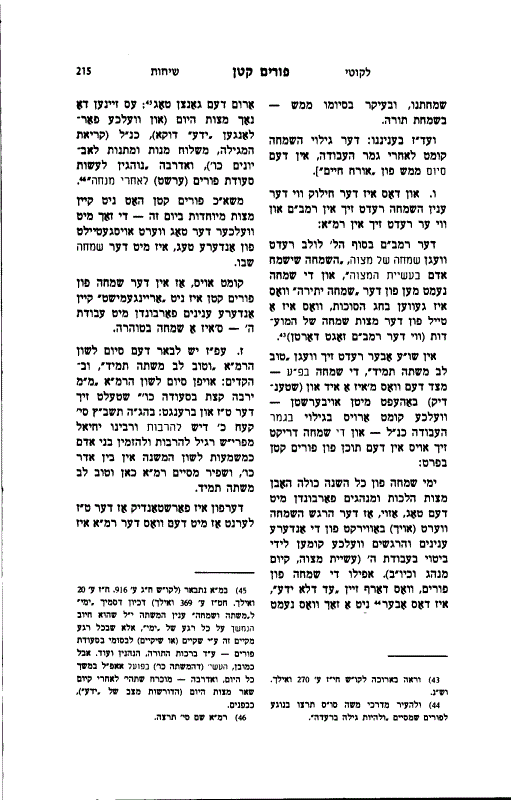
The Rambam, at the end of the Laws of Lulav, speaks of the joy of a mitzvah, "the joy with which a person rejoices in doing the mitzvah." This joy is drawn from the "extra joy" that took place on the festival of Sukkos, which is part of the mitzvah of rejoicing on the festivals (as the Rambam says there)43.
The Shulchan Aruch, however, speaks of "good heart, constant feast," joy in its own right. This joy comes from being a Jew who is (always) bonded with G‑d, and it emerges openly at the completion of the service, as explained above. This joy is expressed in particular in the content of Purim Katan:
Days of joy throughout the year have mitzvos, laws and customs tied to the day, so that the feeling of joy is (also) shaped by the other matters and feelings that find expression in the service of G‑d (doing a mitzvah, keeping a custom, and the like). Even the joy of Purim, which must reach "until he does not know," is still44 not something that fills the entire day45. There are other mitzvos of the day (which specifically require "knowing"), as mentioned (reading the Megillah, sending portions of food, and gifts to the poor, etc.). On the contrary, the custom is to hold the Purim feast (only) after Minchah46.
Purim Katan, however, has no special mitzvos on this day. The thing that sets this day apart from other days is its joy.
It follows that no other matters connected with the service of G‑d are "mixed into" the joy of Purim Katan. It is a pure joy.
7. On this basis one can explain the concluding words of the Rema, "and one who is of good heart has a constant feast." First, a preface: on the Rema's concluding words, "nevertheless one should increase his meal somewhat etc.," the Taz comments and cites: "בהג״ה תשב״ץ סי׳ קעח כ׳ דיש להרבות ורבינו יחיאל מפרי״ש רגיל להרבות ולהזמין בני אדם כמשמעות לשון המשנה אין בין אדר כו׳, ושפיר מסיים רמ״א כאן וטוב לב משתה תמיד" ("In the glosses to the Tashbetz, siman 178, he writes that one should increase [the feast], and Rabbeinu Yechiel of Paris used to increase [it] and invite people, in keeping with the plain sense of the wording of the Mishnah, 'There is no difference between [the first] Adar etc.' The Rema therefore fittingly concludes here, 'and one who is of good heart has a constant feast'").
From this it is understood that, according to the Taz, the Rema concludes with "and one who is of good heart has a constant feast" in order47 to caution and indicate that in the end, "one should increase his meal somewhat" (which he says earlier) is not enough. Rather48, one must increase in feasting and joy similar to Adar II ("There is no difference between Adar etc.")49.
This needs explanation: why does the Rema not say explicitly that one should "increase in joy," instead of alluding to it with the wording "and one who is of good heart has a constant feast"?
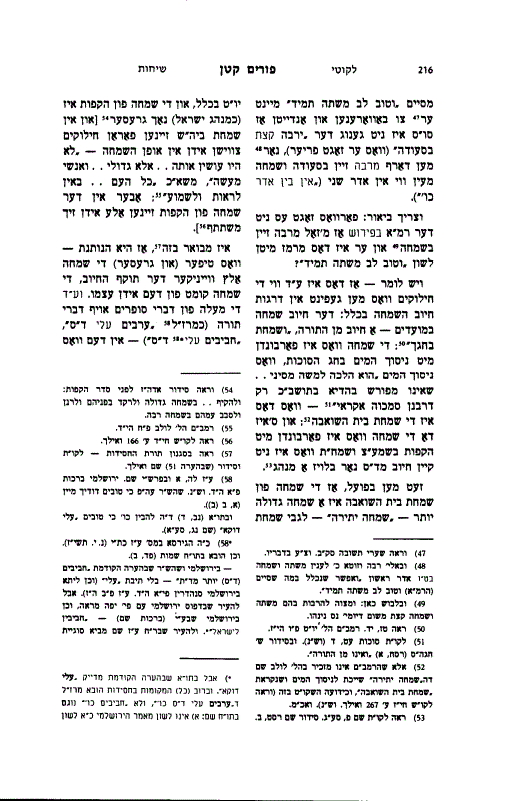
One may say that this resembles the distinctions found among the levels of the obligation of joy in general. There is the obligation of joy on the festivals, a Torah obligation: "ושמחת בחגך" ("And you shall rejoice in your festival")50. There is the joy connected with the water libation on the festival of Sukkos: "ניסוך המים הוא הלכה למשה מסיני . . שאינו מפורש בהדיא בתושב״כ רק דרבנן סמוכו אקרא" ("The water libation is a law given to Moshe at Sinai... which is not stated explicitly in the Written Torah; only the Rabbis based it on a verse")51, and this is the Simchas Beis HaSho'evah52. And there is the joy connected with the hakafos on Shemini Atzeres and Simchas Torah, which is not even a Rabbinic obligation but only a custom53.
One sees in practice that the joy of Simchas Beis HaSho'evah is a greater joy, an "extra joy," compared with the joy of Yom Tov in general, and the joy of the hakafos is (according to the custom of the Jewish people) greater still54. [In Simchas Beis HaSho'evah there are distinctions among Jews in the manner of the joy: "לא היו עושין אותה . . אלא גדולי . . ואנשי מעשה" ("They would not perform it... except the great ones... and men of deeds"), whereas "כל העם . . באין לראות ולשמוע" ("all the people... would come to see and to hear")55. But in the joy of the hakafos all Jews take part56.]
The explanation of this57 is that this itself is the reason: the deeper (and greater) the joy, the weaker the force of the obligation, because the joy comes from the Jew himself. It is similar to the superiority of the words of the Scribes over the words of Torah (as our Sages say58, "ערבים עלי ד״ס" ("The words of the Scribes are dearer to Me"), "חביבים עלי" ("more beloved to Me")58*). When Jews take upon themselves fences and stringencies that are not (explicitly) written in the Written Torah, one sees the love, joy and delight that Jews have in fulfilling the Supreme Will59.
In our case: the joy for which there is an explicit obligation in the Torah, meaning that the Torah obligates everyone in it equally, shows that it matches the level of a person that exists even in the lowest of people. The extra joy of Simchas Beis HaSho'evah, connected with the water libation, for which there is no explicit obligation in the Written Torah, points to a greater and deeper joy. And hakafos, which is not an obligation, not even a Rabbinic obligation, but only a custom, expresses an even deeper joy, one that comes from the Jewish people, who themselves initiated and introduced this joy60.
The same applies, and even more so, to Purim Katan. The Rema mentions "increasing in joy" only by way of allusion and narrative (as the Taz explains) because this is so lofty a level of joy that there is no explicit obligation for it in the Shulchan Aruch, not even as a custom. [Compare the custom of hakafos on Shemini Atzeres and Simchas Torah, which is not stated61 in the Shulchan Aruch but is stated at least in the Rema, as we have learned62: "וקורין יו״ט האחרון שמחת תורה לפי ששמחין ועושין בו סעודת משתה לגמרה של תורה כו׳ ועוד נהגו להקיף עם ספרי התורה כו׳ והכל משום שמחה" ("They call the last day of Yom Tov 'Simchas Torah' because they rejoice and make a festive meal on it for the completion of the Torah... and the custom is also to circle with the Torah scrolls... and all this is because of joy").] For a custom brought in the Rema is also a law (and an obligation).
One may say that this is because, as explained above, the joy of Purim Katan resembles the joy that comes at the completion of the service and after it. It comes after the service and is "higher" than it, and consequently "higher" than any form of obligation. The joy comes (arises) from the Jew himself63.
[Put somewhat differently: if there were a command (or a custom) to rejoice, that itself would make the joy a part of the obligation of fulfilling the Shulchan Aruch, and an element of yoke and fear would have to be mixed into it.]
One may say that this is why it is this joy that is the preface that brings the joy of the future. As the Magen Avraham64 writes on the Rema's words "and one who is of good heart has a constant feast": "בשמחות מצות אלקינו להעמיד" ("through the joys of mitzvos ... of our G‑d to establish")65, so that "מלא שחוק פינו" ("our mouth [will be] filled with laughter")66, and in the future there will be "שמחת עולם על ראשם" ("everlasting joy upon their heads")67, which also means a constant joy and a joy in its own right.
This comes about through increasing joy during the time of exile, in the manner of "מעלין בקודש" ("ascending in holiness"), also in the holiness of "good heart, constant feast."
It brings, "במהרה בימינו" ("speedily in our days")68, literally, "everlasting joy upon their heads."
(From the sichos of Shabbos Parshas Tisa, Shushan Purim Katan, 5727; 5744)
Notes
1) Siman 697.
2) See the Tur's introduction to Orach Chaim, third part.
3) The wording in the heading of siman 697.
4) The wording of the Mechaber (author of the Shulchan Aruch) there.
5) As is evident from [OCR unclear], which cites (also [the view] of his father, the Rosh, Megillah ch. 1, §6, on the Mishnah) on the words of the Gemara there (6b) that the [equality] (of the fourteenth of Adar I and of Adar II) regarding eulogizing and fasting applies only "when they had read the Megillah and on that very day decided to intercalate the year; but if they had not read the Megillah, eulogizing and fasting are permitted." See [OCR unclear] there.
6) Note the wording of the Rambam, Laws of Megillah, ch. 2, halachah [OCR unclear]: "ושני הימים אסורין בהספד ותענית באדר הראשון ובאדר* השני" ("And both days are forbidden for eulogizing and fasting in the first Adar and in* the second Adar"). Perhaps one may say that, in the Rambam's view, the prohibition of eulogizing and fasting on the fourteenth of Adar I is not a result of Purim (the fourteenth and fifteenth of Adar II) and of the mitzvos of that day (see the continuation of the halachah: "villagers who read early, on Monday... are permitted to eulogize..."). Rather, it is an equal obligation, an intrinsic obligation stemming from the day itself in Adar I**. This also fits the plain wording of the Gemara (Megillah there): "There is no difference between the fourteenth of the first Adar and the fourteenth of the second Adar except... regarding eulogizing and fasting, both are equal"***. According to the Tur and Shulchan Aruch, however, the meaning must be that they are equal in the practical law, but not in its cause and reason. See Tzafnas Pa'neach on the Rambam there.
*) This is the widespread reading. The Yemenite manuscripts read "כאדר השני" ("like the second Adar"). See the Frankel edition of the Rambam (and what it cites from the [OCR unclear] printing).
**) Although he does not write that there is an obligation to increase in feasting and joy in Adar I. See Tosafos, s.v. "ור״א," Megillah there; Ran, Megillah there; and elsewhere.
***) See the Beis Yosef at the end of the siman: "because they are days of miracle and deliverance."
7) This itself is the reason that the Tur holds that they are not forbidden for eulogizing and fasting. As for the Mechaber's Shulchan Aruch, although at first he cited the opinion that they are forbidden for eulogizing and fasting (see Yad Malachi, Rules of the Shulchan Aruch, §10), one may say (besides the fact that he follows the order of the Tur) that the prohibition in every leap year is also a result of the main days of Purim.
8) I have found the name "Purim (and Shushan Purim) Katan" (to the best of my limited knowledge) beginning with the Maharil, Laws of Purim; in the Darkei Moshe at the end of the siman (subsection 3); and it is likewise cited in the Alter Rebbe's Siddur before "Lamenatze'ach Ya'ancha." In the Darkei Moshe there, subsection 2: "Purim Rishon" ("the first Purim").
9) Berachos 12a.
10) The wording of the verse, Mishlei 15:15.
11) Birkei Yosef here, at the end; cited in the Sha'arei Teshuvah on the Shulchan Aruch. See also Nimukei Orach Chaim here.
12) The wording of the verse, Tehillim 16:8.
13) The wording of the Birkei Yosef (and the Sha'arei Teshuvah) there. See Nimukei Orach Chaim there.
14) Our parsha (Shemos 29:38). In this year ([OCR unclear]), Purim Katan receives its blessing from Parshas Tetzaveh (as it does most of the time), especially since it falls at the beginning of the week, on Sunday. See the Alter Rebbe's Siddur there, that on the Eve of Purim Katan as well, Tachanun and nefilas apayim are not said, and when the Eve of Purim Katan falls on Shabbos (as this year), "Tzidkas'cha" is not said. Note the Kol Bo, Laws of Purim, at the end, that the days before and after the two days in Adar I are also forbidden for eulogizing and fasting (the Meiri on Megillah there questions this). But the conclusion of all the poskim is that it is not forbidden; see Kaf HaChaim here, §7.
14*) Which come at the beginning of the day, the morning tamid, and at its end, the afternoon tamid, with which all the offerings are completed.
15) Cited in the Alter Rebbe's Shulchan Aruch there, in both editions.
16) In this, the "constancy" of these two matters, fear and joy, differs from the six mitzvos whose "obligation is constant" (the author's letter in Sefer HaChinuch, at its end, printed at the beginning of Sefer HaChinuch). Note that the Tur and Shulchan Aruch contain no special laws for these six mitzvos.
17) Tehillim 2:11; ibid. 100:2.
18) See the Magen Avraham (subsection 2) on the Rema's words "וטוב לב משתה תמיד": "in the joys of mitzvos" (and see the Yad Efraim there, quoted below in note 65). That is, he explains that "and one who is of good heart has a constant feast" must be "in the joys of mitzvos."
19) As with the general matters: the mitzvah of remembering the Exodus [from Egypt] every day has its time in the year on Pesach, the Season of our Freedom. "נותן התורה" ("Who gives the Torah") is in the present tense, meaning that He gives it to us every day (Likkutei Torah, Nitzavim 46b; Sukkos 61c; and see Berachos 22a; 63b), and its time in the year is Shavuos, the Season of the Giving of our Torah; and so on. See also the maamar beginning "ועשית חג שבועות" 5705, [OCR unclear].
20) Siman 695.
21) Rema there.
22) Shulchan Aruch there (Megillah 7b); and so in the Tur there.
23) See at length the discourses on the festival of Sukkos in Likkutei Torah, and elsewhere.
24) See Maamarei Admur HaZaken 5567, p. 379; Or HaTorah, Berachah, p. [OCR unclear]; Sefer HaMaamarim 5654, p. 36; Sefer HaMaamarim 5702, p. 49. See also Likkutei Torah, Re'eh 32a (beginning of the maamar "אני לדודי").
25) Rosh Hashanah 16a; 34b.
26) At the end of the Laws of Lulav.
27) There, halachah 12ff.
28) Especially since in the time of exile there is no "extra joy" as there was in the Beis HaMikdash.
29) See the sources in note 24, "that they are roots and sources."
30) Unlike Temple times, when the level of service throughout the year was also more elevated, and therefore closer to the level of service of the month of Tishrei.
31) On the other hand, there must also be a greater joy: the boundless joy of Purim. The joy of the Season of our Rejoicing, which is limited, does not suffice. See the Siddur, end of Sha'ar HaPurim (283d); Torah Or, Megillas Esther 99c ff.; Likkutei Torah, Nitzavim 48a; and elsewhere.
32) Shulchan Aruch, Orach Chaim, beginning of siman 696. However, "nowadays the custom everywhere is not to work, and one who works..." (Shulchan Aruch and Rema there). See at length Torah Or there, 99d ff., and elsewhere.
33) Simply put, the Rambam includes in his work all the laws of Temple times and of the future.
34) Also, work is not done on it (as above, note 32). See below in the text, section 7, near its end, that a custom cited in the Shulchan Aruch now has the force of law, which is not so on Purim Katan. See the Beis Yosef (citing the Smak), Orach Chaim, end of siman 697; Darkei Moshe there; Turei Zahav on the Shulchan Aruch there; Eliyah Rabbah and Eliyah Zuta; and elsewhere.
35) But see below, section 6, [OCR unclear].
36) One should stand to pray only out of joy (of a mitzvah): Berachos 31a; Tur and Shulchan Aruch, Orach Chaim, siman 93, paragraphs 2–3. "And likewise for a matter of halachah" (Shabbos 30b, and the sources cited there).
37) Mishnah, Berachos, beginning of ch. 2. See also Mechilta, Yisro 20:3; and elsewhere.
38) So it reads in the Mishnah as it appears in the Gemara (Bavli). In the Mishnah as it appears in the Mishnayos (and the Yerushalmi): "יקבל" ("should accept").
39) Similar to what is explained in Tanya, ch. 44 (p. [OCR unclear], beginning of col. a), regarding "love of delights."
40) Likkutei Torah, Bechukosai 45c; and elsewhere.
41) Tehillim 2:11. See Likkutei Torah, Nitzavim 47a ff.; and elsewhere.
42) See Sefer HaMaamarim 5703, p. 6, at the end.
43) See at length Likkutei Sichos vol. 17, p. 270ff., and the sources cited there.
44) Note the Darkei Moshe, end of siman 696, regarding Purim, where he concludes "ולהיות גילה ברעדה" ("and to rejoice with trembling").
45) As explained elsewhere (Likkutei Sichos vol. 3, p. 916; vol. 7, p. 20ff.; vol. 16, p. 369ff.), since "days" is juxtaposed with "feasting and joy," one may say that feasting is an obligation that extends over every moment of the "days." At every moment one fulfills it by having fulfilled (or by being about to fulfill) "becoming intoxicated" at the Purim feast, similar to the blessings over Torah, the blessings over enjoyment, and so on. Obviously, however, the actual doing (of the feasting, etc.) cannot extend through the entire day. On the contrary, it must come after the other mitzvos of the day are fulfilled (which require a state of "knowing"), as in the text.
46) Rema there, siman 695.
47) See Sha'arei Teshuvah, subsection 2; his words require further examination.
48) In the Eliyah Rabbah and Zuta he writes, regarding feasting and joy on the fifteenth of Adar I: "and perhaps it is included in what he (the Rema) concluded, 'and one who is of good heart has a constant feast.'"
49) The Levush here: "and it is a mitzvah to increase feasting and joy on them somewhat, because they are days of miracle."
50) Re'eh (Devarim) 16:14. Rambam, Laws of Yom Tov, ch. 6, halachah 16.
51) Likkutei Torah, Sukkos 79d (and the sources cited there). In the Siddur, Sha'ar Chag HaSukkos (268a): "and it is not from the Torah."
52) However, the Rambam does not mention in the Laws of Lulav there that the "extra joy" belongs to the water libation and is called Simchas Beis HaSho'evah, and the discussion on this point is well known (see Likkutei Sichos vol. 10, p. 267ff., and the sources cited there). This is not the place to elaborate.
53) See Likkutei Torah there, 80, end of col. c; Siddur there, 269b.
54) See the Alter Rebbe's Siddur before the order of hakafos: "and to circle... with great joy, and to dance before them and sing, and go around with them with much joy."
55) Rambam, Laws of Lulav 8:14.
56) See Likkutei Sichos vol. 10, p. 166ff.
57) See it in the style of the teachings of Chassidus: Likkutei Torah and the Siddur (cited in note 51), there and onward.
58) Avodah Zarah 35a, and Rashi there; Yerushalmi, Berachos 1:4, and the sources cited there; Shir HaShirim Rabbah on the verse "כי טובים דודיך מיין" ("For your love is better than wine") (1:2 (2)). In Torah Or (52d), the maamar beginning "להבין כו׳ כי טובים": "'to Me' specifically" (there, 53, end of col. a).
58*) So is the reading in tractate Avodah Zarah, manuscript (N.Y., 5707). It is likewise cited in Torah Chaim, Shemos (84b). In the Yerushalmi and Shir HaShirim Rabbah cited in the previous note: "חביבים (ד״ס) יותר מד״ת" ("[The words of the Scribes] are more beloved than the words of Torah"), without the word "עלי" ("to Me") (and it is likewise absent in Yerushalmi, Sanhedrin 1:4; Avodah Zarah 2:7). Note, however, that in the printed Yerushalmi with the commentary Yefeh Mar'eh, and likewise in the Yerushalmi as cited in [OCR unclear] (Berachos there), it reads "חביבין לישראל" ("beloved to the Jewish people")*. Note also that [OCR unclear] on Avodah Zarah there cites the passage of the Yerushalmi mentioned above: "The words of the Scribes are more beloved than the words of Torah; know this, for [OCR unclear]..."
*) But in Torah Or, cited in the previous note, he is precise: "'to Me' specifically." In most (all) places in Chassidus the saying of our Sages is cited as "ערבים עלי ד״ס כו׳" ("The words of the Scribes are dearer to Me..."), and not "חביבים כו׳" ("beloved..."). (In Torah Chaim there as well: a) it is not the wording of the Yerushalmi's saying but the wording of the Bavli, Avodah Zarah (and Rashi) there, except that he changes "dearer" to "beloved"; b) in the continuation of the maamar there it says "ערבים עלי כו׳" ("dearer to Me...").)
59) See at length [OCR unclear], Matos (85a ff.), where it says that through the words of the Scribes the great love was aroused; see there.
60) See also Likkutei Sichos vol. 11, p. 87, and elsewhere.
61) Although he cites it in the Beis Yosef on the spot: "and they make feasting and joy and a festive day for the completion of the Torah (the wording of the Tur there)... and I found the root of the custom in the Midrash... from here [we learn] that one makes a feast for the completion of the Torah."
62) Orach Chaim, siman 669.
63) See Likkutei Sichos vol. 19, p. 382ff.
64) Subsection 2.
65) In the Yad Efraim [OCR unclear], on the words of the Magen Avraham: "בשמחת מצות ונזכה בית אלקינו להעמיד" ("in the joy of mitzvos, and may we merit to establish the House of our G‑d").
66) Tehillim 126:2. See Berachos 30b, end: "I am wearing tefillin." Note also the Megillah, "ויקר" ("and honor"), "these are tefillin" (Megillah 16b).
67) Yeshayahu 35:10; 51:11.
68) The concluding words of the Magen Avraham there. Note the Be'er Heitev there: "בית תפארתנו במהרה יעמוד וביראה אותו לעבוד. נכון יהי׳ הר הבית בראש הרים עדי עד" ("May our glorious House speedily stand, and may we serve Him in awe. May the Temple Mount be established at the top of the mountains forever"). One may say that he stresses awe here in order to connect the end to the beginning of the Shulchan Aruch, as explained above in the text.
Key Lesson
The Shulchan Aruch opens with fear of G‑d and closes with joy, because accepting His yoke comes before the service and true joy is revealed once it is complete. Purim Katan carries no special mitzvos and is not even a formal obligation of joy, so its joy is pure and comes from the Jew himself. Increasing this kind of joy during exile brings the everlasting joy of the Redemption, speedily in our days.