
Likkutei Sichos Vol. 19 – Vayeilech 2
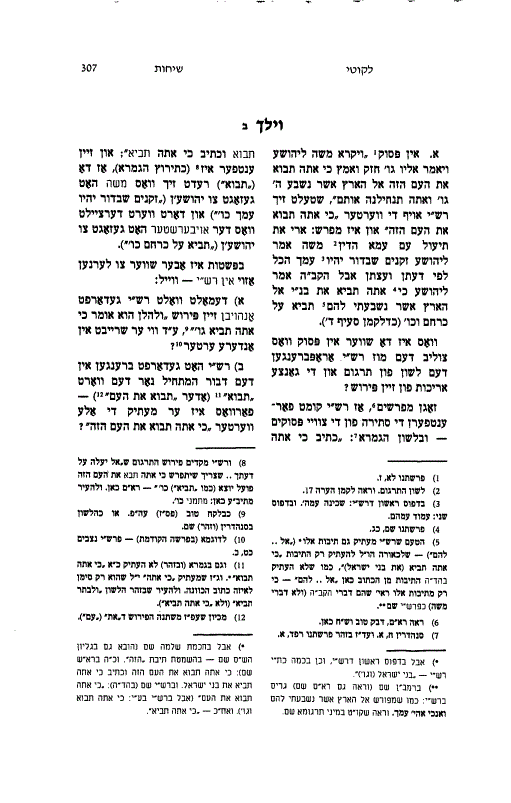
1. Rashi explains that Moses spoke to the heavens and the earth, asking them to listen and serve as "witnesses" to his warning to the Jewish people. He continues to elaborate, "And why did he call upon the heavens and the earth as witnesses, etc.?"
However, we need to understand: Earlier, at the end of Parshas Nitzavim, the verse states, "I call heaven and earth to witness against you today," and there Rashi provides two explanations: "They exist forever, and when calamity befalls you, they will testify that I warned you about all this. Another explanation: I call heaven and earth to witness against you today, said the Holy One, blessed be He, to Israel: Look at the heavens that I created to serve you. Have they ever changed their nature? Have they ever failed to rise, etc.? If these, which were not created for reward, etc., then certainly you, if you merit, etc." It is not clear: a) Why does Rashi ask here, "Why did he call upon the heavens and the earth as witnesses," when we have already learned about the testimony of the heavens and the earth and the reason they were appointed as witnesses?
b) Even if Rashi wishes (for whatever reason) to explain in this parsha the reason why the heavens and the earth were appointed as witnesses, he should have written it briefly. Why does Rashi write at length about this matter in this parsha where it is mentioned for the second time, and not at the first instance in the verse "I call heaven and earth to witness against you today" (where he only briefly states, "They exist forever, and when calamity befalls you, etc.")?
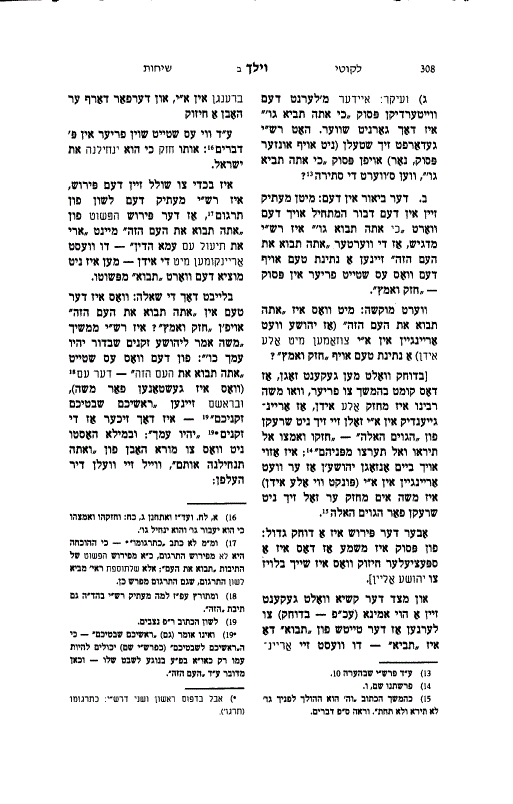
2. Similarly, we need to understand regarding the second explanation in our parsha: It is understandable why Rashi does not mention in our parsha the second explanation from Parshas Nitzavim, "The Holy One, blessed be He, said to Israel: Look at the heavens, etc., have they ever changed their nature, etc.," because since "I call heaven and earth to witness against you today" was said by Moses to Israel, making the heavens and the earth witnesses, but not to the heavens and the earth themselves to be witnesses, it is therefore fitting only there (in Parshas Nitzavim) for the Jews to learn the lesson from the heavens and the earth, unlike in our parsha.
However, the second explanation that Rashi gives in our parsha, "If they merit, the witnesses will come and give them their reward, etc.," seems to also fit in Parshas Nitzavim, where Moses tells the Jews that the heavens and the earth are witnesses — that when the Jews merit, the witnesses will give them their reward, and if, G‑d forbid, not, etc. Why does Rashi not explain this at the first instance, but only here where Moses addresses the testimony to the heavens and the earth themselves?
3. We also need to understand the nuances in Rashi's commentary:
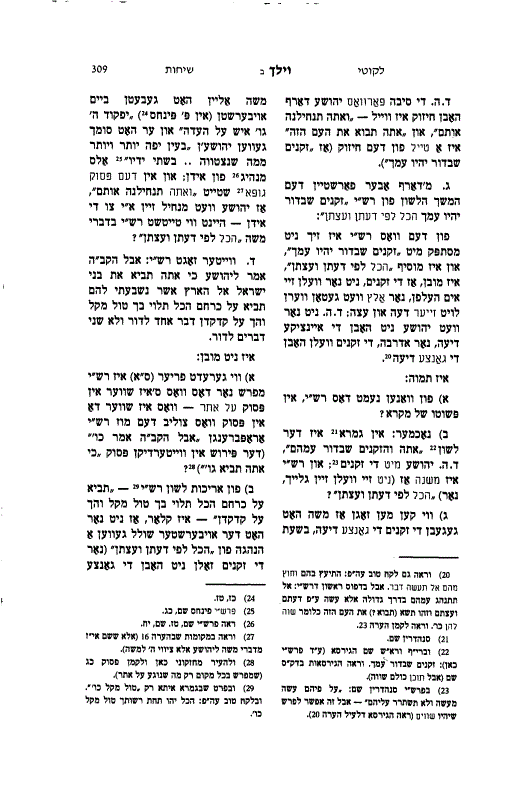
a) Why does Rashi elaborate and explain, "Thus I said to them that you will be witnesses" — what is the relevance of informing the heavens and the earth that he has warned the Jews that they will be witnesses?
And we cannot say that this ensures the possibility that the Jews might not want the heavens and the earth to be witnesses, because seemingly it makes no difference for the testimony whether the warned party agrees to their testimony or not — they become witnesses in any case.
3. We will understand this by first addressing another question regarding the overall matter:
As implied by Rashi, when Moses said to the Jews, "I call heaven and earth to witness against you this day" at the end of Parshas Nitzavim, and the testimony in our parsha — "Give ear, O heavens" — are the same thing. The difference is only, as Rashi states, "There (in Parshas Nitzavim) he spoke to the Jews, but not to the heavens and the earth, and now he comes to say, 'Give ear, O heavens,'" and as Rashi also says in this verse, "Thus I said to them that you will be witnesses." However, seemingly this is not the case, because the words in Parshas Nitzavim, where Moses said to the Jews, "I call heaven and earth to witness against you this day," are not what the heavens and the earth heard (the Song of Ha'azinu) and became witnesses to.
Today, Rashi says that it is the same thing, "Thus I said to them that you will be witnesses," and the difference is only that in Ha'azinu he also informed the heavens and the earth.
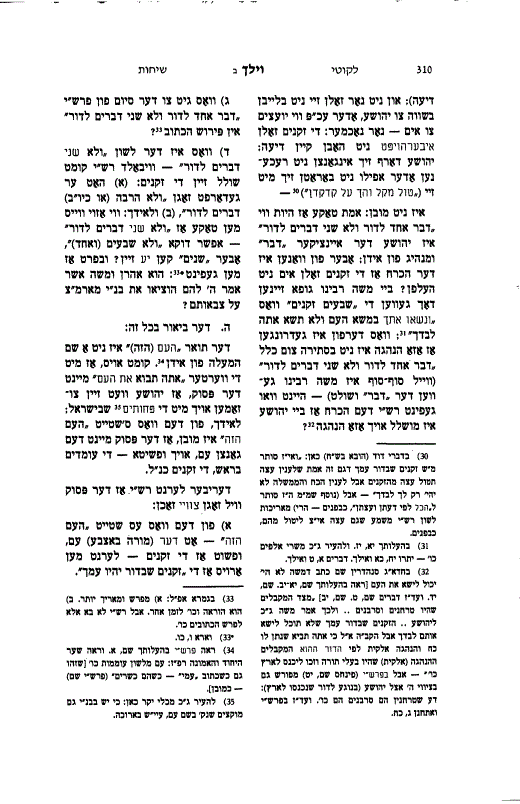
4. The explanation of all this: The simple meaning of the word "testimony" in several verses is — a sign, a symbol for remembrance of a certain matter — and this can occur in several ways:
a) One establishes a testimony, a sign for a certain matter, but the object made as a sign has no connection to the content and matter of what is being signified. As we have learned earlier with Abraham and Abimelech: In response to Abimelech's question, "What are these seven ewe lambs?" Abraham said to him, "For these seven ewe lambs you shall take from my hand, that they may be a witness for me, that I have dug this well."
The seven ewe lambs themselves had no connection and were not proof that Abraham had dug the well, but he and Abimelech both agreed that the seven ewe lambs would be a testimony, a sign and symbol to remember that "I have dug this well."
5. This type of testimony and sign does not need to remain "existent" later on; rather, the purpose of the testimony and sign remains even after the sign itself is nullified. As is understood simply, the seven ewe lambs did not live for the entire duration that a "witness" was needed, not even for the entire lifetime of Abraham and Abimelech, although their testimony and sign were useful for a long time afterward.
b) When the testimony and sign for a matter have a connection to the content of the matter itself; for example, the pile of stones that Jacob our forefather made as a "witness" between himself and Laban — "This pile is a witness, and this monument is a witness, that I will not pass beyond this pile to you, and you will not pass beyond this pile and this monument to me for harm."
That is, this type of testimony is also merely a sign and reminder of the matter they agreed upon, but the testimony and sign also have a connection to the content of the matter. A "pile" of stones indicates a barrier and separation between the two sides.
From this, it is understood in our context: When one learns the verse "I call heaven and earth to witness against you this day" — regarding testimony that is not of flesh and blood, there is no question about the content of the testimony or why specifically this testimony is taken. This is because it was agreed upon and established as a "testimony" and sign for a certain matter, even if it has no connection to the content of the matter.
Rashi explains the purpose of the testimony and sign of the heavens and the earth — "When misfortune befalls you, they will be witnesses that I warned you."
And the reason why such testimony is required to be "eternal," unlike the testimony and sign (and the like) of the seven ewe lambs, is because with the seven ewe lambs, since it was only concerning a specific place and only between Abraham and Abimelech and their descendants,
We know and remember the sign even after this. However, in our case, the sign and testimony are relevant to all Jews at all times and in all places. Therefore, it is not sufficient for the testimony to exist only at the time of the making of the sign.
However, this explanation is not entirely smooth: When is it appropriate to say that a certain thing is a testimony, a sign, and a reminder for another matter (which has no connection to it)? This is when it is set up (by a person) for this purpose, to be a sign. Then it serves as a reminder. But regarding the heavens and the earth, which have been in the same state since the six days of creation, "existing forever," this does not seem applicable, since they are not designated for this purpose, and in general, there has been no change in them.
Therefore, Rashi offers another explanation: "Another explanation: The Holy One, blessed be He, said to Israel, 'Look at the heavens that I created to serve you; have they changed their nature?'" Thus, the testimony of the heavens and the earth is in such a manner that by their very nature, they are a sign and reminder that evokes the observance of the Torah and mitzvos.
[And regarding the testimony "Look at the heavens, etc.," there is no contradiction to the fact that they have been here forever, since (through looking, their content is) "they have not changed their nature, etc." — a testimony and reminder.]
On the other hand, according to the second explanation, the word "today" is not smooth, because since they themselves are a testimony and reminder for the observance of the Torah and mitzvos through "Look at the heavens, etc.," their testimony is always the same and not specifically "today."
However, according to the first explanation, although the sign is relevant for later, the establishment of the testimony, the designation of them as a sign, is accomplished "today," when Moshe Rabbeinu warns the Jews and makes them witnesses.
5. The commonality in the two aforementioned types of testimony is that one does not necessarily need a person, a speaker, and it is not relevant that the testimonies should be aware of the sign.
6. The distinction between the two types of testimony is that in the first type, the testimony is inherent in the heavens and the earth themselves, as they serve as a constant reminder for the observance of the Torah and mitzvos. This is because they have not changed their nature and thus continuously testify to the Creator. In contrast, the second type of testimony requires an active role from Moshe Rabbeinu, who designates the heavens and the earth as witnesses "today," at the moment he warns the Jewish people. This act of designation is what establishes their role as witnesses.
In the first type, the testimony is ongoing and does not depend on a specific time or event. The heavens and the earth, by their very existence and constancy, remind us of the Creator and the need to observe His commandments. In the second type, however, the testimony is linked to a specific event — the warning given by Moshe Rabbeinu. It is this event that transforms the heavens and the earth into witnesses, making their testimony relevant from that point onward.