Likkutei Sichos Vol. 19 – Ki Savo / Chai Elul
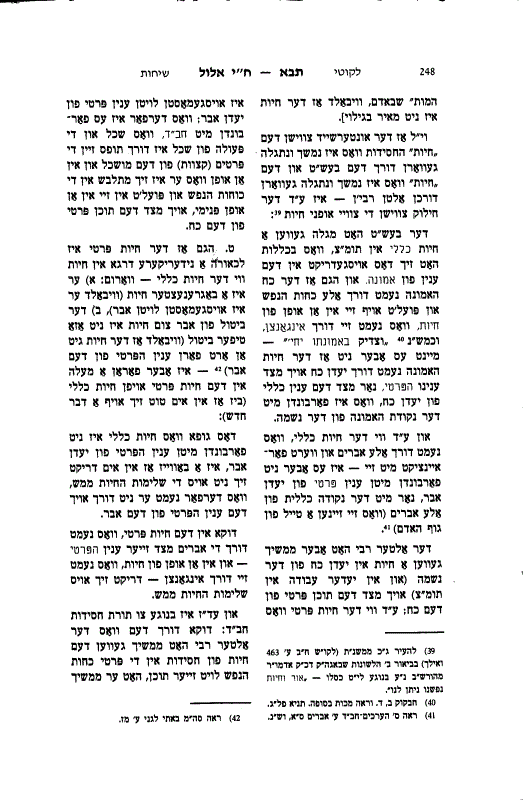
1. The 18th of Elul, the birthday of the "two great luminaries" — the Baal Shem Tov (founder of general Chassidic teachings) and the Alter Rebbe (founder of Chabad Chassidic teachings) — always occurs in proximity to the Torah portion of Ki Tavo (or on the Shabbat of Ki Tavo itself).
Since all the festivals (from the term "moed" — a time with a special content) of the year are alluded to in the Torah portions read during the times they occur, it follows that the content of the 18th of Elul is also alluded to in the portion of Ki Tavo (especially since it is referred to as a "Yom Tov" and "Moed" as is known).
2. The name of our portion [in which, as is known, the content of the entire portion is indicated] is — (Ki) Tavo. The meaning of "Tavo el ha'aretz" is "after inheritance and settlement";
The portion not only specifies "and you shall inherit it and dwell in it," but as our Sages say, wherever it states "Ki Tavo" (and similar expressions), it means "after inheritance and settlement."
Since this is the meaning of "Ki Tavo" everywhere, it is understood that although we learn it from the fact that "the verse specifies in one of them after inheritance and settlement," this is inherent in the meaning of the word "Tavo" itself.
Moreover, "inheritance and settlement" does not refer to the "inheritance and settlement" of the individual (that after he receives his portion in the Land of Israel, he must bring the first fruits), but rather — after the fourteen years of conquest and division of the entire Land of Israel [as has been explained previously] the precise language of Rashi at the beginning of our portion — "it teaches that they were not obligated in the first fruits until they conquered the land and divided it" (and he does not say — as the language of the verse — "after inheritance and settlement") — with this, Rashi emphasizes that "and you shall inherit it and dwell in it" here means the conquest and division of the entire land (which took fourteen years);
Therefore, the matter in "and you shall inherit it and dwell in it" is also inherent in the meaning of the word "Tavo."
3. The explanation of this is as follows: The true meaning of "entry" is to enter completely, as the sages say, "Partial entry is not considered entry." If even a small part is missing from the entry, it is not the true completeness of "entry." For example, in immersion in water "and he shall be purified" — immersion requires that even a single hair must be submerged in the water.
Therefore, "Tavo" specifically means "after inheritance and settlement," because only then have they fully entered the Land of Israel in a manner of settlement. Furthermore, due to the unity of the Jewish people, as long as the settlement of all Jews (who are supposed to be there) in the Land of Israel has not occurred, the "Tavo" of each individual is also lacking, even if for him personally it is already "after inheritance and settlement" of his portion. Therefore, the true "entry" into the Land of Israel is only after the conquest and division of the entire land.
This also connects the portion of Tavo with the 18th of Elul: The purpose of the teachings of Chassidus [which were revealed by the Baal Shem Tov and the Alter Rebbe] is that the observance of Torah and mitzvos should be done in a manner of "Tavo" — entering completely into the service, until there is no part of a person that is not permeated with Torah and mitzvos, as will be explained.
Just as in the matter of "Tavo" there are two aspects: a) the general concept of "Tavo," b) the details and manner of the "Tavo" — "and you shall inherit it and dwell in it,"
so too, in the 18th of Elul, there are similar two aspects: a) the birthday of the Baal Shem Tov, the founder of the general teachings of Chassidus, b) the birthday of the Alter Rebbe, the founder of the teachings of Chabad Chassidus;
3. The difference between them is, as expressed by the Previous Rebbe, that the Baal Shem Tov showed how one should serve the Almighty, which corresponds to the general concept of "Tavo" — entering completely into the service. The Alter Rebbe, on the other hand, demonstrated how one can be a servant of G‑d, meaning how to bring this into practical action — including (and primarily) in detail, similar to "and you shall inherit it and dwell in it," as will be explained in section 10.
4. This can be understood by first considering the well-known idea that the revelation of the teachings of Chassidus is a preparation for the coming of Moshiach. It is known from the response of Moshiach to the Baal Shem Tov that "when your wellsprings will spread outward," then "your master will come." It is stated in the Kabbalistic texts that until the coming of Moshiach, all "revelations" in the world are only from the "external aspect of Atik," and Moshiach will bring about the revelation of the "inner aspect of Atik."
Since a preparation contains within it a "taste" of the matter for which it is a preparation, it must be said that the effect of Chassidus is the aspect of "innerness" in the service of man in Torah and mitzvos. Therefore, Chassidus draws down the "innerness" of G‑dliness, the "inner aspect of Atik."
5. The difference between "innerness" and "externality" in simple terms (regarding a person): "Innerness" refers to how a person is to himself, while "externality" refers to how he stands in relation to the outside, to an "other" that is outside of him.
The practical difference between them in a person's service:
When a person does something only with his externality, he is not fully invested in it with his entire "essence" and "innerness," but only with his externality (and even within that, only the "level" in him that relates to the matter that is "outside" of him). Therefore, "he" and the thing he is doing remain two separate entities.
However, when a person acts with his innerness, he is fully invested in it. Since, from the perspective of his innerness, there is no place for anything that is "outside" of him, it follows that when he does something (even a specific detail) with his "innerness" and "essence," the thing becomes united with him as one entity.
6. This is also the effect of the revelation of Chassidus:
Chassidus (and generally the inner dimension of the Torah, which is called "the soul of the Torah") reveals the point of vitality...
7. This also explains (as a possible approach) why Chassidus serves as the preparation for the coming of Moshiach, when the "inner aspect of Atik" will be revealed:
All levels of the chain of creation, up to the "external aspect of Atik," allow for the existence of something that is "outside" of G‑d's essence. Therefore, even when they are revealed in the world, it is still in a manner that does not completely negate the existence of the world.
The "inner aspect of Atik" refers to the essence of G‑dliness, from whose perspective there is no place for anything that is "outside" of Him. Therefore, when the inner aspect of Atik is revealed in the worlds, it is in such a way that the world (in its existence) and G‑dliness become, so to speak, one entity — "there is nothing else besides Him."
8. In the vitality of a person, which spreads throughout the body, there are two levels:
a) The general vitality that enlivens the entire body, with all its limbs, equally; in this vitality, there are no distinctions between one limb and another.
b) The specific vitality, which is measured in each limb according to its characteristics [due to this vitality, the heel of the foot is referred to as the "angel"].
9. The distinction between the "vitality" of Chassidus that was drawn down and revealed by the Baal Shem Tov and the "vitality" that was drawn down and revealed by the Alter Rebbe is similar to the difference between the two types of vitality:
The Baal Shem Tov revealed a general vitality in Torah and mitzvos, which was primarily expressed in the concept of faith. Although the power of faith permeates all the faculties of the soul and affects them in a manner of vitality that completely encompasses them, as it is written, "And the righteous shall live by his faith," this does not mean that the vitality of faith permeates each faculty also in its specific aspect. Rather, it is connected to the general aspect of each faculty, which is linked to the point of faith of the soul.
This is similar to the general vitality that permeates all the limbs and unites with them, but it is not connected to the specific aspect of each limb, only to the general point of all the limbs (as they are part of the human body).
The Alter Rebbe, however, drew down a vitality into each faculty of the soul (and into each service in Torah and mitzvos) also from the specific content of the faculty; similar to the specific vitality that is measured according to the specific aspect of each limb. Therefore, it is connected with Chabad, as intellect and the function of intellect is to grasp the details (extremities) of the concept and in a manner that it enclothes itself in the faculties of the soul and affects them in an internal way, also from the specific content of the faculty.
10. Although the specific vitality is seemingly a lower level of vitality than the general vitality — because: a) it is a limited vitality (since it is measured according to the limb), b) the nullification of the limb to the vitality is not as deep (since the vitality gives room for the specific aspect of the limb) — there is, however, an advantage in the specific vitality over the general vitality (to the extent that in it, a new thing is revealed):
The very fact that the general vitality is not connected to the specific aspect of each limb is proof that it does not express the complete vitality itself, and therefore it does not permeate also the specific aspect of the limb.
Specifically in the specific vitality, which permeates the limbs from their specific aspect — and in a manner of vitality that completely encompasses them — is where the complete vitality itself is expressed.
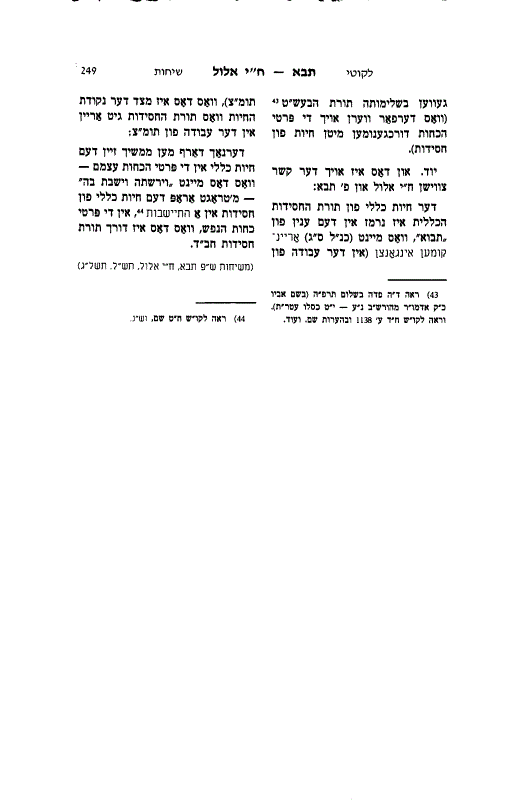
And similarly, regarding the teachings of Chassidus Chabad: specifically through the fact that the Alter Rebbe drew down the vitality of Chassidus into the specific faculties of the soul according to their content, he continued...
11. This is the complete Torah of the Baal Shem Tov, which is why the specific faculties are also imbued with the vitality of Chassidus.
12. This also explains the connection between the 18th of Elul and the portion of Ki Tavo: The general vitality of the general teachings of Chassidus is alluded to in the concept of "Tavo," which means (as mentioned above in section 3) to enter completely (into the service of Torah and mitzvos). This is due to the point of vitality that the teachings of Chassidus instill into the service of Torah and mitzvos.
Afterward, one must draw down this general vitality into the specific faculties themselves — which is the meaning of "and you shall inherit it and dwell in it" — bringing down the general vitality of Chassidus into a settled state within the specific faculties of the soul. This is achieved through the teachings of Chassidus Chabad.
(From the talks of the portion of Ki Tavo, 18th of Elul, 5730 and 5733)