Likkutei Sichos Vol. 19 – Ki Savo 2
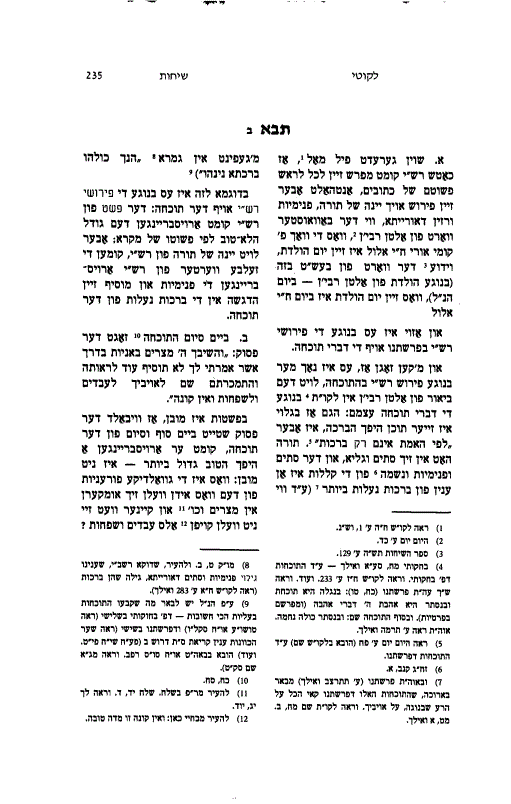
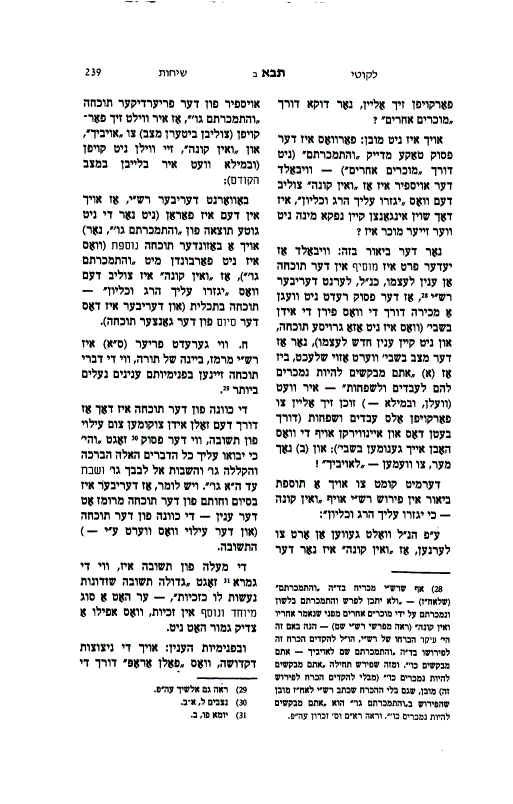
1. It has been discussed many times that although Rashi's primary intent is to explain the simple meaning of the verses, his commentary also contains the "wine of Torah," the inner dimensions and secrets of the Torah. This is similar to the well-known saying of the Alter Rebbe, whose birthday is on the 18th of Elul, which falls during the week of Parshas Ki Savo. It is also known from the Baal Shem Tov regarding this (concerning the birth of the Alter Rebbe on this day), that his birthday is on the 18th of Elul.
This concept applies to Rashi's commentaries on the words of rebuke in our parsha as well. One could say that this is even more applicable to Rashi's commentary on the rebuke, according to the explanation of the Alter Rebbe in Likutei Torah regarding the words of rebuke themselves: although outwardly their content appears to be the opposite of a blessing, "in truth, they are only blessings." The Torah contains both the revealed and the hidden, and the hidden, inner, and soul aspect of the curses is actually a matter of the highest blessings.
We find in the Gemara that "all of these are blessings." Similarly, Rashi's commentaries on the rebuke serve to highlight the great negativity according to the simple meaning of the text; however, according to the "wine of Torah" in Rashi's commentary, the same words of Rashi bring out the inner dimensions and add emphasis to the elevated blessings within the rebuke.
2. At the conclusion of the rebuke, the verse states: "And the L‑rd will bring you back to Egypt in ships, by the way of which I said to you, 'You shall never see it again,' and there you shall offer yourselves for sale to your enemies as male and female slaves, but there will be no buyer."
On the surface, it is understood that since this verse appears at the end and conclusion of the rebuke, it is meant to convey a great opposite of good. However, it is not clear: what is the tremendous calamity in the fact that the Jews will return to Egypt, etc., and no one will want to buy them as male and female slaves?
Rashi explains: "In ships" means "in boats as captives" — that is, they will come to Egypt as captives; and regarding "but there will be no buyer," Rashi says, "for they will decree upon you death and destruction."
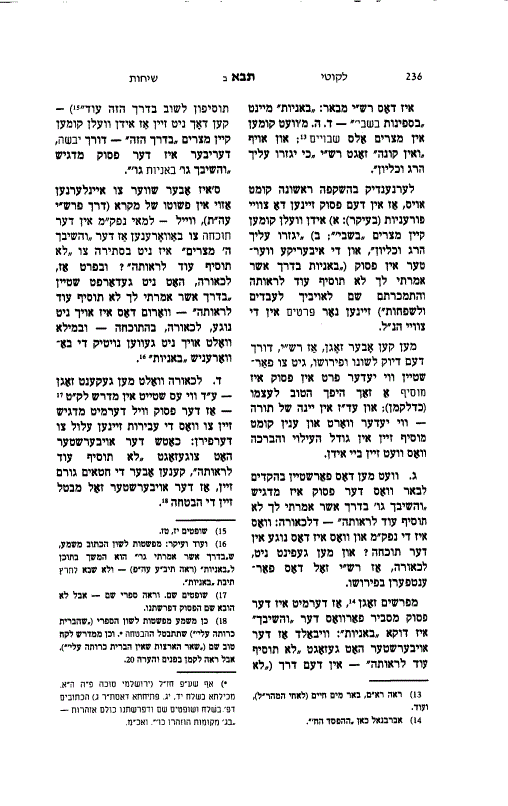
3. At first glance, it seems that in this verse there are two main calamities: a) the Jews will come to Egypt "as captives"; b) "they will decree upon you death and destruction." The remaining words in the verse are merely details of these two calamities.
However, one can say that Rashi, through his precise language and explanation, helps us understand how each detail in the verse adds something negative in its own right (as will be explained); and similarly, in the "wine of Torah," each word and matter comes to add to the greatness of the elevation and blessing that will be for the Jews.
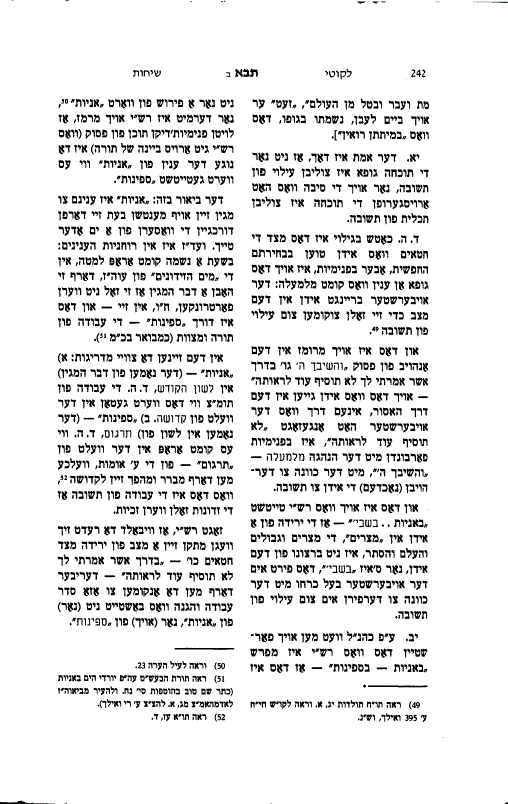
4. We will understand this by first explaining why the verse emphasizes "And the L‑rd will bring you back... by the way of which I said to you, 'You shall never see it again.'" At first glance, what is the significance and relevance of this in the rebuke? And it seems that Rashi does not explicitly address this in his commentary.
Commentators say that this verse explains why the "And the L‑rd will bring you back" is specifically "in ships": since the L‑rd said, "You shall never see it again" — in this way — it cannot be that the Jews will come to Egypt "by this way" — by land. Therefore, the verse emphasizes "And the L‑rd will bring you back in ships."
However, it is difficult to interpret this in the simple meaning of the text, because — what is the significance in the rebuke of warning that the "And the L‑rd will bring you back to Egypt" is not in contradiction to "You shall never see it again"? Especially since, seemingly, it did not need to state "by the way of which I said to you, 'You shall never see it again'" — because this also seems irrelevant in the rebuke — and consequently, the warning "in ships" would not have been necessary either.
5. At first glance, one might say — similar to what is stated in the Midrash Lekach Tov — that the verse intends to emphasize what the transgressions can lead to: although the L‑rd promised "You shall never see it again," the sins can cause the L‑rd to annul the promise.
5. However, this explanation is also not straightforward according to the simple meaning of the text. To understand the concept that a sin (especially significant sins) can cause the annulment of the promise from the Almighty, one does not need to resort to the most severe curses (especially at the conclusion) of the rebuke, because we have already learned this earlier with Jacob. Furthermore, why is this specifically relevant (and therefore it is specifically mentioned) in the context of returning to Egypt?
It is clear that it does not make sense — according to the simple meaning of the text — to interpret that although there was a command from G‑d not to return "by this way" to Egypt, the sin causes the Almighty to disregard this and bring them to transgress the command as well. What relevance does this have to the rebuke, that sins lead to transgressing another command against their will?
6. This will be understood by first adding an explanation in Rashi's commentary on "in ships" — "in captivity." At first glance, the interpretation that the Jews will go to Egypt "in captivity" seems to relate (not to the word "in ships," but) to the word "and the L‑rd will bring you back" — so Rashi should have explained it by "and the L‑rd will bring you back" and not in the phrase where he interprets the word "in ships."
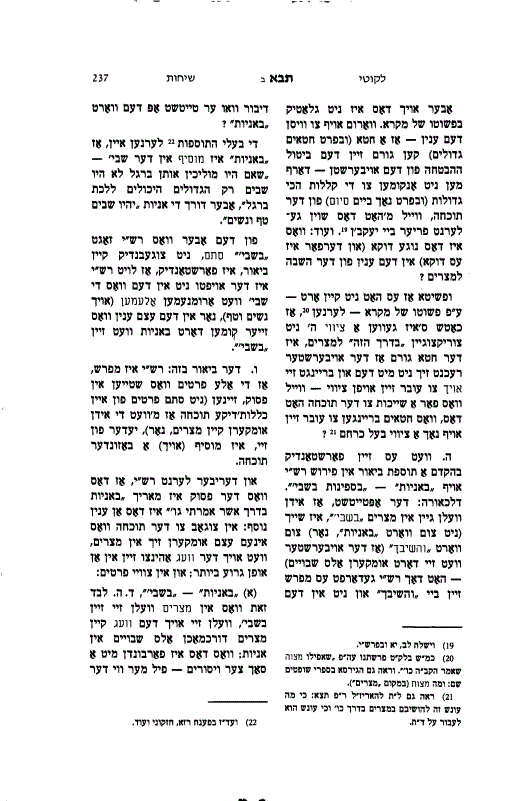
The Ba'alei HaTosafos explain that "in ships" adds to the captivity — "if they were taken on foot, only the adults capable of walking would return," but through the ships, "even the children and women will return."
However, from the fact that Rashi simply states "in captivity" without adding an explanation, it is understood that according to Rashi, the emphasis is not on the fact that the captivity will include everyone (also women and children), but on the very fact that their coming there in ships will be "in captivity."
7. The explanation is as follows: Rashi interprets that all the details mentioned in the verse are not merely details of a general rebuke that the Jews will be returned to Egypt, but each of them adds an additional rebuke.
Therefore, Rashi learns that the verse's elaboration "in ships by the way of which I said to you, etc." is an additional matter: in addition to the rebuke of the very return to Egypt, the way there will also be in the most degrading manner; and in two aspects:
(a) "In ships" — "in captivity," meaning besides the fact that in Egypt they will be "in captivity," they will also endure the journey to Egypt as captives in ships; which is associated with much pain and suffering — far more than the pain of going into captivity by land, because "in ships" they are more and strongly under the control of those who captured them, as is evident in simple terms.
8. This also explains why Rashi does not interpret like the Baalei Tosafos. In addition to the fact that, in simple terms, even women and children can walk on foot (at least at a slow pace), as was the case during the Exodus from Egypt, according to their interpretation, it turns out that the very act of returning "in ships" is not a rebuke in itself. Rather, it merely adds to the general rebuke of "and the L‑rd shall bring you back to Egypt," indicating that this includes everyone. According to this, it should have initially stated "and the L‑rd shall bring you all back, etc." or something similar, but not add it as a new matter.
"By the way of which I said to you, you shall see it no more again" — they will return to Egypt through the way they had previously traveled — through the great and terrible wilderness, with serpents, fiery serpents, and scorpions, and thirst where there was no water (and obviously, without the miracles and kindnesses of the first journey in the wilderness). Therefore, G‑d had promised that in this "way" — "you shall see it no more again"; thus, the magnitude of the rebuke in traveling through this "way" is understood.
Rashi does not need to explain this explicitly — just as he does not need to explain the magnitude of the calamity of "and the L‑rd shall bring you back to Egypt" — because Rashi has already explained that "a person is shown only what he fears," and just as the very return to Egypt is something a Jew fears, so too is the "way" to Egypt a "thing he fears."
9. Based on this, we can also understand the continuation in Rashi's commentary on the subsequent words in the same verse, "and you shall sell yourselves there to your enemies" — "you will seek to be sold to them as slaves and maidservants," meaning (not "through other sellers," but) that you want to sell yourselves, as Rashi explains in the following commentary.
At first glance, this seems puzzling: this appears to contradict what he previously explained that they are being brought to Egypt "in captivity," and therefore not in a position to sell themselves, but rather only through "other sellers"?
10. It is also not understood: Why does the verse specifically emphasize "and you shall sell yourselves" (not through "other sellers")? Since the outcome is that "and no one will buy" because "they will decree upon you death and destruction," it seems irrelevant who the seller is.
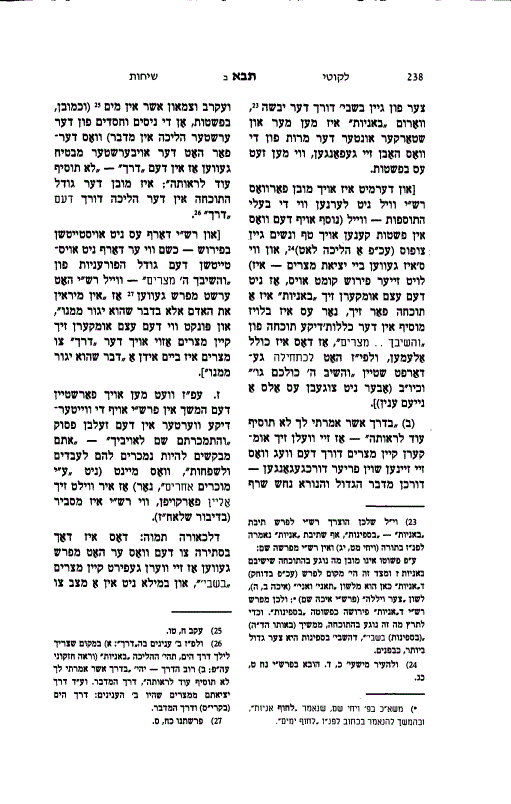
However, the explanation is as follows: Since every detail adds to the rebuke or is an independent matter, as mentioned earlier, Rashi therefore explains that the verse is not speaking about a sale through those who lead the Jews into captivity (which would not be such a great rebuke and not an independent matter). Rather, the situation in captivity becomes so dire that (a) "you will seek to be sold to them as slaves and maidservants" — you will want, and therefore seek, to sell yourselves as slaves and maidservants (by requesting and influencing those who have taken you captive); and (b) even more so, to whom — "to your enemies"!
This also adds an explanation to Rashi's commentary on "and no one will buy — because they will decree upon you death and destruction":
Based on the above, one might think that "and no one will buy" is merely the conclusion of the previous rebuke "and you shall sell yourselves," that you want to sell yourselves (due to the bitter situation) to "your enemies," and "and no one will buy," they do not want to buy (and therefore you will remain in the previous state):
Rashi therefore warns that even in this there is (not only the negative outcome of "and you shall sell yourselves," but) also an additional independent rebuke (which is not connected with "and you shall sell yourselves"), that "and no one will buy" is because "they will decree upon you death and destruction" — a complete rebuke (and therefore this is the conclusion of the entire rebuke).
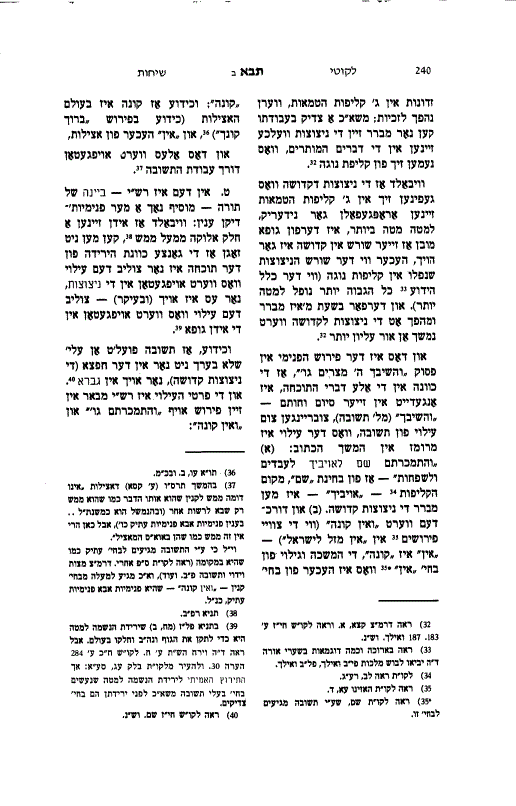
8. As mentioned earlier (section 1), Rashi hints, in the inner dimension of the Torah, how the words of rebuke are, in their essence, very lofty matters.
The purpose of the rebuke is that through it, the Jews should reach the elevation of repentance, as the verse states, "And it shall be when all these things come upon you, the blessing and the curse... and you will take it to heart... and you will return to the L‑rd your G‑d." It can be said that therefore, at the conclusion and seal of the rebuke, this matter is hinted at — the purpose of the rebuke (and the elevation that comes through it —) repentance.
The greatness of repentance is, as the Gemara states, "Great is repentance, for it transforms deliberate sins into merits," — it has a unique and additional type of merit, which even a completely righteous person does not have.
In the inner dimension: even the sparks of holiness that "fall down" through the...
9. The deliberate sins, which are in the three impure klipos, are transformed into merits. This is unlike a tzadik, who through his service can only refine the sparks that are in permissible matters, which derive from the klipas nogah.
Since the sparks of holiness that are found in the three impure klipos have fallen very low, to the lowest depths, it is understood from this itself that their root in holiness is very high, higher than the root of the sparks that fell into klipas nogah (as is known from the principle that "the higher something is, the lower it falls"). Therefore, when one refines and transforms these sparks to holiness, a higher light is drawn down.
This is the inner explanation of the verse "And the L‑rd will bring you back to Egypt," that the intention in all these words of rebuke is hinted at in their conclusion and seal — "and He will bring you back" (from the word 'teshuvah'), to bring about the elevation of repentance, which is hinted at in the continuation of the verse: (a) "And you will sell yourselves there to your enemies as slaves and maidservants" — that from the aspect of "there," the place of the klipos — "your enemies" — one refines the sparks of holiness. (b) And through this, "and no one will buy" (as the two interpretations of "there is no mazal for Israel") — "no one" is "will buy," the drawing down and revelation of the aspect of "no one," which is higher than the aspect of "will buy"; as is known, "will buy" is in the world of Atzilus (as is known from the explanation of "Blessed is your Maker"), and "no one" is higher than Atzilus, and all this is accomplished through the service of repentance.
10. In this, Rashi — the wine of the Torah — adds an even deeper matter: Since Jews are a part of G‑d above, literally, one cannot say that the entire purpose of the descent of the rebuke is only for the elevation that is accomplished in the sparks, but it is also (and primarily) for the elevation that is accomplished in the Jews themselves.
As is known, repentance effects an incomparable elevation not only in the object (the sparks of holiness) but also in the person. The specific elevations Rashi explains in his commentary on "And you will sell yourselves" and "and no one will buy":
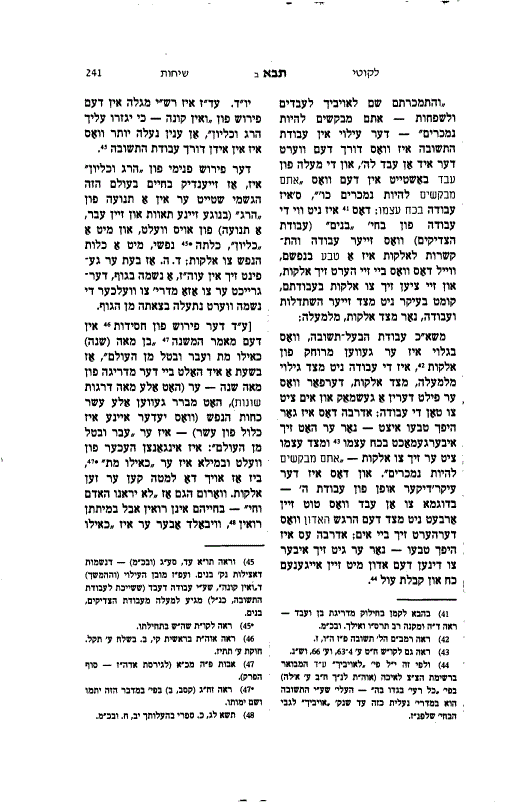
11. "And you will sell yourselves there to your enemies as slaves and maidservants" — you seek to be sold. The elevation in the service of repentance is that through this, the Jew becomes a servant to G‑d. The advantage of a servant is that you seek to be sold, which is a service with one's own strength. This is not like the service of the level of children (the service of the righteous), whose service and connection to G‑dliness is a natural part of their soul. For them, the perception of G‑dliness and their attraction to it in their service does not primarily come from their own effort and work, but from G‑dliness, from above.
In contrast, the service of the baal teshuva, who outwardly was distant from G‑dliness, is not due to a revelation from above, from G‑dliness, because he feels a taste in it and is drawn to perform the service. On the contrary, it is actually against his nature now — rather, he has transformed himself with his own strength, and from his own self, he is drawn to G‑dliness — you seek to be sold. And this is the primary manner of serving G‑d — similar to a servant who performs his work not because of the feeling of the master that is perceived by him; on the contrary, it is against his nature — rather, he dedicates himself to serve the master with his own strength and acceptance of the yoke.
14. Similarly, Rashi reveals in the explanation of "and no one will buy — for they will decree upon you death and destruction," that there is a higher matter within Jews through the service of repentance.
The inner meaning of "death and destruction" is that while being alive in this physical world, he stands in a state of "death" (concerning his desires and his past, a state) of being beyond the world, and with a "destruction," my soul longs, with a longing of the soul for G‑dliness. That is, while he is in this world, a soul in a body, he reaches such a level to which the soul is elevated when it departs from the body.
[Similar to the explanation in Chassidus on the saying of the Mishnah "at one hundred years old, it is as if he is dead, passed, and nullified from the world," that when a Jew reaches the level of one hundred years — he has clarified all ten soul powers (each one included of ten) — he is "passed and nullified from the world": he is entirely above the world, and consequently, he is "as if dead," to the extent that even here below he can see G‑dliness. For although "no man shall see Me and live" — in their lifetime they do not see, but in their death they see, since he is "as if dead."]
11. The truth is that not only is the rebuke itself for the sake of the elevation through repentance, but also the cause that brought about the rebuke is for the purpose of repentance.
Although outwardly it appears to be due to the sins that Jews commit by their free choice, internally, this too is an aspect that comes from Above: G‑d brings Jews into this situation so that they may reach the elevation of repentance.
This is also hinted at in the beginning of the verse, "And the L‑rd will bring you back... on the path of which I said to you, you shall not see it again." Even the fact that Jews go on this forbidden path, the path that G‑d commanded "you shall not see it again," is internally connected with the conduct from Above — "And the L‑rd will bring you back," with the intention to elevate (afterwards) the Jews to repentance.
This is also what Rashi explains, "in ships... in captivity" — that the descent of a Jew into "Egypt," the constraints and limitations and concealment, is not by the Jew's will, but it is "in captivity," G‑d leads him against his will with the intention to bring him to the elevation of repentance.
12. Based on the above, we can also understand why Rashi interprets "in ships — in vessels" — that this is not merely an explanation of the word "ships," but with this, Rashi also hints that according to the inner content of the verse, the matter of "ships" as it is interpreted as "vessels" is relevant.
The explanation is: "Ships" serve to protect people when they need to cross the waters of a sea or river. Accordingly, in spiritual matters: when a soul descends below, into the "proud waters" of this world, it needs something to protect it so that it does not become drowned, G‑d forbid, in them — and this is through "vessels" — the service of Torah and mitzvos.
There are two levels in this: A) "Ships" — the name of the protective thing in the Holy Tongue, meaning the service of Torah and mitzvos as it is done in the world of holiness. B) "Vessels" — the name in the language of the Targum, meaning as it comes down into the world of "Targum" — from the seventy nations, which need to be refined and transformed into holiness, which is the service of repentance so that the intentional sins become merits.
Rashi says that since here it speaks of rectifying a state of descent due to sins, etc. — "on the path of which I said to you, you shall not see it again" — therefore, one must resort to such a manner of service and protection that consists not only of "ships," but also of "vessels."
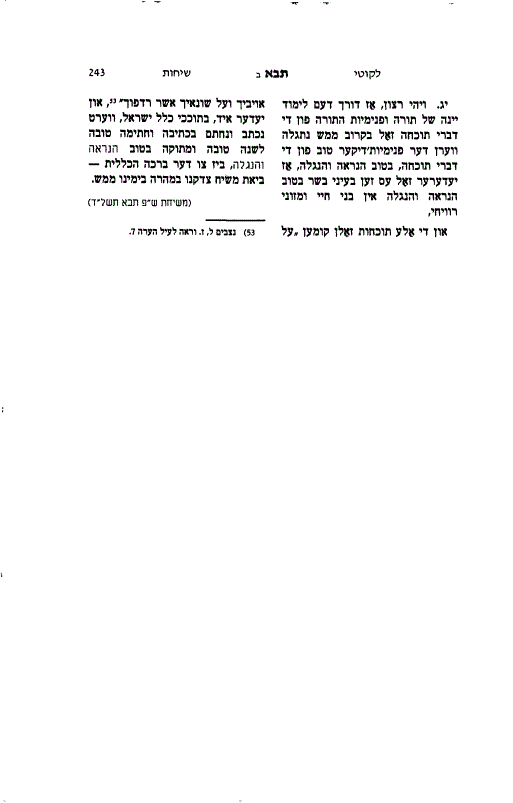
13. May it be G‑d's will that through the study of the "wine" of Torah and the inner dimension of Torah, the inner goodness of the words of rebuke will soon be revealed, in a way that is visibly and manifestly good, so that everyone may see it with their physical eyes in a manner of visible and manifest good, in children, life, and abundant sustenance.
And may all these rebukes befall "your enemies and those who hate you, who pursued you," and may every Jew, within the entirety of the Jewish people, be inscribed and sealed for a good and sweet year, in a manner of visible and manifest good, until the ultimate blessing — the coming of our righteous Moshiach, speedily in our days, amen.
(From the talk of Shabbat Parshat Ki Tavo, 5734)