



Parshas Vayikra
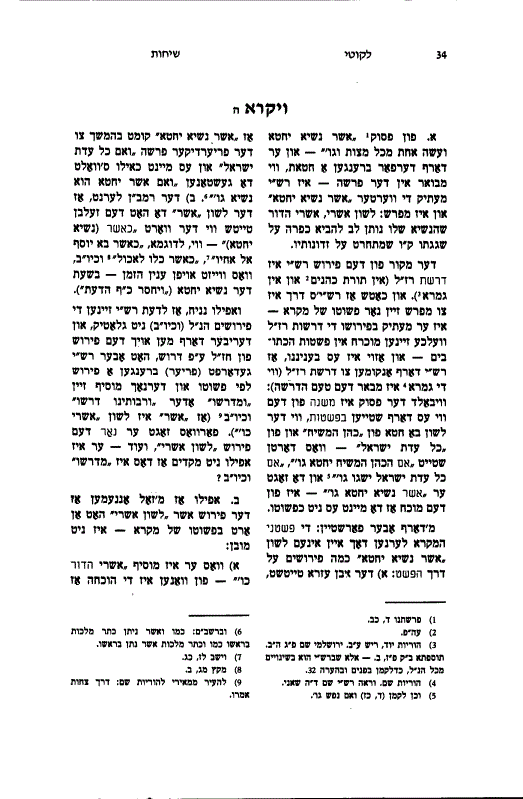
1. On the verse "אשר נשיא יחטא ועשה אחת מכל מצות וגו׳" ("When a ruler sins, and does one of all the commandments etc.")1 — and he must therefore bring a sin-offering, as explained in the passage — Rashi quotes the words "אשר נשיא יחטא" ("When a ruler sins") and explains: "לשון אשרי, אשרי הדור שהנשיא שלו נותן לב להביא כפרה על שגגתו ק״ו שמתחרט על זדונותיו" ("An expression of 'fortunate': fortunate is the generation whose ruler sets his heart to bring atonement for his unintentional sin; all the more so will he regret his intentional sins").
The source of this interpretation of Rashi is an exposition of our Sages (in Toras Kohanim2 and in the Gemara3). And although Rashi's way is to explain only the plain meaning of Scripture, he does cite in his commentary those expositions of our Sages that are compelled by the plain meaning of the verses — and so it is in our case: Rashi must resort to the exposition of our Sages (as the Gemara4 explains the reason for the exposition), since the verse departs from the way it ought to read plainly, as in the wording regarding the sin of the "anointed Kohen" and of "the entire congregation of Israel." There it says "אם הכהן המשיח יחטא וגו׳" ("If the anointed Kohen sins etc."), and "אם כל עדת ישראל ישגו וגו׳" ("If the entire congregation of Israel errs etc.")5, whereas here it says "When a ruler sins etc." — this proves that here it is not meant in its literal sense.
We must, however, understand: the commentators on the plain meaning of Scripture offer several interpretations of the phrase "When a ruler sins" by way of plain meaning: a) The Ibn Ezra explains that "אשר נשיא יחטא" continues the preceding passage, "ואם כל עדת ישראל" ("And if the entire congregation of Israel"), and it means as if it had said "ואם אשר יחטא הוא נשיא וגו׳" ("And if the one who sins is a ruler etc.")6; b) The Ramban explains that the word "asher" here has the same meaning as the word "ka'asher" ("when" a ruler sins) — as, for example, "כאשר בא יוסף אל אחיו" ("When Yosef came to his brothers")7, "כאשר כלו לאכול" ("When they had finished eating")8, and the like — which indicates time: at the time the ruler sins ("and the letter kaf of 'ka'asher' is missing").
And even if we assume that, according to Rashi, the above interpretations (and similar ones) are not smooth, and therefore the interpretation of Chazal by way of drush is also needed, Rashi should nevertheless have (first) brought an interpretation according to the plain meaning, and afterwards added "ומדרשו" ("and its Midrashic interpretation") or "ורבותינו דרשו" ("and our Rabbis expounded") or the like (that "asher" is an expression of "fortunate etc."). Why does he give only the interpretation "an expression of 'fortunate'"9? Moreover — he does not even preface it by saying that this is "its Midrashic interpretation" or the like!
2. Even if we were to accept that the interpretation of "asher" as "an expression of 'fortunate'" has a place in the plain meaning of Scripture, it is not understood:
a) Why does he add "Fortunate is the generation etc."? From where is the proof that "fortunate" here refers (not to the ruler who is explicitly mentioned in the verse, but) to the generation10?
b) In what does the good fortune, the happiness, of the generation consist, when the ruler "sets his heart to bring atonement for his unintentional sin etc."?
c) What relevance does "Fortunate is the generation etc." have to the plain meaning and content of the passage of the ruler's sin-offering?
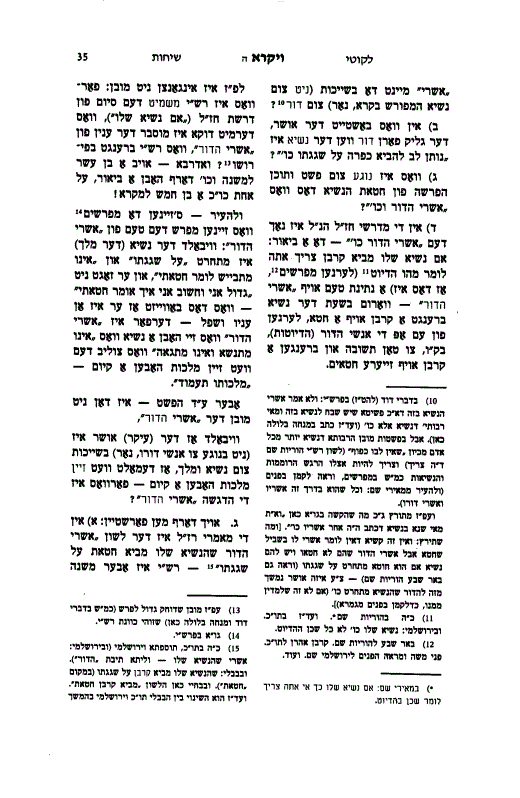
d) In the Midrashim of Chazal, after "Fortunate is the generation etc.", there is an explanation: "אם נשיא שלו מביא קרבן צריך אתה לומר מהו הדיוט" ("If its ruler brings an offering, need you ask what a commoner [will do]?")11 — which (the commentators12 explain) is a reason for "Fortunate is the generation": for when the ruler brings an offering for a sin, the people of the generation (the commoners) learn from him, all the more so, to repent and to bring an offering for their sins.
Accordingly, it is entirely not understood: why does Rashi omit the conclusion of Chazal's exposition ("If its ruler..."), through which specifically the matter of "Fortunate is the generation," which Rashi brings in his commentary, is explained? On the contrary — if a ten-year-old who studies Mishnah etc. needs an explanation, how much more so a five-year-old who studies Scripture!13
It should be noted that there are commentators14 who explain the reason for "Fortunate is the generation": since the ruler (the king) regrets "his unintentional sin" and "is not ashamed to say 'I have sinned,'" and does not say "I am great and I am important — how can I say 'I have sinned'?" — which shows that he is humble and lowly — therefore "fortunate is the generation" that has a ruler who "does not exalt himself and is not haughty," on account of which his kingdom will endure — "his kingdom will stand."
But according to the plain meaning, "Fortunate is the generation" is then not understood: since the (main) good fortune relates (not to the people of his generation, but) to the ruler and king — that his kingdom will then endure — why the emphasis "fortunate is the generation"?
3. We must also understand: a) In the sayings of our Sages the wording is "אשרי הדור שהנשיא שלו מביא חטאת על שגגתו" ("Fortunate is the generation whose ruler brings a sin-offering for his unintentional sin")15 — Rashi, however, changes and lengthens the wording: "sets his heart16 to bring atonement17 for his unintentional sin"?
b) Why does Rashi quote from the verse only "When a ruler sins"? The good fortune, after all, is because he brings "atonement for his unintentional sin"; Rashi should therefore have quoted the continuation from the second verse (where it speaks of the offering he must bring), or at least alluded to the continuation with an "etc."18
4. The explanation of this:
Regarding the interpretation "Fortunate is the generation whose ruler sets his heart etc.," Rashi need not preface it by saying that this is "its Midrashic interpretation" or the like, because he has already explained this earlier — in the same matter (the connection of the entire people with the one who sins). On the verse19 "אם הכהן המשיח יחטא לאשמת העם" ("If the anointed Kohen sins, to the guilt of the people"), Rashi explains: "ופשוטו לפי אגדה כשהכהן הגדול חוטא אשמת העם הוא זה שהן תלויין בו לכפר עליהם ולהתפלל בעדם ונעשה מקולקל" ("Its plain meaning according to the Aggadah: when the Kohen Gadol sins, it is the guilt of the people, for they depend on him to atone for them and to pray on their behalf, and he has become corrupted"). Consequently, Rashi need not repeat here as well that this is "its plain meaning according to the Aggadah."
Furthermore — from his (earlier) interpretation Rashi proves that the good fortune here ("Fortunate is the generation") does not mean as in the aforementioned (conclusion and) explanation (section 2) — that when the ruler brings an offering "for his unintentional sin," the people of the generation (the commoners) also learn from his conduct20. For according to that, the question arises: from the anointed Kohen too one ought to learn the conduct of bringing an offering for atonement; why then is "fortunate" stated specifically regarding the ruler, and not earlier regarding the anointed Kohen21? Moreover — regarding the anointed Kohen the very opposite is emphasized: "to the guilt of the people."
And although one could say that the conduct of a ruler is more apt to bring people to learn from him — for after all, a ruler, whose "heart is not humbled"22, stands, as his title implies, in a state of elevation, loftiness and exaltation (especially over the people of his generation), and nevertheless he repents and brings an offering for his unintentional sin22 — then how much more so must this be the conduct of the rest of the people, the commoners, who do not have this tendency of self-elevation*22;
yet on the other hand, there is an infinitely greater advantage in the case of an anointed Kohen, a Kohen Gadol: he is set apart from the people by the greatness of his holiness23, and also by his constant service in the Sanctuary; and what is more, he is the one who atones for each and every one and for the entire Jewish people — and nevertheless he brings an offering for his unintentional sin. This is especially so since he brings the offering in the manner the Torah states: "והוציא את כל הפר אל מחוץ למחנה" ("He shall take the entire bull outside the camp") — "outside the three camps"24 — so that all three camps see him bringing an offering for an unintentional sin25. How much more so should all Jews, who are far from his level, learn from him not to be ashamed to bring an offering for a sin!
From all this there is proof that the meaning of "Fortunate is the generation" regarding a ruler is not that the generation will learn from him (all the more so etc.)26, but rather a different matter (one that does not apply to the anointed Kohen) — which Rashi derives from the verse, as will be explained.
5. In the verse "When a ruler sins" two questions arise:
a) The word "asher" (in its simple sense: "which," etc.) indicates, in general, that one is in the middle of a subject — that the matter which follows continues what was stated before. It is not understood: what connection does the matter of "When a ruler sins" have to the preceding matter, "חטאת הקהל הוא" ("It is a sin-offering of the congregation")27?
b) Since we say that the Torah wishes thereby to emphasize the matter of "Fortunate is the generation" whose ruler brings an offering for his unintentional sin, the Torah should have alluded to this (not in the words "When a ruler sins," which speak of the ruler's sin, but) in the second verse, where it speaks of his atonement (repentance, etc.) — "הודע אליו חטאתו גו' והביא את קרבנו גו'" ("His sin is made known to him... he shall bring his offering..."). In connection with the sin itself, it seemingly does not fit to say "fortunate"!
Because of these two difficulties, Rashi understands that "fortunate" regarding a ruler indeed does not relate to his actual bringing of an offering for his unintentional sin, but to a matter that is bound up with the sin (and Rashi indicates this by departing from the wording of our Sages and saying "sets his heart to bring atonement for his unintentional sin"), as will be explained.
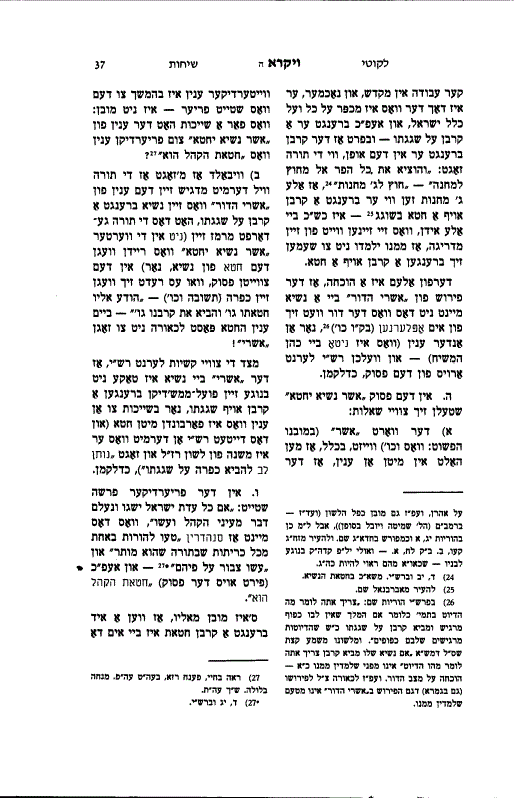
6. In the preceding passage it says: "אם כל עדת ישראל ישגו ונעלם דבר מעיני הקהל ועשו" ("If the entire congregation of Israel errs, and a matter is hidden from the eyes of the assembly, and they do..."), which means that the Sanhedrin "erred in ruling that one of all the prohibitions punishable by kares in the Torah is permitted," and "the community acted on their word"*27 — and nevertheless (the verse concludes) "it is a sin-offering of the congregation."
It is self-understood that when a Jew brings a sin-offering, he has (and must have28) the feeling of regret and repentance. So too in our case: since the verse emphasizes "it is a sin-offering of the congregation" — a sin-offering brought by the entire congregation — we must say that the feeling of regret and repentance is present in the entire congregation. Seemingly, though: how can it be that the entire congregation should feel regret and repent for a "sin" of which they are not guilty at all, not even unintentionally? They did what was demanded of them according to Torah — to obey the Sanhedrin!
Rashi therefore explains that this is why the verse says "When a ruler sins": Rashi need not explain what is self-understood, that it means "if29 a ruler sins"30; rather he writes his novel point — that since the verse says it with the word "asher," which shows that it continues from what came before, we learn that "its plain meaning" here is "according to the Aggadah": that it is (also) an expression of "fortunate." For the ruler, when he stumbles into an unintentional sin, is concerned not only with fulfilling the Torah's command and "bringing a sin-offering for his unintentional sin"; rather, he feels and senses the deficiency and the severity of the sin itself, and therefore (he not only brings the offering in actual practice31, but) he "sets his heart to bring atonement for his unintentional sin; all the more so will he regret his intentional sins"32. Therefore "fortunate is the generation": he thereby warns and arouses (directly) the people of his generation regarding the severity of sin, and how careful one must be not to stumble even in an unintentional sin.
And this is the connection of "When a ruler sins" with what precedes it, with "the sin-offering of the congregation": since the ruler feels so strongly the severity of even an unintentional sin, it is understood that also when the entire congregation has committed a sin (even though they are not at all guilty in it), the ruler, through his conduct, brings about in the whole congregation the feeling that is evoked in those who bring a sin-offering — regret and repentance.
7. Based on the above, it is also understood why, regarding the anointed Kohen, the Torah says "to the guilt of the people" and makes no mention at all of the matter of "Fortunate is the generation," which is stated regarding "When a ruler sins":
"Fortunate is the generation etc." applies (mainly) to a generation that is guarded from the outset from "sin," even from an unintentional sin33, and not so much to those who stumble into sin and afterwards repent and bring an offering.
Herein lies the difference between the anointed Kohen and a ruler: the role of the anointed Kohen is "to atone for them and to pray on their behalf" — to offer sacrifices and to atone for the Jewish people. Therefore, even when the people of his generation see him bringing an offering for an unintentional sin, what it mainly evokes in them is (not so much the carefulness not to commit a transgression in the first place, but) the feeling that after one has committed a transgression, one should not be ashamed, and should bring an offering even "for his unintentional sin."
[And even when the anointed Kohen arouses Jews regarding the severity of sin — since his role is to atone for Jews, his arousal does not have the needed effect on carefulness to avoid sin, but mainly on the rectification and atonement of sin, in keeping with his role.]
Whereas the ruler, whose task is to lead the generation and to conduct the affairs of kingdom and state, etc., and who nevertheless "sets his heart to bring atonement for his unintentional sin" — he "feels" it and thereby, as a matter of course, arouses others to the severity of sin. This brings about that people are careful about sin from the outset, and consequently "fortunate is the generation."
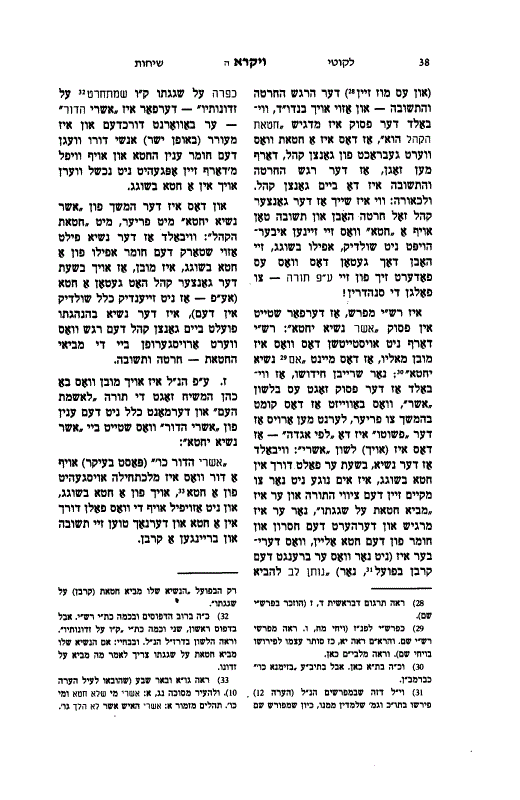
8. The "wine of Torah" (the inner dimension) in Rashi's commentary: "Nasi" here means (not a tribal leader, but) "זה מלך שנאמר מכל מצות ה' אלקיו שאין על גביו אלא ה' אלקיו" ("This is a king, as it says 'of all the commandments of the L‑rd his G‑d' — one who has no one above him but the L‑rd his G‑d")34 (as is also understood from this very statement — "Fortunate is the generation").
The difference between a Kohen Gadol and a king in their influence and effect upon Jews is this: the Kohen Gadol draws down love of G‑d — "great love" (Ahavah Rabbah) — to the Jewish people35, while through the king, self-nullification (bittul) and fear of G‑d are drawn down to them36.
Love is the root of all the 248 positive commandments, and fear is the root of the 365 prohibitions37. Accordingly, it follows that from the accomplishment of the Kohen Gadol — drawing down love of G‑d — one senses that one must act, fulfilling the Supernal Will; in our case — fulfilling G‑d's command, including bringing an offering. From fear of G‑d, one senses the severity of sin — that he "fears to rebel against the King of kings, the Holy One, blessed be He."
9. More deeply: a sin-offering comes for an unintentional sin, which a person commits without his knowledge. Yet this itself — that a person could stumble into a transgression unintentionally — is proof that he is not entirely as he ought to be; it comes "from the strengthening of the animal soul, which derives from its body"38.
And this is the reason that regarding "the anointed Kohen sins" it says "to the guilt of the people," while regarding a ruler it says "asher — fortunate is the generation." From the aspect of the service of love of G‑d (which comes through the Kohen Gadol): since love (even at the highest levels39) is in the category of extension and self-existence — "there is one who loves"40, for the movement of love is bound up with the existence of the person — there can result from it, by way of descent (at the level of "the people"41), at least an unintentional sin, due to the strengthening of his own existence.
But from the aspect of fear of G‑d, which is drawn down to Jews through the king (who is nullified to the Kingdom of Heaven, and from whom this nullification is drawn down to the people36), Jews are utterly nullified to G‑d. Therefore there is no room for even a movement of selfhood and existence to result, even by way of descent, and consequently there is no room for unintentional sin either.
10. The lesson from Rashi's commentary in a person's service of G‑d:
The world is called a "large body," and man is likened to a "small world"42. Thus, just as there is the ruler of the generation, the king, so too in the human body there is the king within it, namely the head43 and brain, which rules over the entire body [as is alluded to in the initial letters of the word "Melech" (king)44: Mo'ach (brain), Lev (heart), Kaved (liver) — the three rulers in the human body45 — and the first letter (the main one and) the head of the word (of the entire word46) is the mem, the brain in the human body].
And on this comes the lesson of "Fortunate is the generation": when is the conduct of the "generation" — of the person — as it should be, to the point of "good fortune"? When "its ruler sets his heart" — when in him "the mind rules over the heart," for "every person can, by the will in his mind, restrain himself and rule over the spirit of his desire in his heart, so as not to fulfill the wishes of his heart in deed, speech and thought etc."47 — then he is guarded from stumbling into sin.
And when he does stumble into a sin, even only unintentionally, he must not only repent in actual practice (bringing an offering for his unintentional sin), but he must also reflect in his mind that even an unintentional sin is something for which he is culpable, as explained above — for had he not allowed the strengthening of the animal soul, he would not have come to it.
And when he has deep contemplation of the severity of doing something contrary to the Supernal Will48, then "its ruler sets his heart"49 — the brain (the ruler) brings about submission in the heart50, "to be broken and contrite," through which there comes about not only atonement for his unintentional sin, but also "the removal of the spirit of impurity and the sitra achra"48 in general; and it also effects the breaking of the animal soul.
And when his repentance, even for an unintentional sin, is of this kind, then it is "all the more so (kal vachomer) that he regrets his intentional sins": he learns from this "kal" — for him it becomes "kal" (easy) not to stumble into intentional sins, because the animal soul and the evil inclination within him have become broken and subdued.
And through each Jew's "ruler" — the brain in the head — ruling and governing him, this hastens that this be the generation of "ודוד עבדי נשיא להם לעולם" ("And David My servant shall be their ruler forever") and "king over them"51, with the coming of our righteous Moshiach, when the Kingship of the Holy One, blessed be He, will be revealed, and "the L‑rd shall be King over all the earth" (the generation).
(From the sicha of Shabbos Parshas Vayikra, 5728)
Notes
1) Our parsha, 4:22.
2) On this verse.
3) Horayos 10b [OCR reads "17"], beginning of side b. Yerushalmi there, 3:2. Tosefta Bava Kamma 7:2. — However, in Rashi it appears with variations from all of the above, as discussed below in the text and in note 32.
4) Horayos there. See also Rashi there, s.v. "Sha'ani."
5) Similarly below (4:27): "And if a soul [OCR unclear]..."
6) And in the Rashbam: like "and on whose head the royal crown was placed" — like "and the royal crown which was placed on his head."
7) Vayeshev 37:23.
8) Mikeitz 43:2.
9) Cf. the Meiri on Horayos there: "They said it by way of wordplay."
10) In Divrei David (by the Taz) on Rashi: "He did not say 'fortunate is the ruler' in this, for then it would be obvious that the ruler is praiseworthy in this, and what novelty would there be regarding a ruler? Rather etc." (and similarly in Minchah Belulah here). But plainly, the novelty regarding a ruler, more than any other person, is understood, since "his heart is not humbled" (Rashi's wording in Horayos there, s.v. "Tzarich"), and he must have a sense of loftiness and leadership, as written in the commentators; see below in the text (and cf. the Meiri there: "And whoever is in this way — fortunate is he and fortunate is his generation").
Accordingly, there is also resolved the question of the Gur Aryeh here: "And if you ask, why is it different with a ruler, that it wrote 'asher' — fortunate etc." [As for his answer — "This is no difficulty, for one cannot say 'fortunate is he' because he sinned; rather, fortunate is the generation which did not sin and has a ruler who, if he sins, regrets his unintentional sin" (see also Be'er Sheva on Horayos there) — this requires study: what good fortune results for the generation from the ruler's regretting etc.? (Unless it is that they learn from him, as discussed below in the text, from the Gemara.)]
11) So it is in Horayos there*. And similarly in Toras Kohanim. And in the Yerushalmi: "Its ruler etc. — all the more so the commoner."
*) In the Meiri there: "If its ruler is so, you need not say that so it is with the commoner."
12) Be'er Sheva on Horayos there. Korban Aharon on Toras Kohanim. Pnei Moshe and Mar'eh HaPanim on the Yerushalmi there. And elsewhere.
13) From this it is understood that it is very forced to explain (as written in Divrei David and Minchah Belulah here) that this is Rashi's intention.
14) Gur Aryeh on Rashi.
15) So it is in Toras Kohanim, the Tosefta and the Yerushalmi (and in the Yerushalmi: "Fortunate is the one whose ruler" — the word "generation" is absent). And in the Bavli: "whose ruler brings an offering for his unintentional sin" (instead of "a sin-offering"); and in Rabbeinu Bachya here the wording is "brings an offering, a sin-offering." And similarly there is a difference between the Bavli, Toras Kohanim and the Yerushalmi in the continuation of the exposition*.
*) In the Tosefta the continuation of the exposition is absent.
16) So it is in most printings, and so in the first printing and several manuscripts of Rashi. But in the second printing and several manuscripts: "whose ruler brings etc." And similarly it is in the Tur HaAroch, citing Rashi. But the Ramban cited it from Toras Kohanim.
17) And so it is also in the second printing (and in the Ramban and the Tur HaAroch on the verse), and in several manuscripts of Rashi: "brings an offering," as in the Gemara.
18) Plainly, it may be said that Rashi sometimes quotes the beginning of a matter and intends the entire continuation of the passage, as has been discussed several times.
19) 4:3.
20) Cf. Yefeh Mar'eh on the Yerushalmi there.
21) Rashi, Horayos there.
22) See Maskil L'David on Rashi. But he does not explain it in terms of the rest of the people learning from him.
*22) See Kli Yakar on our parsha, 4:20.
23) As is understood already from his virtue described in Parshas Tetzaveh. And note that only regarding him is it said (I Divrei HaYamim 23:13): "And Aharon was set apart, to sanctify him as holy of holies." — For seemingly "holy of holies" pertains only to the Kohen Gadol, since only he enters the Holy of Holies. Accordingly, in the verse "to sanctify him as holy of holies, he and his sons," "to sanctify him" refers to all of them, and "holy of holies" refers to Aharon; and accordingly the double wording is also understood (and similarly in the Rambam, Laws of Shemittah and Yovel, at their end). But this is not so in Horayos 13a, as is explicit in Chiddushei Aggados there. And cf. Zohar III 176b; [OCR unclear] 38a. — And perhaps "holy of holies" can be explained with regard to his sons as well — that each of them is fit to be Kohen Gadol.
24) 4:12 and Rashi. This is not so with the ruler's sin-offering.
25) Cf. Abarbanel there.
26) In Rashi on Horayos there: "'Need you ask what a commoner' — meaning, if the king, whose heart is not humbled, feels it and brings an offering for his unintentional sin, all the more so the commoners, whose hearts are humbled, feel it." And from his wording it seems somewhat that he holds that the statement "If its ruler brings an offering, need you ask what a commoner" is not because they learn from him, but rather a proof regarding the state of the generation. And accordingly, it seemingly must be said according to his explanation (also in the Gemara) that the explanation of "Fortunate is the generation" is likewise not because they learn from him.
27) See Rabbeinu Bachya, Pa'aneach Raza and Ba'al HaTurim on the verse; Minchah Belulah; Shach on the verse.
*27) 4:13 and Rashi.
28) See Targum on Bereishis 4:7 (mentioned in Rashi there).
29) As Rashi explained earlier (Vayechi 48:6; see the commentators on Rashi there; and the Re'em on Re'eh 11:27 contradicts his own explanation in Vayechi there). And see Malbim here.
30) And so it is in Targum Onkelos here. But in Targum Yonasan ben Uziel: "at the time when" — like the Ramban.
31) And it may be said that the reason the aforementioned commentators (note 12) explained in Toras Kohanim and the Gemara that they learn from him is that it is stated there explicitly only that in actual practice "its ruler brings a sin-offering (an offering) for his unintentional sin."
32) So it is in most printings and several manuscripts of Rashi. But in the first and second printings and several manuscripts: "all the more so for his intentional sins." And see the wording in the exposition of our Sages cited above. And in Rabbeinu Bachya: "If its ruler brings a sin-offering for his unintentional sin, need I say what he brings for his intentional sin?"
33) See Gur Aryeh and Be'er Sheva (cited above, note 10). And cf. Sukkah 53a: "Fortunate is he who did not sin, and he who etc." Tehillim, Psalm 1: "Fortunate is the man who did not walk etc."
34) Mishnah, Horayos 10a.
35) See the maamar "VeAsisa Bigdei Kodesh" in Torah Or (62a ff.) and Or HaTorah there (p. 1586 ff.), and elsewhere; the discourses on the verse "בהעלותך את הנרות" ("When you kindle the lamps") (Likkutei Torah, and elsewhere) concerning the kindling of the lamps by Aharon.
36) Derech Mitzvosecha, the mitzvah of appointing a king, at its beginning.
37) Tanya, ch. 4.
38) Iggeres HaKodesh, end of section 28 (from Likkutei Torah of the Arizal, Parshas Vayikra). And see Rashi, Shevuos 2a, s.v. "Toleh." — And cf. Rashi on Noach (9:5) and Mishpatim (21:13). — And see Likkutei Sichos vol. 3, p. 944 ff.
39) See Tanya ch. 35 (44b): "And even a complete tzaddik who cleaves to Him with great love etc. — and if so, this one who loves is 'something' (yesh) etc." (However, there it speaks not of the difference between love and fear, but of the difference between the service of love and fear and "mitzvos and deeds," as written there before this: "even if he is a complete tzaddik who serves G‑d with fear and love with delights, nevertheless etc. — he is only a thing unto himself, fearing G‑d and loving Him"; whereas what is explained in the text is the difference between the movement of love and that of fear (nullification), as indicated in the following note.)
40) Torah Or 114c ff.; its Biurim 61a–b; and elsewhere. And see Sefer HaErchim-Chabad vol. 1 (p. 279 ff.) on the aspect of selfhood in love as compared with fear, and the sources noted there.
41) See Shaar HaYichud VehaEmunah ch. 7. And cf. Rashi, Beha'aloscha 11:1.
42) Tanchuma, Pekudei 3. Zohar III 33b. Tikkunei Zohar, Tikkun 69 (100b). And see Avos d'Rabbi Nosson ch. 31:3.
43) See Shabbos 61a.
44) Magen Avos by the Rashbatz on Avos 5:19. Erchei HaKinuyim (by the author of Seder HaDoros), under this entry. Nitzotzei Oros on the Zohar there, 153a (in the name of the Ramaz).
45) Zohar there. And in Zohar Chadash, Rus (80a): "And there are three kings in the body: the brain, the heart and the liver." — And cf. Toras Shalom, the maamar "Telas Shalitin."
46) See Shaar HaYichud VehaEmunah ch. 2: "that each letter which comes first in a combination is the dominant one and is the main one etc."
47) Tanya, ch. 12.
48) Iggeres HaTeshuvah, ch. 7.
49) And "the essence of repentance is in the heart" (Tanya ch. 29 — 36b; Iggeres HaKodesh section 10 — 115b). And see Iggeres HaTeshuvah ch. 1, and elsewhere.
50) Cf. the wording of the Rambam, Laws of Repentance (2:2): "And what is repentance? That the sinner abandon his sin, remove it from his thoughts, and resolve in his heart etc."
51) Yechezkel 37:24–25.
Key Lesson
A true leader's sensitivity to even an unintentional wrong protects the whole generation from stumbling in the first place. Within each person, the "ruler" is the mind: when it governs the heart and contemplates the gravity of even an inadvertent sin, it breaks the animal soul, makes avoiding deliberate sin "easy," and hastens the coming of Moshiach.