Likkutei Sichos Vol. 14 – Ki Savo 1
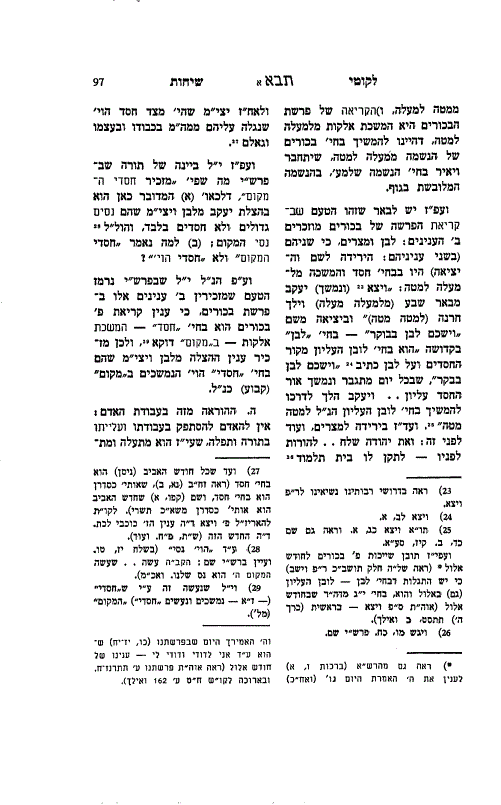
1. At the beginning of our parsha, in the section of the declaration of the first fruits, it is stated: "And you shall declare and say... An Aramean sought to destroy my father, and he went down to Egypt and sojourned there with a few people, and there he became... And the L‑rd brought us out of Egypt with a strong hand... and He brought us to this place."
The reason that the one bringing the first fruits mentions these two matters—"An Aramean sought to destroy my father" (intending to emphasize the salvation from Laban) and the descent of the Children of Israel to Egypt and their redemption from this exile—seems straightforward. It is a praise and thanksgiving to the Holy One, blessed be He, for these kindnesses, that He saved our ancestors from being "lost" and destroyed by Laban and in the Egyptian exile, etc., until He brought them to a land "flowing with milk and honey." This verbal gratitude is also expressed in action: bringing the first fruits of the land to the L‑rd.
However, it must be understood: if the reason is to recall "the kindnesses of the Omnipresent" that He performed for our ancestors, starting from "An Aramean sought to destroy my father" until their arrival in the land—why does it only mention these two kindnesses (the salvation from Laban and the redemption from Egypt) and not the other miracles and kindnesses that the Holy One, blessed be He, performed for them before bringing them to the land: the splitting of the sea, the war with Amalek; and also the kindnesses in the desert: the manna and the well, etc.? For these are what enabled our ancestors to remain alive and endure during their forty-year journey in the desert ("the great and terrible"), to come to this land and bring from its fruits the first fruits?! And similar kindnesses, like "the slope of the valleys," the war with Sihon and Og, etc.
And even if one were to say that the salvation from the hand of Laban and from the Egyptian exile are primary and general kindnesses, through which and by which the Holy One, blessed be He, saved our ancestors and all their descendants from complete destruction and annihilation; whereas the other kindnesses and miracles are like a continuation of specific miracles and an offshoot of the kindness of the Exodus from Egypt in order to bring them to the land—for the miracle of the Exodus is not complete without the miracles that followed: the splitting of the sea, the manna, and the well, etc.—it is still difficult: why is the kindness done to Jacob and his sons between the time of "An Aramean sought to destroy my father" and the time of "and he went down to Egypt" not mentioned, which was a primary and general salvation: the salvation of Jacob and his sons from Esau and his men (about which Jacob our father said in his prayer, "Deliver me, I pray, etc., lest he come and smite me, the mother with the children")?
And since this question arises in the "plain meaning of the text," it is puzzling: why is there no (hint of a) resolution to this question in Rashi's commentary?
2. In resolving this question, one might initially suggest that the reason the one bringing the first fruits does not mention the kindness of Jacob's salvation from Esau is because it was not a rescue from an actualized danger or threat, but rather from a potential danger that existed only in thought. For in actuality, Esau did not commit any wicked act against Jacob.
And even though Laban did not actualize his evil intentions, it is nevertheless considered as if his thought was fulfilled in action. Because "since he intended to do so, the Holy One, blessed be He, considers it as if he had done it," as Rashi explains, "for the nations of the world, G‑d considers thought as action." Therefore, the one bringing the first fruits says, "An Aramean sought to destroy my father." However, regarding Esau, since he was considered a renegade Israelite, his evil thought is not considered as an action. Since he did not carry out his intended plan, it is merely the nullification of a potential evil, and thus this salvation is not mentioned alongside the two matters that were actualized (or considered as actualized).
However, this cannot be said (in addition to the fact that we do not find in the plain meaning of the verses that Esau had the status of a renegade Israelite; and regarding the Patriarchs in general, there is no evidence from the plain meaning of the verses that the definition and law of Israel, as defined for the Children of Israel after the Giving of the Torah, applied to them) because, logically:
3. If we were to say that the acknowledgment in the bringing of the first fruits should only mention those acts of kindness that involved the salvation of our forefathers from actual distress and danger (similar to what happened in Egypt: "The Egyptians mistreated us and afflicted us, etc., and He brought us out, etc."), then it should not have mentioned "An Aramean sought to destroy my father," since ultimately no harm came to "my father" (to Jacob our forefather) in actual deed.
For this measure of considering thought as action pertains only to the severity of Laban's sin and his punishment, but it does not make a difference regarding Jacob, for whether thought is considered as action or not, Laban did not harm Jacob in any way.
Rather, on the contrary, it must be said that even though the danger of destruction from Laban was only in potential and in thought, nevertheless, the one bringing the first fruits rightly says "An Aramean sought to destroy my father," and this is included in "the kindnesses of the Omnipresent." Therefore, it should also include gratitude for the kindness that the Holy One, blessed be He, did for Jacob our forefather in saving him from Esau.
The conclusion from the above is that the two acts of kindness mentioned in the verse have a special connection to the mitzvah of the first fruits, which is not found in all other acts of kindness.
4. The explanation is as follows:
The obligation of the mitzvah of first fruits did not apply to the Children of Israel until they came to the land, conquered it, and settled in it, as Rashi explains ("And you shall inherit it and dwell in it" —) "This teaches that they were not obligated in the first fruits until they conquered the land and divided it."
From this, it is understood that this mitzvah of bringing the first fruits is not merely an acknowledgment for the very giving of the land by the Holy One, blessed be He, to the Children of Israel, but also (and primarily) for the fact that they came to the inheritance with a permanent settlement in it, for only then does it bring them the goodness that they rejoice in — and the first fruits of their produce are brought to G‑d.
And since the ultimate purpose of the first fruits is to thank G‑d for His kindness and goodness in giving us "this land, a land flowing with milk and honey" to dwell in permanently and to eat of its fruit and be satisfied with its goodness — therefore, to emphasize the greatness of this kindness, the one bringing the first fruits also mentions (only) examples — the "kindnesses of the Omnipresent" that were done for our forefathers when they were in a fixed place and in that place they did not receive any goodness, but on the contrary — there they stood to be destroyed and lost (the ultimate evil), and the Holy One, blessed be He, did kindness with them and saved them — until "He brought us to this place," and they were given the goodness that comes from the place itself and the ultimate goodness of this.
And this is why it specifically mentions the "kindnesses of the Omnipresent" that were done for our forefathers in Aram.
And in Egypt, because in these places our forefathers dwelled in a permanent manner ("twenty years" in Aram and "two hundred and ten years" in Egypt).
4. This also clarifies why the thanksgiving begins with "An Aramean sought to destroy my father — and he went down to Egypt," to emphasize, as mentioned earlier, that from the perspective of the places themselves, Aram and Egypt, there was a threat of destruction and annihilation. However, it was through G‑d's kindness that they were saved and redeemed, until they were brought to a place that is itself filled with the blessing of G‑d.
In contrast, the salvation of Jacob from Esau, which occurred while he was on the way, and similarly with other kindnesses done for the Children of Israel while they were in the desert (even though it is essentially not a place of settlement for humans), these are kindnesses that are not similar to the thanksgiving to G‑d expressed through the bringing of the first fruits, as mentioned earlier.
5. On a deeper level, it can be said:
It is explained in Ohr HaTorah regarding the mitzvah of bringing the first fruits: The fruit of the tree represents the soul that has been clothed in a body, and the mitzvah of the first fruits is to connect and unite the aspect of the soul below with its root, which is called the "upper first fruits," as it is written, "I saw your forefathers as the first fruit of a fig tree." It explains there that there are two aspects to this: the bringing of the first fruits is an elevation from below to above, and the reading of the first fruits passage is the drawing down of G‑dliness from above to below, meaning to draw the aspect of the first fruits of the soul from above to below, so that it connects and illuminates the aspect of the soul above, in the soul clothed in the body.
Based on this, it can be explained that this is the reason why the reading of the first fruits passage mentions two matters: Laban and Egypt, because both were in the aspect of kindness and drawing down from above to below: "And Jacob went out from Be'er Sheva (from above, above) and went to Haran (below, below)" and in the exodus from there "Laban rose early in the morning" — the aspect of "Laban" in holiness is the aspect of the upper whiteness, the source of kindnesses, and regarding Laban it is written, "Laban rose early in the morning," that every day the light of the upper kindness increases and is drawn down... and Jacob went on his way to draw down the aspect of the upper whiteness below, below. Similarly, with the descent to Egypt, and even before that: "And he sent Judah... to prepare for him a house of study."
And similarly, the exodus from Egypt was due to the kindness of G‑d, who revealed Himself to them as the King of Kings in His glory and redeemed them.
Based on this, it can be said in the inner dimension of Torah regarding Rashi's commentary on "mentioning the kindnesses of the Omnipresent," that seemingly (a) the discussion here is about the salvation of Jacob from Laban and the exodus from Egypt, which are great miracles and not merely kindnesses, and it should have said "miracles of the Omnipresent"; (b) why does it say "kindnesses of the Omnipresent" and not "kindnesses of G‑d"?
According to the above, it can be said that in Rashi's commentary, the reason is hinted at why these two matters are mentioned in the first fruits passage, because the reading of the first fruits passage is in the aspect of "kindness" — the drawing down of G‑dliness — specifically in the "place," and therefore it mentions the matter of salvation from Laban and the exodus from Egypt, which are in the aspect of "kindnesses" of G‑d drawn down in a "fixed place," as mentioned above.
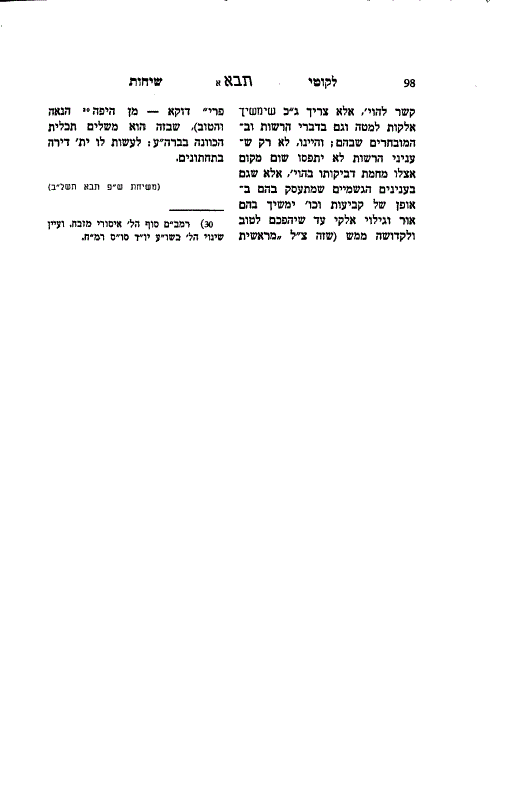
6. The lesson from this in the service of man: A person should not be satisfied with his service and elevation in Torah and prayer, through which he elevates and...
6....connection to G‑d, but he must also draw down G‑dliness below, even into mundane matters and into the best of them. This means that not only should mundane matters not occupy any place within him due to his attachment to G‑d, but also in the physical matters in which he is engaged in a fixed manner, he should draw into them the light and revelation of G‑dliness until he transforms them into good and actual holiness. This is what is meant by "from the first of the fruits of the land" — from the beautiful and good — thereby completing the ultimate purpose of creation: to make for Him, blessed be He, a dwelling place in the lower realms.
(From the talk of Shabbat Parshat Ki Tavo, 5732)