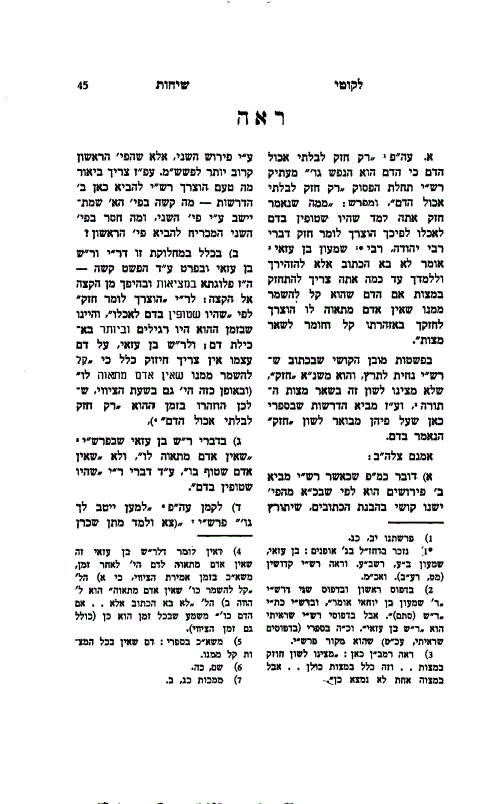
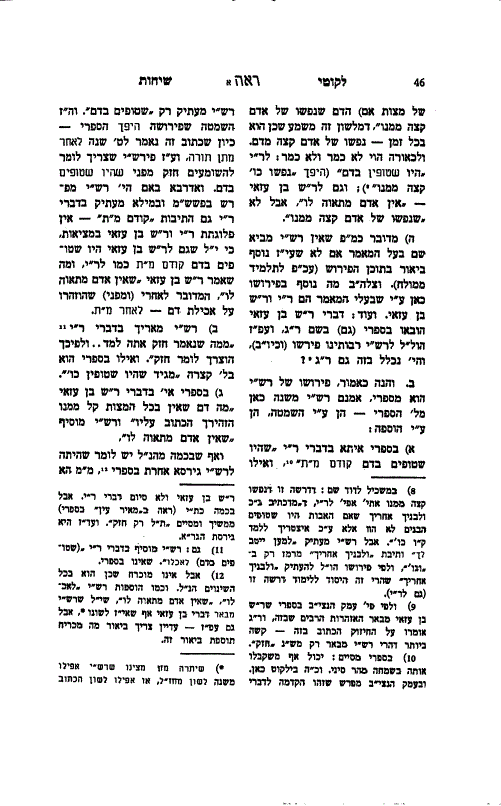
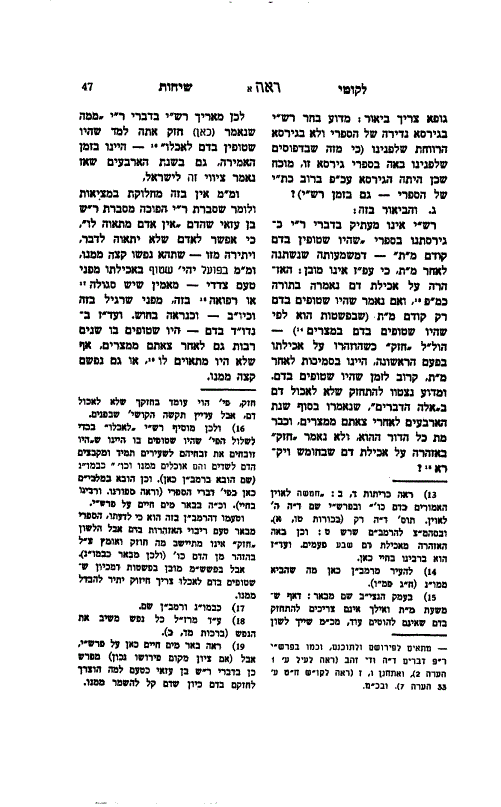
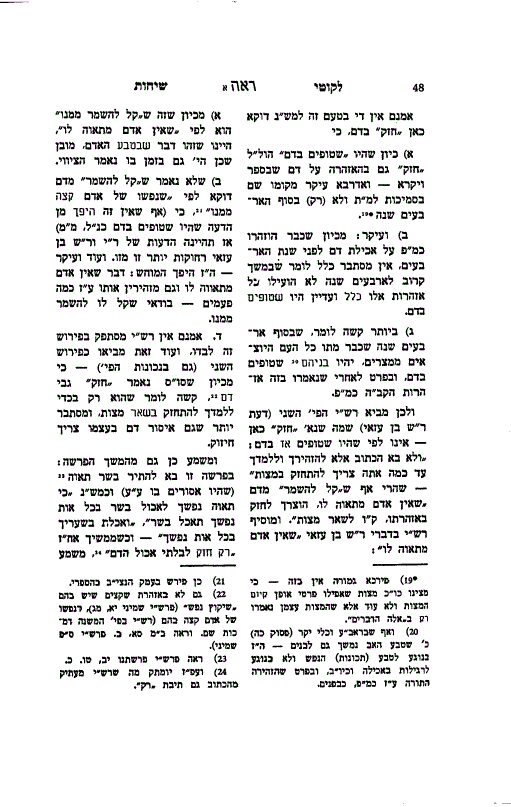
There is no factual disagreement between Rabbi Yehudah and Rabbi Shimon ben Azzai as to whether the Jewish people were deeply involved in consuming blood. Even though people do not naturally desire blood, they may nevertheless have been accustomed to consuming it for an external reason, believing that it possessed a special benefit, medicinal value, or something similar.
Rashi comments on the verse:
“Only be strong not to eat the blood”
(Devarim 12:23):
“Only be strong not to eat the blood”—From the fact that the verse says “be strong,” you learn that they were deeply involved in consuming blood. Therefore, it was necessary to tell them, “Be strong.” These are the words of Rabbi Yehudah.
Rabbi Shimon ben Azzai says: The verse comes only to warn you and teach you how greatly a person must strengthen himself in the observance of the mitzvos. If regarding blood—which is easy to avoid, since a person does not desire it—the Torah nevertheless found it necessary to strengthen you with a warning, how much more so must one strengthen oneself regarding the other mitzvos.
This requires explanation. How can there be such an extreme disagreement concerning a matter of fact? According to Rabbi Yehudah, the people were deeply involved in consuming blood, whereas according to Rabbi Shimon ben Azzai, blood is something easy to avoid because people have no desire for it. There are also several further details requiring clarification.
The explanation is as follows:
Rashi changes the wording found in the Sifrei. He does not say that the Jewish people had been deeply involved in consuming blood before the giving of the Torah.
Had he said so, it would imply that their behavior subsequently changed and that by the end of the fortieth year they were no longer accustomed to consuming blood. The Torah, however, appears to indicate the opposite: the expression “be strong” was stated specifically at the end of the fortieth year, in the Book of Devarim, and was not stated earlier in the Book of Vayikra.
There is, however, no factual disagreement between Rabbi Yehudah and Rabbi Shimon ben Azzai. Even though people do not naturally desire blood, they may nevertheless have been deeply involved in consuming it for some secondary reason. They may have believed that it possessed a special power, served as a remedy, or provided some other benefit.
The first explanation, that of Rabbi Yehudah, nevertheless presents a difficulty. Why was the expression “be strong” not stated in the Book of Vayikra, when the Jewish people were closer in time to their stay in Egypt? Presumably, they would have been even more deeply accustomed to consuming blood at that earlier time.
Rashi therefore brings the second explanation, that of Rabbi Shimon ben Azzai.
The second explanation, however, is also not entirely sufficient. It is difficult to say that the expression “be strong,” which is stated specifically in connection with blood, does not refer primarily to blood at all, but rather to all the other mitzvos.
Rabbi Yehudah states elsewhere:
“Words are understood according to their literal meaning.”
(Pesachim 21b)
Accordingly, he maintains that the words “be strong,” stated in connection with blood, must be understood literally as referring to the prohibition against consuming blood itself.
Ben Azzai, by contrast, follows his general approach of urging energetic commitment to all the mitzvos. He teaches:
“Run to perform even a minor mitzvah,”
and:
“One mitzvah brings another mitzvah in its wake.”
He therefore maintains that the expression “be strong” is a general encouragement applying to the observance of all the mitzvos.
From the Wine of Torah
The reason blood is forbidden for consumption is that blood is identified with the life-force itself.
Meat is different. Although the life-force is present within the meat, the meat undergoes a process of transformation before it becomes part of the person who eats it—“his flesh becomes like his own flesh.”
Blood, however, is absorbed directly into the person’s blood without undergoing such a process of refinement.
Rabbi Yehudah’s spiritual quality is associated with hoda’ah—acknowledgment, submission, and bittul—and with the refinement of physical matters.
He therefore says that the Jewish people were deeply involved in blood, which spiritually represents the emotional attributes of the animal soul. According to his approach, the task of Divine service is to refine the emotions of the animal soul.
Ben Azzai, by contrast, was characterized entirely by ratzoh, a yearning to rise upward and draw closer to the Holy One, blessed be He. As he said:
“My soul desires the Torah.”
According to his approach, the call to “be strong” relates not specifically to the refinement of blood, but to the entirety of Divine service. A person must strengthen himself in every mitzvah, including one that appears light and easy.