Likkutei Sichos Vol. 9 – Ha'azinu 2
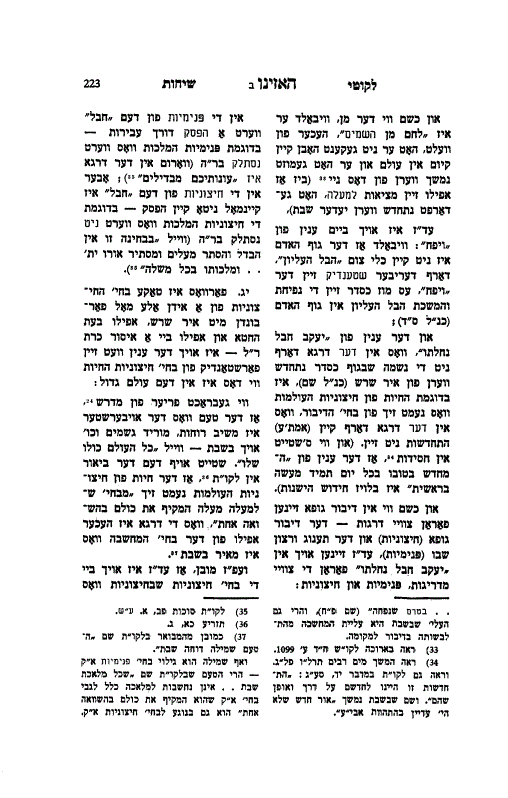
1. Parshas Ha'azinu is always read on Shabbos Shuvah or, as in this year, during the four days between Yom Kippur and Sukkos. Regarding these four days, the Rebbe (Rabbi Sholom DovBer) of blessed memory said, "Now is the time to truly repent."
Since all matters of Torah are precise, we indeed find that several chapters in Iggeres HaTeshuvah are based on the verse "For the L‑rd's portion is His people; Jacob is the lot of His inheritance," which appears in Parshas Ha'azinu.
2. On the phrase "Jacob is the lot of His inheritance," the Alter Rebbe explains in Iggeres HaTeshuvah, chapter 5, that the soul — the part within the human body along with its root — is like a rope, "one end of which is tied above and the other end below." He elaborates on the concept of karet (spiritual excision), explaining that when a Jew transgresses a prohibition that incurs karet, G‑d forbid, "the rope of extension from the Name of the L‑rd, blessed be He, is severed and cut off."
He adds that this "rope of extension" from the Name of the L‑rd, blessed be He, is "composed of the 613 mitzvos," similar to a "thick rope" that is "twisted from 613 thin strands." Therefore, even with other transgressions that do not involve karet — where the overall rope is not severed as it is with a karet prohibition — a "thin strand" is nevertheless cut.
Further (in chapter 6), he presents another concept regarding "Jacob is the lot of His inheritance." Just as a rope has "one end above and the other end below," when a person pulls the "lower end," the "upper end" is also drawn down. Similarly, with the rope of the soul, through a Jew's "evil deeds and thoughts," he drags not only the soul below into the "chambers of the sitra achra" but also the influence from the level of the lower hei — the root and source of the soul.
This raises a question: Since through a transgression the "rope of extension" is severed, as mentioned earlier, why should the "lower end" drag along the "upper end" — isn't the rope already severed?
3. We must also understand: Earlier, the Alter Rebbe states, "its head is bound above and its end below" — referring to the soul above as "its head" and the soul below as "its end." Yet later, he refers to both as "head" — "one head above and the other head below." Why this change in terminology?
4. When the Alter Rebbe discusses the first concept in "Jacob is the lot of His inheritance" (how through a transgression the rope is severed), he brings the verse "And He breathed into his nostrils the breath of life" and explains that the reason the verse uses the term "breathed" is "to teach us" that just as when a person blows to a certain place, if there is "something that obstructs and interrupts in between, the breath does not reach that place at all," similarly, if there is an obstruction between the body of a person and the level of the higher breath, it does not reach him.
He further explains in the analogy that "there is no physical or spiritual thing that obstructs before Him, blessed be He," but "as it is written in Isaiah, 'but your iniquities have separated between you and your G‑d.'" This raises a question: From the concept of "breathed," it seems that "your iniquities have separated" cause the "higher breath" not to reach the person below at all — similar to "a person blowing to a certain place," where if there is an obstruction, "the breath does not reach that place at all." However, from the concept of "Jacob is the lot of His inheritance," it seems that the transgressions interrupt the connection, but do not initially prevent the connection from being established.
Another distinction: In the concept of "Jacob is the lot of His inheritance," the Alter Rebbe explains (as mentioned earlier in section 2),
3. Through a sin that incurs karet, the entire rope is severed, while "with other transgressions that do not incur karet," only a thin rope is severed. However, from the perspective of the concept of "breathed," it emerges that every transgression, since it is an obstruction, completely prevents the higher breath from reaching — as understood from the analogy of a person blowing, where if there is an "obstruction and interruption," even if the obstruction is small — merely "some thing," "the breath of the blower does not ascend and reach that place at all."
4. From all the above, it is understood that the three concepts in Tanya — the concept of "breathed" where through (an obstructing thing) a transgression, the breath does not initially reach; the concept in "Jacob is the lot of His inheritance" where through transgressions the rope of connection is severed; and the concept in "Jacob is the lot of His inheritance" where "through his evil deeds, etc.," he also drags down the "head above" into the chambers of the sitra achra — are three distinct levels:
The concept of "breathed" is at the level of the soul that must constantly be drawn from the level of the higher breath. Regarding this level, since the "breath of the blower" must be continuous, even transgressions that do not incur karet, since they too are an obstruction and interruption, prevent the higher breath from reaching the body of the person.
The concept in "Jacob is the lot of His inheritance" where through transgressions the rope of connection is severed, is at the level of the soul below where its connection with its source is (not in a manner of continuous renewal, but) similar to a rope, where the lower end has already been drawn from the upper head, and now they are only connected, but the connection is such that the soul below is not a "head" for itself, but a "tip" of the soul above.
And regarding this level, since the interruption of connection caused by transgressions is through an action that creates an interruption (unlike in the level of "breathed," where through transgressions the higher breath cannot initially reach), therefore, there is a distinction between sins that incur karet and other transgressions, where a sin that incurs karet causes an interruption in the entire rope, and other transgressions only in a thin rope.
Then there is a lower level in "Jacob is the lot of His inheritance," where the connection of the soul below with the soul above is not in a manner where the soul below is a subordinate and "tip" of the soul above, but it is also a "head," it is a principal and "head" in its own right.
And at this level, there is never an interruption, and since at this level the "head below" is always connected with the "head above," even at the time of sin, therefore "through his evil deeds and thoughts," he also drags down the "head below" into the chambers of the sitra achra, so to speak.
5. On the above explanation, that "He breathed" and "Jacob is the lot of His inheritance" are two separate levels, one might seemingly ask: Earlier, he brings the verse "For the L‑rd's portion is His people; Jacob is the lot of His inheritance" and explains it: "Like a rope, metaphorically, whose one end is tied above and the other end below." Then he explains the peshat of "He breathed," that when there is an obstruction and interruption (your sins separate), the higher breath does not reach. Later, he concludes, "And this is the concept of karet, that the rope of the extension is severed and cut off, etc." From the fact that he places the concept of "He breathed" in the middle of the explanation of "rope," it seems to be a proof that this is part of the explanation concerning the rope. How then can one say that "He breathed" and "rope" are two separate levels?
However, when one examines Iggeres HaKodesh, one sees that not only is there no contradiction to the above, but on the contrary, it is a proof that "He breathed" and "Jacob is the lot of His inheritance" are two separate levels, as will be explained.
6. At the beginning of the chapter, the Alter Rebbe explains and emphasizes that "the drawing down and descent of the divine soul into this world to be clothed in the human body" is "from the aspect of the inner and source of speech," and he brings proof from the verse "And He breathed into his nostrils the breath of life, and man became a living soul," which implies "one who breathes, etc." Then he continues: "And this is what is stated, 'For the L‑rd's portion is His people; Jacob is the lot of His inheritance,' meaning like a rope, metaphorically, whose one end is tied above and the other end below" (as mentioned earlier).
This is not understood: From the verse "For the L‑rd's portion is His people; Jacob is the lot of His inheritance," we seemingly only know that the soul below is connected to its source (similar to a rope, whose lower end is connected to its upper end). However, we do not know what level the source of the soul is — what is the connection and association of this verse with what he states earlier, that the soul derives from "the aspect of the inner, etc." (which due to this connection of the two concepts, he says "and this is what is stated, etc.")?
7. Therefore, we must say that the proof from the verse regarding the concept that "the drawing down and descent of the divine soul into this world... is drawn from the aspect of the inner, etc." is primarily (not from "Jacob is the lot of His inheritance," but) from "For the L‑rd's portion is His people," because the name of G‑d indicates the inner vitality.
By bringing the conclusion of the verse "Jacob is the lot of His inheritance," he is stating another concept, that even after the soul has already descended below (i.e., the level that does not need to be constantly renewed), it is still connected to its source, similar to a rope, whose lower end remains connected to its upper end even after it has descended below.
After explaining these two concepts — regarding "the drawing down and descent of the divine soul, etc." and regarding the divine soul that has already descended into the body — he begins to explain what is affected by transgressions in these two aspects (levels) of the soul, and in the same order as before:
First, he explains what transgressions cause in the aspect of "And He breathed," in "the drawing down and descent of the divine soul" as it is drawn from the upper breath — that transgressions prevent the upper breath from reaching the human body. Then he explains what transgressions affect in the level of "Jacob is the lot of His inheritance," in the level that has already descended into the body — that through transgressions, a disruption occurs in the connection.
8. To understand the aforementioned three levels (section 4) in the soul of man — a microcosm, we must first explain how these levels exist in the macrocosm:
In connection with Rosh Hashanah (from which we derive), it is stated in the Gemara that G‑d says to the Jewish people, "Say before Me... kingship so that you will make Me king over you... and with what? With the shofar."
Why is it necessary on Rosh Hashanah to make G‑d a king — was He not a king before? It is explained in Chassidus that on the eve of Rosh Hashanah at dusk, the attribute of kingship ascends and withdraws above, and therefore, on Rosh Hashanah, Jews must effect that G‑d should once again become a king.
The question arises: the vitality and existence of the world come from the attribute of kingship, and since on the eve of Rosh Hashanah at dusk, the attribute of kingship ascends above and is only drawn down during the blowing of the shofar and the recitation of the verses of kingship, etc., how can the world exist on Rosh Hashanah before the Jews blow the shofar?
9. The explanation given is that on Rosh Hashanah, only the inner aspect of kingship ascends and withdraws. This refers to the pleasure and will within kingship, while the vitality of the worlds at that time comes from the external aspect of kingship. This is similar to a person who performs a task while being tired and lacking enthusiasm.
The same question is asked regarding Shabbos: Since on Shabbos, G‑d rests from the work of heaven and earth, how does the world exist on Shabbos? The answer given is that on Shabbos, G‑d rests only from the ten utterances (speech), which is the external aspect of kingship, and the vitality of the worlds on Shabbos comes from thought, the inner aspect of kingship.
One might ask: On a Rosh Hashanah that falls on Shabbos, both the external aspect of kingship (due to Shabbos) and the inner aspect of kingship (due to Rosh Hashanah) ascend. How, then, can the worlds continue to exist?
The explanation is that the external aspect that ascends on Shabbos is not the same as the external aspect of the inner aspect that ascends on Rosh Hashanah. Rather, it is the external aspect of a higher level. Therefore, the existence of the worlds is maintained even on a Rosh Hashanah that falls on Shabbos, because the external aspect of the lower level, from which the existence of the worlds is derived, does not ascend.
10. This can be understood by prefacing with what the Midrash brings as proof that "the Holy One, blessed be He, honors the Shabbos" from the manna, which descended all days of the week but did not descend on Shabbos.
This is not understood: Regarding all other matters that G‑d performs on Shabbos, such as the blowing of the winds, the descent of rain, and the growth of grass, the same Midrash states that this is not a contradiction to "the Holy One, blessed be He, honors the Shabbos," because "the entire world is His," and therefore He is "permitted in the entire world."
What, then, is different about the descent of the manna compared to all other matters?
Furthermore, regarding the manna itself, it is found that it only did not descend below on Shabbos, but its drawing down above occurred specifically on Shabbos. As it is stated in the Zohar: "All six days are blessed (with manna) from the seventh day."
This is entirely not understood: Why is the descent of the manna below considered a labor (even though all other influences are not considered labor by G‑d), and the drawing down of the manna above occurred specifically on Shabbos?
11. The explanation is as follows:
12. In the worlds, there are two aspects: their physical and external aspect, and their spiritual and internal aspect. From this, it is understood that also in the Divine vitality that enlivens them, there are two aspects: the external vitality, which is in the aspect of speech (revelation), enlivens the external aspect of the worlds; and the internal vitality, which is in the aspect of thought, enlivens the internal aspect of the worlds. However, for the internal influences that derive from thought to descend into the world, there must be a descent of the aspect of thought and its investment into the aspect of speech.
And herein lies the rest (ascent) of the vitality on Shabbos: that then, the aspect of thought that is invested in speech rests from its investment in speech and ascends to the aspect of thought as it is in its place (and its level).
Accordingly, it is explained why all influences exist also on Shabbos, but the manna did not descend on Shabbos:
All other influences, since they are related to the external aspect of the worlds and their drawing down is from speech, therefore exist also on Shabbos. This is because the rest (and ascent) of Shabbos is only in the aspect of thought, which ascends from its investment in speech, but speech itself exists also on Shabbos.
However, the manna, since it derives from the aspect of the internal [and even in its descent below, "it is truly clothed with supernal lights," and therefore, when it comes down below, "there is no waste in it"], did not descend on Shabbos. For the manna to descend below and become a physical sustenance, the aspect of thought must be invested in speech, and on Shabbos, thought ascends from its investment in speech.
This also explains why the drawing down of the manna above occurred specifically on Shabbos:
During the six weekdays, when the aspect of thought does not shine as it is in its place (because then thought is invested in speech), the matter of the manna cannot be accomplished. Only after it is drawn down (above) on Shabbos—because then the aspect of thought itself shines—can it then descend below during the weekdays, through the thought being invested in speech.
11. Based on the above, it is understandable that the external and internal aspects discussed regarding Rosh Hashanah and Shabbos are in two separate levels:
Regarding Rosh Hashanah, both the external and internal aspects are in the realm of speech:
The speech itself is an external aspect, while the delight and will present in the creation through speech are internal aspects. It is said that this internal aspect ascends on Rosh Hashanah. (As mentioned at the end of section 6, the creation of the worlds on Rosh Hashanah is similar to a person who performs work without deriving pleasure from it.)
However, when we speak of external and internal aspects concerning Shabbos, both are in the realm of thought: Thought that is clothed in speech is the external aspect, and thought in its place is the internal aspect. The statement that on Shabbos the external aspect ascends refers to the external aspect of thought, as explained in section 6.
12. Man is considered a "small world"—thus, within the soul of man, there are several levels analogous to the aforementioned levels in the vitality of the great world:
The concept of "And He breathed into his nostrils the breath of life," which means "He who breathes, breathes from within himself" ("from His innermost and innermost being")—is similar to the vitality derived from the aspect of thought, which is the general concept of the internal aspect.
And just as the manna, since it is "bread from heaven," is above the world and could not have a permanent existence in the world, it had to be drawn anew (even its existence above had to be renewed every Shabbos).
Similarly, with the concept of "And He breathed": Since the human body is not a vessel for the "supernal breath," there must constantly be the "breathing," the continuous descent and drawing of the supernal breath into the human body (as explained in section 4).
13. The concept of "Yaakov is the rope of His inheritance," in which the soul within the body does not need to be constantly renewed from its source (as explained earlier), is analogous to the vitality from the external aspect of the worlds, which derives from the aspect of speech. In this level, there is no need for true renewal. (As it is stated in Chassidus, the concept of "He renews in His goodness every day, continuously, the work of creation" is only a renewal of the existing.)
Just as within speech itself there are two levels—the speech itself (external) and the pleasure and will within it (internal)—similarly, within "Yaakov is the rope of His inheritance," there are also two levels, internal and external:
In the internal aspect of this "rope," there is an interruption through transgressions—analogous to the internal aspect of Malchus, which is withdrawn on Rosh Hashanah (because in this level, "your sins separate"). However, in the external aspect of this "rope," there is never an interruption—analogous to the external aspect of Malchus, which is not withdrawn on Rosh Hashanah (because "in this aspect, no concealment or hiding obscures His light... and His sovereignty rules over all").
Why is it that the external aspect of a Jew is always connected to its source, even during sin and even in the case of a sin punishable by excision, G‑d forbid? This can also be understood from the external aspect of vitality as it is in the great world:
As previously brought from the Midrash, the reason why G‑d returns the spirits, brings down rain, etc., even on Shabbos, is because "the whole world is His." The explanation in Likkutei Torah states that the vitality of the external aspect of the worlds derives "from the level that is above, encompassing all equally," which is even higher than the aspect of thought that illuminates on Shabbos.
Based on this, it is understood that similarly, the external aspect of the external aspect of the soul of man is connected to the essence of the soul as it is rooted in the Essence—higher even than "He breathed," which is only a "part of the Name of the L‑rd, blessed be He."
Therefore, the external aspect is always connected to its source—because the essence of the soul is "even at the time of sin, it was in faith with Him," it is always "embraced and cleaved to You."
[Analogous to the Essence (where the essence of the soul is rooted), for which "darkness is like light." This itself is the reason why one can find oneself...
10. Even in the chambers of the sitra achra—because even when he is there, he is not truly grasped by them, G‑d forbid, for "even darkness does not obscure from You."
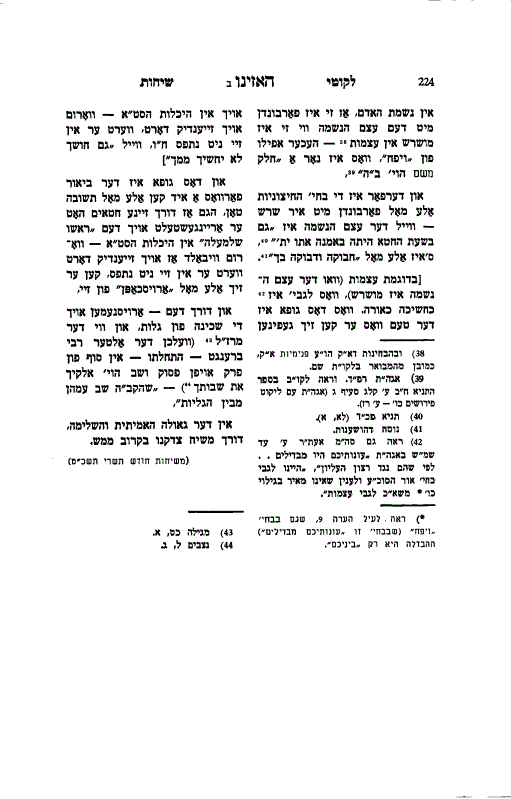
This itself explains why a Jew can always repent, even though through his sins he has placed even the "head above" into the chambers of the sitra achra—because since even when he is there, he is not truly grasped by them, he can always "snatch himself out" from them.
And through this, he can also redeem the Shechinah from exile, as our Sages say, "that the Holy One, blessed be He, returns with them from among the exiles,"
in the true and complete redemption, through our righteous Mashiach, very soon.
(From the talks of the month of Tishrei, 5729)